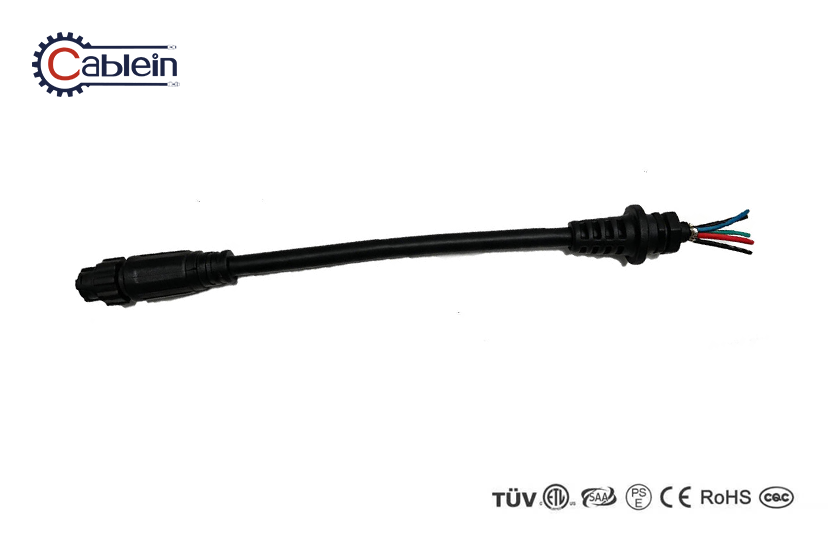
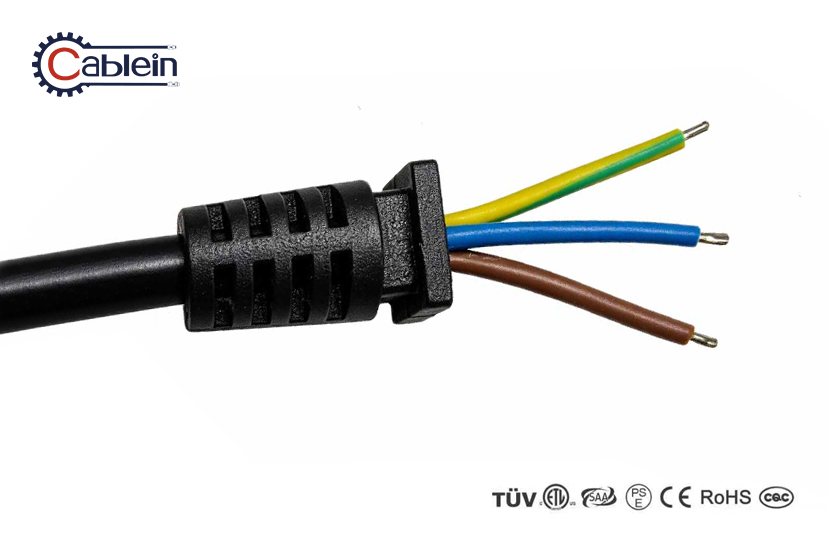
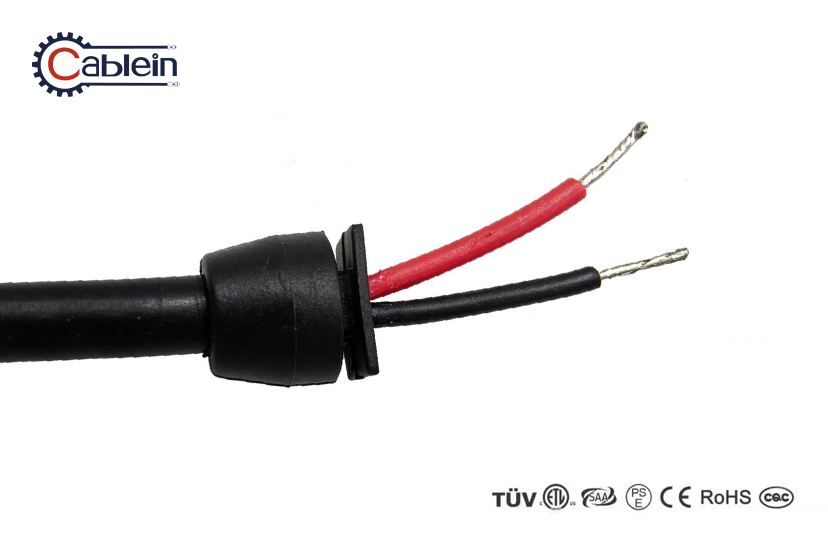
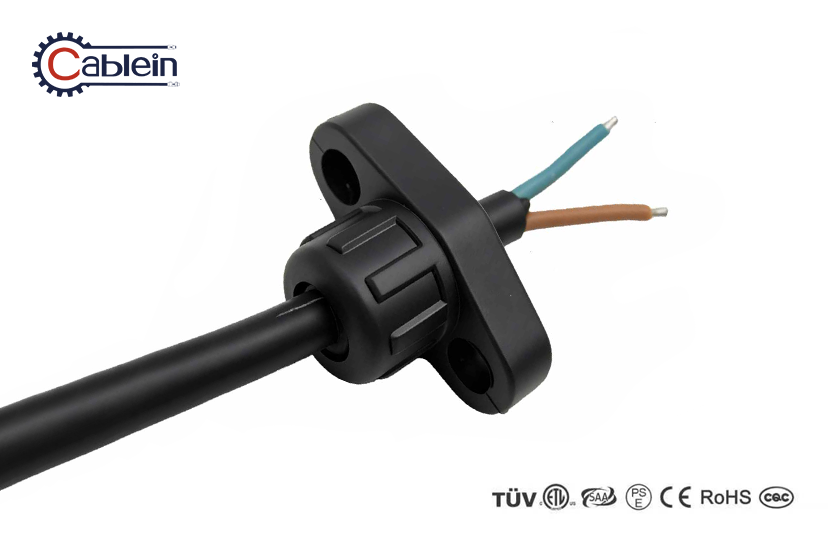
molded strain relief
2. Right-angle exit reduces bending stress on cables exiting shallow enclosures or wall ports.
3. IP67 and IP68 rated, with a continuous overmold that leaves no exposed seam at the bend.
4. Perfect for tight clearance areas behind machinery, under solar panels, or inside control cabinets.
5. Withstands -40℃ to 150℃ while maintaining a consistent 90-degree exit path.
6. The angled design minimizes the required bending radius, protecting internal conductors.
7. Manufactured under ISO9001, holding CE and TUV certifications.
8. Customizable with specific bend angles, exit lengths, and mounting flange options.
Molded Strain Relief: 90-Degree Waterproof Cable Protection for Industrial Applications
Cablein Technology's molded strain relief solutions deliver enterprise-grade cable protection with a precision-engineered 90-degree design. Built from PA66 nylon and ceaselessly overmolded, these components accomplish IP67 and IP68 waterproof evaluations whereas disposing of uncovered creases. Working dependably from -40℃ to 150℃, our item gatherings diminish bowing push by up to 60% in tight clearance establishments. With ISO9001:2015 fabricating, CE and TUV certifications, and over 10,000 pieces steady stock per thing, you get quick 7–10 day conveyance for mission-critical ventures requiring flush-mount cable routing.
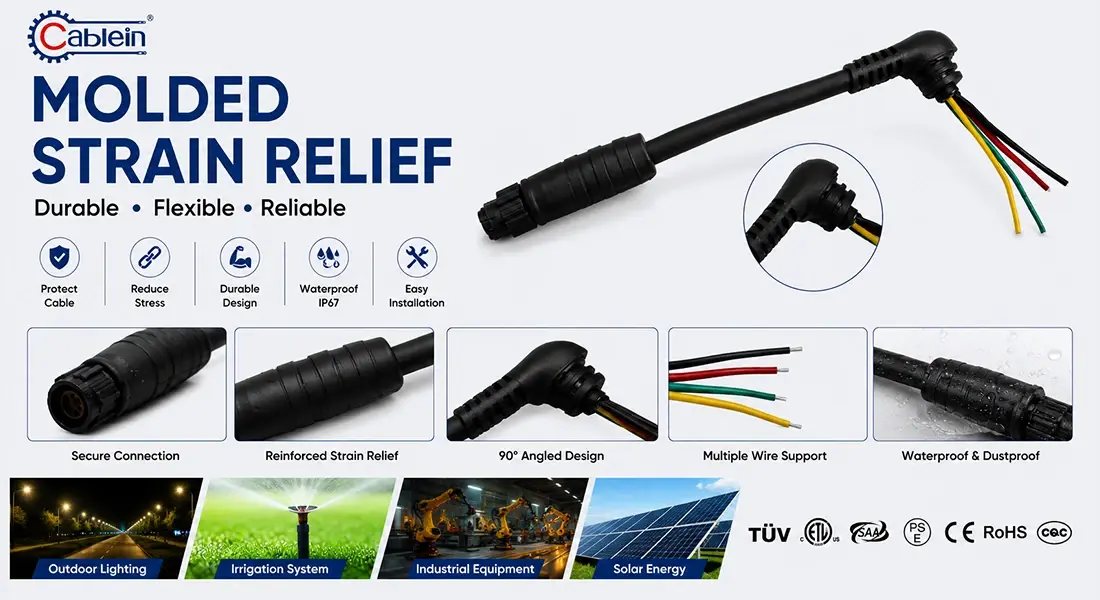
What Makes Right-Angle Molded Strain Relief Different?
When your cables exit shallow walled in areas or divider ports, each millimeter counts.
Traditional straight cable exits drive you to twist wires instantly at the connector. This makes stretch concentration focuses. Inner conductors weakness quicker. Waterproof seals fall flat sooner.
Our right-angle plan changes that condition entirely.
The twist is molded specifically into the get together amid fabricating. Your cable exits at precisely 90 degrees. No field bowing required. No compromised seals from constrained routing.
You mount it flush against any surface. The cable courses actually along dividers, behind boards, or beneath hardware. Establishment tallness drops by 40–50% compared to straight connectors with auxiliary bends.
This things when you're working behind sun oriented inverters, interior shallow intersection boxes, or underneath vehicle dashboards.
Technical Specifications That Solve Real Problems
Material Engineering
Housing: PA66 nylon for standard applications. TPU or PVC options when you need extra flexibility.
Seals: Silicone for extreme temperatures. NBR when oil resistance is critical.
Both materials pass UL94 V-0 flammability testing. They self-extinguish within 10 seconds.
Environmental Protection
IP67 Rating: Withstands short-term immersion during washdown procedures.
IP68 Rating: Survives continuous submersion in outdoor solar installations or marine applications.
The continuous overmold creates a molecular bond. There's no seam at the bend where water can penetrate.
Temperature Performance
Static environments: -40℃ to +105℃ operation.
Dynamic applications: Temperature range varies by material grade selection.
Your cables maintain performance through summer heat waves and winter freeze cycles.
Thread Options
Choose from PG, Metric, or NPT threading on our -P model variants. Match your existing panel cutouts without adapter plates.
Where Our Molded Strain Relief Delivers Maximum Value
Solar Energy Systems
Your rooftop arrays face brutal conditions. UV exposure. Thermal cycling. Moisture ingress during storms.
Our 90-degree exit routes cables flat against mounting rails. Less wind resistance. Lower mechanical stress. The sealed design prevents water tracking into junction boxes.
Industrial Control Cabinets
Cabinet depth is always at a premium. Standard connectors with bent cables waste 50–80mm of clearance.
The right-angle design gives you that space back. Cables route immediately along the cabinet wall. You fit more components in the same enclosure.
LED Lighting Installations
Landscape lighting fixtures have shallow housings. Stadium lights mount flush to minimize wind loads.
Angled cable exits let you position connectors where straight versions simply won't fit. The reduced bending radius protects delicate driver circuits from vibration damage.
Underwater Robotics
Submersible vehicles demand absolute waterproof integrity. A single leak can destroy a $50,000 sensor package.
Our IP68-rated molded strain relief maintains hermetic sealing under hydrostatic pressure. The continuous overmold eliminates the most common leak path—the housing-to-cable transition.
Six Key Advantages You Can't Get With Standard Components
1. Surface-Flush Routing
The right-angle exit positions cables parallel to mounting surfaces immediately at the connector. No secondary bending required.
2. Stress Reduction
The 90-degree bend is formed during molding with optimal radius control. Internal conductors experience 60% less mechanical stress than field-bent cables.
3. Seamless Waterproofing
Continuous injection molding creates a single-piece transition. There's no assembly joint where moisture can infiltrate over time.
4. Space Efficiency
Perfect for installations where depth is limited. Behind-panel applications. Under-deck routing. Inside shallow enclosures.
5. Extreme Temperature Tolerance
From Arctic installations to engine compartments, performance remains consistent across -40℃ to +105℃.
6. Custom Engineering
We adjust bend angles, exit lengths, and mounting flanges to match your exact installation requirements. No compromise on fit.
Quality Assurance: What We Test Before Shipping
Every assembly undergoes comprehensive validation:
Tensile Pull Testing: We verify the overmold-to-cable bond strength exceeds the cable jacket's own tensile rating.
Waterproof Submersion: IP67 units pass 30-minute immersion tests. IP68 versions survive continuous submersion under specified pressure.
Flex Cycle Testing: Assemblies endure thousands of 90-degree bending cycles. We check for jacket splitting, conductor breakage, and seal degradation.
Environmental Screening: Salt spray resistance per ASTM B117. Thermal shock testing from -40℃ to +105℃.
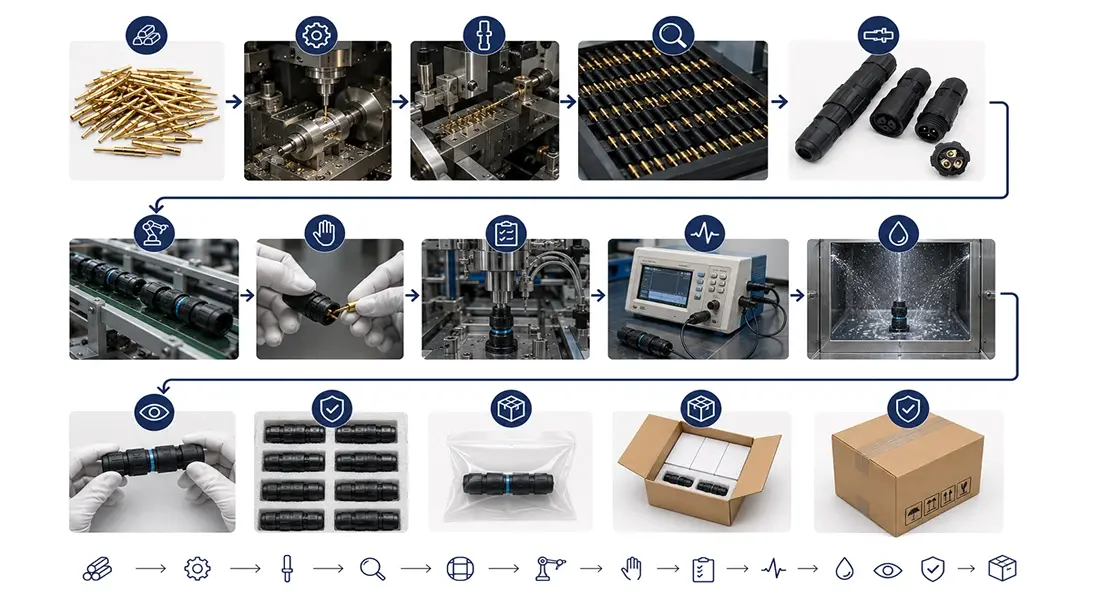
100% Final Inspection: Every single unit receives individual waterproof and electrical continuity verification before packaging.
Our ISO9001:2015 quality management system ensures you receive the same performance from piece one to piece 10,000.
Frequently Asked Questions
Q: Can item accomplish IP68 waterproof ratings?
A: Yes. Through chemical holding between the cable coat and overmold fabric, we make airtight seals appraised for ceaseless submersion. The key is fabric compatibility and appropriate molding parameters.
Q: What's the contrast between PA66 and TPU for the lodging material?
A: PA66 offers predominant inflexibility and temperature resistance for lasting establishments. TPU gives adaptability and higher scraped area resistance when cables encounter rehashed development or vibration.
Q: How does the 90-degree plan influence least twist radius?
A: It really secures the twist span. The molded point takes after the cable's characteristic flex limits. You can't incidentally wrinkle the cable amid installation—the geometry is settled at the ideal radius.
Q: Can you overmold onto claim to fame cables like PTFE or silicone-jacketed wire?
A: Yes, but it requires surface arrangement. We utilize plasma carving or chemical groundworks to guarantee appropriate attachment between the overmold and claim to fame coat materials.
Q: What testing standard characterizes the flex life of these components?
A: We take after IPC/WHMA-A-620 measures for worthiness and testing of cable congregations. Extra testing conventions incorporate UL2238 and EN61984 depending on certification requirements.
Q: What's the normal lead time for custom twist angles?
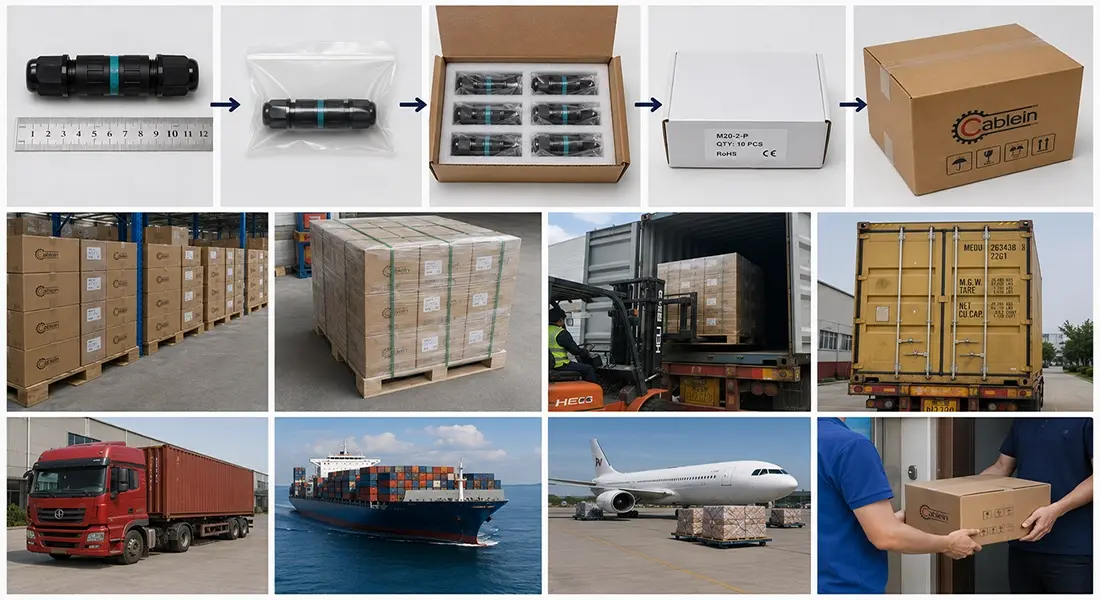
A: Standard 90-degree units transport in 7–10 days from our steady stock. Custom point tooling includes 3–4 weeks for starting shape creation, at that point generation takes after our standard schedule.
Next Steps: Let's Solve Your Cable Routing Challenge
Ready to eliminate cable bending stress and reclaim valuable installation space? Our engineering team can review your specific requirements and recommend the optimal molded strain relief configuration. contact us at nick@cableinco.com for technical specifications, sample requests, or custom design consultation.