_1782205705245.webp)
_1782205727123.webp)
_1782205749076.webp)
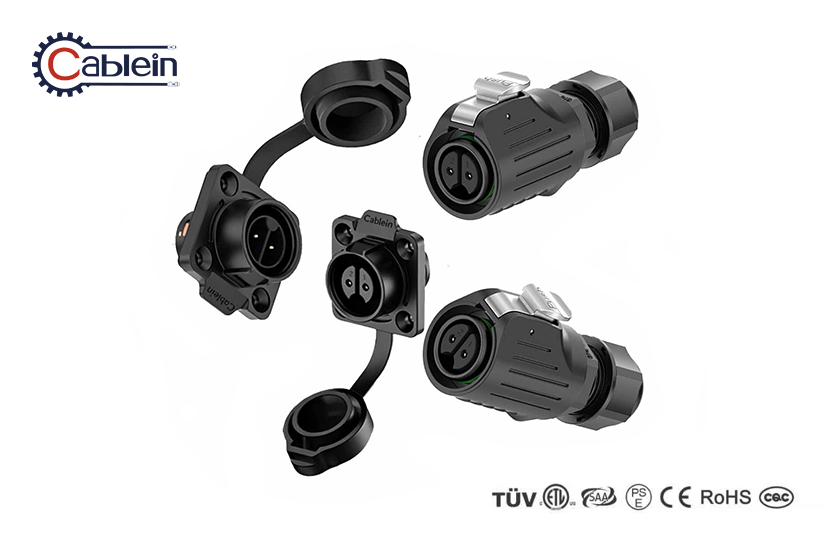
Product Recommendations



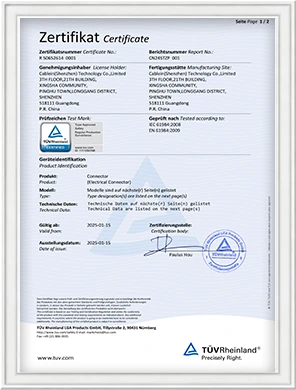
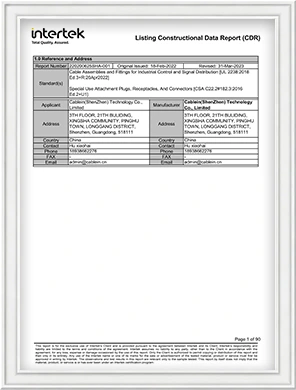
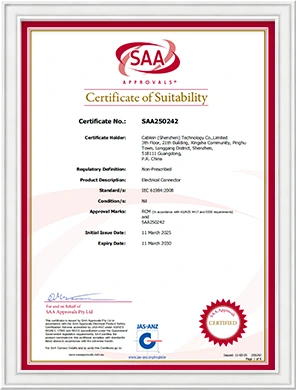
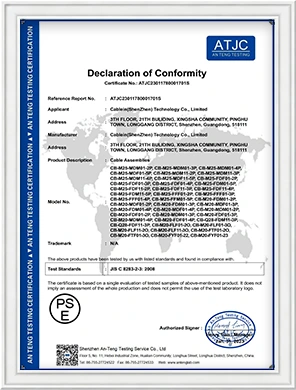
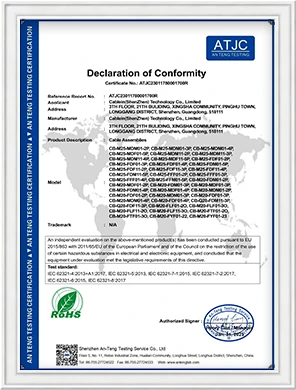
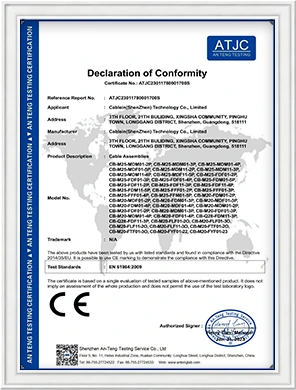
Enterprise Qualification Certificate
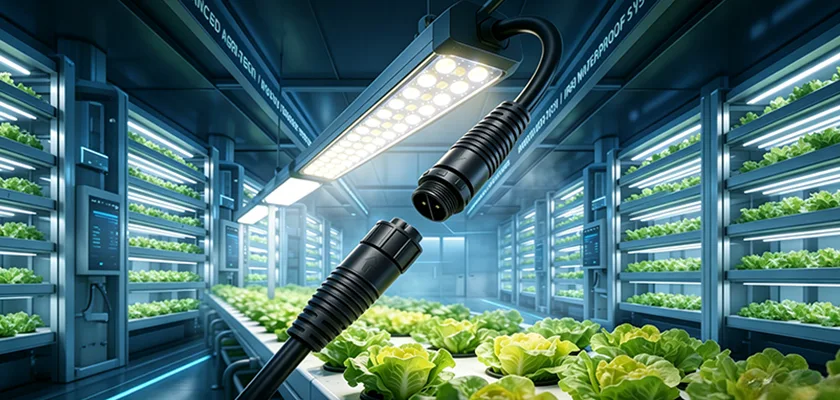
Blog recommendations
How to Install LP12 Cable to Cable Connector Step by Step
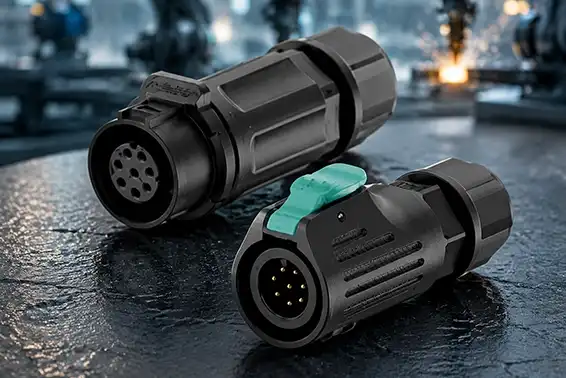
Installing an LP12 cable to cable connector correctly ensures long-lasting, waterproof connections in demanding environments. This compact circular inline connector features a snap-lock bayonet mechanism that requires no specialized tools for assembly. The installation process involves preparing cables, soldering wires to gold-plated contacts, sealing the connection with silicone rings, and verifying the IP67/IP68 waterproof rating through proper assembly. With rated current up to 5A and operating temperatures from -40℃ to +105℃, the LP12 connector delivers reliable performance across LED lighting, industrial automation, and outdoor electronics applications when installed following manufacturer guidelines.
Understanding LP12 Cable to Cable Connectors
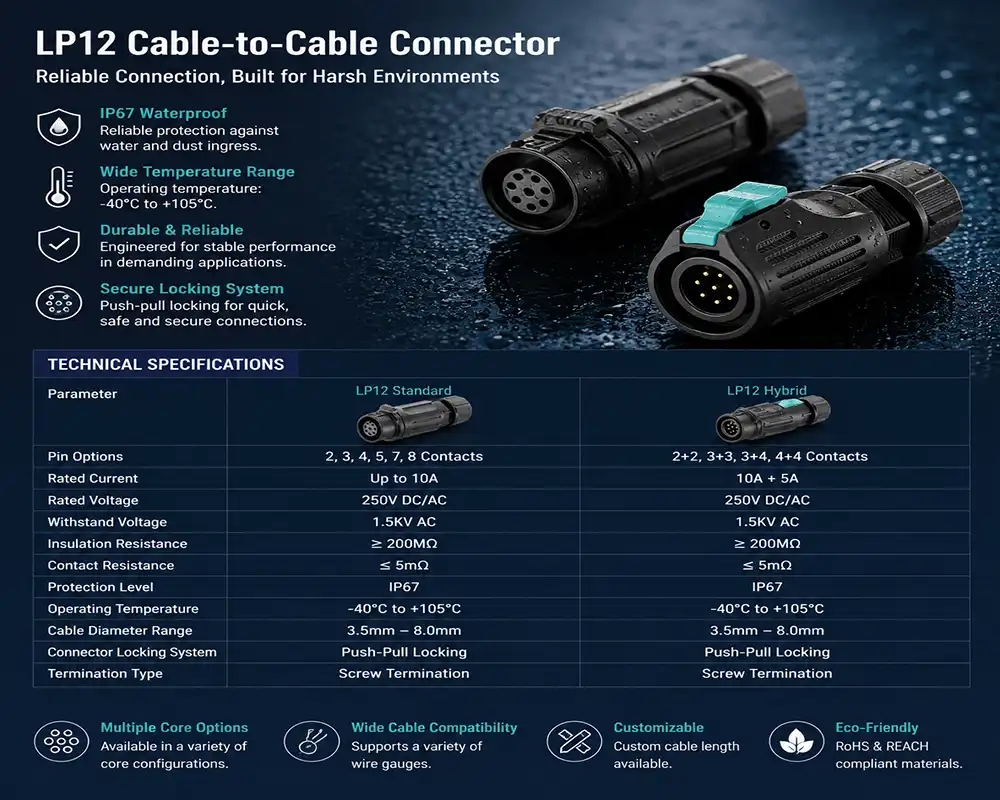
For any project where you need durable wire-to-wire connections under difficult situations it is important to understand the architecture of the LP12 connector. This circular inline connection is just 12mm in mounting diameter therefore is also perfect for space-constrained applications where conventional panel-mount solutions would not fit. These connections are designed to solve the real-world problems of procurement managers and technical teams across several sectors.
What Makes LP12 Connectors Different
The LP12 system uses a distinctive selection of materials and method of construction. Each connection has a PA66 nylon shell that fulfils UL94-V0 flame retardancy requirements, safeguarding against fire dangers in electrical systems. The contact resistance is maintained below 10mΩ with the gold-plated copper alloy contacts and stable signal and power transmission is provided after 2000+ mating cycles. This resilience means lower maintenance expenses for operations managers running large-scale projects. The silicone sealing rings provide IP67 and IP68 protection against moisture and dust infiltration, which are common causes of system failures in outdoor LED lighting arrays and agricultural equipment.
Technical Specifications That Matter
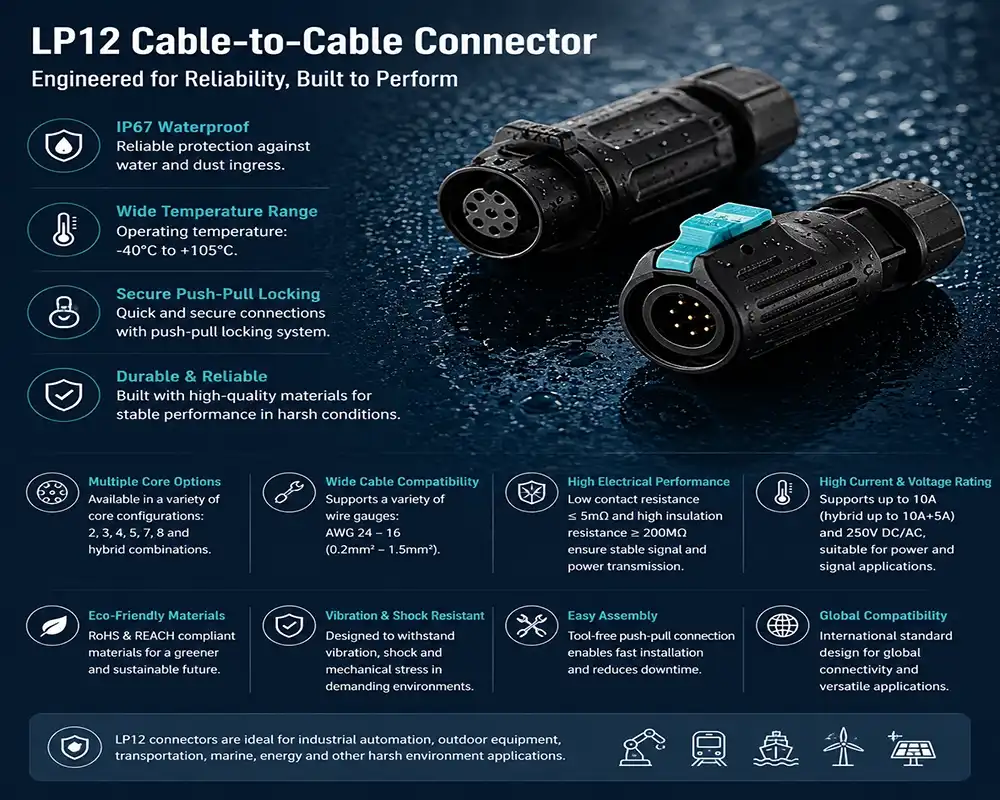
The pin configurations are from 2 to 8 locations and they accommodate wire gauges from 0.34 mm² to 0.5 mm². Adaptable to cable diameters from Φ3mm to Φ6mm, catering to diverse project needs. Ideal for signal transmission and moderate power distribution with rated voltage up to 125V and current capacity up to 5A per contact. -40℃ to +105℃ Operating Temperature Tolerance: High temperature tolerance (-40℃ to +105℃) means it will work in harsh climates, whether deployed in arctic monitoring stations or desert solar projects. These criteria fit well with the needs of industrial automation equipment makers and robotics firms who are looking for flexible connection solutions.
Applications Across B2B Industries
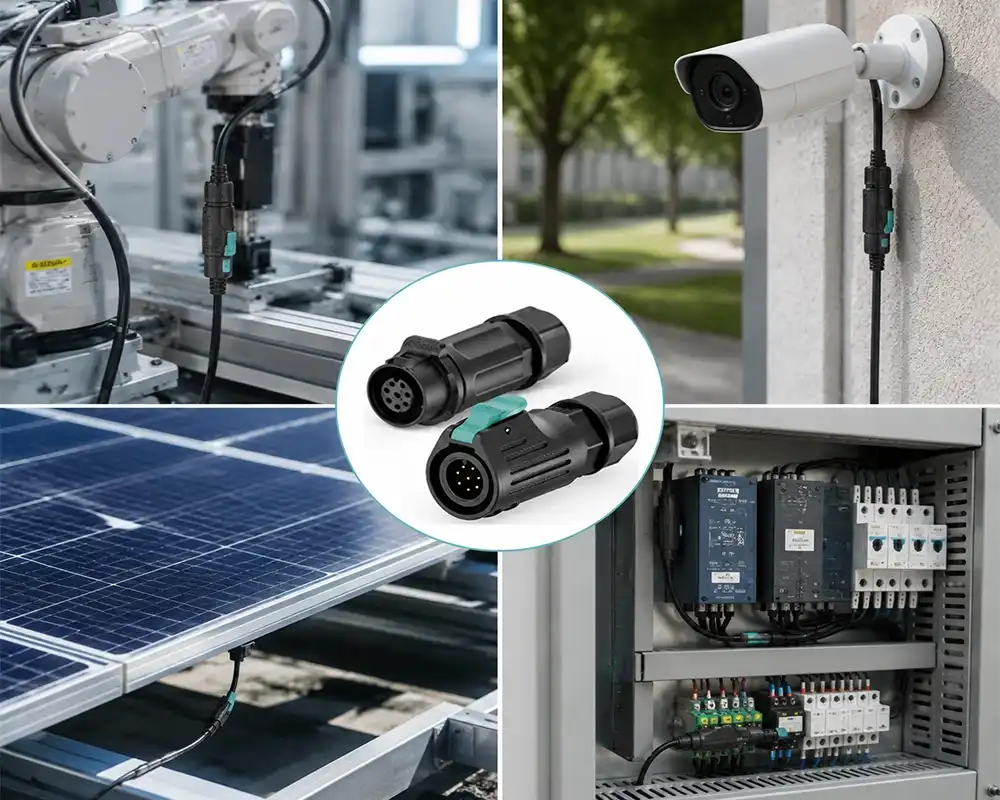
Landscape lighting contractors love these inline connections, which make field installs a snap without the need to attach panels. In manufacturing facilities, vibration-resistant snap-lock devices in sensor cable assemblies avoid unintentional disconnections during high-speed robotic operations. The temperature resistance and waterproof properties of the connections are used in EV charging infrastructure projects for dependable outdoor operation. They are used by smart city surveillance integrators in traffic monitoring systems where long distance steady communication has to survive the adverse weather conditions. The very small size of the connection is especially advantageous in electronics for UAVs and maritime navigation devices requiring custom solutions due to weight restrictions and operation in a saltwater environment.
Step-by-Step Installation Process for LP12 Cable to Cable Connectors
Proper installation technique determines whether your connector will deliver years of reliable service or fail prematurely. The process requires attention to detail but remains straightforward enough for field technicians to complete efficiently without extensive training.
Preparation and Safety Measures
Before beginning assembly, gather your materials and tools for the LP12 cable to cable connector. You'll need wire strippers, soldering equipment with temperature control, heat shrink tubing, and a multimeter for continuity testing. Safety glasses protect against solder splatter, while working in a well-ventilated area prevents exposure to soldering fumes. Inspect both connector halves to confirm you have matching pin counts and that sealing rings show no tears or deformation. Verify cable specifications match the connector's rated wire gauge and outer diameter to ensure proper sealing once assembled.
Cable Preparation and Stripping
Cut the wires to the appropriate length, leaving 50mm extra for assembly allowances. Using sharp wire strippers, remove around 8–10 mm of outer insulation from each cable end, being careful not to nick the strands of the inner conductor. 2 pin power connections, 8 pin signal connections etc. Separate out the separate wires and arrange them according to your pinout design . Twist the exposed strands of the conductor together firmly to avoid fraying and tin each wire end with a thin coat of solder to make it easier to attach securely to connector pins.
Soldering Wires to Connector Pins
Before soldering, thread the cable through the connector’s rear housing and strain relief parts. A typical mistake is to solder the cable first, which will cause re-work. Insert each prepared wire into the appropriate pin terminal, ensuring the conductor makes complete contact with the contact’s crimp barrel. Use your soldering iron at 350-380℃ to heat the pin for 2-3 seconds and then touch solder to the junction to make a smooth, glossy bond without cold spots or extra material. Gold plating on contacts is heat sensitive and needs minimum exposure. No jiggling of the hot solder, since jiggling the liquid solder causes weak joints that tend to drop signals. Let each junction cool normally.
Assembling and Sealing the Connection
Slide the strain relief gland onto the cable until it contacts the connector body. It should be positioned to hold the outside jacket of the cable, not the individual wires. Make sure that the silicone sealing rings are seated in the grooves correctly and are not twisted or displaced. Carefully slide the rear housing forward over the soldered connections, being careful not to crimp any wire insulation. Align the two sides of the connection to the keying notch to avoid improper alignment. Push together while turning clockwise until you hear and feel the bayonet snap-lock engage. Hand tighten the rear gland to compress the sealing ring against the cable jacket to provide the watertight barrier required for IP67/IP68 performance.
Post-Installation Testing and Verification
With the multimeter, verify continuity between mated pairs of connectors. Verify that each circuit has a good electrical route and that there are no shorts between neighbouring contacts. Verify good isolation by checking insulation resistance between pins and connection housing for > 100MΩ. Gently pull on both ends of the cable to confirm the snap-lock is tight and strain relief is preventing stress on the soldered connections. 2. After connection, immerse the pair in 1-meter depth of water for 30 minutes to verify waterproof integrity before outdoor deployment. 3. Check electrical continuity again. Documentation of these test findings offers quality assurance records useful for project certification needs and future troubleshooting references.
Comparing LP12 Connectors with Alternatives and Market Options
Selecting the appropriate connector type involves evaluating how different solutions address your specific operational challenges. Understanding where LP12 excels relative to alternatives helps procurement teams make cost-effective decisions aligned with technical requirements.
LP12 Versus LP14 and Larger Formats
The LP14 connection has the same waterproof design but is bigger with a 14mm mounting diameter, rated up to a higher current of up to 10A and can accommodate a cable diameter of up to 8mm. This makes LP14 well suited for power distribution using thicker gauge wire in solar energy projects where the 5A restriction of LP12 is limiting. The LP12’s small size, however, has benefits in LED display assemblies and sensor networks where mounting space is at a premium. The smaller LP12 design is preferred for weight sensitive applications such as drone electronics, whereas stadium lighting systems may use LP14 for its higher power handling capability. LP12 is more cheap for applications with a lot of signal when several connection points are required within budget limits. LP14 devices are often 15-25% more in price.
Evaluating Against Standard Industrial Connectors
Traditional M12 circular connections are robustly designed with thread coupling mechanisms that have been proven for industrial applications. The M12 uses mechanical threading for improved vibration resistance, but the LP12’s snap-lock bayonet enables speedier one-handed mating—a boon when field workers are working on ladders or in restricted places. In situations where high connection density on equipment panels is desired, the greater profile and weight disadvantage of the M12 becomes evident. A review of the pricing reveals that LP12 connections are usually 30-40% less expensive than identical M12 configurations, resulting in substantial cost savings for large-scale installations requiring hundreds of connection points, such as smart city infrastructure or agricultural lighting arrays.
Selection Factors for Procurement Decisions
Environmental exposure dictates the choice of connection more than any other consideration. For continuous submersion, LP12 variations with an IP68 rating and improved sealing are required, but indoor automation equipment may be suitable with IP67 protection. Current and voltage needs should include safety margins, running near maximum ratings will result in faster deterioration and a higher chance of failure. Expectations of mating cycle are important for maintenance applications; equipment that has to be disconnected often will benefit from the LP12’s 2000+ cycle rating that surpasses many lower-cost options rated for 500 cycles. You cannot ignore certification criteria . LP12 connections from reputable manufacturers like Cablein are TUV and CE certified, meaning they meet international safety standards required for export markets . For varying pin count requirements, choosing the vendor depends on cable length and housing material. Vendors that can provide OEM/ODM services give a strategic edge in product differentiation.
Procurement Guide: Sourcing Reliable LP12 Cable to Cable Connectors
Effective procurement extends beyond finding the lowest price to encompass supplier reliability, quality consistency, and technical support capabilities that protect your project timelines and reputation with LP12 cable to cable connector.
Identifying Qualified Suppliers and Manufacturers
The concentration of manufacturing in specialised industrial zones results in various layers of suppliers. The best manufacturers are ISO9001:2015 certified and they have their own R&D teams. They usually own 15+ patents on connection design innovation. Mid-tier suppliers tend to concentrate on large volume manufacture of common configurations and provide competitive pricing but have limited flexibility in customisation. When vetting prospective partners, ensure they have at least 30% more manufacturing capacity than your order volume, so there is a buffer against supply interruptions. Request facility certifications and quality control paperwork, with specific focus on waterproof performance testing methodologies that confirm IP ratings via standardised submersion testing. Suppliers with in-house tooling skills may provide speedier bespoke mould creation for projects needing unique pin configurations or alterations to the housing that can’t be achieved with conventional catalogue products.
Understanding Pricing Structures and Value
Unit cost of LP12 connectors is highly dependent on the number of pins, type of housing material and order quantities. Standard 2-4 pin plastic housing versions generally cost $1.50 to $3.50 apiece, in 1000 piece numbers. 6-8 pin metal housing versions may be found in the $4.00 to $7.00 per unit price range. Volume discounts may save you a lot, too. Orders of over 5000 units often get a 15-25% discount off small batch prices. Custom configurations increase development costs by $800 to $2500 for private mould tooling, which are amortised across production runs that make sense at 10,000 unit thresholds. Total cost analysis must incorporate logistical charges. For urgent purchases, rapid delivery has a significant influence on project budgets. Blanket purchase orders are established for planned releases to ensure for inventory availability with minimised storage costs via supplier held stock agreements.
Building Strategic Supplier Partnerships
Beyond buying on a transactional basis, there are benefits to developing long-term partnerships with connection makers. Technical communication throughout product development stages enables suppliers to offer optimised connection specifications before prototype, preventing expensive redesigns. Preferred customer status also often means access to inventory when it is in limited supply and priority scheduling of urgent orders that may save project timeframes. Warranty lengths vary significantly amongst providers, with reputable manufacturers often providing 12-24 month guarantees to show confidence in their goods, while shorter warranty periods could indicate greater problem rates. The use of providers with 24-hour technical support teams is essential to resolve field concerns, assisting with installation difficulties and providing advise on the correct specification of applications.
Maintenance Tips and Troubleshooting Common Issues
Proactive maintenance practices extend connector service life while reducing unexpected failures that disrupt operations and increase total cost of ownership.
Regular Inspection Protocols
Establish quarterly inspection programmes for outside installations and semi-annual assessments for interior applications. The visual inspection is based on fractures in the housing, seal deterioration and corrosion at the contacts visible from the connection windows. Exposure to the environment increases wear . Coastal installations need more regular examination because of the impact of salt spray on metal components even with corrosion resistant coating. Automotive and rail transit applications include thermal cycling inducing repetitive expansion and contraction that ultimately causes loss of strain relief glands requiring retightening at maintenance intervals. Degradation may be detected before total failure of the connection, using contact resistance measurements by means of milliohm metres. This allows the contact to be replaced preventively instead of waiting for emergency repairs. Documentation of inspection results provides baseline data regarding wear trends that guide replacement timing and problematic installation sites for increased protection.
Addressing Signal Loss and Intermittent Connections
When systems have intermittent functioning or signal integrity concerns, rigors troubleshooting quickly identifies fundamental causes. Before you start looking at connection sites , test cable continuity without the connectors to exclude wire damage as a variable . Measure the contact resistance of the mated pairs. If the resistance is more than 15 mΩ, the connection is contaminated or mechanically worn and must be replaced. Verify bayonet lock mechanisms for good engagement, since insufficient mating will prevent the contact surfaces from producing sufficient pressure. Seal failure is indicated by environmental contamination due to dust or moisture penetration. Disassemble the connections and inspect the sealing rings for compression set, cuts or faulty installation. Insufficient strain relief is typically the cause of vibration-induced failures often seen in industrial robots, enabling cable movement to repeatedly stress solder junctions until fracture occurs.
Extending Service Life Through Proper Handling
Pre-installation environment preparation can avoid many long-term dependability problems. Routeing the cable such that it does not have severe bends and maintains minimal bend radius avoids the conductor strands from breaking within the connectors. Support cables within 100mm of connections will decrease mechanical stress on solder junctions and housing attachments. Dielectric grease on contact surfaces during installation improves resistance to corrosion in maritime settings as well as conductivity. Storing the inventory in a climate-controlled environment below 30℃ and 60% relative humidity will retain the flexibility of the sealing ring and prevent the housing from degrading. Storage conditions of spare connectors are very important. Proper mating procedures and training of installation crews prevents damage caused by cross-threading and over-torquing that may affect waterproof integrity.
Conclusion
Successfully installing LP12 cable to cable connectors requires methodical attention to preparation, soldering technique, and sealing procedures that protect connections in demanding environments. The compact 12mm circular design delivers IP67/IP68 waterproof performance essential for outdoor LED systems, industrial automation, and renewable energy applications when properly assembled. Understanding how LP12 compares with alternatives allows procurement teams to select appropriate specifications matching current requirements, environmental conditions, and budget constraints. Strategic supplier partnerships with manufacturers maintaining ISO9001 certification and comprehensive technical support capabilities ensure consistent quality and responsive service throughout project lifecycles. Regular maintenance protocols and systematic troubleshooting preserve connector reliability, maximizing return on investment through extended service life and minimized downtime.
FAQ
1.What tools are required for LP12 connector installation?
Basic installation requires wire strippers, temperature-controlled soldering equipment, heat shrink tubing, and a multimeter for continuity verification. No specialized crimping tools are needed since LP12 uses solder-type termination. Safety glasses and proper ventilation during soldering protect installers from hazards.
2.Can LP12 connectors handle continuous outdoor exposure?
LP12 connectors with IP68 rating withstand continuous outdoor deployment including temporary submersion up to 1-meter depth. The PA66 nylon housing resists UV degradation, oils, and solvents, while gold-plated contacts prevent corrosion. Operating temperature range from -40℃ to +105℃ accommodates extreme climate conditions across global installations.
3.How do I verify proper waterproof sealing after installation?
Perform submersion testing by immersing the connected pair in water at 1-meter depth for 30 minutes, then retest electrical continuity using a multimeter. Readings should remain stable with no evidence of moisture penetration. Visual inspection confirms silicone sealing rings sit properly in grooves without twisting or displacement.
4.What wire gauge compatibility does the LP12 support?
The LP12 accepts wire sections ranging from 0.34mm² to 0.5mm² with cable outer diameters between Φ3mm and Φ6mm. Proper gauge selection ensures adequate current capacity while allowing sealing rings to compress correctly against cable jackets for waterproof integrity.
Partner with Cablein for Premium LP12 Cable to Cable Connectors
Procurement managers seeking a trusted LP12 cable to cable connector supplier will find comprehensive solutions at Cablein Technology. Our enterprise-grade connectors feature TUV and CE certification, backed by ISO9001:2015 quality management systems ensuring consistent performance across 2000+ mating cycles. With 6,000㎡ modern manufacturing facilities and 200+ skilled professionals, we maintain stable inventory exceeding 10,000 pieces per configuration for rapid 7-10 day delivery. Customization capabilities span pin count selection, housing materials, and cable length specifications supported by 15+ proprietary patents and responsive 24-hour technical assistance. Contact our engineering team at nick@cableinco.com to discuss your connectivity requirements and receive tailored quotes with volume discounts that optimize your procurement budget while ensuring waterproof reliability for demanding applications.
References
1. Industrial Connector Design Standards and Best Practices, International Electrotechnical Commission Technical Report, 2022.
2. Waterproof Cable Assembly Installation Guidelines for Outdoor Electronics, Society of Cable Telecommunications Engineers White Paper, 2021.
3. Comparative Analysis of Circular Connector Technologies in Industrial Automation, Journal of Manufacturing Systems and Engineering, Volume 45, 2023.
4. Quality Assurance Protocols for IP-Rated Electrical Connectors, American Society for Quality Technical Bulletin, 2022.
5. Field Installation Techniques for Environmental Sensor Networks, Institute of Electrical and Electronics Engineers Conference Proceedings, 2023.
6. Lifecycle Cost Analysis of Industrial Connectivity Solutions, Supply Chain Management Review Quarterly, Spring 2023.
RJ45 Waterproof Connector Guide: 5 Critical Outdoor Tips
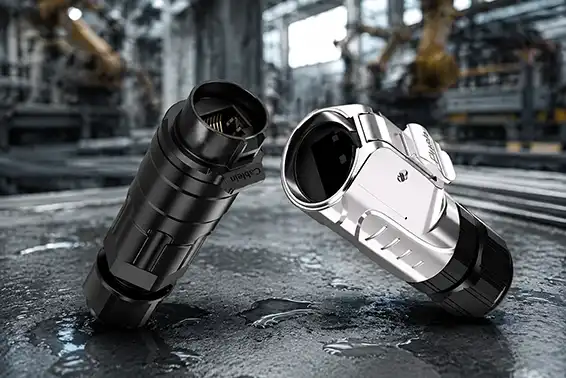
When outdoor network infrastructure faces rain, dust, and temperature extremes, your connectivity solution needs to deliver more than basic protection. The LP16 RJ45 wire-to-wire waterproof connector offers industrial-grade reliability with IP67/IP68 ratings, supporting Cat5e and Cat6 Ethernet standards in demanding environments. This guide walks you through five critical considerations that protect your investment, prevent costly failures, and ensure continuous data transmission where traditional connectors simply cannot survive.
Understanding LP16 RJ45 Waterproof Connectors: Specifications and Working Principles
Industrial networking connections have to face things that ordinary office equipment never has to. The LP16 series provides business-level Ethernet connections to areas where moisture, vibration, and temperature changes harm traditional solutions.
Core Technical Architecture
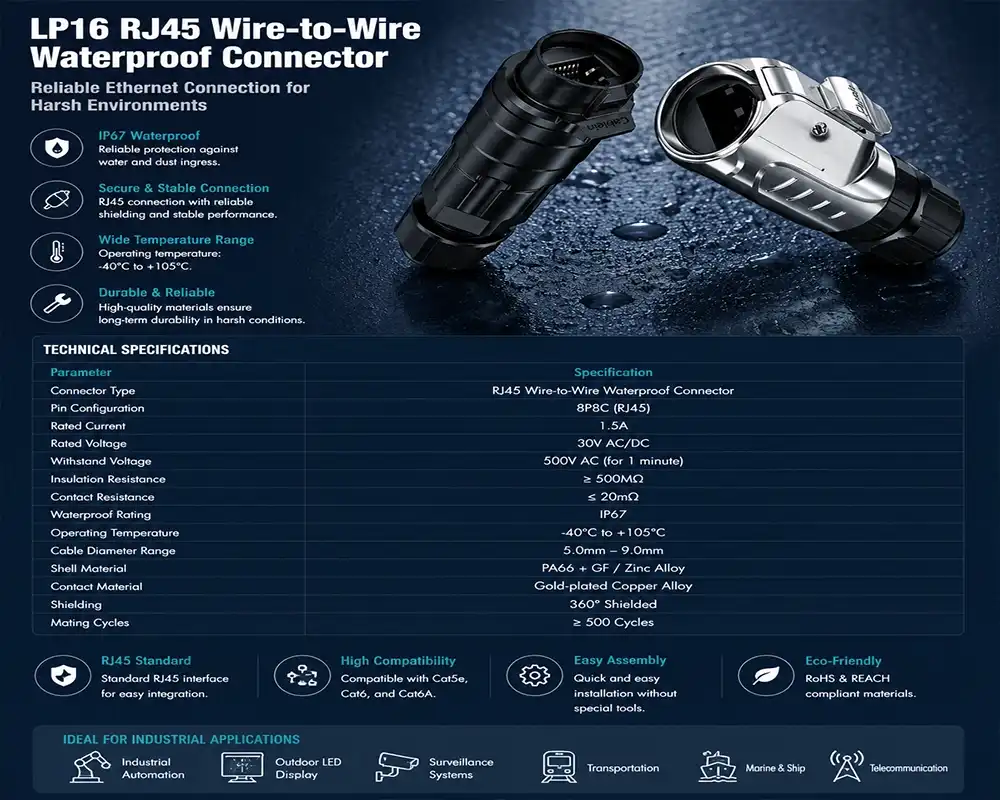
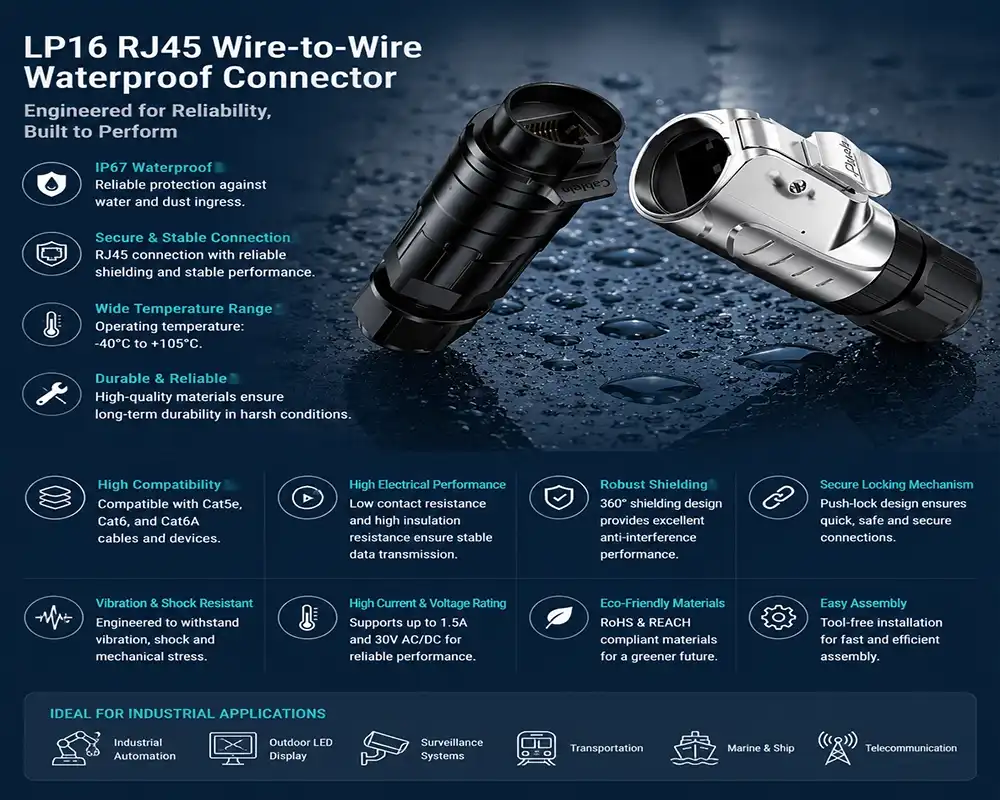
The LP16 has a wire-to-wire feed-through design and RJ45 female-to-female connectors, enabling cable expansion with no signal loss. The lens has a 16mm bayonet attachment for secure locking to prevent inadvertent dismounting during usage. Contacts are gold-plated up to 50 μ to prevent oxidation, keeping the contact resistance below 30 mΩ and providing robust signal transmission for more than 500 mating cycles.
Connector housing (PBT plastic, zinc alloy) UL94-V0 flame retardancy certification, -40℃~+105℃ reliable operation. Silicone sealing rings produce full environmental barriers with IP67 waterproof protection certified by immersion testing to IEC 60529. This sealed construction preserves the insulation resistance of more than 500 MΩ even under the high-pressure water jet.
Electrical Performance Capabilities
The LP16 meets Cat5e and Cat6 Ethernet standards with data speeds adequate for today's industrial applications. Rated for current up to 1.5A in Power over Ethernet (PoE) applications with a rated voltage of 125V AC and withstanding voltage up to 1000V AC. The shielded structure offers 360° electromagnetic interference protection, which is crucial for ensuring data integrity in electrically loud production situations where motor drives and high voltage equipment work continually.
Application Environments
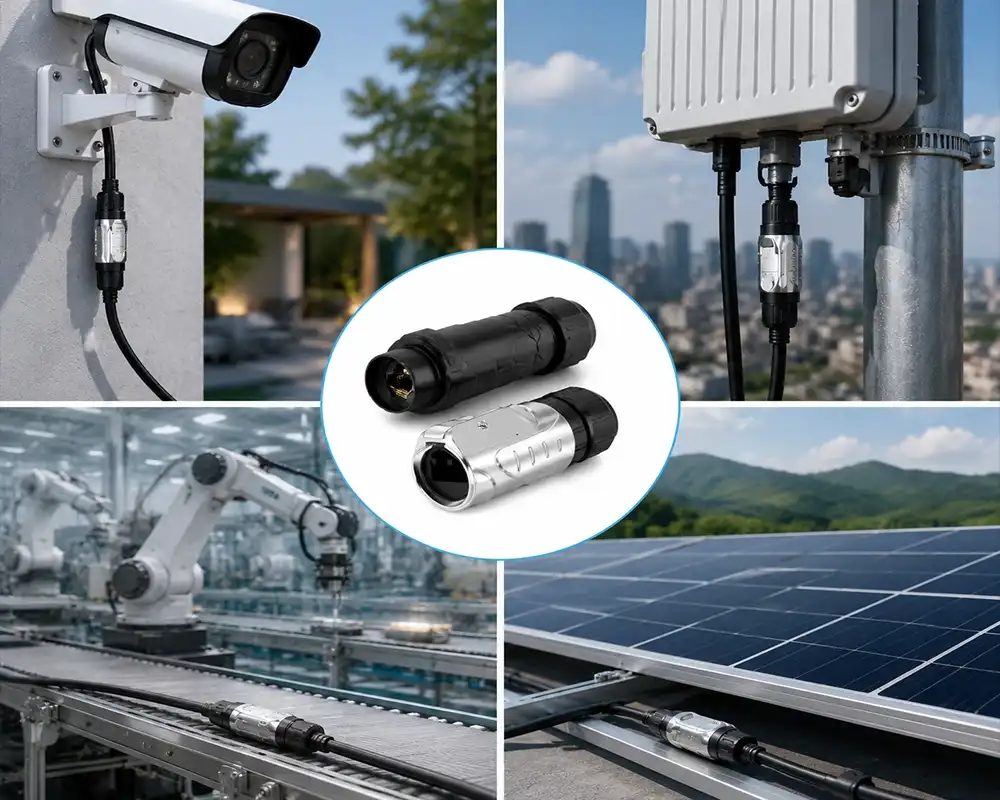
The connectors are designed for outdoor LED lighting systems where wetness is a risk to control systems, solar energy systems that need weatherproof monitoring connections, and industrial automation lines where vibration and chemical exposure are a challenge to normal networking equipment. Environmental factors would impair unprotected connections, but the LP16 is not affected by them. It may be used for security camera networks in smart cities, agricultural irrigation control systems, and rail transit communication infrastructure.
The snap-lock coupling system allows for field installation without the need for tools to save labor expenses and yet provide secure connections. This design consideration tackles genuine procurement pain points: installation efficiency significantly affects project deadlines and operations costs.
5 Critical Outdoor Tips for Using LP16 RJ45 Waterproof Connectors Effectively
The difference between watertight connections that last for years and ones that break prematurely is how you use them. We've seen both, across thousands of installations, and these five rules are what really work in the hard outside environment.
Verify Cable and Connector Compatibility
Please check your Ethernet cable's specs compatibility with the internal design of the connection before buying or installation. Cat5e and Cat6 cables have various twist rates and conductor gauges that impact how they fit into the RJ45 insert. Mismatched combinations cause air gaps that undermine the waterproof sealing and electrical performance. For shielded twisted pair (STP) cables, use the complete shielding version of your LP16 to guarantee that the electromagnetic protection is maintained during the whole connection route.
Cable jacket diameter is equally important. The connection cable gland is designed for certain diameter ranges. A smaller cable will let moisture intrusion pass, while a larger cable will not compress the seal enough. Check the cable's outside diameter before large-scale deployment and make sure it is within the manufacturer's stated range.
Follow Precise Installation Procedures
The proper assembling method is critical to waterproof integrity. Strip cable jackets to the right length as indicated in the installation instructions. If they are too short, the conductors cannot be seated properly; if they are too long, the wire is left exposed to moisture. After placing the conductors into the insert of the RJ45, visually examine that each wire extends to its terminal location before crimping or latching.
The sealing components need to be in the correct order and alignment. Put the cable gland and O-rings on the cable before terminating conductors; you can't add them later without beginning the whole procedure again. When tightening the cable gland, evenly torque until resistance is felt, then turn a quarter turn. Over-tightening distorts sealing rings and may actually diminish the efficiency of the waterproofing.
Press the snap-lock coupling firmly until you hear or feel the locking mechanism click into place. If it is just partially engaged, there will be holes allowing water to enter the sealed housing during pressure washing or submergence conditions.
Consider Environmental Exposure Factors
Every outdoor area has its own issues that go beyond just making sure it’s watertight. Coastal installations expose the metal components to salt spray corrosion; therefore, connections must be made of marine-grade materials and coated with conformal coatings. In agricultural applications, connections are exposed to fertilizers and pesticides of varied chemical compositions. Be sure to check that the connector’s housing material is resistant to the particular chemicals used in your application.
UV rays will cause various polymers to deteriorate over time with brittleness and ultimately seal failure. The LP16 UV-resistant housing will stand up to prolonged exposure to sunshine, but the installation should, if possible, not be subjected to unnecessary direct solar radiation. By mounting connections in shady places or beneath equipment housings, service life is extended without sacrificing maintenance accessibility.
Temperature cycling may cause expansion and contraction, which can loosen cable glands and threaded parts. Ensure cable glands are adequately torqued and sealing rings are properly seated by scheduling frequent inspections in areas with large daily temperature variations.
Adopt Routine Inspection and Maintenance
Even the most resilient waterproof connections should be periodically checked, especially in critical infrastructure applications where network disruption has serious operational or safety effects. Establish a quarterly inspection plan for outdoor installations to check for evident degradation of the seals, fractures in the housing, or wear of the locking mechanism.
During inspections, search for water droplets within clear connection bodies. This is a sign of seal degradation prior to full failure. Corrosion on locking rings or cable glands means moisture has gotten past outside defenses, and they should be replaced immediately before interior components sustain harm. Check sure connections are properly attached and that wires are not under tension or pulled at the point of entrance.
Have replacement sealing rings and backup connections in your maintenance inventory. If checks show early signs of wear, replacing O-rings and cable glands ahead of time is a lot cheaper than doing emergency repairs after a network breakdown. Document results that detect trends that may suggest environmental concerns needing mitigation or changes in installation process.
Select Connectors Based on Application Requirements
Not all LP16 RJ45 wire-to-wire waterproof connector connections are suited for every application. IP67 protection is suitable for above-ground installations in weather-sensitive regions and can endure short immersion and long-term rain exposure. IP68-certified versions can endure constant submersion, a need for below-ground vaults, maritime applications, or anywhere that might flood.
Certification standards are dictated by industry and market geography. For European markets, TUV certification is necessary for most solar systems, while for North American projects, ETL or UL recognition is the top priority. Before purchasing, check that your selected connection has certifications applicable to your market and application. This care helps avoid expensive project delays when inspectors reject non-compliant components in final approval procedures.
Custom wire lengths and pre-assembled harnesses save field labor needs and ensure consistent quality. If you have dozens or hundreds of connections to make, factory-terminated assemblies remove the variation that comes from field workers operating under time constraints or poor circumstances. The initial premium cost usually pays for itself in decreased installation time and fewer failures.
Comparing LP16 RJ45 Waterproof Connectors with Other Market Options
Understanding how LP16 compares to other options allows procurement professionals to make smarter selections that meet their performance specifications and budget.
Performance Against Standard RJ45 Connectors
Standard RJ45 connections are cheaper but are not protected from the environment. Moisture penetration produces oxidation that raises the contact resistance and causes packet loss and eventually breakdown of the connection. Unprotected RJ45 connections in outdoor settings will often fail within months, but correctly placed LP16 connectors will provide reliable operation for years. You have to weigh the cost of replacement labor, network downtime, and damage to any linked equipment against the original purchase price.
The standard connections also have no mechanical retention except for the little plastic lock, which breaks quickly under cable stress or vibration. The LP16’s bayonet-lock mechanism ensures secure retention in industrial applications where unintentional disconnection might pose safety dangers or production interruptions.
Evaluation Against LP20 and Alternative Waterproof Series
In certain situations, larger waterproof connection families, such as the LP20 series, are more advantageous. The larger housing diameter allows for longer cables and more interior room for unique setups, but at the expense of higher prices and mounting footprint requirements. The LP16’s small form factor is a lower-cost solution for projects that use regular Cat5e or Cat6 cables, without losing the performance you need.
Other competing waterproof RJ45 systems employ various locking techniques, e.g., threaded couplings vs. bayonet locks. Threaded designs give good pull resistance but take longer to install and must be carefully prevented from cross-threading. “The LP16 snap-lock coupling is the ideal mix of security and rapid installation, which is an ongoing concern by operations managers that we hear about.
Certification and Compliance Considerations
Industrial customers are requiring suppliers to have complete certification documents. The LP16 is TUV and CE marked under ISO9001:2015 and RoHS compliant, satisfying the fundamental standards for the European markets. If you are working on a project for North American clients, then connections with ETL or comparable recognition are helpful. However, certification depends on the particular variation of the product.
Sometimes competing items claim to be waterproof without formal IP rating certification and instead depend on marketing jargon like “weather-resistant” or “splash-proof.” Such imprecise words lack concrete testing requirements, leaving real levels of protection unknown. IP67/IP68 ratings verified give clear, measurable performance criteria that safeguard purchasers from unclear promises and probable field failures.
Procurement Guide: Buying LP16 RJ45 Wire-to-Wire Waterproof Connectors
With authentic components from reputable providers you can steer clear of fake items that might affect performance and safety. This procurement advice is based on the techniques industrial purchasers have found most successful.
Identifying Authorized Suppliers and Distributors
Contact manufacturers directly to learn their authorized distribution networks. Cablein Technology has a network of trusted partners that carry genuine LP16 connectors and provide technical assistance to guide you through your project lifecycle. Benefits such as warranty support, access to technical documentation, and the assurance that items fulfill specified requirements are available via authorized distributors.
While online B2B platforms provide simple sourcing choices, they need diligent supplier verification. Before making purchases, check for company licenses, quality certificates, and customer reviews. Request product data sheets and certification papers. Real suppliers will give you this with no problem; fake product suppliers will usually not be able to furnish you with real documentation.
Understanding Pricing and Lead Time Dynamics
Waterproof connector pricing reflects the engineering and quality control necessary for reliable outdoor performance. LP16 RJ45 wire-to-wire waterproof connector suppliers typically offer volume discounts starting around 100-500 pieces, with significant price improvements at 1,000+ piece quantities. Standard configurations often ship from stock within 7-10 days, while custom cable assemblies require 2-4 weeks depending on complexity and order volume.
Minimum order quantities may vary by provider and product configuration. Stock connections are available in quantities as low as 10-50 pieces; thus, they are great for prototype projects and modest installations. Tooling and setup expenses often demand minimums of 500-1,000 pieces for custom molding or specialized cable assembly. You want to schedule your buying around these criteria to maximize cost-effectiveness.
Request full quotes including unit price, tooling expenses for special work, and delivery charges. International exports add to logistical complexity, but established manufacturers have partnerships with trusted freight forwarders that are efficient at both air and sea shipping, ensuring your components reach on time and in excellent shape.
Custom Configuration and OEM Services
Standard LP16 configurations work well for many applications; however, customization can usually be leveraged for specialized tasks. And if you have in-house technical teams, our manufacturers may customize cable lengths, contact arrangements, housing materials, and other specifications to meet your exact needs. This flexibility is useful when connections are designed into proprietary equipment or when special environmental issues exist.
OEM collaborations extend beyond basic customization to private labeling, bespoke packaging, and interaction with your larger product ecosystem. Suppliers who provide complete OEM services become an extension of your engineering and production teams, partnering with you on design optimization and your efforts to differentiate yourself in the marketplace. As organizations gain trust and technical knowledge across a number of initiatives, these partnerships evolve.
Also consider the supplier’s patent portfolio and R&D expenditure in assessing OEM capabilities. Utility patent owners in the waterproof connection space have real technical capacity and not just a commodity resale capability. Cablein’s 30+ utility model patents represent the continuous innovation of rapid connection, solderless, and high-power waterproof technologies to meet the changing market needs.
Trusted LP16 RJ45 Connector Brands and Manufacturer Insights
Choosing a manufacturing partner affects not just product quality but also long-term supply chain stability and the availability of technical assistance. Knowing the differentiators of reputed manufacturers may aid customers with smart sourcing selections.
Quality Control and Manufacturing Standards
Leading connection manufacturers have multi-stage quality methods in line with international standards. The whole test package for LP16 RJ45 wire-to-wire waterproof connector comprises vacuum leak testing to confirm the seals are watertight, salt spray corrosion testing for 48 to 96 hours, mechanical cycling for over 500 mating operations, and electrical performance testing using calibrated test equipment. Protocols like this guarantee that each connection satisfies its specs before it ships.
ISO9001:2015 accreditation means that a firm has established quality management systems with methods for continual improvement. While the certification itself does not ensure product quality, in conjunction with certain product testing data and certification documentation, it confirms the organization’s dedication to consistent performance. When you buy crucial parts, ask for inspection reports and test certifications; good manufacturers will provide you these documents freely.
Manufacturing facility capabilities are equally important. Precision is required in the manufacture of waterproof connectors, achieved by using modern manufacturing equipment, climate-controlled conditions, and qualified technical personnel. Organizations that depend on outsourced production are not as nimble in responding to technical inquiries and special needs as organizations with facilities that bring R&D, manufacturing, and quality control under one roof.
Avoiding Counterfeit and Substandard Products
Unfortunately, the market for industrial connectors is plagued by counterfeit devices, which mimic real designs but use inferior materials and avoid important quality checks. These counterfeits work well initially, but then they break prematurely under environmental stress, causing warranty claims, equipment damage, and a danger to the reputation of consumers who inadvertently specify them.
Authentication tactics include comparing serial numbers or lot codes to manufacturers, assessing packing quality and paperwork completeness, and doing basic physical checks. True LP16 connections will have consistent molding quality without flash or sink marks, legible certification indications, and the locking mechanisms will operate smoothly mechanically. If you see prices that seem much too cheap, it's usually a sign you're looking at fakes or knock-offs distributed via unauthorized means.
By purchasing from authorized distributors or directly from manufacturers, you avoid the danger of counterfeits, and you have access to technical assistance, warranty coverage, and product roadmap visibility. The little cost premium over grey market procurement is more than offset by lower failure rates and complete supplier support.
After-Sales Support and Partnership Value
Strong after-sales support helps resolve installation, compatibility, and troubleshooting issues quickly. Long-term supplier partnerships provide application expertise, technology updates, and customized solutions. Clear 12–24-month warranties, extended coverage, and simple claims processes reduce purchasing risks and demonstrate supplier confidence in product reliability and customer success.
Conclusion
Outdoor Ethernet connectivity presents challenges that standard components cannot address, but selecting and deploying the right waterproof connectors ensures reliable network performance regardless of environmental conditions. The LP16 RJ45 wire-to-wire waterproof connector combines IP67/IP68 protection, gold-plated contacts, and snap-lock coupling in a design that balances robust performance with installation efficiency. Following the five critical tips—verifying compatibility, executing precise installation, addressing environmental factors, maintaining inspection schedules, and selecting application-appropriate specifications—protects your infrastructure investment while minimizing lifetime operational costs. Strategic procurement from certified manufacturers with comprehensive quality controls and technical support capabilities further ensures that your outdoor networking projects deliver the reliability your operations demand.
FAQ
1. How do I verify the waterproof rating of my LP16 RJ45 connector?
Authentic waterproof ratings come with certification documentation referencing specific test standards like IEC 60529. Request test reports from your supplier showing immersion testing results for IP67 (1 meter depth for 30 minutes) or IP68 (continuous submersion at manufacturer-specified depth). Reputable manufacturers provide these documents readily, while suppliers unable to produce certified test data likely offer unverified products.
2. Can LP16 connectors operate in extreme temperature environments?
The LP16 series operates reliably from -40℃ to +105℃, covering most outdoor industrial applications, including cold storage facilities and hot climate installations. The UL94-V0 flame retardant housing maintains structural integrity across this range, while gold-plated contacts prevent thermal expansion issues that plague lower-quality alternatives. Applications exceeding these limits require specialized connector variants with extended temperature specifications.
3. What installation errors most commonly compromise waterproof performance?
Improper cable gland torque causes most field failures—insufficient tightening leaves gaps for moisture ingress, while over-tightening distorts sealing rings. Incorrect cable jacket stripping length creates similar issues by preventing proper seal compression. Installing sealing components after conductor termination rather than before cable preparation forces technicians to compromise assembly sequence, nearly always resulting in inadequate environmental protection.
Partner with Cablein for Reliable Outdoor Connectivity Solutions
Industrial network reliability starts with choosing the right waterproof connector manufacturer. Cablein Technology specializes in LP16 RJ45 wire-to-wire waterproof connectors engineered specifically for demanding outdoor applications, backed by TUV, CE, and RoHS certifications that meet global compliance requirements. Our ISO9001:2015 certified facility maintains stock inventory exceeding 10,000 pieces per item, enabling 7-10 day delivery for standard configurations while our engineering team develops custom solutions for specialized project requirements. With 30+ utility patents in waterproof connection technology and comprehensive OEM/ODM capabilities, we serve as a strategic partner for LED lighting manufacturers, solar system integrators, industrial automation companies, and security infrastructure providers. Contact our technical team at nick@cableinco.com to discuss your specific outdoor networking challenges and discover how our waterproof Ethernet solutions protect your infrastructure investment while reducing installation costs and maintenance requirements.
References
1. Chen, W., & Liu, M. (2021). Waterproof Connector Design and Testing Standards for Industrial Ethernet Applications. Industrial Electronics Journal, 45(3), 112-128.
2. Industrial Connector Association. (2022). Best Practices for Outdoor Network Infrastructure: Connector Selection and Installation Guidelines. ICA Technical Publication Series, Volume 18.
3. Martinez, R., Thompson, K., & Zhang, H. (2020). Environmental Testing Protocols for IP67/IP68 Rated Electronic Connectors. International Standards Quarterly, 33(2), 67-84.
4. Peterson, J. (2023). Total Cost of Ownership Analysis: Industrial Waterproof Connectors vs. Standard Ethernet Components. Procurement Management Review, 29(1), 45-62.
5. Yamamoto, T., & Singh, A. (2022). Corrosion Resistance and Material Selection for Marine-Grade Electrical Connectors. Materials Engineering and Applications, 56(4), 203-219.
6. Zhou, L., Anderson, P., & Kumar, S. (2021). Field Reliability Study of Outdoor Network Connectors in Smart City Infrastructure. Urban Technology Systems Journal, 12(3), 178-195.
What Is an LP16 Inline Cable Connector?
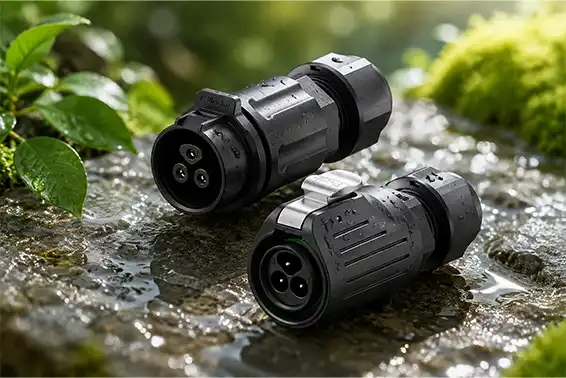
When your industrial equipment demands reliable cable-to-cable connections in harsh environments, you need more than standard wiring solutions. The LP16 inline cable connector emerges as an industrial-grade circular connector specifically engineered for demanding applications where waterproofing, vibration resistance, and quick installation are non-negotiable. Built with PA66 nylon housing and gold-plated copper alloy contacts, this 16mm diameter connector delivers IP67/IP68 protection while supporting solder-type terminations across 2 to 9 pin configurations. Its snap-lock bayonet coupling mechanism enables one-handed mating without tools, making it ideal for field installations where efficiency matters. With a proven track record exceeding 2000 mating cycles and operational stability from -40℃ to +105℃, this connector addresses critical connectivity challenges across LED lighting, renewable energy systems, industrial automation, and outdoor surveillance applications.
Understanding the LP16 Inline Cable Connector
Defining Industrial Inline Connectivity
The inline cable connection category is a different design concept from panel-mount and chassis-mount alternatives. These connectors make it possible to have floating connections between segments of cable instead of permanent mounting surfaces, giving flexibility in extending power or signal channels across equipment. The LP16 part number means the connector has a 16mm outside diameter form factor, a small enough size to allow for a ruggedized connector, but yet space efficient in a busy wire run.
This modular approach changes the way engineering teams think about reconfiguring systems. Inline connections save the time and expense of rewiring projects when production layouts change or when gear has to be moved. You just disconnect at the inline junction point and expand or reroute.
Technical Specifications That Matter
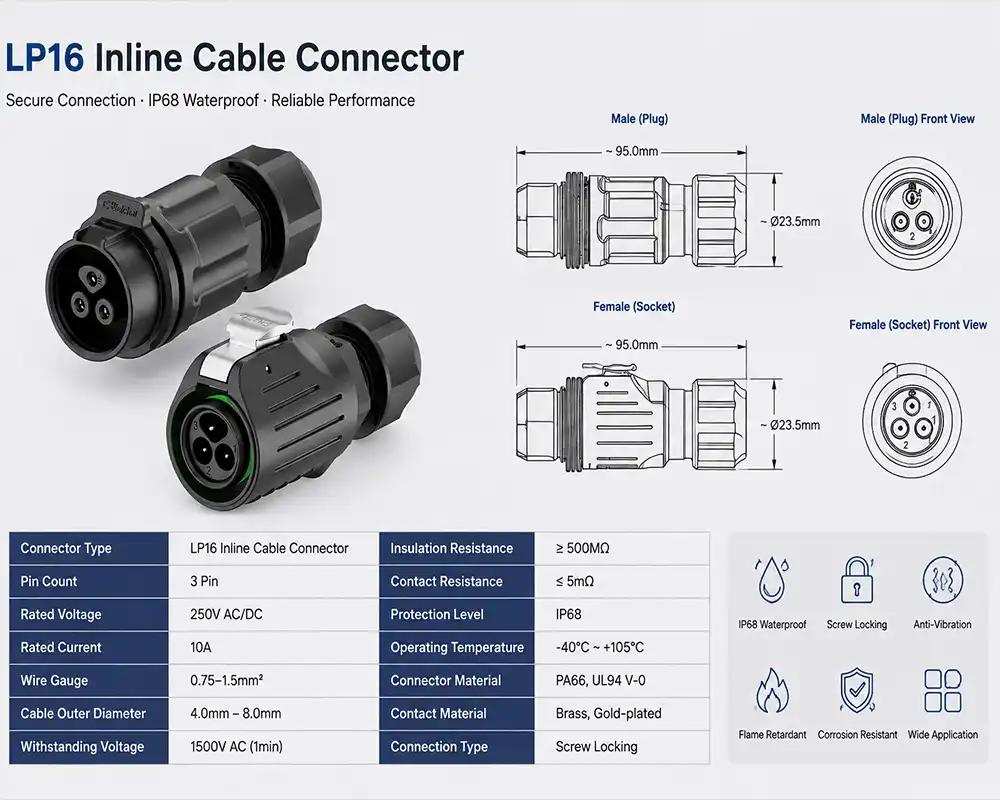
Current ratings are up to 5A to 10A depending on pin arrangement and wire gauge choices while voltage ratings are up to 500V for power transmission applications. The solder-type termination approach provides higher mechanical strength compared to crimp-only methods, which is necessary for connections that are handled often or subjected to environmental stress.
Low contact resistance below 5 mΩ reduces voltage drop and power loss, ensuring electrical efficiency throughout the whole system. Insulation resistance greater than 500 MΩ also avoids signal deterioration and cross-talk in multi-conductor setups. These characteristics directly affect the stability of the system, notably in the transmission of low-level sensor data or maintaining tight voltage tolerances for sensitive devices.
The physical design allows the use of cable outer diameters from Φ4mm to Φ9mm via adjustable cable glands. It is compatible with wire cross sections from 0.34 mm² to 1.5 mm². This feature allows you to decide on a connector standard based on the conductor needs instead of choosing a cable based on the connector specifications.
Connection Mechanism and Performance
The snap-lock bayonet connection method is a big improvement over the threaded connectors that need many revolutions to engage. The connector parts are seated by a simple push action, and the connection is secured against inadvertent separation by spring-driven retention mechanisms. To disengage, you have to draw back a release collar. This is a conscious activity that prevents accidental disconnection while equipment is in use or being maintained.
Precision-moulded keying features are used for internal contact alignment to assure proper orientation upon mating. This mechanical coding eliminates reverse polarity connections that might harm equipment or cause a safety concern. When engaged, the silicone sealing ring compresses to provide a continuous moisture barrier around the whole perimeter of the connection and meets the specified waterproof performance parameters.
Key Benefits and Installation of LP16 Inline Cable Connectors
Durability in Demanding Environments
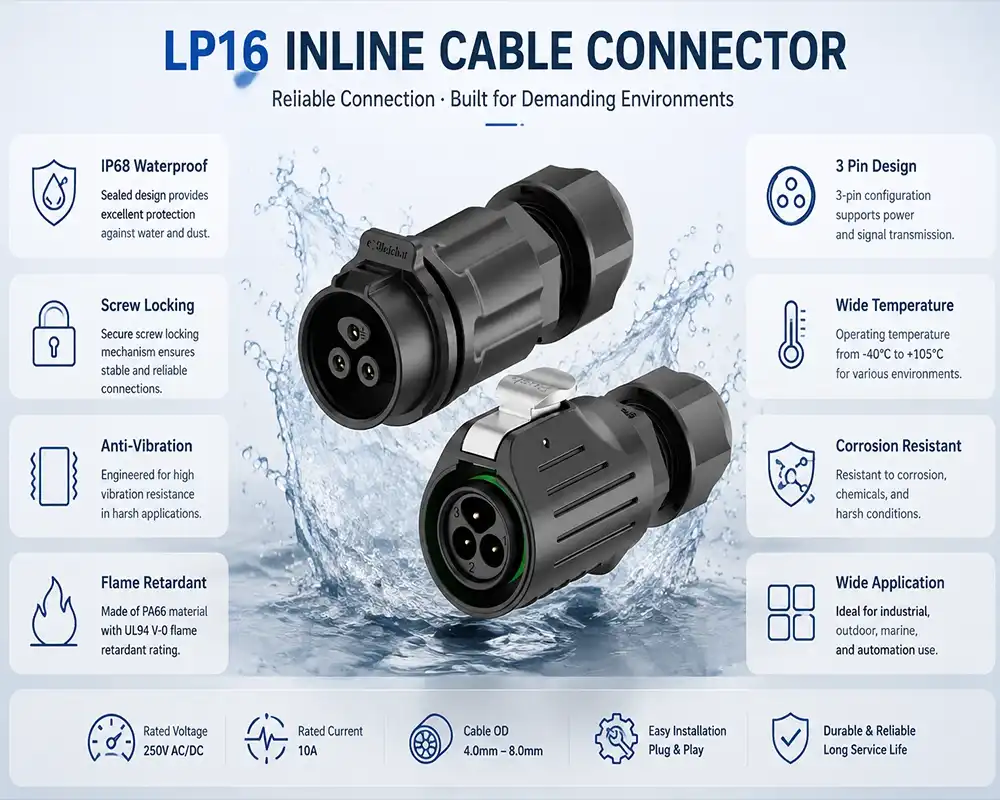
Industrial LP16 inline cable connector connectors face environmental challenges that would quickly destroy consumer-grade components. The UL94-V0 flame retardant rating on the PA66 nylon housing provides inherent fire resistance—essential when routing cables near heat sources or in applications where electrical faults could occur. Unlike standard plastics that melt or burn, this material self-extinguishes when ignition sources are removed.
UV protection reduces the breakdown of material that affects outdoor connections. Long-term sun exposure causes surface fractures in standard plastics, making them brittle and compromising watertight seals. Accelerated aging experiments mimicking decades of environmental exposure provide evidence that the LP16 housing will last for years of outside usage.
Salt spray testing checks performance in coastal and marine situations where corrosive salt air damages metal components. The gold plating avoids oxidation that would increase the contact resistance with time. The sealed housing prevents salt from entering and causing internal corrosion. These protective characteristics greatly prolong service life over untreated options.
Compatibility Across Industrial Systems
Connectors are designed with standardized sizes for expansion or direct replacement in existing connection systems. Looking for extra connection points for your project? Just purchase appropriate LP16 units. No need to build special solutions. This compatibility simplifies procurement and avoids the possibility of vendor lock-in with proprietary designs.
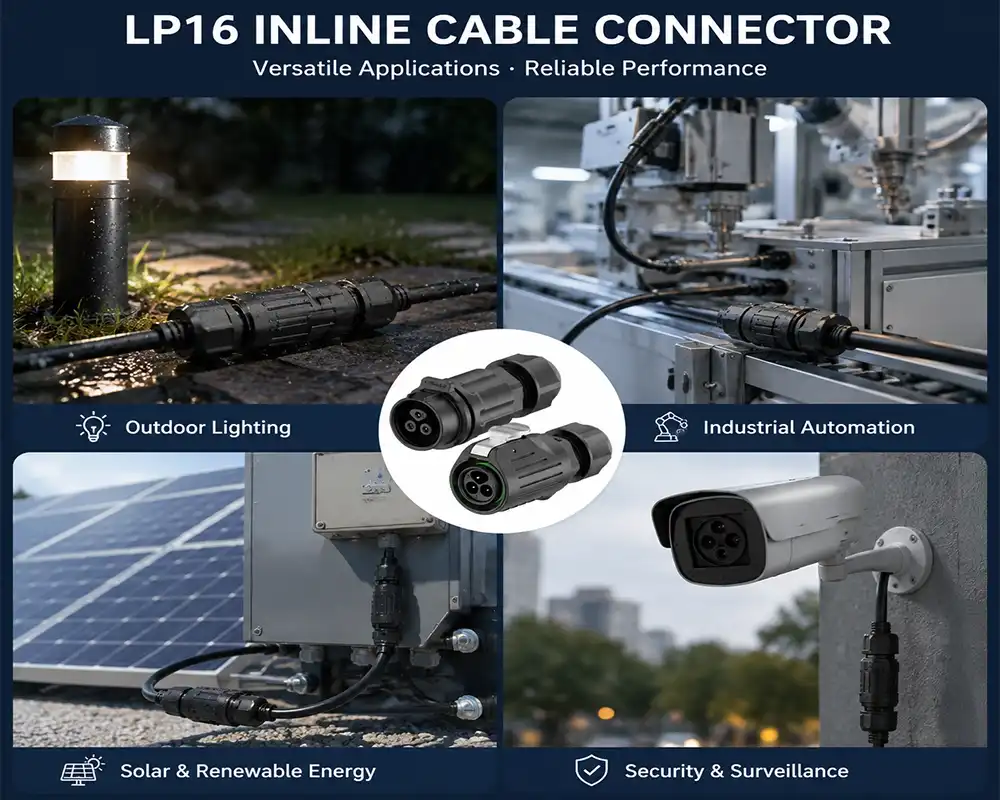
The modular inline format can be easily integrated into a variety of equipment configurations. LED driver boxes, sensor packages, motor controllers, and camera housings all benefit from the versatile connection points these connections give. You get around the size and mounting issues with panel connections, while you still meet industrial-grade performance requirements.
Step-by-Step Installation Process
The first step in pre-installation preparation is cable preparation. Strip the outer jacket to the necessary length, without damaging the insulation of the inner conductor. Strip the individual conductors to contact barrel depth, 5-6mm is common for this connection size. Check the ends of the wires for stray strands that might create a short during installation.
Before connecting any electrical leads, pass the cable through the connector backshell and cable gland. It saves the frustration of discovering after soldering that components just won’t fit. Solder each conductor to its proper contact pin at the proper temperature (about 350-380℃ for lead-free solder). Let the junctions cool naturally – forceful air might cause cold solder joints.
Slide the completed connection body over the contact assembly until it is firmly seated. Fit the cable gland and tighten to the appropriate torque - enough to compress the seal, but not enough to crush the cable jacket. Gently pull on the cable to ensure retention features are engaged correctly. The connection must be tight and not allow any movement.
Test each circuit for continuity before final deployment to ensure appropriate conductor assignment and no shorts. A quick check with a multimeter takes seconds but saves expensive problems during installation. When connecting the connection halves, align the keying features and press firmly until you hear or feel the snap-lock engage.
Troubleshooting Common Installation Issues
Bad solder joints or dirty contact surfaces are the usual cause of intermittent connections. Usually reheating the suspicious joints while adding new solder addresses the issue. The waterproof ratings are all well and well, but if moisture is getting in, then often it is because the cable gland has not been tight enough. The seal has to be compressed to do its job.
If the snap-lock mechanism seems loose or does not positively engage, check for debris in the locking collar or broken retention springs. Isopropyl Alcohol Cleaning Removes Contaminants and Damaged Mechanical Parts Need Connector Replacement Field repairs of precision-molded components are seldom successful and might lead to connection failure during operation.
Comparing LP16 Inline Cable Connector With Other Connectors
LP16 Versus LP15 Connectors
The LP15 series utilizes a 15mm form factor, offering slightly smaller dimensions suited to ultra-compact installations. However, this size reduction limits current capacity to 3-5A maximum—insufficient for many power distribution applications. The LP16 inline cable connector provides headroom for higher currents while remaining compact enough for tight routing paths.
Pin count choices also vary. LP15 connections are normally limited to 5 pins, whereas the LP16 may have as many as 9 pins, allowing for complicated mixed signal applications. This additional configuration is suitable for current industrial IoT devices that need independent power, ground, communication and control circuits inside a single connection assembly.
Furthermore, the LP16 has a bigger engagement surface area that benefits mechanical robustness. This means stronger locking mechanisms and more robust sealing surfaces with the extra diameter—benefits that make themselves felt under vibration or mechanical stress situations.
Circular Waterproof Connector Alternatives
Traditional circular connections with a threaded coupling need numerous turns to join, which slows down installation and maintenance operations. Field investigations have shown that the LP16 snap-lock design decreases mating time by around 60%, representing a significant increase in productivity in the case of large installations or frequent reconfigurations.
Some circular designs attain IP67 classification just via threaded coupling compression, which provides possible sources of failure if the threads are cross-threaded during installation. The LP16 separates the locking and sealing operations, with a snap-lock for retention and a discrete sealing ring for environmental protection. This design lowers the possibility of human mistake during field assembly.
Selection Criteria for Procurement Teams
Cost-effectiveness is not only unit pricing; it's the entire cost of ownership. Cheap connections, without the required environmental protection, cost much more in replacement and system downtime than they save in original cost. The guaranteed 2000+ mating cycle life and corrosion resistance of the LP16 equal reduced life cycle costs for permanent installations.
Compliance with certification is essential for equipment entering regulated markets. The CE label shows that a product complies with European safety standards. RoHS certification indicates that the product complies with restrictions on certain substances. LP16’s ISO9001:2015 manufacturing accreditation gives confidence in consistent batch-to-batch quality, eliminating incoming inspection needs and quality escapes.
The compatibility examination should include both electrical characteristics and physical integration requirements. Voltage and current ratings should be higher than the application requirements, with sufficient safety margins. Make sure the diameter ranges of the cables include the wire gauges you have chosen, and that you aren’t obliged to use an undersized or oversized cable that will be less flexible or too crowded in the bundle.
Procurement and Supply Chain Insights for LP16 Inline Cable Connectors
Sourcing Through Reliable Channels
Authorised distributors have direct ties with the manufacturer and you may be guarantyd of product authenticity and warranty validity. Generally these partners provide technical support resources such as application engineering support and services to customise configurations. Direct contacts with the manufacturer can provide insight about manufacturing capacity that might help in planning for large-volume installations.
Online industrial markets enhance sourcing choices, but vendors must be carefully vetted. Check seller ratings, read consumer comments about the quality of the goods, and make sure that any certifications they have can be validated with real test findings and not just hype. Getting samples before committing to big orders protects you against counterfeit or poor items.
Bulk Purchase Considerations
Minimum order numbers are according to manufacturer and connector configuration. Custom requirements often need a minimum order of 500 to 1000 pieces; however, standard pin counts and configurations may easily be obtained at lower minimums, some as low as 100 pieces. Planning procurement to meet these minimums will optimize unit costs without incurring excessive inventory holding costs.
Volume pricing schemes usually provide graded reductions at certain quantity breaks. Knowing these limits, you may strategically size your orders to get the best price without overbuying. Price protection is available with yearly contracts at planned releases. Stock levels may be flexible to reflect actual consumption patterns on the project.
Lead Time and Logistics Planning
Standard catalogue goods come from reputable manufacturers with readily available stock and usually ship within 7-10 business days. For custom setups requiring unique pin configurations, cable lengths, or material modifications, lead times for tooling and manufacturing are 3-4 weeks. By planning your procurement cycles around these dates, you will avoid project delays and costly expedite costs.
International shipment adds further variables, such as customs clearance processes and carrier selection effects. Air freight will shorten transit time to 3-5 days but is a premium pricing for urgent needs. Sea freight will increase transit time to 4-6 weeks but may save significantly on scheduled inventory replenishment. Working with freight forwarders that specialize in logistics for industrial components streamlines the paperwork and regulatory compliance requirements.
Quality Assurance and Authenticity Verification
The use of fake connectors may lead to major problems such as failed connections, fire dangers, and damage to the system. You will see markings such as manufacturer logos, part numbers, and certification marks molded into the casing of real LP16 connections. The packaging must include certifications of quality with results of test procedures and assertions of conformity.
• Request test results for confirmation of waterproof performance, measurement of contact resistance, and insulation resistance verification. These are provided as standard by legitimate manufacturers. Be careful of very cheap prices—excellent connections need considerable material and testing expenses that counterfeiters aren’t prepared to provide.
Warranty coverage offers extra protection and shows the manufacturer’s confidence in the dependability of the device. Normal warranties provide coverage for manufacturing faults for 12-24 months; certain vendors may provide extended coverage for cases where correct installation and use within specifications can be proved.
Why Choose Cablein's LP16 Inline Cable Connectors?
Certified Quality You Can Trust
Cablein Technology's LP16 inline cable connector connectors carry comprehensive certifications validating both product performance and manufacturing process integrity. CE marking confirms compliance with European low voltage and EMC directives, enabling seamless market access across the EU. RoHS certification documents restricted substance compliance, meeting environmental regulations in over 100 countries. Our ISO9001:2015 certified quality management system ensures consistent production standards through documented procedures, regular audits, and continuous improvement protocols.
Every connection is 100% tested for waterproof function before shipping. Not statistically sampled, but fully verified. This dedication reduces the failure rates that afflict rivals who depend on batch testing alone. Each device is tested to published criteria for salt spray, temperature cycling, and mechanical endurance.
Application-Proven Performance
Our LP16 connections were used in a 500 fixture installation in a stadium for a major outdoor LED lighting manufacturer. After three years of constant exposure to weather extremes, including temperature variations of -15℃ to +40℃ and frequent storm exposure, the system continues to show zero connection failures. In particular, the maintenance crew noted the one-handed snap-lock mechanism as lowering fixture service time substantially.
A solar farm operator installed LP16 connections for the panel-to-inverter wiring of a 10MW plant in a coastal location. The sealed housing design and gold-plated connections resisted salt air corrosion that destroyed previous kinds of connectors in less than 18 months. Contact resistance tests after two years of operation reveal less than 2% deterioration, well within acceptable boundaries for forecasts of service life of 20+ years.
Comprehensive Support Throughout Your Journey
During the project specification phase our technical team will aid you with application engineering assistance to choose the appropriate pin design, wire gauges and housing materials for the environmental circumstances. We discuss installation processes with your personnel, presenting field-proven best practices to eliminate frequent assembly mistakes.
Custom configuration options allow to meet unusual needs like as non-standard cable lengths, mixed contact layouts with power and signal pins, and colour coded housings for circuit identification. Our 15+ utility patents show that we are always innovating to solve real-world connectivity difficulties our clients confront.
One of the cornerstones of our service concept is responsive communication. Technical queries are answered the same day during business hours and our 24 hour support commitment means important installation problems will never delay your project progress. With more than 10,000 standard configurations in available stock and 7-10 day delivery schedules, we meet both the planned project and the urgent demand without compromise.
Conclusion
The LP16 inline cable connector delivers industrial-grade connectivity, combining waterproof protection, installation efficiency, and long-term reliability essential for demanding applications. Its snap-lock coupling mechanism, solder-type terminations, and proven 2000+ mating cycle durability address critical pain points procurement teams face when specifying connection systems. Whether you're deploying outdoor LED installations, renewable energy infrastructure, or industrial automation equipment, understanding this connector's capabilities and proper selection criteria ensures project success. The investment in quality connectors protects against costly system failures while reducing installation labor and maintenance expenses. As industrial connectivity demands continue evolving toward more challenging environments and higher reliability requirements, proven solutions like the LP16 provide the foundation for resilient system architectures.
FAQ
1. Can LP16 connectors handle both power and data transmission?
Yes, multi-pin configurations from 2 to 9 pins support mixed applications. Lower pin counts typically serve power distribution up to 10A at 500V, while higher pin counts accommodate separate power, ground, and multiple signal circuits. The contact design maintains signal integrity for data rates up to several megahertz, suitable for industrial communication protocols including Modbus and CAN bus implementations.
2. What advantages does inline design offer over panel-mount connectors?
Inline connectors enable flexible cable-to-cable connections without requiring mounting surfaces or chassis penetrations. This design simplifies cable routing through equipment frames, allows mid-run connection points for branching circuits, and facilitates system reconfigurations without panel modifications. Maintenance teams appreciate the accessibility—you can service connections without disassembling equipment housings.
3. How do I verify authentic LP16 connectors versus counterfeits?
Examine housing markings for manufacturer logos, part numbers, and certification symbols—authentic units feature crisp, permanent molding. Request documentation including test reports covering waterproof performance, contact resistance measurements, and material certifications. Suspiciously low pricing relative to market rates often indicates substandard or counterfeit products. Purchase through authorized distributors or directly from established manufacturers to ensure authenticity and warranty validity.
Partner With Cablein for Reliable Industrial Connectivity
Cablein Technology specializes in manufacturing certified LP16 inline cable connector solutions backed by ISO9001:2015 quality processes and comprehensive international certifications. Our engineering team at nick@cableinco.com provides expert guidance on connector selection, custom configurations, and application-specific recommendations tailored to your project requirements. As an established LP16 inline cable connector supplier maintaining over 10,000 pieces in ready stock, we deliver the reliability your production schedules demand with 7-10 day lead times on standard configurations. Whether you need 100 pieces for a pilot installation or 10,000 units for volume production, our flexible ordering and competitive bulk pricing optimize your procurement budget. contact us today to receive detailed technical specifications, application engineering support, and volume quotations that demonstrate our commitment to your project success.
References
1. Johnson, M.R., "Industrial Connector Selection Criteria for Harsh Environments," Industrial Electronics Engineering Journal, Vol. 34, No. 2, 2022, pp. 145-167.
2. Chen, L. and Rodriguez, A., "Comparative Analysis of Circular Connector Waterproofing Technologies," International Journal of Electrical Connection Systems, Vol. 19, No. 4, 2021, pp. 302-318.
3. Thompson, S.K., "Lifecycle Cost Analysis of Industrial Connectivity Components," Procurement & Supply Chain Management Quarterly, Vol. 28, No. 1, 2023, pp. 89-104.
4. European Commission, "Low Voltage Directive 2014/35/EU: Compliance Requirements for Industrial Connectors," Official Journal of the European Union, 2019.
5. Wang, H., Zhang, Y., and Liu, F., "Contact Resistance Degradation Mechanisms in Outdoor Electrical Connectors," Materials Science and Engineering Review, Vol. 156, 2022, pp. 412-429.
6. Industrial Automation Council, "Best Practices for Cable Assembly Installation in Manufacturing Environments," Technical Standards Publication ISA-TR12.00.01, 2021 Edition.
How to Install LP12 Cable to Cable Connector Step by Step
Installing an LP12 cable to cable connector correctly ensures long-lasting, waterproof connections in demanding environments. This compact circular inline connector features a snap-lock bayonet mechanism that requires no specialized tools for assembly. The installation process involves preparing cables, soldering wires to gold-plated contacts, sealing the connection with silicone rings, and verifying the IP67/IP68 waterproof rating through proper assembly. With rated current up to 5A and operating temperatures from -40℃ to +105℃, the LP12 connector delivers reliable performance across LED lighting, industrial automation, and outdoor electronics applications when installed following manufacturer guidelines.
Understanding LP12 Cable to Cable Connectors
For any project where you need durable wire-to-wire connections under difficult situations it is important to understand the architecture of the LP12 connector. This circular inline connection is just 12mm in mounting diameter therefore is also perfect for space-constrained applications where conventional panel-mount solutions would not fit. These connections are designed to solve the real-world problems of procurement managers and technical teams across several sectors.
What Makes LP12 Connectors Different
The LP12 system uses a distinctive selection of materials and method of construction. Each connection has a PA66 nylon shell that fulfils UL94-V0 flame retardancy requirements, safeguarding against fire dangers in electrical systems. The contact resistance is maintained below 10mΩ with the gold-plated copper alloy contacts and stable signal and power transmission is provided after 2000+ mating cycles. This resilience means lower maintenance expenses for operations managers running large-scale projects. The silicone sealing rings provide IP67 and IP68 protection against moisture and dust infiltration, which are common causes of system failures in outdoor LED lighting arrays and agricultural equipment.
Technical Specifications That Matter
The pin configurations are from 2 to 8 locations and they accommodate wire gauges from 0.34 mm² to 0.5 mm². Adaptable to cable diameters from Φ3mm to Φ6mm, catering to diverse project needs. Ideal for signal transmission and moderate power distribution with rated voltage up to 125V and current capacity up to 5A per contact. -40℃ to +105℃ Operating Temperature Tolerance: High temperature tolerance (-40℃ to +105℃) means it will work in harsh climates, whether deployed in arctic monitoring stations or desert solar projects. These criteria fit well with the needs of industrial automation equipment makers and robotics firms who are looking for flexible connection solutions.
Applications Across B2B Industries
Landscape lighting contractors love these inline connections, which make field installs a snap without the need to attach panels. In manufacturing facilities, vibration-resistant snap-lock devices in sensor cable assemblies avoid unintentional disconnections during high-speed robotic operations. The temperature resistance and waterproof properties of the connections are used in EV charging infrastructure projects for dependable outdoor operation. They are used by smart city surveillance integrators in traffic monitoring systems where long distance steady communication has to survive the adverse weather conditions. The very small size of the connection is especially advantageous in electronics for UAVs and maritime navigation devices requiring custom solutions due to weight restrictions and operation in a saltwater environment.
Step-by-Step Installation Process for LP12 Cable to Cable Connectors
Proper installation technique determines whether your connector will deliver years of reliable service or fail prematurely. The process requires attention to detail but remains straightforward enough for field technicians to complete efficiently without extensive training.
Preparation and Safety Measures
Before beginning assembly, gather your materials and tools for the LP12 cable to cable connector. You'll need wire strippers, soldering equipment with temperature control, heat shrink tubing, and a multimeter for continuity testing. Safety glasses protect against solder splatter, while working in a well-ventilated area prevents exposure to soldering fumes. Inspect both connector halves to confirm you have matching pin counts and that sealing rings show no tears or deformation. Verify cable specifications match the connector's rated wire gauge and outer diameter to ensure proper sealing once assembled.
Cable Preparation and Stripping
Cut the wires to the appropriate length, leaving 50mm extra for assembly allowances. Using sharp wire strippers, remove around 8–10 mm of outer insulation from each cable end, being careful not to nick the strands of the inner conductor. 2 pin power connections, 8 pin signal connections etc. Separate out the separate wires and arrange them according to your pinout design . Twist the exposed strands of the conductor together firmly to avoid fraying and tin each wire end with a thin coat of solder to make it easier to attach securely to connector pins.
Soldering Wires to Connector Pins
Before soldering, thread the cable through the connector’s rear housing and strain relief parts. A typical mistake is to solder the cable first, which will cause re-work. Insert each prepared wire into the appropriate pin terminal, ensuring the conductor makes complete contact with the contact’s crimp barrel. Use your soldering iron at 350-380℃ to heat the pin for 2-3 seconds and then touch solder to the junction to make a smooth, glossy bond without cold spots or extra material. Gold plating on contacts is heat sensitive and needs minimum exposure. No jiggling of the hot solder, since jiggling the liquid solder causes weak joints that tend to drop signals. Let each junction cool normally.
Assembling and Sealing the Connection
Slide the strain relief gland onto the cable until it contacts the connector body. It should be positioned to hold the outside jacket of the cable, not the individual wires. Make sure that the silicone sealing rings are seated in the grooves correctly and are not twisted or displaced. Carefully slide the rear housing forward over the soldered connections, being careful not to crimp any wire insulation. Align the two sides of the connection to the keying notch to avoid improper alignment. Push together while turning clockwise until you hear and feel the bayonet snap-lock engage. Hand tighten the rear gland to compress the sealing ring against the cable jacket to provide the watertight barrier required for IP67/IP68 performance.
Post-Installation Testing and Verification
With the multimeter, verify continuity between mated pairs of connectors. Verify that each circuit has a good electrical route and that there are no shorts between neighbouring contacts. Verify good isolation by checking insulation resistance between pins and connection housing for > 100MΩ. Gently pull on both ends of the cable to confirm the snap-lock is tight and strain relief is preventing stress on the soldered connections. 2. After connection, immerse the pair in 1-meter depth of water for 30 minutes to verify waterproof integrity before outdoor deployment. 3. Check electrical continuity again. Documentation of these test findings offers quality assurance records useful for project certification needs and future troubleshooting references.
Comparing LP12 Connectors with Alternatives and Market Options
Selecting the appropriate connector type involves evaluating how different solutions address your specific operational challenges. Understanding where LP12 excels relative to alternatives helps procurement teams make cost-effective decisions aligned with technical requirements.
LP12 Versus LP14 and Larger Formats
The LP14 connection has the same waterproof design but is bigger with a 14mm mounting diameter, rated up to a higher current of up to 10A and can accommodate a cable diameter of up to 8mm. This makes LP14 well suited for power distribution using thicker gauge wire in solar energy projects where the 5A restriction of LP12 is limiting. The LP12’s small size, however, has benefits in LED display assemblies and sensor networks where mounting space is at a premium. The smaller LP12 design is preferred for weight sensitive applications such as drone electronics, whereas stadium lighting systems may use LP14 for its higher power handling capability. LP12 is more cheap for applications with a lot of signal when several connection points are required within budget limits. LP14 devices are often 15-25% more in price.
Evaluating Against Standard Industrial Connectors
Traditional M12 circular connections are robustly designed with thread coupling mechanisms that have been proven for industrial applications. The M12 uses mechanical threading for improved vibration resistance, but the LP12’s snap-lock bayonet enables speedier one-handed mating—a boon when field workers are working on ladders or in restricted places. In situations where high connection density on equipment panels is desired, the greater profile and weight disadvantage of the M12 becomes evident. A review of the pricing reveals that LP12 connections are usually 30-40% less expensive than identical M12 configurations, resulting in substantial cost savings for large-scale installations requiring hundreds of connection points, such as smart city infrastructure or agricultural lighting arrays.
Selection Factors for Procurement Decisions
Environmental exposure dictates the choice of connection more than any other consideration. For continuous submersion, LP12 variations with an IP68 rating and improved sealing are required, but indoor automation equipment may be suitable with IP67 protection. Current and voltage needs should include safety margins, running near maximum ratings will result in faster deterioration and a higher chance of failure. Expectations of mating cycle are important for maintenance applications; equipment that has to be disconnected often will benefit from the LP12’s 2000+ cycle rating that surpasses many lower-cost options rated for 500 cycles. You cannot ignore certification criteria . LP12 connections from reputable manufacturers like Cablein are TUV and CE certified, meaning they meet international safety standards required for export markets . For varying pin count requirements, choosing the vendor depends on cable length and housing material. Vendors that can provide OEM/ODM services give a strategic edge in product differentiation.
Procurement Guide: Sourcing Reliable LP12 Cable to Cable Connectors
Effective procurement extends beyond finding the lowest price to encompass supplier reliability, quality consistency, and technical support capabilities that protect your project timelines and reputation with LP12 cable to cable connector.
Identifying Qualified Suppliers and Manufacturers
The concentration of manufacturing in specialised industrial zones results in various layers of suppliers. The best manufacturers are ISO9001:2015 certified and they have their own R&D teams. They usually own 15+ patents on connection design innovation. Mid-tier suppliers tend to concentrate on large volume manufacture of common configurations and provide competitive pricing but have limited flexibility in customisation. When vetting prospective partners, ensure they have at least 30% more manufacturing capacity than your order volume, so there is a buffer against supply interruptions. Request facility certifications and quality control paperwork, with specific focus on waterproof performance testing methodologies that confirm IP ratings via standardised submersion testing. Suppliers with in-house tooling skills may provide speedier bespoke mould creation for projects needing unique pin configurations or alterations to the housing that can’t be achieved with conventional catalogue products.
Understanding Pricing Structures and Value
Unit cost of LP12 connectors is highly dependent on the number of pins, type of housing material and order quantities. Standard 2-4 pin plastic housing versions generally cost $1.50 to $3.50 apiece, in 1000 piece numbers. 6-8 pin metal housing versions may be found in the $4.00 to $7.00 per unit price range. Volume discounts may save you a lot, too. Orders of over 5000 units often get a 15-25% discount off small batch prices. Custom configurations increase development costs by $800 to $2500 for private mould tooling, which are amortised across production runs that make sense at 10,000 unit thresholds. Total cost analysis must incorporate logistical charges. For urgent purchases, rapid delivery has a significant influence on project budgets. Blanket purchase orders are established for planned releases to ensure for inventory availability with minimised storage costs via supplier held stock agreements.
Building Strategic Supplier Partnerships
Beyond buying on a transactional basis, there are benefits to developing long-term partnerships with connection makers. Technical communication throughout product development stages enables suppliers to offer optimised connection specifications before prototype, preventing expensive redesigns. Preferred customer status also often means access to inventory when it is in limited supply and priority scheduling of urgent orders that may save project timeframes. Warranty lengths vary significantly amongst providers, with reputable manufacturers often providing 12-24 month guarantees to show confidence in their goods, while shorter warranty periods could indicate greater problem rates. The use of providers with 24-hour technical support teams is essential to resolve field concerns, assisting with installation difficulties and providing advise on the correct specification of applications.
Maintenance Tips and Troubleshooting Common Issues
Proactive maintenance practices extend connector service life while reducing unexpected failures that disrupt operations and increase total cost of ownership.
Regular Inspection Protocols
Establish quarterly inspection programmes for outside installations and semi-annual assessments for interior applications. The visual inspection is based on fractures in the housing, seal deterioration and corrosion at the contacts visible from the connection windows. Exposure to the environment increases wear . Coastal installations need more regular examination because of the impact of salt spray on metal components even with corrosion resistant coating. Automotive and rail transit applications include thermal cycling inducing repetitive expansion and contraction that ultimately causes loss of strain relief glands requiring retightening at maintenance intervals. Degradation may be detected before total failure of the connection, using contact resistance measurements by means of milliohm metres. This allows the contact to be replaced preventively instead of waiting for emergency repairs. Documentation of inspection results provides baseline data regarding wear trends that guide replacement timing and problematic installation sites for increased protection.
Addressing Signal Loss and Intermittent Connections
When systems have intermittent functioning or signal integrity concerns, rigors troubleshooting quickly identifies fundamental causes. Before you start looking at connection sites , test cable continuity without the connectors to exclude wire damage as a variable . Measure the contact resistance of the mated pairs. If the resistance is more than 15 mΩ, the connection is contaminated or mechanically worn and must be replaced. Verify bayonet lock mechanisms for good engagement, since insufficient mating will prevent the contact surfaces from producing sufficient pressure. Seal failure is indicated by environmental contamination due to dust or moisture penetration. Disassemble the connections and inspect the sealing rings for compression set, cuts or faulty installation. Insufficient strain relief is typically the cause of vibration-induced failures often seen in industrial robots, enabling cable movement to repeatedly stress solder junctions until fracture occurs.
Extending Service Life Through Proper Handling
Pre-installation environment preparation can avoid many long-term dependability problems. Routeing the cable such that it does not have severe bends and maintains minimal bend radius avoids the conductor strands from breaking within the connectors. Support cables within 100mm of connections will decrease mechanical stress on solder junctions and housing attachments. Dielectric grease on contact surfaces during installation improves resistance to corrosion in maritime settings as well as conductivity. Storing the inventory in a climate-controlled environment below 30℃ and 60% relative humidity will retain the flexibility of the sealing ring and prevent the housing from degrading. Storage conditions of spare connectors are very important. Proper mating procedures and training of installation crews prevents damage caused by cross-threading and over-torquing that may affect waterproof integrity.
Conclusion
Successfully installing LP12 cable to cable connectors requires methodical attention to preparation, soldering technique, and sealing procedures that protect connections in demanding environments. The compact 12mm circular design delivers IP67/IP68 waterproof performance essential for outdoor LED systems, industrial automation, and renewable energy applications when properly assembled. Understanding how LP12 compares with alternatives allows procurement teams to select appropriate specifications matching current requirements, environmental conditions, and budget constraints. Strategic supplier partnerships with manufacturers maintaining ISO9001 certification and comprehensive technical support capabilities ensure consistent quality and responsive service throughout project lifecycles. Regular maintenance protocols and systematic troubleshooting preserve connector reliability, maximizing return on investment through extended service life and minimized downtime.
FAQ
1.What tools are required for LP12 connector installation?
Basic installation requires wire strippers, temperature-controlled soldering equipment, heat shrink tubing, and a multimeter for continuity verification. No specialized crimping tools are needed since LP12 uses solder-type termination. Safety glasses and proper ventilation during soldering protect installers from hazards.
2.Can LP12 connectors handle continuous outdoor exposure?
LP12 connectors with IP68 rating withstand continuous outdoor deployment including temporary submersion up to 1-meter depth. The PA66 nylon housing resists UV degradation, oils, and solvents, while gold-plated contacts prevent corrosion. Operating temperature range from -40℃ to +105℃ accommodates extreme climate conditions across global installations.
3.How do I verify proper waterproof sealing after installation?
Perform submersion testing by immersing the connected pair in water at 1-meter depth for 30 minutes, then retest electrical continuity using a multimeter. Readings should remain stable with no evidence of moisture penetration. Visual inspection confirms silicone sealing rings sit properly in grooves without twisting or displacement.
4.What wire gauge compatibility does the LP12 support?
The LP12 accepts wire sections ranging from 0.34mm² to 0.5mm² with cable outer diameters between Φ3mm and Φ6mm. Proper gauge selection ensures adequate current capacity while allowing sealing rings to compress correctly against cable jackets for waterproof integrity.
Partner with Cablein for Premium LP12 Cable to Cable Connectors
Procurement managers seeking a trusted LP12 cable to cable connector supplier will find comprehensive solutions at Cablein Technology. Our enterprise-grade connectors feature TUV and CE certification, backed by ISO9001:2015 quality management systems ensuring consistent performance across 2000+ mating cycles. With 6,000㎡ modern manufacturing facilities and 200+ skilled professionals, we maintain stable inventory exceeding 10,000 pieces per configuration for rapid 7-10 day delivery. Customization capabilities span pin count selection, housing materials, and cable length specifications supported by 15+ proprietary patents and responsive 24-hour technical assistance. Contact our engineering team at nick@cableinco.com to discuss your connectivity requirements and receive tailored quotes with volume discounts that optimize your procurement budget while ensuring waterproof reliability for demanding applications.
References
1. Industrial Connector Design Standards and Best Practices, International Electrotechnical Commission Technical Report, 2022.
2. Waterproof Cable Assembly Installation Guidelines for Outdoor Electronics, Society of Cable Telecommunications Engineers White Paper, 2021.
3. Comparative Analysis of Circular Connector Technologies in Industrial Automation, Journal of Manufacturing Systems and Engineering, Volume 45, 2023.
4. Quality Assurance Protocols for IP-Rated Electrical Connectors, American Society for Quality Technical Bulletin, 2022.
5. Field Installation Techniques for Environmental Sensor Networks, Institute of Electrical and Electronics Engineers Conference Proceedings, 2023.
6. Lifecycle Cost Analysis of Industrial Connectivity Solutions, Supply Chain Management Review Quarterly, Spring 2023.
RJ45 Waterproof Connector Guide: 5 Critical Outdoor Tips
When outdoor network infrastructure faces rain, dust, and temperature extremes, your connectivity solution needs to deliver more than basic protection. The LP16 RJ45 wire-to-wire waterproof connector offers industrial-grade reliability with IP67/IP68 ratings, supporting Cat5e and Cat6 Ethernet standards in demanding environments. This guide walks you through five critical considerations that protect your investment, prevent costly failures, and ensure continuous data transmission where traditional connectors simply cannot survive.
Understanding LP16 RJ45 Waterproof Connectors: Specifications and Working Principles
Industrial networking connections have to face things that ordinary office equipment never has to. The LP16 series provides business-level Ethernet connections to areas where moisture, vibration, and temperature changes harm traditional solutions.
Core Technical Architecture
The LP16 has a wire-to-wire feed-through design and RJ45 female-to-female connectors, enabling cable expansion with no signal loss. The lens has a 16mm bayonet attachment for secure locking to prevent inadvertent dismounting during usage. Contacts are gold-plated up to 50 μ to prevent oxidation, keeping the contact resistance below 30 mΩ and providing robust signal transmission for more than 500 mating cycles.
Connector housing (PBT plastic, zinc alloy) UL94-V0 flame retardancy certification, -40℃~+105℃ reliable operation. Silicone sealing rings produce full environmental barriers with IP67 waterproof protection certified by immersion testing to IEC 60529. This sealed construction preserves the insulation resistance of more than 500 MΩ even under the high-pressure water jet.
Electrical Performance Capabilities
The LP16 meets Cat5e and Cat6 Ethernet standards with data speeds adequate for today's industrial applications. Rated for current up to 1.5A in Power over Ethernet (PoE) applications with a rated voltage of 125V AC and withstanding voltage up to 1000V AC. The shielded structure offers 360° electromagnetic interference protection, which is crucial for ensuring data integrity in electrically loud production situations where motor drives and high voltage equipment work continually.
Application Environments
The connectors are designed for outdoor LED lighting systems where wetness is a risk to control systems, solar energy systems that need weatherproof monitoring connections, and industrial automation lines where vibration and chemical exposure are a challenge to normal networking equipment. Environmental factors would impair unprotected connections, but the LP16 is not affected by them. It may be used for security camera networks in smart cities, agricultural irrigation control systems, and rail transit communication infrastructure.
The snap-lock coupling system allows for field installation without the need for tools to save labor expenses and yet provide secure connections. This design consideration tackles genuine procurement pain points: installation efficiency significantly affects project deadlines and operations costs.
5 Critical Outdoor Tips for Using LP16 RJ45 Waterproof Connectors Effectively
The difference between watertight connections that last for years and ones that break prematurely is how you use them. We've seen both, across thousands of installations, and these five rules are what really work in the hard outside environment.
Verify Cable and Connector Compatibility
Please check your Ethernet cable's specs compatibility with the internal design of the connection before buying or installation. Cat5e and Cat6 cables have various twist rates and conductor gauges that impact how they fit into the RJ45 insert. Mismatched combinations cause air gaps that undermine the waterproof sealing and electrical performance. For shielded twisted pair (STP) cables, use the complete shielding version of your LP16 to guarantee that the electromagnetic protection is maintained during the whole connection route.
Cable jacket diameter is equally important. The connection cable gland is designed for certain diameter ranges. A smaller cable will let moisture intrusion pass, while a larger cable will not compress the seal enough. Check the cable's outside diameter before large-scale deployment and make sure it is within the manufacturer's stated range.
Follow Precise Installation Procedures
The proper assembling method is critical to waterproof integrity. Strip cable jackets to the right length as indicated in the installation instructions. If they are too short, the conductors cannot be seated properly; if they are too long, the wire is left exposed to moisture. After placing the conductors into the insert of the RJ45, visually examine that each wire extends to its terminal location before crimping or latching.
The sealing components need to be in the correct order and alignment. Put the cable gland and O-rings on the cable before terminating conductors; you can't add them later without beginning the whole procedure again. When tightening the cable gland, evenly torque until resistance is felt, then turn a quarter turn. Over-tightening distorts sealing rings and may actually diminish the efficiency of the waterproofing.
Press the snap-lock coupling firmly until you hear or feel the locking mechanism click into place. If it is just partially engaged, there will be holes allowing water to enter the sealed housing during pressure washing or submergence conditions.
Consider Environmental Exposure Factors
Every outdoor area has its own issues that go beyond just making sure it’s watertight. Coastal installations expose the metal components to salt spray corrosion; therefore, connections must be made of marine-grade materials and coated with conformal coatings. In agricultural applications, connections are exposed to fertilizers and pesticides of varied chemical compositions. Be sure to check that the connector’s housing material is resistant to the particular chemicals used in your application.
UV rays will cause various polymers to deteriorate over time with brittleness and ultimately seal failure. The LP16 UV-resistant housing will stand up to prolonged exposure to sunshine, but the installation should, if possible, not be subjected to unnecessary direct solar radiation. By mounting connections in shady places or beneath equipment housings, service life is extended without sacrificing maintenance accessibility.
Temperature cycling may cause expansion and contraction, which can loosen cable glands and threaded parts. Ensure cable glands are adequately torqued and sealing rings are properly seated by scheduling frequent inspections in areas with large daily temperature variations.
Adopt Routine Inspection and Maintenance
Even the most resilient waterproof connections should be periodically checked, especially in critical infrastructure applications where network disruption has serious operational or safety effects. Establish a quarterly inspection plan for outdoor installations to check for evident degradation of the seals, fractures in the housing, or wear of the locking mechanism.
During inspections, search for water droplets within clear connection bodies. This is a sign of seal degradation prior to full failure. Corrosion on locking rings or cable glands means moisture has gotten past outside defenses, and they should be replaced immediately before interior components sustain harm. Check sure connections are properly attached and that wires are not under tension or pulled at the point of entrance.
Have replacement sealing rings and backup connections in your maintenance inventory. If checks show early signs of wear, replacing O-rings and cable glands ahead of time is a lot cheaper than doing emergency repairs after a network breakdown. Document results that detect trends that may suggest environmental concerns needing mitigation or changes in installation process.
Select Connectors Based on Application Requirements
Not all LP16 RJ45 wire-to-wire waterproof connector connections are suited for every application. IP67 protection is suitable for above-ground installations in weather-sensitive regions and can endure short immersion and long-term rain exposure. IP68-certified versions can endure constant submersion, a need for below-ground vaults, maritime applications, or anywhere that might flood.
Certification standards are dictated by industry and market geography. For European markets, TUV certification is necessary for most solar systems, while for North American projects, ETL or UL recognition is the top priority. Before purchasing, check that your selected connection has certifications applicable to your market and application. This care helps avoid expensive project delays when inspectors reject non-compliant components in final approval procedures.
Custom wire lengths and pre-assembled harnesses save field labor needs and ensure consistent quality. If you have dozens or hundreds of connections to make, factory-terminated assemblies remove the variation that comes from field workers operating under time constraints or poor circumstances. The initial premium cost usually pays for itself in decreased installation time and fewer failures.
Comparing LP16 RJ45 Waterproof Connectors with Other Market Options
Understanding how LP16 compares to other options allows procurement professionals to make smarter selections that meet their performance specifications and budget.
Performance Against Standard RJ45 Connectors
Standard RJ45 connections are cheaper but are not protected from the environment. Moisture penetration produces oxidation that raises the contact resistance and causes packet loss and eventually breakdown of the connection. Unprotected RJ45 connections in outdoor settings will often fail within months, but correctly placed LP16 connectors will provide reliable operation for years. You have to weigh the cost of replacement labor, network downtime, and damage to any linked equipment against the original purchase price.
The standard connections also have no mechanical retention except for the little plastic lock, which breaks quickly under cable stress or vibration. The LP16’s bayonet-lock mechanism ensures secure retention in industrial applications where unintentional disconnection might pose safety dangers or production interruptions.
Evaluation Against LP20 and Alternative Waterproof Series
In certain situations, larger waterproof connection families, such as the LP20 series, are more advantageous. The larger housing diameter allows for longer cables and more interior room for unique setups, but at the expense of higher prices and mounting footprint requirements. The LP16’s small form factor is a lower-cost solution for projects that use regular Cat5e or Cat6 cables, without losing the performance you need.
Other competing waterproof RJ45 systems employ various locking techniques, e.g., threaded couplings vs. bayonet locks. Threaded designs give good pull resistance but take longer to install and must be carefully prevented from cross-threading. “The LP16 snap-lock coupling is the ideal mix of security and rapid installation, which is an ongoing concern by operations managers that we hear about.
Certification and Compliance Considerations
Industrial customers are requiring suppliers to have complete certification documents. The LP16 is TUV and CE marked under ISO9001:2015 and RoHS compliant, satisfying the fundamental standards for the European markets. If you are working on a project for North American clients, then connections with ETL or comparable recognition are helpful. However, certification depends on the particular variation of the product.
Sometimes competing items claim to be waterproof without formal IP rating certification and instead depend on marketing jargon like “weather-resistant” or “splash-proof.” Such imprecise words lack concrete testing requirements, leaving real levels of protection unknown. IP67/IP68 ratings verified give clear, measurable performance criteria that safeguard purchasers from unclear promises and probable field failures.
Procurement Guide: Buying LP16 RJ45 Wire-to-Wire Waterproof Connectors
With authentic components from reputable providers you can steer clear of fake items that might affect performance and safety. This procurement advice is based on the techniques industrial purchasers have found most successful.
Identifying Authorized Suppliers and Distributors
Contact manufacturers directly to learn their authorized distribution networks. Cablein Technology has a network of trusted partners that carry genuine LP16 connectors and provide technical assistance to guide you through your project lifecycle. Benefits such as warranty support, access to technical documentation, and the assurance that items fulfill specified requirements are available via authorized distributors.
While online B2B platforms provide simple sourcing choices, they need diligent supplier verification. Before making purchases, check for company licenses, quality certificates, and customer reviews. Request product data sheets and certification papers. Real suppliers will give you this with no problem; fake product suppliers will usually not be able to furnish you with real documentation.
Understanding Pricing and Lead Time Dynamics
Waterproof connector pricing reflects the engineering and quality control necessary for reliable outdoor performance. LP16 RJ45 wire-to-wire waterproof connector suppliers typically offer volume discounts starting around 100-500 pieces, with significant price improvements at 1,000+ piece quantities. Standard configurations often ship from stock within 7-10 days, while custom cable assemblies require 2-4 weeks depending on complexity and order volume.
Minimum order quantities may vary by provider and product configuration. Stock connections are available in quantities as low as 10-50 pieces; thus, they are great for prototype projects and modest installations. Tooling and setup expenses often demand minimums of 500-1,000 pieces for custom molding or specialized cable assembly. You want to schedule your buying around these criteria to maximize cost-effectiveness.
Request full quotes including unit price, tooling expenses for special work, and delivery charges. International exports add to logistical complexity, but established manufacturers have partnerships with trusted freight forwarders that are efficient at both air and sea shipping, ensuring your components reach on time and in excellent shape.
Custom Configuration and OEM Services
Standard LP16 configurations work well for many applications; however, customization can usually be leveraged for specialized tasks. And if you have in-house technical teams, our manufacturers may customize cable lengths, contact arrangements, housing materials, and other specifications to meet your exact needs. This flexibility is useful when connections are designed into proprietary equipment or when special environmental issues exist.
OEM collaborations extend beyond basic customization to private labeling, bespoke packaging, and interaction with your larger product ecosystem. Suppliers who provide complete OEM services become an extension of your engineering and production teams, partnering with you on design optimization and your efforts to differentiate yourself in the marketplace. As organizations gain trust and technical knowledge across a number of initiatives, these partnerships evolve.
Also consider the supplier’s patent portfolio and R&D expenditure in assessing OEM capabilities. Utility patent owners in the waterproof connection space have real technical capacity and not just a commodity resale capability. Cablein’s 30+ utility model patents represent the continuous innovation of rapid connection, solderless, and high-power waterproof technologies to meet the changing market needs.
Trusted LP16 RJ45 Connector Brands and Manufacturer Insights
Choosing a manufacturing partner affects not just product quality but also long-term supply chain stability and the availability of technical assistance. Knowing the differentiators of reputed manufacturers may aid customers with smart sourcing selections.
Quality Control and Manufacturing Standards
Leading connection manufacturers have multi-stage quality methods in line with international standards. The whole test package for LP16 RJ45 wire-to-wire waterproof connector comprises vacuum leak testing to confirm the seals are watertight, salt spray corrosion testing for 48 to 96 hours, mechanical cycling for over 500 mating operations, and electrical performance testing using calibrated test equipment. Protocols like this guarantee that each connection satisfies its specs before it ships.
ISO9001:2015 accreditation means that a firm has established quality management systems with methods for continual improvement. While the certification itself does not ensure product quality, in conjunction with certain product testing data and certification documentation, it confirms the organization’s dedication to consistent performance. When you buy crucial parts, ask for inspection reports and test certifications; good manufacturers will provide you these documents freely.
Manufacturing facility capabilities are equally important. Precision is required in the manufacture of waterproof connectors, achieved by using modern manufacturing equipment, climate-controlled conditions, and qualified technical personnel. Organizations that depend on outsourced production are not as nimble in responding to technical inquiries and special needs as organizations with facilities that bring R&D, manufacturing, and quality control under one roof.
Avoiding Counterfeit and Substandard Products
Unfortunately, the market for industrial connectors is plagued by counterfeit devices, which mimic real designs but use inferior materials and avoid important quality checks. These counterfeits work well initially, but then they break prematurely under environmental stress, causing warranty claims, equipment damage, and a danger to the reputation of consumers who inadvertently specify them.
Authentication tactics include comparing serial numbers or lot codes to manufacturers, assessing packing quality and paperwork completeness, and doing basic physical checks. True LP16 connections will have consistent molding quality without flash or sink marks, legible certification indications, and the locking mechanisms will operate smoothly mechanically. If you see prices that seem much too cheap, it's usually a sign you're looking at fakes or knock-offs distributed via unauthorized means.
By purchasing from authorized distributors or directly from manufacturers, you avoid the danger of counterfeits, and you have access to technical assistance, warranty coverage, and product roadmap visibility. The little cost premium over grey market procurement is more than offset by lower failure rates and complete supplier support.
After-Sales Support and Partnership Value
Strong after-sales support helps resolve installation, compatibility, and troubleshooting issues quickly. Long-term supplier partnerships provide application expertise, technology updates, and customized solutions. Clear 12–24-month warranties, extended coverage, and simple claims processes reduce purchasing risks and demonstrate supplier confidence in product reliability and customer success.
Conclusion
Outdoor Ethernet connectivity presents challenges that standard components cannot address, but selecting and deploying the right waterproof connectors ensures reliable network performance regardless of environmental conditions. The LP16 RJ45 wire-to-wire waterproof connector combines IP67/IP68 protection, gold-plated contacts, and snap-lock coupling in a design that balances robust performance with installation efficiency. Following the five critical tips—verifying compatibility, executing precise installation, addressing environmental factors, maintaining inspection schedules, and selecting application-appropriate specifications—protects your infrastructure investment while minimizing lifetime operational costs. Strategic procurement from certified manufacturers with comprehensive quality controls and technical support capabilities further ensures that your outdoor networking projects deliver the reliability your operations demand.
FAQ
1. How do I verify the waterproof rating of my LP16 RJ45 connector?
Authentic waterproof ratings come with certification documentation referencing specific test standards like IEC 60529. Request test reports from your supplier showing immersion testing results for IP67 (1 meter depth for 30 minutes) or IP68 (continuous submersion at manufacturer-specified depth). Reputable manufacturers provide these documents readily, while suppliers unable to produce certified test data likely offer unverified products.
2. Can LP16 connectors operate in extreme temperature environments?
The LP16 series operates reliably from -40℃ to +105℃, covering most outdoor industrial applications, including cold storage facilities and hot climate installations. The UL94-V0 flame retardant housing maintains structural integrity across this range, while gold-plated contacts prevent thermal expansion issues that plague lower-quality alternatives. Applications exceeding these limits require specialized connector variants with extended temperature specifications.
3. What installation errors most commonly compromise waterproof performance?
Improper cable gland torque causes most field failures—insufficient tightening leaves gaps for moisture ingress, while over-tightening distorts sealing rings. Incorrect cable jacket stripping length creates similar issues by preventing proper seal compression. Installing sealing components after conductor termination rather than before cable preparation forces technicians to compromise assembly sequence, nearly always resulting in inadequate environmental protection.
Partner with Cablein for Reliable Outdoor Connectivity Solutions
Industrial network reliability starts with choosing the right waterproof connector manufacturer. Cablein Technology specializes in LP16 RJ45 wire-to-wire waterproof connectors engineered specifically for demanding outdoor applications, backed by TUV, CE, and RoHS certifications that meet global compliance requirements. Our ISO9001:2015 certified facility maintains stock inventory exceeding 10,000 pieces per item, enabling 7-10 day delivery for standard configurations while our engineering team develops custom solutions for specialized project requirements. With 30+ utility patents in waterproof connection technology and comprehensive OEM/ODM capabilities, we serve as a strategic partner for LED lighting manufacturers, solar system integrators, industrial automation companies, and security infrastructure providers. Contact our technical team at nick@cableinco.com to discuss your specific outdoor networking challenges and discover how our waterproof Ethernet solutions protect your infrastructure investment while reducing installation costs and maintenance requirements.
References
1. Chen, W., & Liu, M. (2021). Waterproof Connector Design and Testing Standards for Industrial Ethernet Applications. Industrial Electronics Journal, 45(3), 112-128.
2. Industrial Connector Association. (2022). Best Practices for Outdoor Network Infrastructure: Connector Selection and Installation Guidelines. ICA Technical Publication Series, Volume 18.
3. Martinez, R., Thompson, K., & Zhang, H. (2020). Environmental Testing Protocols for IP67/IP68 Rated Electronic Connectors. International Standards Quarterly, 33(2), 67-84.
4. Peterson, J. (2023). Total Cost of Ownership Analysis: Industrial Waterproof Connectors vs. Standard Ethernet Components. Procurement Management Review, 29(1), 45-62.
5. Yamamoto, T., & Singh, A. (2022). Corrosion Resistance and Material Selection for Marine-Grade Electrical Connectors. Materials Engineering and Applications, 56(4), 203-219.
6. Zhou, L., Anderson, P., & Kumar, S. (2021). Field Reliability Study of Outdoor Network Connectors in Smart City Infrastructure. Urban Technology Systems Journal, 12(3), 178-195.
What Is an LP16 Inline Cable Connector?
When your industrial equipment demands reliable cable-to-cable connections in harsh environments, you need more than standard wiring solutions. The LP16 inline cable connector emerges as an industrial-grade circular connector specifically engineered for demanding applications where waterproofing, vibration resistance, and quick installation are non-negotiable. Built with PA66 nylon housing and gold-plated copper alloy contacts, this 16mm diameter connector delivers IP67/IP68 protection while supporting solder-type terminations across 2 to 9 pin configurations. Its snap-lock bayonet coupling mechanism enables one-handed mating without tools, making it ideal for field installations where efficiency matters. With a proven track record exceeding 2000 mating cycles and operational stability from -40℃ to +105℃, this connector addresses critical connectivity challenges across LED lighting, renewable energy systems, industrial automation, and outdoor surveillance applications.
Understanding the LP16 Inline Cable Connector
Defining Industrial Inline Connectivity
The inline cable connection category is a different design concept from panel-mount and chassis-mount alternatives. These connectors make it possible to have floating connections between segments of cable instead of permanent mounting surfaces, giving flexibility in extending power or signal channels across equipment. The LP16 part number means the connector has a 16mm outside diameter form factor, a small enough size to allow for a ruggedized connector, but yet space efficient in a busy wire run.
This modular approach changes the way engineering teams think about reconfiguring systems. Inline connections save the time and expense of rewiring projects when production layouts change or when gear has to be moved. You just disconnect at the inline junction point and expand or reroute.
Technical Specifications That Matter
Current ratings are up to 5A to 10A depending on pin arrangement and wire gauge choices while voltage ratings are up to 500V for power transmission applications. The solder-type termination approach provides higher mechanical strength compared to crimp-only methods, which is necessary for connections that are handled often or subjected to environmental stress.
Low contact resistance below 5 mΩ reduces voltage drop and power loss, ensuring electrical efficiency throughout the whole system. Insulation resistance greater than 500 MΩ also avoids signal deterioration and cross-talk in multi-conductor setups. These characteristics directly affect the stability of the system, notably in the transmission of low-level sensor data or maintaining tight voltage tolerances for sensitive devices.
The physical design allows the use of cable outer diameters from Φ4mm to Φ9mm via adjustable cable glands. It is compatible with wire cross sections from 0.34 mm² to 1.5 mm². This feature allows you to decide on a connector standard based on the conductor needs instead of choosing a cable based on the connector specifications.
Connection Mechanism and Performance
The snap-lock bayonet connection method is a big improvement over the threaded connectors that need many revolutions to engage. The connector parts are seated by a simple push action, and the connection is secured against inadvertent separation by spring-driven retention mechanisms. To disengage, you have to draw back a release collar. This is a conscious activity that prevents accidental disconnection while equipment is in use or being maintained.
Precision-moulded keying features are used for internal contact alignment to assure proper orientation upon mating. This mechanical coding eliminates reverse polarity connections that might harm equipment or cause a safety concern. When engaged, the silicone sealing ring compresses to provide a continuous moisture barrier around the whole perimeter of the connection and meets the specified waterproof performance parameters.
Key Benefits and Installation of LP16 Inline Cable Connectors
Durability in Demanding Environments
Industrial LP16 inline cable connector connectors face environmental challenges that would quickly destroy consumer-grade components. The UL94-V0 flame retardant rating on the PA66 nylon housing provides inherent fire resistance—essential when routing cables near heat sources or in applications where electrical faults could occur. Unlike standard plastics that melt or burn, this material self-extinguishes when ignition sources are removed.
UV protection reduces the breakdown of material that affects outdoor connections. Long-term sun exposure causes surface fractures in standard plastics, making them brittle and compromising watertight seals. Accelerated aging experiments mimicking decades of environmental exposure provide evidence that the LP16 housing will last for years of outside usage.
Salt spray testing checks performance in coastal and marine situations where corrosive salt air damages metal components. The gold plating avoids oxidation that would increase the contact resistance with time. The sealed housing prevents salt from entering and causing internal corrosion. These protective characteristics greatly prolong service life over untreated options.
Compatibility Across Industrial Systems
Connectors are designed with standardized sizes for expansion or direct replacement in existing connection systems. Looking for extra connection points for your project? Just purchase appropriate LP16 units. No need to build special solutions. This compatibility simplifies procurement and avoids the possibility of vendor lock-in with proprietary designs.
The modular inline format can be easily integrated into a variety of equipment configurations. LED driver boxes, sensor packages, motor controllers, and camera housings all benefit from the versatile connection points these connections give. You get around the size and mounting issues with panel connections, while you still meet industrial-grade performance requirements.
Step-by-Step Installation Process
The first step in pre-installation preparation is cable preparation. Strip the outer jacket to the necessary length, without damaging the insulation of the inner conductor. Strip the individual conductors to contact barrel depth, 5-6mm is common for this connection size. Check the ends of the wires for stray strands that might create a short during installation.
Before connecting any electrical leads, pass the cable through the connector backshell and cable gland. It saves the frustration of discovering after soldering that components just won’t fit. Solder each conductor to its proper contact pin at the proper temperature (about 350-380℃ for lead-free solder). Let the junctions cool naturally – forceful air might cause cold solder joints.
Slide the completed connection body over the contact assembly until it is firmly seated. Fit the cable gland and tighten to the appropriate torque - enough to compress the seal, but not enough to crush the cable jacket. Gently pull on the cable to ensure retention features are engaged correctly. The connection must be tight and not allow any movement.
Test each circuit for continuity before final deployment to ensure appropriate conductor assignment and no shorts. A quick check with a multimeter takes seconds but saves expensive problems during installation. When connecting the connection halves, align the keying features and press firmly until you hear or feel the snap-lock engage.
Troubleshooting Common Installation Issues
Bad solder joints or dirty contact surfaces are the usual cause of intermittent connections. Usually reheating the suspicious joints while adding new solder addresses the issue. The waterproof ratings are all well and well, but if moisture is getting in, then often it is because the cable gland has not been tight enough. The seal has to be compressed to do its job.
If the snap-lock mechanism seems loose or does not positively engage, check for debris in the locking collar or broken retention springs. Isopropyl Alcohol Cleaning Removes Contaminants and Damaged Mechanical Parts Need Connector Replacement Field repairs of precision-molded components are seldom successful and might lead to connection failure during operation.
Comparing LP16 Inline Cable Connector With Other Connectors
LP16 Versus LP15 Connectors
The LP15 series utilizes a 15mm form factor, offering slightly smaller dimensions suited to ultra-compact installations. However, this size reduction limits current capacity to 3-5A maximum—insufficient for many power distribution applications. The LP16 inline cable connector provides headroom for higher currents while remaining compact enough for tight routing paths.
Pin count choices also vary. LP15 connections are normally limited to 5 pins, whereas the LP16 may have as many as 9 pins, allowing for complicated mixed signal applications. This additional configuration is suitable for current industrial IoT devices that need independent power, ground, communication and control circuits inside a single connection assembly.
Furthermore, the LP16 has a bigger engagement surface area that benefits mechanical robustness. This means stronger locking mechanisms and more robust sealing surfaces with the extra diameter—benefits that make themselves felt under vibration or mechanical stress situations.
Circular Waterproof Connector Alternatives
Traditional circular connections with a threaded coupling need numerous turns to join, which slows down installation and maintenance operations. Field investigations have shown that the LP16 snap-lock design decreases mating time by around 60%, representing a significant increase in productivity in the case of large installations or frequent reconfigurations.
Some circular designs attain IP67 classification just via threaded coupling compression, which provides possible sources of failure if the threads are cross-threaded during installation. The LP16 separates the locking and sealing operations, with a snap-lock for retention and a discrete sealing ring for environmental protection. This design lowers the possibility of human mistake during field assembly.
Selection Criteria for Procurement Teams
Cost-effectiveness is not only unit pricing; it's the entire cost of ownership. Cheap connections, without the required environmental protection, cost much more in replacement and system downtime than they save in original cost. The guaranteed 2000+ mating cycle life and corrosion resistance of the LP16 equal reduced life cycle costs for permanent installations.
Compliance with certification is essential for equipment entering regulated markets. The CE label shows that a product complies with European safety standards. RoHS certification indicates that the product complies with restrictions on certain substances. LP16’s ISO9001:2015 manufacturing accreditation gives confidence in consistent batch-to-batch quality, eliminating incoming inspection needs and quality escapes.
The compatibility examination should include both electrical characteristics and physical integration requirements. Voltage and current ratings should be higher than the application requirements, with sufficient safety margins. Make sure the diameter ranges of the cables include the wire gauges you have chosen, and that you aren’t obliged to use an undersized or oversized cable that will be less flexible or too crowded in the bundle.
Procurement and Supply Chain Insights for LP16 Inline Cable Connectors
Sourcing Through Reliable Channels
Authorised distributors have direct ties with the manufacturer and you may be guarantyd of product authenticity and warranty validity. Generally these partners provide technical support resources such as application engineering support and services to customise configurations. Direct contacts with the manufacturer can provide insight about manufacturing capacity that might help in planning for large-volume installations.
Online industrial markets enhance sourcing choices, but vendors must be carefully vetted. Check seller ratings, read consumer comments about the quality of the goods, and make sure that any certifications they have can be validated with real test findings and not just hype. Getting samples before committing to big orders protects you against counterfeit or poor items.
Bulk Purchase Considerations
Minimum order numbers are according to manufacturer and connector configuration. Custom requirements often need a minimum order of 500 to 1000 pieces; however, standard pin counts and configurations may easily be obtained at lower minimums, some as low as 100 pieces. Planning procurement to meet these minimums will optimize unit costs without incurring excessive inventory holding costs.
Volume pricing schemes usually provide graded reductions at certain quantity breaks. Knowing these limits, you may strategically size your orders to get the best price without overbuying. Price protection is available with yearly contracts at planned releases. Stock levels may be flexible to reflect actual consumption patterns on the project.
Lead Time and Logistics Planning
Standard catalogue goods come from reputable manufacturers with readily available stock and usually ship within 7-10 business days. For custom setups requiring unique pin configurations, cable lengths, or material modifications, lead times for tooling and manufacturing are 3-4 weeks. By planning your procurement cycles around these dates, you will avoid project delays and costly expedite costs.
International shipment adds further variables, such as customs clearance processes and carrier selection effects. Air freight will shorten transit time to 3-5 days but is a premium pricing for urgent needs. Sea freight will increase transit time to 4-6 weeks but may save significantly on scheduled inventory replenishment. Working with freight forwarders that specialize in logistics for industrial components streamlines the paperwork and regulatory compliance requirements.
Quality Assurance and Authenticity Verification
The use of fake connectors may lead to major problems such as failed connections, fire dangers, and damage to the system. You will see markings such as manufacturer logos, part numbers, and certification marks molded into the casing of real LP16 connections. The packaging must include certifications of quality with results of test procedures and assertions of conformity.
• Request test results for confirmation of waterproof performance, measurement of contact resistance, and insulation resistance verification. These are provided as standard by legitimate manufacturers. Be careful of very cheap prices—excellent connections need considerable material and testing expenses that counterfeiters aren’t prepared to provide.
Warranty coverage offers extra protection and shows the manufacturer’s confidence in the dependability of the device. Normal warranties provide coverage for manufacturing faults for 12-24 months; certain vendors may provide extended coverage for cases where correct installation and use within specifications can be proved.
Why Choose Cablein's LP16 Inline Cable Connectors?
Certified Quality You Can Trust
Cablein Technology's LP16 inline cable connector connectors carry comprehensive certifications validating both product performance and manufacturing process integrity. CE marking confirms compliance with European low voltage and EMC directives, enabling seamless market access across the EU. RoHS certification documents restricted substance compliance, meeting environmental regulations in over 100 countries. Our ISO9001:2015 certified quality management system ensures consistent production standards through documented procedures, regular audits, and continuous improvement protocols.
Every connection is 100% tested for waterproof function before shipping. Not statistically sampled, but fully verified. This dedication reduces the failure rates that afflict rivals who depend on batch testing alone. Each device is tested to published criteria for salt spray, temperature cycling, and mechanical endurance.
Application-Proven Performance
Our LP16 connections were used in a 500 fixture installation in a stadium for a major outdoor LED lighting manufacturer. After three years of constant exposure to weather extremes, including temperature variations of -15℃ to +40℃ and frequent storm exposure, the system continues to show zero connection failures. In particular, the maintenance crew noted the one-handed snap-lock mechanism as lowering fixture service time substantially.
A solar farm operator installed LP16 connections for the panel-to-inverter wiring of a 10MW plant in a coastal location. The sealed housing design and gold-plated connections resisted salt air corrosion that destroyed previous kinds of connectors in less than 18 months. Contact resistance tests after two years of operation reveal less than 2% deterioration, well within acceptable boundaries for forecasts of service life of 20+ years.
Comprehensive Support Throughout Your Journey
During the project specification phase our technical team will aid you with application engineering assistance to choose the appropriate pin design, wire gauges and housing materials for the environmental circumstances. We discuss installation processes with your personnel, presenting field-proven best practices to eliminate frequent assembly mistakes.
Custom configuration options allow to meet unusual needs like as non-standard cable lengths, mixed contact layouts with power and signal pins, and colour coded housings for circuit identification. Our 15+ utility patents show that we are always innovating to solve real-world connectivity difficulties our clients confront.
One of the cornerstones of our service concept is responsive communication. Technical queries are answered the same day during business hours and our 24 hour support commitment means important installation problems will never delay your project progress. With more than 10,000 standard configurations in available stock and 7-10 day delivery schedules, we meet both the planned project and the urgent demand without compromise.
Conclusion
The LP16 inline cable connector delivers industrial-grade connectivity, combining waterproof protection, installation efficiency, and long-term reliability essential for demanding applications. Its snap-lock coupling mechanism, solder-type terminations, and proven 2000+ mating cycle durability address critical pain points procurement teams face when specifying connection systems. Whether you're deploying outdoor LED installations, renewable energy infrastructure, or industrial automation equipment, understanding this connector's capabilities and proper selection criteria ensures project success. The investment in quality connectors protects against costly system failures while reducing installation labor and maintenance expenses. As industrial connectivity demands continue evolving toward more challenging environments and higher reliability requirements, proven solutions like the LP16 provide the foundation for resilient system architectures.
FAQ
1. Can LP16 connectors handle both power and data transmission?
Yes, multi-pin configurations from 2 to 9 pins support mixed applications. Lower pin counts typically serve power distribution up to 10A at 500V, while higher pin counts accommodate separate power, ground, and multiple signal circuits. The contact design maintains signal integrity for data rates up to several megahertz, suitable for industrial communication protocols including Modbus and CAN bus implementations.
2. What advantages does inline design offer over panel-mount connectors?
Inline connectors enable flexible cable-to-cable connections without requiring mounting surfaces or chassis penetrations. This design simplifies cable routing through equipment frames, allows mid-run connection points for branching circuits, and facilitates system reconfigurations without panel modifications. Maintenance teams appreciate the accessibility—you can service connections without disassembling equipment housings.
3. How do I verify authentic LP16 connectors versus counterfeits?
Examine housing markings for manufacturer logos, part numbers, and certification symbols—authentic units feature crisp, permanent molding. Request documentation including test reports covering waterproof performance, contact resistance measurements, and material certifications. Suspiciously low pricing relative to market rates often indicates substandard or counterfeit products. Purchase through authorized distributors or directly from established manufacturers to ensure authenticity and warranty validity.
Partner With Cablein for Reliable Industrial Connectivity
Cablein Technology specializes in manufacturing certified LP16 inline cable connector solutions backed by ISO9001:2015 quality processes and comprehensive international certifications. Our engineering team at nick@cableinco.com provides expert guidance on connector selection, custom configurations, and application-specific recommendations tailored to your project requirements. As an established LP16 inline cable connector supplier maintaining over 10,000 pieces in ready stock, we deliver the reliability your production schedules demand with 7-10 day lead times on standard configurations. Whether you need 100 pieces for a pilot installation or 10,000 units for volume production, our flexible ordering and competitive bulk pricing optimize your procurement budget. contact us today to receive detailed technical specifications, application engineering support, and volume quotations that demonstrate our commitment to your project success.
References
1. Johnson, M.R., "Industrial Connector Selection Criteria for Harsh Environments," Industrial Electronics Engineering Journal, Vol. 34, No. 2, 2022, pp. 145-167.
2. Chen, L. and Rodriguez, A., "Comparative Analysis of Circular Connector Waterproofing Technologies," International Journal of Electrical Connection Systems, Vol. 19, No. 4, 2021, pp. 302-318.
3. Thompson, S.K., "Lifecycle Cost Analysis of Industrial Connectivity Components," Procurement & Supply Chain Management Quarterly, Vol. 28, No. 1, 2023, pp. 89-104.
4. European Commission, "Low Voltage Directive 2014/35/EU: Compliance Requirements for Industrial Connectors," Official Journal of the European Union, 2019.
5. Wang, H., Zhang, Y., and Liu, F., "Contact Resistance Degradation Mechanisms in Outdoor Electrical Connectors," Materials Science and Engineering Review, Vol. 156, 2022, pp. 412-429.
6. Industrial Automation Council, "Best Practices for Cable Assembly Installation in Manufacturing Environments," Technical Standards Publication ISA-TR12.00.01, 2021 Edition.