M20 T-Shape Connector vs. Y-Shape Waterproof Connector: Key Differences Explained
When specifying branch connectors for outdoor or submerged electrical systems, the geometry you choose matters more than most engineers expect. The IP68 M20 T shape waterproof connector and its Y-shape counterpart share the same ingress-protection rating, yet they behave differently under real installation conditions. One keeps the main cable running straight while tapping a perpendicular branch; the other splits the line at an angle, creating a fork. That structural difference affects cable routing space, seal longevity, and field labor time—factors that directly hit project budgets and maintenance schedules.
Understanding IP68 M20 Waterproof Connectors
Before you compare shapes, it's helpful to know what the rating and size names mean in real life.
What IP68 Really Means for Field Use
The IEC 60529 standard says that IP68 means full dust-tight security plus continuous submersion below one meter. The exact depth and length of time are decided upon between the buyer and the maker, but 10 meters for 72 hours is a good standard. This rating is one level higher than IP67, which only covers temporary immersion. It is the lowest level of protection that can be used for lighting chains buried in the ground or sensor wiring on the dock.
The M20 Cable-Gland Standard Explained
"M20" refers to the gland port's 20 mm metric thread. This size can fit cable outer diameters ranging from about 5 mm to 12 mm, which is the same range that Cablein's M20 branch connectors offer: 5–9 mm and 9–12 mm. Because they are dual compatible, you don't need reducer inserts when you run a run with both thin signal lines and heavier power cables.
Construction Materials That Determine Service Life
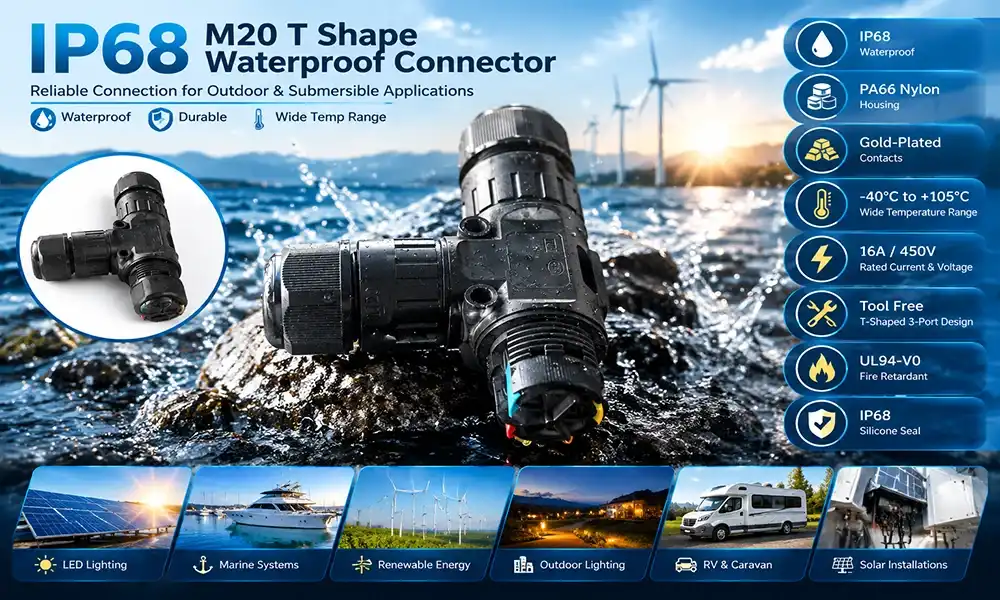
The PA66 fabric housing doesn't break down when exposed to UV light and keeps its IP68 M20 T shape waterproof connector from -40 °C to +105 °C. With its UL94-V0 flame-retardant rating, gold-plated brass contacts, and high-elasticity silicone O-rings, this set of materials keeps a tight seal even after being heated and cooled many times. When you run 16 A at 450 V through landscape lighting strings over the course of a project that lasts several years, contact resistance stays below 5 mΩ.
Comparing M20 T-Shape vs. Y-Shape Waterproof Connectors
Both types can send power or signals in three directions, but they do so in very different ways that will affect your installation.
Physical Configuration and Cable Routing
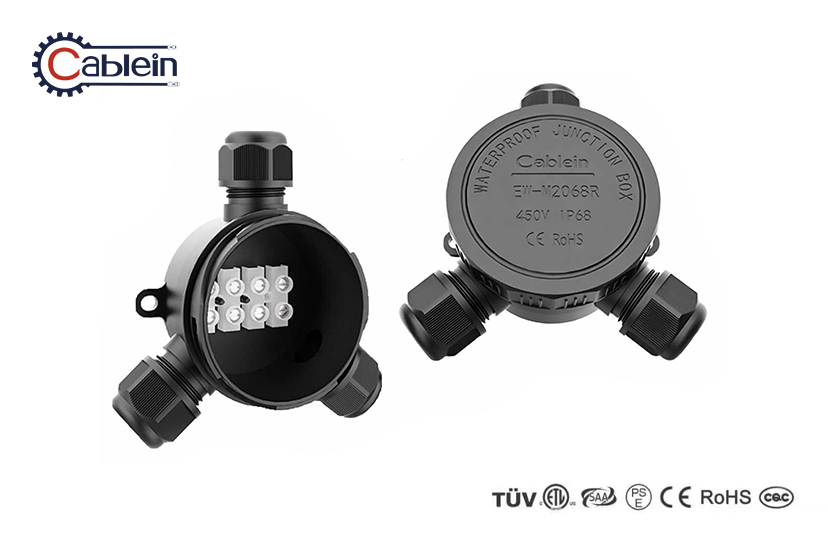
The main conductor stays straight with a T-shaped connector. The branch port comes out at a right angle, so the main cable doesn't have to bend. This is important for conduit runs or trunking, where any bends lose room. A Y-shaped connection turns both output ports away from the input, usually by 30° to 45°. This works with open-air fan-out wiring but needs more space on the sides around the fitting.
Sealing Integrity Under Long-Term Stress
The T-shape form puts all of the mechanical stress on one right-angle joint. As long as there is a good combined gasket at that point, water can't get into the main line. Y-shaped links spread stress over two angled points at the same time. If one seal ages faster than the other because of uneven cable tension, water can get in through the weaker side before it can be seen.
Installation Speed and Field Labor Costs
Snap-lock termination can be used on both types, but the T-shape layout makes it easier for field electricians to put them together: run the main cable through both inline ports, tighten the gland nuts, and then connect the branch. There are fewer coding mistakes on-site with this linear logic. When installing hundreds of ground-level fixtures in a row for gardening projects, cutting the time it takes to put the connectors together by just two minutes per unit saves a lot of work over the course of the whole installation.
How to Choose the Right Waterproof Connector for Your Industrial Needs
There are three real factors that determine whether to use a T-shape or a Y-shape: space limitations, wire topology, and certification needs.
Match Geometry to Your Cable Topology
An IP68 M20 T shape waterproof connector fits easily into an existing run without having to reroute the wires if your wiring plan uses a daisy-chain or loop layout, which is common in LED landscape lighting and solar monitoring arrays. If your design needs a star-burst branch point where two outputs split off at right angles, a Y-shape might work better in terms of how it is laid out. Before you place an order, look over your as-built drawings.
Verify Temperature and Chemical Exposure Ratings
In the Middle East, outdoor connections have to deal with temps that stay above 60 °C all summer. Every year, marine installations near harbor structures have to deal with air that is full of salt. In either case, make sure the housing has a real UL94-V0 flame rating and the O-ring is made of silicone or EPDM instead of normal PVC, which breaks down more quickly when exposed to UV and ozone.
Check Certifications Against Project Tender Requirements
When you send your products to EU city lighting bids or marine equipment classification groups, you have to include CE and RoHS documentation. Connectors made with ISO 9001:2015 quality control have production records that can be checked. A qualified seller can quickly make batch test reports when a project inspector asks for them. This stops expensive delays in the verification stage of the project.
Installation Guide for IP68 M20 T-Shape Waterproof Connectors
The performance of IP68 is either kept or lost by how well it is put together.
Pre-Installation Checks
Before taking each connector to the site, check to see if the seal is still good. Make sure that the rubber O-ring fits perfectly in its groove. An O-ring that isn't in place is the most common reason why water gets in early. Make sure the cable's outside diameter is within the rated range for the port. For dual-segment models, the range is 5–9 mm for smaller ports and 9–12 mm for larger ports.
Step-by-Step Assembly Sequence
The wire jacket should be cut to the length listed on the product sheet. For M20 glands, this is usually 35–40 mm. Before putting the wire into the housing, workers often forget to thread it through the gland nut. To fix this, the whole unit has to be taken apart. Place the conductors on their terminals and press the snap-lock button until you hear a click. Tighten the gland nut all the way by hand, and then use a wrench to add one more quarter-turn.
Common Mistakes That Compromise the Seal
When you over-tighten, the silicone O-ring breaks, and when you under-tighten, a capillary gap is left. Both failures look the same when you look at them, but the rate at which water enters is different. Before backfilling a ground-mounted fixture, a pull-out force test is done by steadily pulling on the cable to make sure that the gland has a good grip on the jacket.
Trusted Brands and Suppliers for IP68 M20 Waterproof Connectors
There are both global component brands and specialized manufacturers that focus on niche industrial segments in the M20 waterproof branch connectors market.
Global Component Manufacturers
TE Connectivity, Amphenol, and HARTING all make waterproof connectors that work with M20 and have a lot of test data available. These names are good for procurement teams that need catalog things that are in stock right away in their own country and don't have a minimum order size.
Specialized Manufacturers with OEM Flexibility
If you work as a landscape lighting contractor, marine electronics integrator, or new-energy project engineer and need custom pin layouts, branch lengths, or private-label marking, specialized factories can make it happen faster. Cablein Technology was established in 2017 and is based in Shenzhen. It has CE, RoHS, and ISO 9001:2015 certifications and ships standard M20 T-shape waterproof connectors from stock in quantities exceeding 10,000 units per item. Customized orders can be planned based on project schedules.
Supplier Evaluation Criteria That Reduce Risk
If you want to find a good IP68 M20 T-shape waterproof connector supplier, you should ask for hydrostatic pressure test reports (at least 1.0 MPa), salt-spray aging records (for 48 to 96 hours, according to IEC 60068-2-11), and thermal cycling data. These three papers tell you if the connector was actually tested to the rating it says it has or if that rating was just written on it.
Conclusion
Both T-shape and Y-shape IP68 M20 T shape waterproof connectors are rated IP68, but because of how they are built, each is better for certain wire schemes and installation situations. The T-shape helps keep the main cable route clean and straight, speeds up field assembly, and focuses sealing at a single controlled joint. These are all benefits that are important in landscape lighting chains that are buried in the ground, marine sensor runs, and solar array monitoring circuits. Whether a connector lasts as long as it's supposed to or breaks early depends on picking the right shape, making sure the material is certified, and following the right installation steps.
FAQ
1. What is the difference between IP67 and IP68 for outdoor connectors?
IP67 means that it can be submerged for 30 minutes in water up to one meter deep. IP68 allows continuous submersion below one meter, as long as the user and maker agree on the depth and length of the submersion. IP68 is the right minimum requirement for fixtures that will be buried in the ground or equipment that will be used at the dock.
2. Can I use different cable diameters in the three ports of a T-shape connector?
In the M20 T-shape series from Cablein, models with a dual-segment gland design can accept 5–9 mm cables in one port group and 9–12 mm cables in another.
3. How long does an IP68 M20 connector last in outdoor environments?
If you put something in full sunlight for 5 to 10 years, the UV-stabilized PA66 case and silicone seals should still work fine. If the contact material is not gold-plated or nickel-plated brass, this will last less long in salt-spray settings near the coast. Make sure you know the specs before you buy.
4. Is tool-free installation available on M20 T-shape connectors?
Yes, you only need to use your hand pressure and a standard wrench to tighten a snap-lock or push-lock termination. You don't need any crimping or soldering tools, which cuts down on the time it takes to put on big landscaping jobs.
5. What certifications should I require from an IP68 M20 connector supplier?
Ask for at least CE, RoHS, and ISO 9001:2015. For marine use, you should ask for IEC 60068-2-11 salt-spray test reports. For EU local project bids, the goods must be delivered with CE paperwork.
Get a Quote from Cablein — Your IP68 M20 T Shape Waterproof Connector Supplier
Cablein Technology has CE- and RoHS-approved IP68 M20 T shape waterproof connector branch connections in stock. You can choose from OEM pin-layout and private-label choices starting at 200 pieces. Our engineering team gets back to you within 24 hours, whether you need a standard T-shape connection for a landscape lighting job or a special marine-grade assembly. To get samples or mass prices, email us at nick@cableinco.com.
References
1. International Electrotechnical Commission. IEC 60529: Degrees of Protection Provided by Enclosures (IP Code). IEC, 2013.
2. Underwriters Laboratories. UL 94: Tests for Flammability of Plastic Materials for Parts in Devices and Appliances. UL Standards, 2021.
3. International Electrotechnical Commission. IEC 60068-2-11: Environmental Testing – Salt Mist. IEC, 2021.
4. International Organization for Standardization. ISO 9001:2015 Quality Management Systems – Requirements. ISO, 2015.
5. TE Connectivity. Connector Selection Guide for Industrial and Harsh-Environment Applications. TE Connectivity Technical Publications, 2022.
6. Amphenol Industrial Operations. IP-Rated Circular Connectors: Design and Application Handbook. Amphenol Technical Series, 2020.