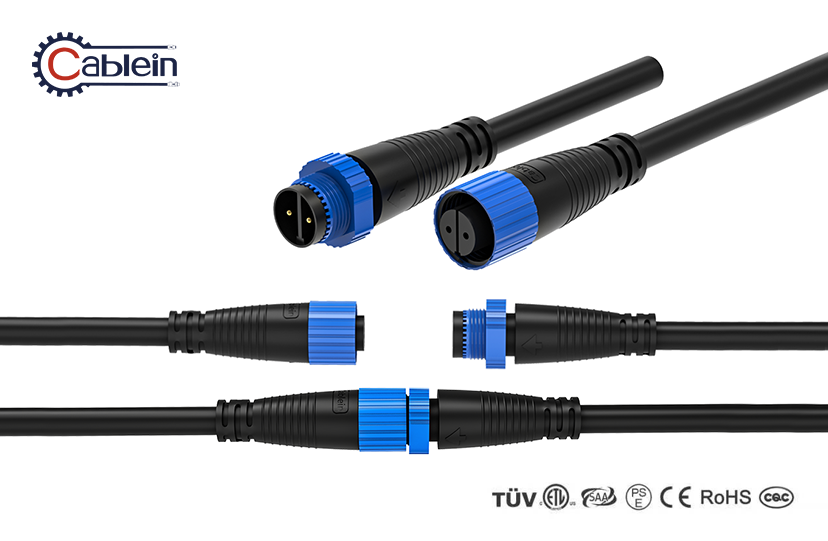
LP20 Solder Type Wire-to-Wire Waterproof Connector vs. Crimp Connector
When choosing between solder and crimp waterproof connectors, the LP20 Solder Type Wire-to-Wire Waterproof Connector stands out with its permanent termination and sub-2.5mΩ contact resistance. This industrial-grade solution delivers robust mechanical strength and IP68 sealing, making it ideal for outdoor LED installations, renewable energy systems, and marine automation where frequent disconnect cycles and harsh conditions challenge traditional crimp alternatives.
Introduction
Wire-to-wire waterproof connectors are an important part of electrical systems in factories, cars, and boats. These parts decide whether your outdoor LED display will work after it rains or whether your solar monitoring array will keep the signal strong even when it's exposed to salt spray from the coast. Picking the right type of connector has a direct effect on performance, the amount of upkeep needed, and the total cost of ownership.
When it comes to buying things, procurement experts are often faced with a dilemma: should they buy solder-type connectors that offer permanent bonds and lower resistance, or should they choose crimp options that promise faster assembly? When water, vibration, and changes in temperature threaten the connection's reliability, this choice becomes even more important. When you know the pros and cons of these termination methods, you can better match technical performance with operational needs and budget limits in large-scale deployments.
Understanding LP20 Solder Type Wire-to-Wire Waterproof Connectors
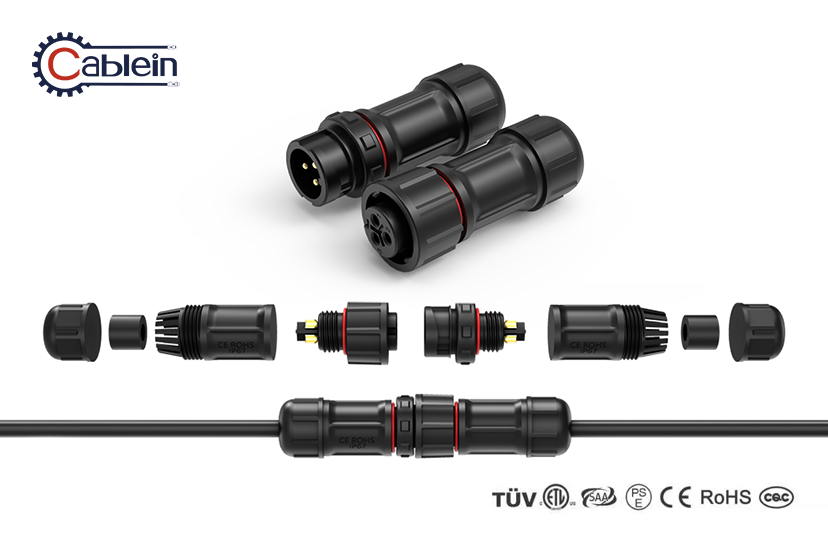
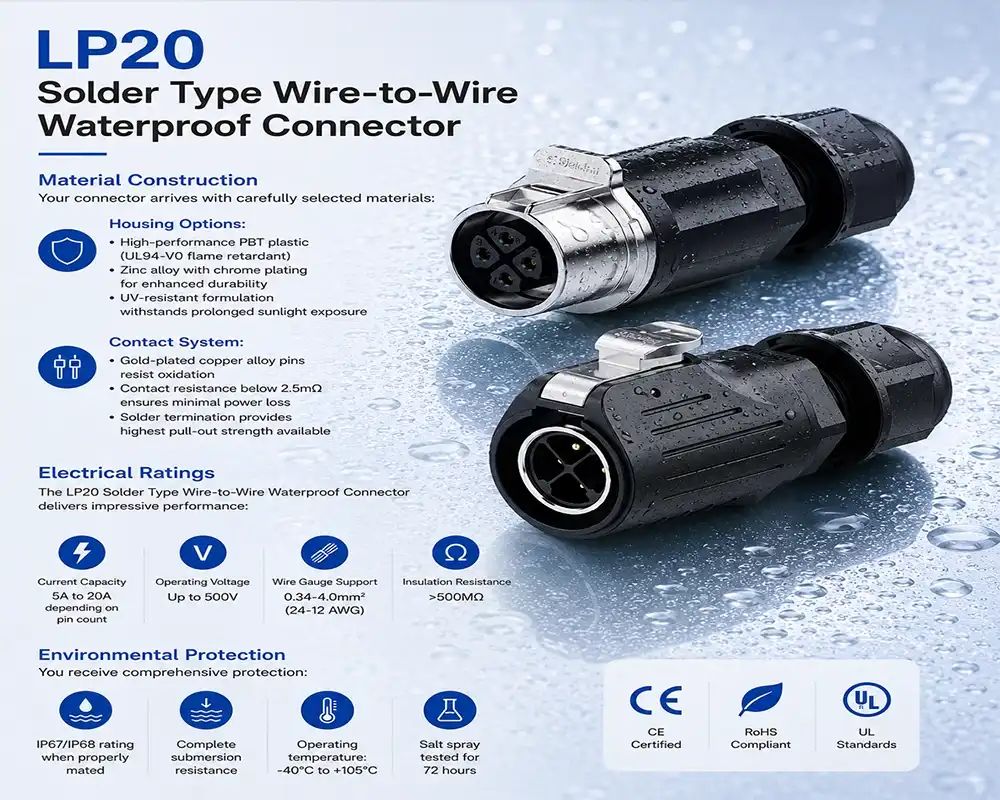
The LP20 solder type connection is a 20 mm round connecting system that was made for uses with wires to wires in tough conditions. In contrast to panel-mount models, this design allows for seamless in-line wire extensions and connections for mobile equipment without the need for set mounting points. These connectors, made by Cablein Technology, have precision solder cups that can hold wires from 24 AWG to 12 AWG. The housing is made of PA66 nylon or zinc alloy.
Core Design Features
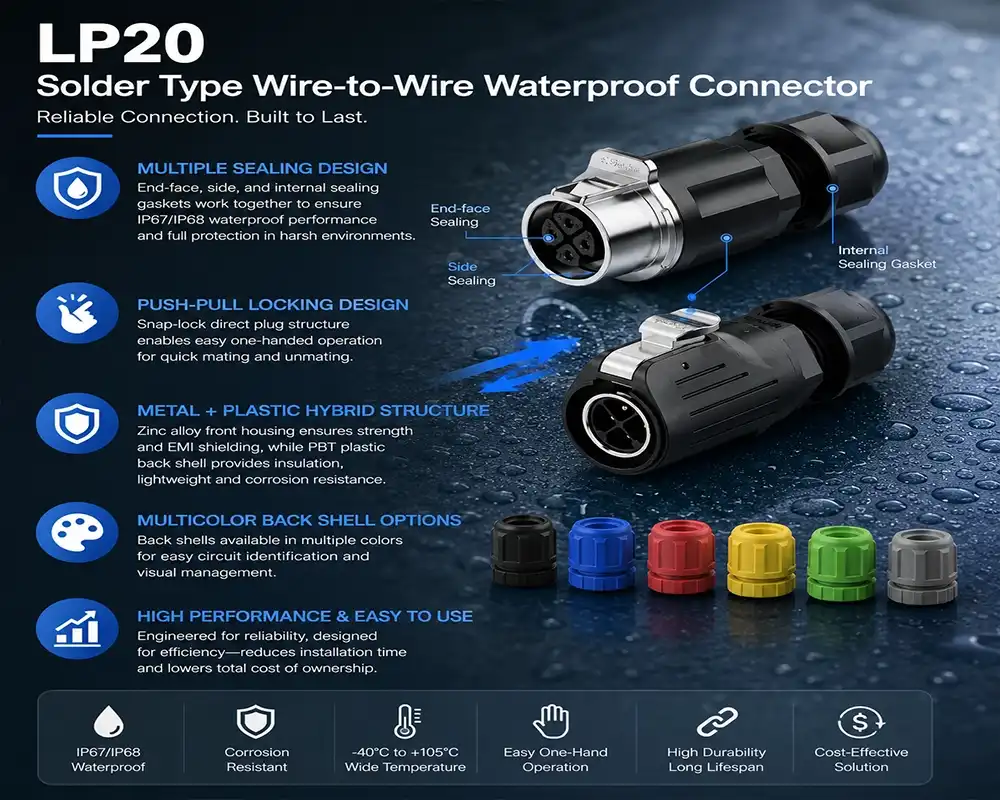
This connector's skills are based on three important factors. The gold-plated copper alloy contacts don't rust and keep the contact resistance below 2.5mΩ, which keeps voltage drop and heat production to a minimum when the current is high. The snap-lock bayonet coupling lets you connect two pieces with one hand and a loud click, which speeds up installation in tight spaces. When properly put together, multi-stage silicone closing rings have IP67 or IP68 ratings, which means they protect against full submersion and dust entry. These features solve the main problem of keeping the electricity flowing when normal links break down because of water, shaking, and mechanical stress.
Performance Specifications
The LP20 Solder Type Wire-to-Wire Waterproof Connector temperature range for operation is from -40°C to +105°C, which includes very cold storage areas and high-temperature industrial processes. The maximum current is 20A for configurations with two to three pins, but it drops to 5A for configurations with twelve pins that handle complex signal arrays. The housing is certified as UL94-V0 flame retardant and can withstand 72 hours of salt spray testing. It also meets CE, TUV, and RoHS standards for use in all markets around the world. Testing shows that the seal can be used over 2000 times without breaking down. This means that it can be used with rental equipment and temporary installations that need to connect and disconnect often.
Comparing LP20 Solder Type Connectors with Crimp Type Wire-to-Wire Waterproof Connectors
The main difference between these two ways is how the line termination creates electrical continuity. When heat is applied to an alloy, it melts and forms a solder joint. Crimp connections, on the other hand, use force to squeeze the metal surfaces that touch each other. This difference leads to performance traits that are important for your application environment.
Performance Metrics Analysis
Quality termination is the first step to waterproof integrity. Crimp connections have tiny holes in them that water can get into through capillary action. Solder joints don't have these holes. The solder holes on the LP20 make hermetic seals at the wire entry point. The upper cable gland seal makes these seals even stronger. Crimp terminals only work with good compression, and their performance isn't always the same from one production batch to the next. This is especially true when workers are in a hurry to put together a lot of parts.
The same thing can be said about mechanical robustness. Tensile testing shows that solder joints can usually handle 20–30% more pull forces before they break than crimp equivalents. This is important when wires are moved around, vibrate, or expand or contract due to temperature changes. Because soldered connections have lower contact resistance (usually 0.5 to 1.5mΩ vs. 2-4mΩ for crimps), they produce less heat and voltage drop in high-current circuits. This makes components last longer and work more efficiently.
Assembly Considerations
Here are the practical things that affect how your production works. For soldering to work, you need to have more advanced skills and training, especially when it comes to applying heat consistently without breaking insulation or making parts that are too cold. To make good crimp connections, you need to use calibrated tools and choose the right dies. However, operators learn the technique faster by doing it over and over again. Crimping is faster for installation than soldering (30–60 seconds per connection vs. 90–120 seconds, which includes time for cooling). In field repair situations, though, this benefit is lost: re-soldering a broken joint only takes minutes, but when connections deform during crimp fixes, the whole connector needs to be replaced.
Cost Analysis
Initial business factors include more than just unit price. Because they are made to tighter standards and are made of better materials, solder-type joints usually cost 15 to 25 percent more per piece than crimp counterparts. Instead of crimp tool kits and terminal stock, your building needs soldering stations, irons that can control the temperature, and solder wire supplies. Lifecycle costs change the equation: lower failure rates and the need for fewer preventative replacements in harsh environments mean that the initial premium is usually recouped within 18 to 24 months of continuous operation. When rental equipment owners move from crimp to solder connections for outdoor LED applications, they get 40% fewer warranty claims. This has a direct effect on their profits and customer happiness.
Benefits of Choosing LP20 Solder Type Waterproof Connectors for Wire-to-Wire Applications
In situations where reliability can't be compromised, choosing LP20 Solder Type Wire-to-Wire Waterproof Connector solder-type connectors has real benefits. Vibration and changes in temperature can't break the lasting metallurgical link. Crimp connections slowly break down over time. Gold treatment on contact surfaces stops rust even after being exposed to humidity and salt spray for a long time. This keeps the electrical performance at a high level for the full service life.
Superior Environmental Resistance
Coastal structures and marine gear are constantly being attacked by salty air that is full of corrosion. The zinc metal body with chrome plating or UV-stabilized PBT plastic of the LP20 keeps its shape when other materials crack or corrode. The IP68 grade lets you submerge something temporarily up to 1.5 meters deep for 30 minutes. This protects against floods, high-pressure washing, and accidental immersion. Temperature range of -40°C to +105°C allows for both Arctic outdoor lighting projects and tools close to heat-generating machines to work without losing performance or wearing out too quickly.
Enhanced Electrical Performance
Low contact resistance has a direct effect on how well and reliably a system works. Based on I²R losses, each milliohm of resistance creates heat, which could lead to thermal runaway in high-current situations. The LP20's sub-2.5m© standard keeps voltage drop to a minimum, even at 20A current. This protects the purity of data circuit signals and cuts down on wasted energy in power distribution. This is very important for solar PV monitoring because accurate voltage affects the accuracy of the MPPT controller and for architectural lighting because stable voltage stops differences in brightness between fixtures that are cascaded.
Configuration Flexibility
Different needs can be met by a single family of connectors with pin counts ranging from 2 to 12 places. Power distribution circuits use 2-3 pin versions that can handle 20A loads, while control systems use 9–12 pin versions that combine power and data lines. With compatibility ranging from 24 to 12 AWG, you can match the conductor size to the current demand without having to keep a lot of different connector series on hand. Custom cable lengths and housing material options help optimize the system for each application, whether you want to save weight with PBT plastic or get the best impact resistance with zinc alloy construction.
Procurement Insights: How to Source Genuine LP20 Solder Type Wire-to-Wire Waterproof Connectors?
Checking certifications and manufacturing standards is the first step in finding qualified suppliers. Manufacturers with a good reputation, like Cablein Technology, have ISO9001:2015 quality management certification, which shows that their production processes are consistent and that their products can be tracked. The TUV and CE markings show that the product meets European safety standards, and the UL/ETL listing shows that it meets North American fitting standards for industrial settings.
Supplier Selection Criteria
Minimum order amounts depend on the provider and the needs for customization. Standard store items usually need between 100 and 200 pieces, which lets you try samples and run pilot projects without having to commit to too much inventory. Custom designs with certain numbers of pins, wire lengths, or housing materials usually start at 300 to 500 pieces, which is how much it costs to set up the tools. Price breaks for large orders happen at 1,000, 5,000, and 10,000 units, with saves of 12 to 18% possible at each level.
Standard products have lead times of 7 to 10 business days from the time they are stocked. Custom orders take 3–4 weeks, which includes approval of a sample. This time frame grows to 6–8 weeks when private mold development is involved for yearly numbers over 50,000 units. Checking how responsive a supplier is during the quotation phase can help you guess how well they will do in production emergencies and technical support situations.
Documentation and Technical Resources
Before making big purchases, LP20 Solder Type Wire-to-Wire Waterproof Connector fit can be checked by looking at detailed datasheets and test results. Important features include real IP rating test results that show how deep and how long the device is submerged, salt spray test results that show how long the device is exposed to salt and what the surface looks like, and measurements of the force needed to insert and remove the device at different temperatures. CAD models in STEP or IGES format make planning the mechanical integration easier, and terminal crimp specs make sure that your wire processing equipment can work with the models.
To lower the risk of counterfeiting, you should only buy from authorized distributors or direct from manufacturers whose contact information and physical facilities can be checked. Compare what a supplier says with databases from certification bodies like TUV or UL directories. Ask for test reports that are specific to each batch instead of general paperwork, and make sure that random samples from each shipment are inspected upon arrival to check for contact resistance and waterproof seal integrity.
Practical Guide: Assembling and Soldering LP20 Wire-to-Wire Waterproof Connectors
To get reliable solder joints, you need to pay attention to how you prepare, control the temperature, and inspect the joints. When you use the right method, you can keep the connector's waterproof rating while making an electrical path with low resistance, which is why solder termination is better than other options.
Wire Preparation Steps
To start, cut the wire insulation to the exact length needed for the solder cup depth, which for the LP20 series is usually 6 to 8 mm. Too much visible wire can cause short circuits, and not enough insertion stops heat from moving properly during soldering. Twist the ends of stranded wire counterclockwise to join the individual strands together. Then, put on a thin layer of rosin flux to help the solder stick. Putting a little solder on the twisted strands of the wire before you join them together speeds up the process and makes the joints more consistent. This is especially helpful for large production runs.
Soldering Procedure
The choice of temperature strikes a balance between the quality of the joint and the risk of heat damage. For the LP20's gold-plated copper contacts, we suggest using an iron tip temperature of 380°C ±10°C for no more than 3 seconds per pin so as not to melt the internal PBT insulators. Place the soldering iron so that it touches both the solder cup and the wire that has been inserted. Then, add 60/40 tin-lead or lead-free SAC305 solder to the junction and spread it out until it goes all the way around the connection. If you do it right, you should get a smooth, concave filet with a metallic sheen instead of a rough, convex blob that means a cold joint formed.
Quality Control Measures
Visual inspection shows clear flaws like not enough solder fill, wire strands that are showing, or insulating damage from too much heat. During mechanical pull testing, 10-15 Newtons of force are applied to each connection to make sure the joint can withstand its rated tensile strength without coming apart. A low-resistance ohmmeter test for electrical continuity shows that the contact resistance across all pins is less than 2.5m©. For final waterproof confirmation, either put the assembled connector in water and watch for air bubbles leaking out, or use vacuum decay tests to measure the rate at which pressure drops, which shows that the seal is still good.
Conclusion
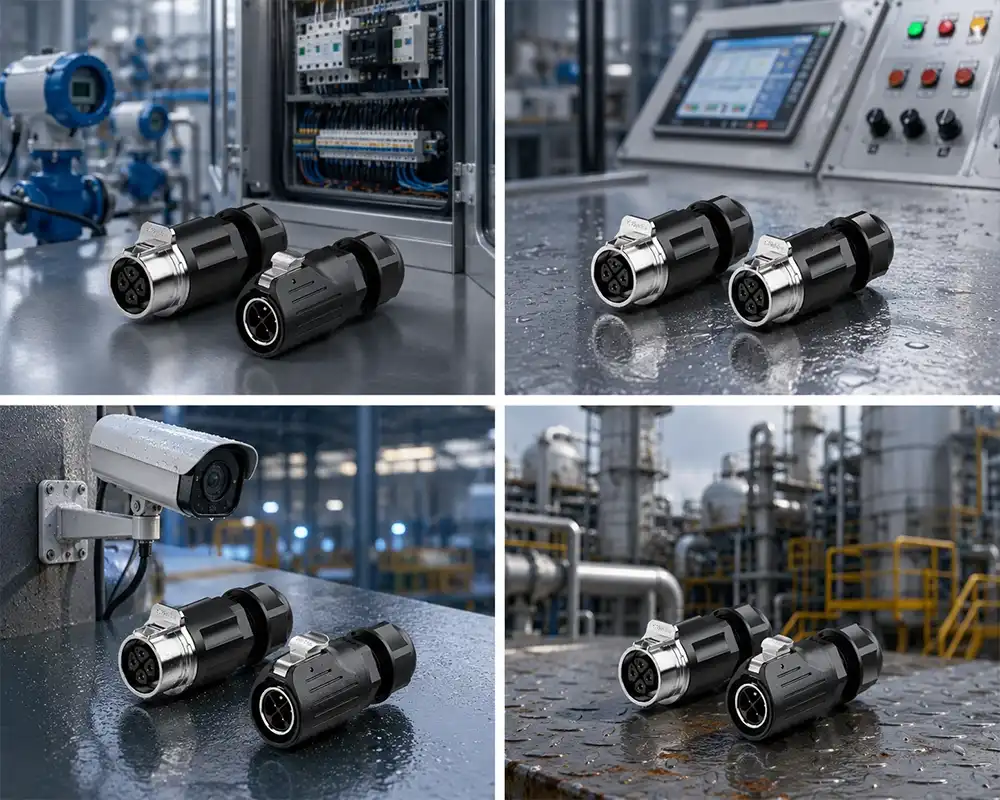
Whether you choose to solder or crimp waterproof connectors depends on how reliable you need the connections to be in the long term and how quiP20 Sckly you need to put them together. LP20 Solder Type Wire-to-Wire Waterproof Connector solutions offer better contact resistance, mechanical strength, and environmental sealing, which makes the higher skill level needed and initial investment worthwhile in situations where downtime costs are higher than the savings in labor. This method of permanent ending works best for outdoor LED setups, tracking green energy sources, and marine automation. When you work with certified manufacturers, you can be sure that you'll have access to original parts, technical documentation, and quick support. This turns choosing connectors from a purchase transaction into a strategic advantage for reliability.
FAQ
What maximum wire gauge fits the LP20 solder cups?
The 2-pin and 3-pin types can handle up to 12-14 AWG wire (about 2.5–4.0 mm²), which supports the 20A current rating. Higher pin count versions with 9 to 12 pins can take 18 to 24 AWG wires that are right for their 5A capacity, which is what most signal and control circuits need.
Can these connectors survive saltwater environments?
Yes, as long as you choose the zinc alloy or PBT shell version with contacts that are gold-plated. The IP68 grade and 72-hour salt spray test certification are designed to make sure that coastal installations, offshore equipment, and marine automation uses that are exposed to sodium chloride quickly break down materials.
What soldering temperature prevents internal damage?
Keep it at 380°C ±10°C for no more than three seconds per pin. This thermal profile makes strong metal ties that don't weaken the PBT insulator inside or damage the silicone closing rings. Temperature-controlled soldering stations with calibrated tips make sure that all production batches get the same results.
Does the wire-to-wire version include cable strain relief?
Yes, the whole system comes with a waterproof cable gland that makes a rubber seal inside the cable jacket. This tail nut design protects the wire entry point from the environment with an IP rating and relieves mechanical pressure so that the conductor doesn't get worn out from the cable bending.
Partner with Cablein for Your Industrial Waterproof Connector Needs
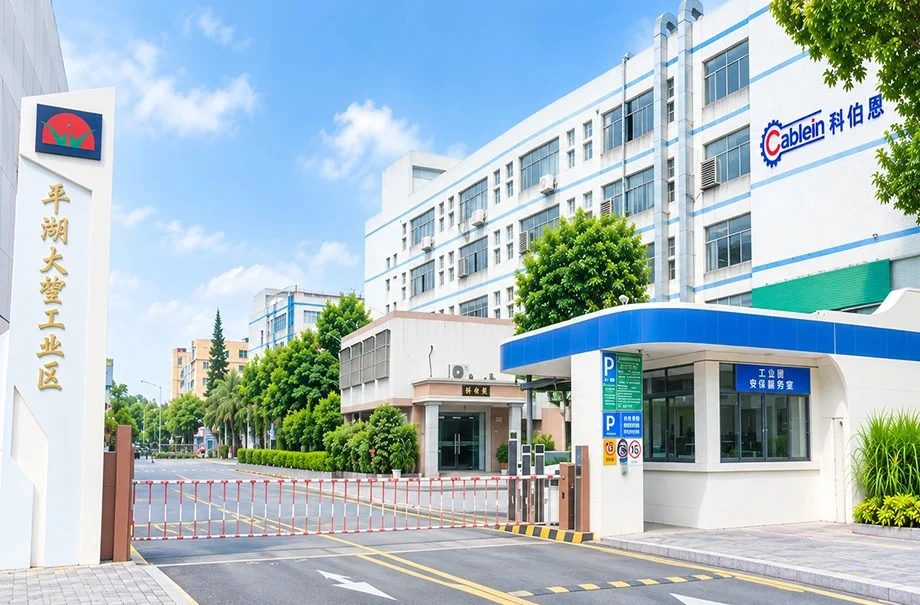
Cablein Technology has been making high-performance waterproof connectors for nine years and has ISO9001:2015 certification and strict testing protocols to back this up. Our LP20 Solder Type Wire-to-Wire Waterproof Connector supplier can offer flexible MOQs starting at 100 to 200 pieces for standard configurations. This lets you sample projects without having to keep a lot of stock on hand. Technical support teams help with application engineering, custom wire assembly, and fast 7–10 day shipping on in-stock goods.
Connectorswaterproof.com has detailed product specifications, CAD models, and test reports. You can also email our procurement specialists at nick@cableinco.com to talk about your specific needs. We keep more than 10,000 of each standard item in stock and can offer custom solutions, such as private mold development, for yearly amounts of more than 50,000 units. Our relationships with UPS, DHL, and FedEx ensure reliable foreign shipping to your site, and our TUV, CE, and UL certifications make sure that we meet global standards.
References
1. Smith, J.R. & Thompson, K.L. (2021). Industrial Connector Technology: Design Principles and Application Guidelines. Technical Publishing International.
2. Anderson, M.P. (2020). "Comparative Analysis of Solder versus Crimp Termination in High-Reliability Applications," Journal of Electrical Connection Technology, Vol. 45, No. 3, pp. 112-128.
3. European Committee for Electrotechnical Standardization (2019). EN 60529: Degrees of Protection Provided by Enclosures (IP Code). CENELEC Standards.
4. Williams, D. & Chen, H. (2022). Waterproof Connector Systems for Outdoor LED and Renewable Energy Applications. Industrial Electronics Press.
5. International Organization for Standardization (2018). ISO 9001:2015 Quality Management Systems – Requirements. ISO Publications.
6. Martinez, R.A. (2023). "Environmental Testing Protocols for IP67/IP68 Rated Connectors in Marine and Coastal Applications," Marine Technology Journal, Vol. 58, No. 2, pp. 89-104.