Plastic vs Metal LP16 Inline Connector Housing: Which Is Better?
When sourcing an LP16 inline cable connector for industrial deployment, one of the most consequential decisions is housing material. Plastic and metal each bring distinct engineering trade-offs that directly affect waterproof performance, EMI shielding, installation efficiency, and total cost of ownership. This guide breaks down both options with technical clarity so procurement engineers, QA managers, and supply chain professionals can make a confident, well-supported decision without second-guessing.
Understanding LP16 Inline Connector Housing Materials
The material of the body of a circular inline connector affects everything from longevity to regulatory compliance. There are two primary families of materials used to manufacture LP16 inline cable connectors.
Plastic Housing: Lightweight, Corrosion-Resistant, and Cost-Effective
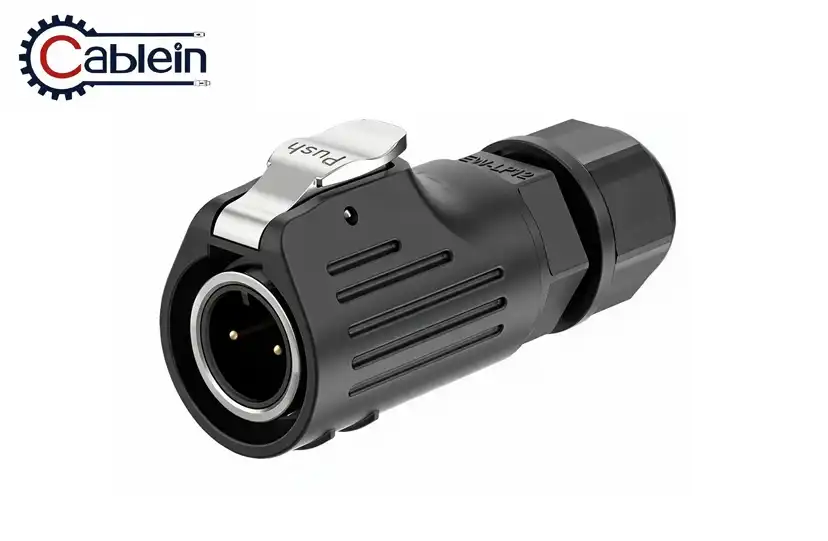
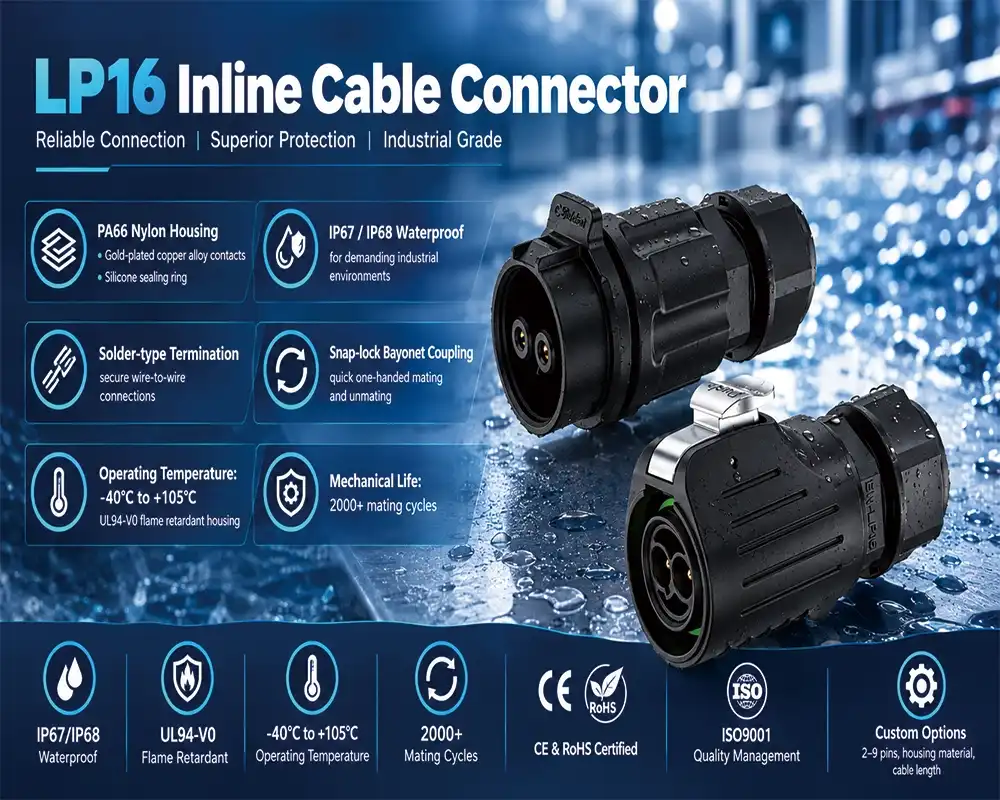
Plastics such as PA66 nylon, PBT, polycarbonate, and PVC are frequently utilized for housings. The LP16 inline cable connector from Cablein is constructed from PA66 nylon, which provides UL94-V0 flame retardancy and does not degrade in water at temperatures ranging from -40℃ to +105℃. Nylon is also inherently resistant to corrosion, making it suitable for wet, saline, and chemically active environments. Plastic connectors simplify logistics and minimize fatigue during labor-intensive field installations because they weigh approximately one-third as much as comparable zinc alloy housings.
Metal Housing: Mechanically Robust and EMI-Shielded
Metal housings, typically composed of zinc alloy or aluminum alloy, offer superior mechanical durability, vibration damping, and electromagnetic interference (EMI) shielding. Zinc alloy housings can endure impact forces that would compromise polymer bodies. Their metallic shells also serve as a grounding path and attenuate radiated emissions, which is critical in motor-drive environments and rail transit applications.
We will talk about the main differences between the two types of materials in terms of their weight, EMI performance, thermal conductivity, and unit cost in the sections that follow.
Performance and Durability Comparison: Plastic vs Metal LP16 Inline Connectors
Real-world performance varies significantly based on the operating environment. Potential field failures can be prevented by identifying where each material excels and where it falls short.
Mechanical Strength and Resistance to Vibration
When subjected to prolonged mechanical stress, metal housings definitely outperform plastic alternatives. In heavy robotics and rail transit, vibration amplitudes can exceed the fatigue limits of standard polymer bodies over extended periods. A zinc alloy shell maintains its dimensional stability under these loads, reducing the risk of seal compression loss and subsequent water ingress.
Plastic connectors are not designed to be fragile. The IP67 and IP68 ratings for Cablein's PA66 housing are verified through vacuum and water immersion testing, utilizing silicone sealing rings and a snap-lock bayonet coupling. The LP16 inline cable connector has been validated to withstand over 2,000 mating cycles, exceeding the typical service intervals in LED lighting and sensor network applications.
Environmental Resistance and Failure Modes
UV exposure can lead to the embrittlement of outdoor connector housings, a common failure mode. This degradation is significantly less likely in high-grade PA66 containing UV stabilizers compared to standard PVC. Metal housings are immune to UV breakdown but are vulnerable to galvanic corrosion, which occurs when dissimilar metals contact each other in saline atmospheres. Suppliers who rigorously validate corrosion protection against IEC 60068-2-11 standards (48–96 hours) can be distinguished from those who simply claim compliance.
As a preventive measure, ensure that outdoor plastic housings specify UV-stabilized nylon and that metal housings possess documented salt spray test reports prior to approval for coastal or marine deployments.
Application Suitability: Which Housing Type Fits Your Industry Need?
Translating material science into procurement decisions requires matching connector properties against specific application environments.
Here is a practical breakdown of where each housing type performs best across the industries we serve:
- PA66 plastic housings are well suited for outdoor LED lighting, agricultural greenhouse fixtures, solar PV monitoring wiring, and CCTV installations characterized by moderate mechanical loads and high moisture or UV exposure. Their lighter weight also reduces the total mass of cable assemblies in large-scale stadium lighting runs.
- Metal (zinc alloy) housings represent the optimal choice for industrial automation featuring servo drives, rail transit rolling stock, and any environment where conducted or radiated EMI levels exceed EN 55011 Class B limits. The conductive shell provides a shield termination point that plastic cannot physically replicate.
- Hybrid considerations apply to energy storage systems and EV charging infrastructure, where high-current transmission (up to 10A per pin at 500V) requires robust contact integrity, while outdoor enclosure requirements favor IP68-rated waterproofing, achievable with either material when properly sealed.
Compatibility with cable diameters from Φ4mm to Φ9mm and pin configurations from 2 to 9 pins applies to both housing types, ensuring system integrators retain design flexibility regardless of the material selected.
Cost Analysis and Procurement Considerations
Upfront unit pricing for an LP16 inline cable connector clearly favors plastic housings. Metal housings incur higher raw material and machining costs. For a procurement manager sourcing 10,000 units, this price gap compounds rapidly.
However, the more instructive metric is total cost of ownership. Using plastic connectors in environments exceeding their mechanical ratings leads to field replacement costs, warranty claims, and unplanned downtime that far outweigh the initial savings. Conversely, deploying metal connectors in benign indoor environments represents unnecessary capital expenditure.
Lead time considerations also differ; Cablein maintains a stable inventory of over 10,000 pieces per item, with standard delivery in 7–10 days for both housing types. Custom configurations, including private mold development for specialized pin counts or proprietary color coding, follow a flexible production schedule communicated transparently at the time of order.
Due to their lighter weight, plastic housings offer lower shipping costs—approximately one-third the freight cost of a zinc alloy order—which is significant for ocean freight and air express fulfillment to the US. Fragility during transit is comparable when both types are packaged correctly.
Making the Right Choice: Practical Guidelines for B2B Procurement Managers
The decision framework can be simplified to four variables: environment, budget, EMI requirements, and expected service life. A solar farm integrator in Arizona deploying panel-to-panel monitoring wiring faces intense UV, moderate vibration, and no significant EMI—PA66 plastic with an IP68 rating is technically sufficient and cost-optimal. A robotics OEM designing a six-axis welding cell with variable-frequency drives generating high EMI should specify zinc alloy to maintain signal integrity on sensor lines.
Emerging procurement trends reinforce this segmentation. The IEC 63000 framework increasingly requires RoHS and REACH compliance records, which Cablein provides as standard documentation. Demand for halogen-free and bio-based polymer housings is also growing among European customers, a trend that informed suppliers are already tracking.
CE and RoHS certification, manufactured under ISO9001:2015 quality management, confirms that both Cablein plastic and metal LP16 variants meet the baseline compliance requirements for US and EU market entry. Each unit undergoes 100% waterproof performance inspection before shipment.
Conclusion
Neither plastic nor metal wins universally—the optimal LP16 inline cable connector housing depends on your specific operating conditions, EMI environment, and total cost calculation. PA66 nylon excels in corrosion resistance, weight efficiency, and cost-conscious deployments. Metal housings deliver where mechanical impact and EMI shielding are non-negotiable. Cablein engineers both variants to IP67/IP68 standards with gold-plated copper alloy contacts, silicone sealing rings, and snap-lock bayonet coupling—giving procurement teams a reliable, certified solution regardless of which housing path they choose.
FAQ
Can plastic LP16 connectors be used outdoors long-term?
Yes, provided the housing utilizes UV-stabilized PA66 nylon rather than standard PVC. Cablein's plastic housing meets UL94-V0 flame retardancy and is tested across -40℃ to +105℃, making it suitable for outdoor LED lighting, surveillance cameras, and solar monitoring wiring exposed to rain, UV, and temperature cycling.
How does a metal housing improve EMI protection?
A Faraday cage is made around the connection points by a conductive zinc alloy shell. When it is connected to a system ground, it reduces electromagnetic interference that is both conducted and radiated. This is important in places like rail transit, motor-drive cabinets, and servo systems where EMI can corrupt sensor signals or trigger false fault events in PLC control systems.
What factors affect lead time on bulk LP16 orders?
Standard in-stock variants ship within 7–10 days. Custom orders involving modified pin counts (2–9 pins), non-standard cable lengths, or private mold tooling require additional scheduling time communicated at the quote stage. Cablein maintains standing inventory above 10,000 pieces per SKU to buffer against surge demand and protect project schedules.
Are both housing types available with the same waterproof ratings?
Yes. Both PA66 plastic and zinc alloy metal versions of the LP16 inline cable connector are available with IP67 and IP68 ratings, verified through vacuum and water immersion testing per IEC 60529.
Get Your LP16 Inline Connector Quote from Cablein Today
Cablein Technology has delivered certified waterproof connectivity solutions to clients across 100+ countries since 2017. Whether you need an LP16 inline cable connector in PA66 nylon or zinc alloy housing—or require custom pin configurations and private mold development—our engineering team responds within 24 hours. Request samples, bulk pricing, or a technical consultation directly at nick@cableinco.com or visit connectorswaterproof.com. Backed by ISO9001:2015, CE, and RoHS certification, we are a trusted manufacturer ready to support your next project.
References
1. UL (Underwriters Laboratories). UL 94: Tests for Flammability of Plastic Materials for Parts in Devices and Appliances. 2023.
2. IEC (International Electrotechnical Commission). IEC 61000-4-3: Electromagnetic Compatibility – Radiated Immunity. 2022.
3. IEC (International Electrotechnical Commission). IEC 60068-2-11: Environmental Testing – Salt Mist Test. 2021.
4. IEC (International Electrotechnical Commission). IEC 60529: Degrees of Protection Provided by Enclosures (IP Code). 2022.
5. European Chemicals Agency. REACH Regulation – Substance Restrictions and Compliance. 2023.
6. ISO (International Organization for Standardization). ISO 9001:2015 – Quality Management Systems Requirements. 2015.