MC4 vs. XT60 Connector for Solar Panels: Key Differences Explained
When selecting connectors for solar installations, two names frequently emerge: MC4 and XT60. The MC4 solar connector represents the industry standard for commercial and residential photovoltaic systems, delivering IP68 waterproof protection, 1500V DC rating, and TUV certification—critical for installations demanding long-term reliability. XT60 connectors, originally designed for radio-controlled hobbyist applications, offer compact connections suitable for portable solar devices but lack the environmental resilience and voltage capacity required for professional energy systems.
Understanding Solar Connectors: MC4 and XT60 Overview
For solar systems to work, the links need to be able to handle harsh environments and keep their electrical integrity for decades. Both types of connectors have specific jobs to do, but their design ideas are very different.
What Defines the MC4 Standard
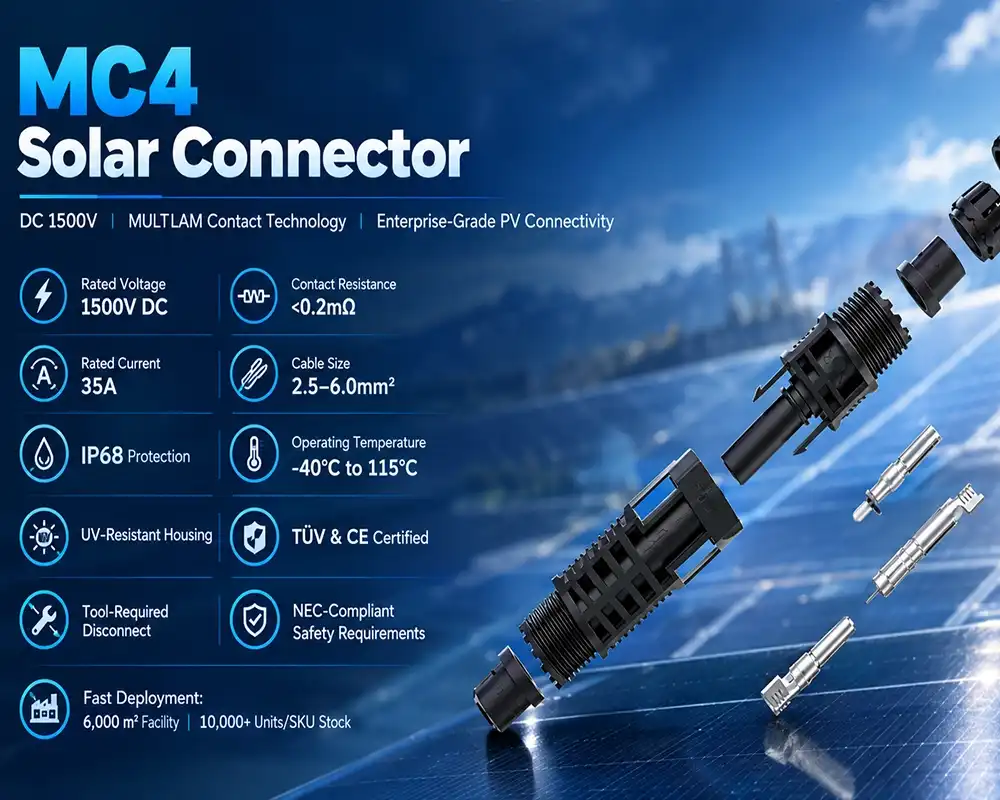
It became the standard for photovoltaic connections around the world, and it fixed some of the most important problems with solar installations. Designing this connector with outdoor sturdiness in mind, it has a snap-lock system that makes gas-tight seals that keep water out. The design stops the connection from being accidentally broken when there is a load on it. This is a safety feature that stops DC arc faults that can start fires. It has been certified by TUV and CE to meet world safety standards. In most places, grid-tied systems are required to have these certificates. The unlocking mechanism that needs a tool makes sure that connections stay tight during cycles of thermal expansion and vibration from wind loads.
The XT60's Hobbyist Origins
XT60 plugs were first used by hobbyists who build RC drones and electric cars, where small size and stable electrical contact are more important than sealing against the environment. The bullet-style contact design makes connections with low resistance and estimated currents of up to 60A constant, which is pretty high for its size. However, the open housing form doesn't have good ingress security. UV-degradable nylon housings and open touch points make it hard to use outside. These connectors are used in portable solar systems where separation and connection happen often and protecting the environment is not as important as making the connectors easy to use.
Application Environments Compared
Professional solar installations have to work in tough conditions that test every part. Ground-mount arrays have to deal with temperature changes of -40°C to 115°C, UV radiation that is the same as decades of regular exposure squished into a few years, and humidity levels that range from dry in the desert to wet in the tropics. The MC4 Solar Connector takes these realities into account with a PPO housing that has a flammability rating of UL94 V-0 and gold-plated contacts that stay conductive even after being outside for a long time. XT60 connectors, on the other hand, work best in controlled settings, like portable solar generators for camping, small off-grid sets, and short-term installations where cost is more important than durability.
Technical Comparison: MC4 vs. XT60 Connectors
Buying choices are based on technical factors that can be measured and have an effect on how well the system works and how safe it is. By looking at the specifications, you can see that these types of connectors are not the same.
Voltage and Current Capacity Analysis
MC4 connectors can handle DC voltages of up to 1500V, which is necessary for modern utility-scale installations that aim to increase string voltage to lower current and the resistive losses that come with it. With cable sizes ranging from 2.5 mm³ to 6.0 mm³ and a constant current rating of 35A, they can handle the power needs of industrial arrays. Throughout the lifetime of the product, the contact resistance stays below 0.2m©. This keeps power loss at connection places to a minimum. XT60 connectors work well at 60A, but they can only handle 600V, so they can only be used in smaller systems. Because their contact resistance is higher (usually between 0.5mΩ and 1.0mΩ), they can't be used in big arrays where the total losses add up over hundreds of links.
Environmental Protection Standards
Ratings for waterproofing tell the difference between expert and consumer-grade gear. Quality MC4 connectors with an IP68 rating are waterproof—they've been tried through vacuum submersion methods that mimic harsh conditions. Before it is shipped, every unit is tested to make sure it is completely waterproof. This makes sure that the seal will hold up through thousands of heat cycles. This safety measure is important for ground-mounted plants that are near flood zones, floating solar installations, and coastal projects that will be hit by salt spray. There is no official IP rating for XT60 connectors. The open housing lets dust and water get in, which raises the risk of corrosion and makes the contact resistance higher over time. These restrictions may not be a problem for installations inside, but they are not for business operations outside.
Certification Requirements for Market Access
International compliance tells us if a product can properly go into a target market. MC4 Solar Connector connectors have been certified by TUV, CE, UL, and IEC 62852 to make sure they are safe for use with electricity, won't catch fire, and will last in harsh environments. These approvals aren't just pieces of paper; they're proof that the claims of performance have been tested and proven by a third party. To meet insurance standards and building rules, utility companies and business installers only use certified connections. Most XT60 connectors don't have these kinds of approvals, so they can only be used in non-grid-tied situations with little government control.
Application Scenarios and Practical Considerations
To choose the right connectors, you need to match your technical skills with the realities of your deployment. It changes how much it costs to install, how often it needs to be maintained, and how reliable the system will be in the long run.
Commercial and Utility-Scale Solar Arrays
Large-scale structures have their own problems. Utility ground-mount plants have thousands of connection points spread out over acres of panels. Each one of these places can cause power loss if the contact resistance drops. When links aren't up to par, they cause projects to lose money over three quarters of a century. These losses are kept to a minimum by MC4 connectors' low-resistance design and stable performance at all temperatures. Unauthorized tampering can't happen because you need a tool to disconnect. This is an important security feature for remote installations. Buying in bulk from certified makers keeps the supply chain stable, and having a large enough quantity to handle both big orders and last-minute replacements is important. Our facility keeps more than 10,000 units of each SKU in stock, which lets us quickly deploy products without having to wait for production to start.
Rooftop and Residential Installations
Rapid thermal cycling happens on commercial rooftop systems because the sun quickly heats panels in the morning and then cools them down at nite. This stretching and shrinking puts stress on every connection, leaving tiny holes in cheap products that cause arcing, which is a major cause of solar fires on roofs. MC4 connectors keep their compression during these cycles, which stops the contact breakup that causes arc problems. The plug-and-play mating design makes it easy to put together in the field without any special training, which lowers the cost of installation work. Installers like the audible click that lets them know the connection is correct. This is a quality control measure that makes sure the mating works reliably during large installations.
Portable and Off-Grid Systems
Different things are more important in small-scale solar uses. Portable solar generators are great for camping, emergency backup power systems, and do-it-yourself off-grid setups because they work at lower voltages and change connections more often. XT60 plugs are good for these situations because they are small, easy to handle with your fingers, and cheap. When equipment is stored inside between uses, it doesn't hurt the environment as much. People who are watching their budgets are willing to accept shorter lifespans in exchange for lower costs right away. But even portable apps need better connections, such as MC4 Solar Connector, when they have to work in difficult conditions or need to be reliable for years without access to upkeep.
Procurement Guide: Choosing Between MC4 and XT60 for Your Business Needs
When people buy something, they don't just look at the unit cost; they also look at the total cost of ownership, the reliability of the supply chain, and compliance with regulations.
Cost Analysis and Value Assessment
Different types of connectors have very different unit prices. XT60 connectors cost between $0.50 and $2.00 per joined pair, which makes them a good choice for projects that need to save money. Price for MC4 connectors varies from $2.00 to $6.00 per pair, based on requirements and order quantity. This price difference seems big until you add up all the costs of the whole project. The cost of installation work, system downtime due to failures, and warranty claims due to early failures often outweighs the original savings from cheaper parts. Professional installations figure out the return on investment over the life of the project, and the reliability of the connectors has a direct effect on the revenue from energy production.
Supply Chain Stability Considerations
Availability of parts affects project timelines and the ability to keep making things. Well-known MC4 makers keep global distribution networks with regional warehouses that keep lead times short. Our normal shipping time is seven to ten days, and we keep a steady stock to handle emergency orders when installation dates change. When planning the plans of subcontractors and material deliveries, supply chain managers like being able to count on this level of predictability. Because most XT60 suppliers only sell to consumers through retail channels, it can be hard to get large quantities. Large-scale usage is hard to do because of things like minimum order amounts, inconsistent quality between production batches, and a lack of expert support.
Certification Compliance and Risk Management
Quality management teams look closely at component certifications to make sure they follow the rules. Products that don't have the right certifications cause delays in getting projects approved, problems with insurance, and the risk of being sued. By buying certified MC4 connections, these risks are taken away, making checks and utility interconnection approvals go more smoothly. Procurement managers have to weigh the need to cut costs right away against the risk of higher costs in the long run. They know that safety incidents caused by failed parts have effects that are much worse than the initial savings.
Conclusion
Choosing the right connector has a big effect on how well, safely, and economically a solar installation works. When it comes to professional solar operations, MC4 Solar Connector connections have the durability, electrical capacity, and certification compliance that are needed. Their high price is justified by the fact that they are reliable in utility-scale plants, on business roofs, and in household arrays. This is because they reduce upkeep costs and increase energy production. XT60 connectors are used in specific situations where portability, small size, and low cost are more important than durability. To get the best system performance and return on investment, procurement decisions should make sure that connector specifications match project needs, environmental conditions, and government rules.
FAQ
Can I Mix MC4 and XT60 Connectors in the Same System?
Mixing adapter types causes more problems with safety and compatibility than it solves. The ratings for voltage and current are very different, which could lead to weak spots where heat builds up. More importantly, the XT60 connection makes the system less waterproof because the environmental protection levels don't match. Professional installations make sure that all of the connectors are the same across groups so that they all work the same and upkeep is easier.
What Certifications Should I Verify When Purchasing MC4 Connectors?
Independent tests done by TUV, CE, and UL certify that safety and performance claims are true. Compliance with IEC 62852 is all about solar connector standards. Asking for approval paperwork before you buy proves that the item is real and makes sure that you are following the rules. Be wary of suppliers who say their products are "MC4-compatible" without showing proof of certification. Fake connectors that aren't made with the right materials or with good manufacturing quality will fail in the field.
How Do I Calculate the Total Cost of Connector Decisions?
The unit price, installation labor, expected lifespan, maintenance needs, and failure rate impacts are all part of the total cost of ownership. Instead of just looking at the purchase price, figure out how much it costs to run each year. A $5.00 connector that doesn't need to be maintained for 25 years costs $0.20 a year, while a $1.00 connector that needs to be replaced every three years costs $0.33 a year plus the work to put it back in place. In professional settings, this analysis usually favors high-quality parts.
Partner with Cablein for Reliable Solar Connectivity Solutions
Choosing the right MC4 Solar Connector source has a direct effect on how well your project turns out and how happy your customers are. Cablein Technology makes high-performance solar connections that are designed to be reliable at the utility scale. Our goods have 1500V DC values, IP68 waterproofing, and gold-plated contacts with less than 0.2m© of contact resistance. Our commitment to international safety standards is shown by our TUV and CE certifications, and our 6,000 facility keeps more than 10,000 units of each SKU in stock so that we can deliver quickly.
As a producer of MC4 solar connectors with a lot of experience, we know the problems that energy system designers and equipment manufacturers face when they try to buy things. Our engineering team helps with the technical side of the specification process and makes sure that the connector you choose works with your environment and electrical needs. Custom wire lengths and pre-assembled harnesses make installation easier and cheaper by cutting down on the need for field work. Email our team at nick@cableinco.com to talk about your project needs and get samples that show the difference in quality that professional-grade connections make. You can see our whole line of products at connectorswaterproof.com and learn why top solar makers trust Cablein with their most important connection needs.
References
1. International Electrotechnical Commission. "IEC 62852: Connectors for DC-Application in Photovoltaic Systems – Safety Requirements and Tests." Geneva: IEC Publications, 2020.
2. Solarpraxis Engineering Team. "Photovoltaic System Installation Quality Standards: Connection Technology and Failure Analysis." Berlin: Solarpraxis AG, 2021.
3. National Renewable Energy Laboratory. "Best Practices in Photovoltaic System Operations and Maintenance, Third Edition." Golden, CO: U.S. Department of Energy, 2022.
4. Hahn, Bernhard and Meyer, Stefan. "Electrical Connectors in Renewable Energy Systems: Performance, Reliability and Safety." Munich: Technical University Munich Press, 2019.
5. Solar Energy Industries Association. "Solar Installation Quality and Electrical Safety Handbook." Washington, DC: SEIA Technical Guidelines, 2023.
6. Thompson, Richard and Chen, Wei. "Material Science in Outdoor Electrical Connectors: Weathering, Degradation and Longevity." Journal of Renewable Energy Technology, Volume 15, Issue 3, 2021.