Common Mistakes When Choosing Waterproof Connectors and How to Avoid Them
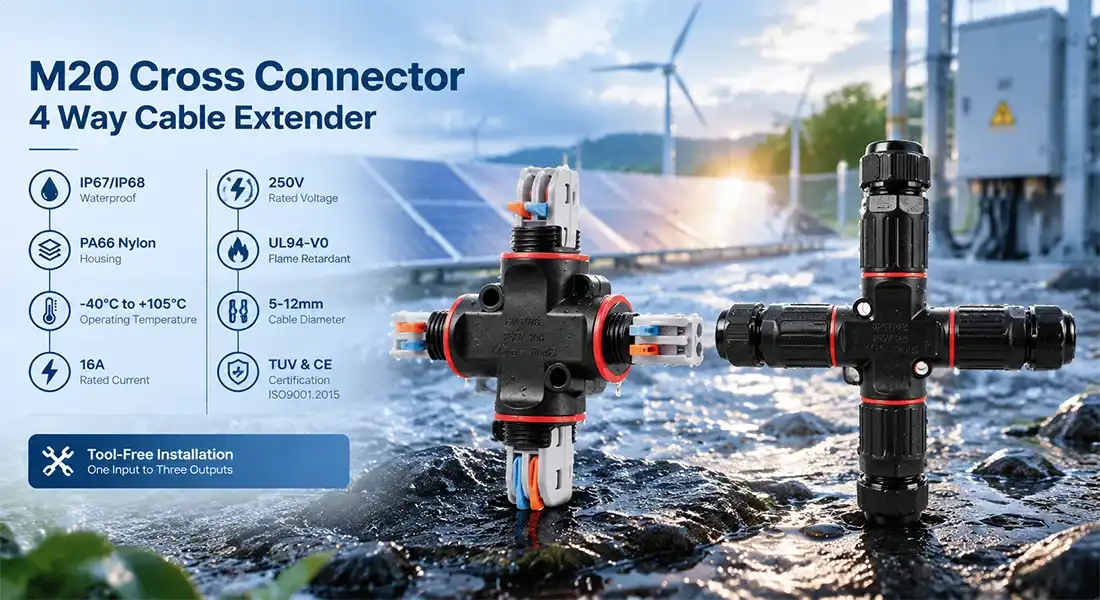
Choosing the wrong waterproof connector is a mistake that costs far more than the connector itself. From failed inspections to expensive field repairs on traffic monitoring poles, the consequences show up fast. One connector type that consistently solves multi-branch outdoor wiring problems is the M20 cross connector 4 way cable extender — a cross-shaped junction device rated IP67/IP68, built for one-input to three-output power or signal distribution. This guide walks through the most common selection errors, how to avoid them, and how to match the right connector to your exact project conditions.
Understanding Waterproof Connectors and Their Role in Industrial Applications
What Makes a Waterproof Connector "Industrial Grade"
Not every IP-rated connection should be used in a harsh area. True industrial-grade waterproof connectors are made of a single piece that is strong, works well electrically, and seals mechanically. The M20 thread standard, for example, creates a seal that keeps out air and water for cable diameters ranging from 5 mm to 12 mm, which includes most outdoor multi-branch wiring situations.
Key Technical Specifications That Actually Matter
The IP number doesn't tell the whole story. You should also look at the range of working temperatures, the material of the contact, the flame rating, and the resistance to shaking. It can handle a lot more stress in real life than a connection with a normal plastic shell that is rated for -40°F to +105°F. Gold-plated copper alloy contacts keep their low contact resistance over many years of use by preventing rust.
How the Wrong Selection Creates System Risk
Choosing a connection based only on price or looks can cause arc flaws, water to get in, and unplanned downtime. Many cameras or radar units can be lost at once if one crossing point fails in smart traffic infrastructure. It would cost a lot more to send a crew back up a 10-meter pole to replace a broken connector than to buy a cheaper part.
Common Mistakes When Choosing Waterproof Connectors and Root Causes
Mistake 1 — Ignoring the Real Environmental Conditions
A lot of buying teams choose an "IP67" grade without thinking about the specifics of the site, like whether there is salt fog near the coast, UV exposure in the desert, or constant vibrations near roads. Immersion up to 1 meter for 30 minutes is covered by IP67. IP68, which was tested at 4 meters for 72 hours, is the right measure for outdoor junctions that will stay open all the time and where water can collect. Not noticing this difference is the main reason why connectors fail too soon.
Mistake 2 — Confusing Connector Type and Load Compatibility
You can't use a 3-way splitter instead of a 4-way cross joint. When you need a cross-pattern distribution point and a Y-splitter, you have to route the cables in a weird way, put more stress on the system, and there's a chance that the pull-out force on each port will be too high. In the same way, using connectors that are designed for different amounts of power in the same circuit leads to hot spots and insulation failure over time.
Mistake 3 — Prioritizing Unit Cost Over Total Project Cost
Choosing a cheaper M20 cross connector 4 way cable extender without proof of third-party approval adds risk to the project testing stage. When a government infrastructure contract calls for TÜV or CE certificates and traceable batch reports, using parts that aren't verified can cause the project to be delayed and can void the guarantee on equipment that is used with them. When a project's schedule slips by weeks, the savings on buying things quickly become invisible.
Mistake 4 — Skipping Supplier Qualification
Not all connector providers follow ISO9001 quality control systems or allow batch tracking. If there aren't any written incoming inspection reports and consistent production controls, two connectors with the same part number may not have the same sealing torque or contact plating thickness. This lack of stability makes it hard for OEM developers who are making PLC cabinets or sensor networks to figure out where the problem is coming from.
How to Choose the Right Four-Way Waterproof Junction Connector
Define Your Load, Environment, and Cable Specifications First
Before you ask for a quote, write down the maximum voltage and current for each branch, the range of cable outer diameters, the installation environment (whether it's indoors or outdoors, UV exposure, or the risk of submersion), and the temperature ranges that the cables will be used in. For most monitoring and low-voltage power needs, a 250V/16A connector will work. For energy storage or heavy automation circuits, higher-density configurations that can handle up to 450V/24A are available.
Evaluate IP Rating, Certification, and Sealing Design Together
Here are the main things that should be looked at when choosing outdoor industrial junction connectors:
- IP rating with actual test data: Require the immersion test report, not just the printed rating. Cablein's M20 cross connector 4 way cable extender carries IP68 certification, tested at 4 meters for 72 hours, with documentation available on request.
- Third-party certifications: TUV and CE certification indicate compliance with European low-voltage directive requirements. ISO9001:2015 production management supports consistent quality across batches.
- Cable diameter compatibility: A 5–12mm accommodation range covers most field cable types without needing adapter sleeves.
- Anti-vibration locking mechanism: A locking nut that resists loosening under sustained vibration is essential for pole-mounted or machine-mounted installations.
When you look at these factors together, they give you a full picture of how well a connection works, not just whether it meets the requirements on paper.
Cross Connector vs. 3-Way Splitter: When to Use Each
In a T-shape, a 3-way splitter sends one input to two outlets. It works well for simple branch points with two devices. A cross-type four-way junction has an extra port that lets cables go in four different ways. This is important for pole placements where wires come in from below and need to reach cameras, radar, and extra lighting all at the same time. The cross layout also spreads mechanical pull forces over four entry points instead of three, which makes the building less stressed when it's windy.
Installation Best Practices for Waterproof Cross Junction Connectors
Cable Preparation and Seal Verification
For screw-terminal connections, the length of the wire insulation that needs to be stripped is usually 8–10 mm. Put the wire in until the conductor is all the way against the end. Make sure the silicone closing ring sits flat against the wire jacket after tightening it. Most IP seal failures in field installations are caused by a gasket that isn't lined up right. This can be easily avoided by looking at the seal before applying the final torque.
Torque, Strain Relief, and Port Sealing
Tighten the locking nut until it reaches the force range shown in the product description. For an M20 thread, this is usually between 2.5 and 3.5 Nm. When the seal is too tight, it deforms, and when it's too loose, it leaves a gap. Always use the provided blanking caps on ports that aren't being used. No matter what other locks are there, if a port is open, the assembly's IP rating drops to IP20 or less.
Post-Installation Verification Steps
Before closing the installation box, do a continuity check across each branch after the wiring is done. Then, use 500V DC to do a basic insulation resistance test between the conductors and the housing. If the work is going to be in a wet or high-humidity area, it's worth the extra time to do a 24-hour soak test with tracking to find any weak seals before the site is turned over.
Benefits of Sourcing High-Quality Connectors from a Verified Supplier
Total procurement risk is lower when you work with a verified industrial connector manufacturer. Cablein Technology was established in 2017 and is based in Shenzhen. All of its products are certified by TUV, CE, and ISO9001:2015. Each unit is tested for 100% waterproof performance at the 6,000-naira production facility before it is sent out. Each item is usually kept in stock in quantities of more than 10,000 pieces, and delivery takes 7–10 business days on average. For big purchases in smart traffic, new energy, or industrial automation, you can get custom pin setups and branch length variations with recorded engineering change control. This is necessary for OEM integration into branded equipment lines.
Conclusion
It's not enough to make assumptions when choosing a waterproof connection; you need to match the written specs to the real-world conditions. If you have a structured evaluation process, you can avoid making the most common mistakes, like ignoring real IP test data, skipping supplier qualification, and matching the wrong M20 cross connector 4 way cable extender geometry to the wrong installation layout. Check the test reports and certifications, and work with a supplier who can give you batch traceability, whether you're looking for parts for a solar monitoring array, a highway surveillance project, or an automation panel. That mix protects the project at every stage, from the acceptance review to the upkeep that will last for a long time.
FAQ
Q1: What is the maximum cable diameter the M20 cross connector supports?
Most M20 types have silicone sealing rings that can be switched out to fit wire outer sizes from 5 mm to 12 mm. To cover the whole range, Cablein has two types of seals: 5–9mm and 9–12mm.
Q2: Can a four-way waterproof junction connector be buried underground?
Yes, as long as the unit has an IP68 rating and has been tested for immersion. For direct burial, you also need armored or direct-burial-rated wire. In places with heavy loads on the ground or mechanical ground movement, it is best to add an extra protective conduit or enclosure.
Q3: Is the connector reusable after field rewiring?
Yes. The screw-terminal design makes it possible to disconnect and reconnect wires without damaging the housing or sealing parts. This is better than resin-filled or heat-shrink junction methods, which need to be replaced completely.
Q4: How do multi-layer silicone gaskets handle thermal expansion?
The high-elasticity silicone substance stays in contact with the wire jacket even when the outer sheath changes size due to changes in temperature. In the long run, this stops gaps from forming that would let water in.
Q5: Does the UL94-V0 flame rating meet project safety codes?
When the flame is put out, UL94-V0-approved housings put out the fire themselves within 10 seconds, with no dripping of burning particles. Most commercial and infrastructure electrical standards say that this meets the fire safety requirements.
Partner with Cablein for Your Next Waterproof Connector Procurement
The M20 cross connector 4 way cable extender units that Cablein sells are TUV/CE-certified and come with full batch tracking, project-scale bulk prices, and technical support for custom setups. We've been making things for 9 years, have more than 30 utility model patents, and offer normal delivery in 7–10 days. We can help buying teams from the sample stage all the way through the full project rollout. You can email our technical team at nick@cableinco.com to get datasheets or a quote that is tailored to your project.
References
1. International Electrotechnical Commission. IEC 60529: Degrees of Protection Provided by Enclosures (IP Code). IEC, 2013.
2. Underwriters Laboratories. UL 94: Tests for Flammability of Plastic Materials for Parts in Devices and Appliances. UL Standards, 2018.
3. International Electrotechnical Commission. IEC 60998-2-1: Connecting Devices for Low-Voltage Circuits — Particular Requirements for Connecting Devices as Separate Entities with Screw-Type Clamping Units. IEC, 2004.
4. International Organization for Standardization. ISO 9227: Corrosion Tests in Artificial Atmospheres — Salt Spray Tests. ISO, 2022.
5. Underwriters Laboratories. UL 746C: Polymeric Materials — Use in Electrical Equipment Evaluations. UL Standards, 2020.
6. National Electrical Manufacturers Association. NEMA 250: Enclosures for Electrical Equipment (1000 Volts Maximum). NEMA, 2020.