T-Shape vs. Straight Waterproof Connector: Which Design Is Right for Your Application?
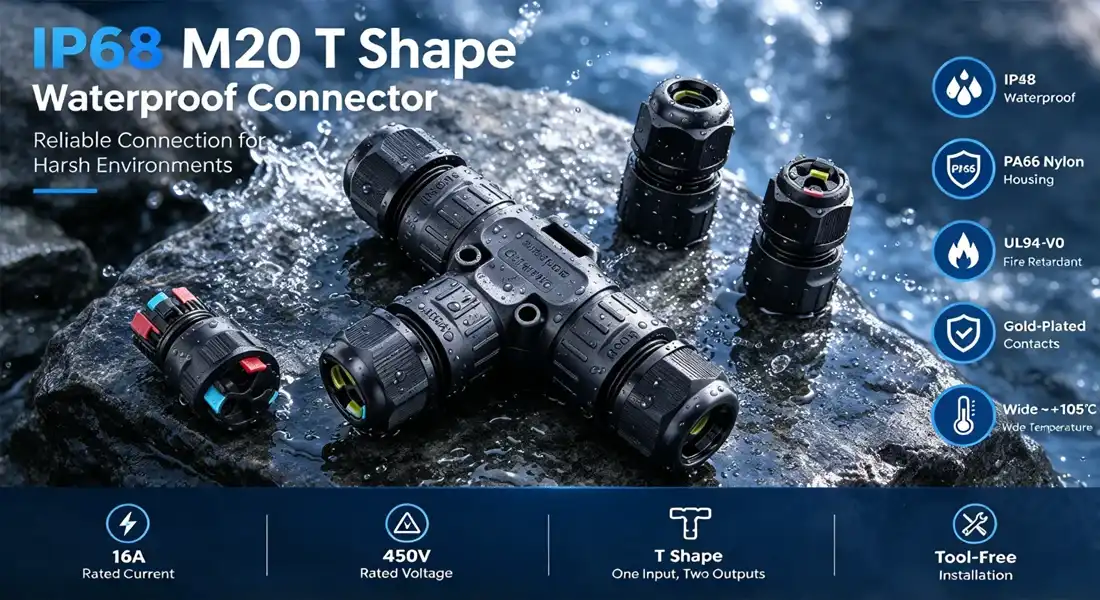
If you're choosing between a T-shape and a straight waterproof connector, the short answer is this: it depends on your wiring topology. A straight connector works well for single-line, point-to-point cable runs. A T-shape connector — such as the IP68 M20 T shape waterproof connector from Cablein — solves a fundamentally different problem. It splits one power or signal input into two outputs at a single junction point, eliminating the need for a separate junction box. For outdoor LED lighting, marine electronics, or renewable energy branch wiring, that distinction directly affects installation time, long-term sealing integrity, and maintenance cost.
Understanding IP68 M20 Waterproof Connectors
Before beginning the process of evaluating various forms, it is essential that you have a solid comprehension of what the M20 IP68 standard signifies for your performance in the field. This is very important. In order to get started, you need to have this comprehension. Acquiring this expertise is really necessary today. You will not be able to begin the process of assessment with any degree of success if you do not take this information into consideration.
What the IP68 Rating Means in Practice
In terms of IEC 60529 ingress protection, IP68 is the highest standard. It confirms that the item can be submerged continuously at least 1 meter deep for 30 minutes or more, based on what the maker says the rating is. Cablein's M20 T-shape connector is tested at 1.0 MPa hydrostatic pressure, which shows that it works better than the standard in real life. This is important for landscape lighting that is hidden in the ground or marine sensor nodes that are covered in water, where IP67 alone isn't enough.
T-Shape vs. Straight: The Core Structural Difference
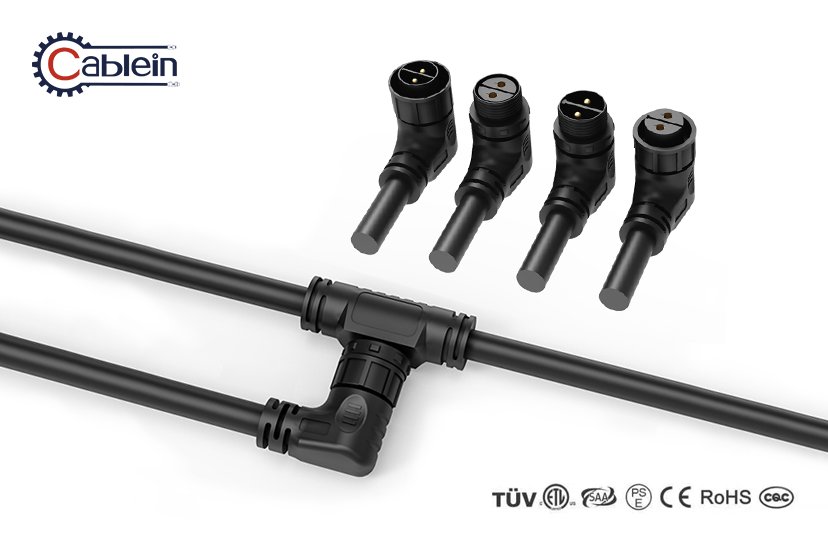
You can connect one cable to a straight waterproof plug and another cable to another one that is straight. A T-shape connection adds a third port that is perpendicular to the first two. This lets the main line go through without any problems, while the branch cable comes out at a right angle. This shape gets rid of the need for a separate enclosure at each split point, which is a big plus in layouts with lots of fixtures or limited equipment bays.
Where These Connectors Are Typically Used
M20 waterproof connectors are used in harbor lighting, outdoor LED landscape systems, solar PV sensor arrays, marine display electronics, and branch wiring for industrial automation. The T-shape version is designed for situations where one power feed needs to power two devices further down the line. This is a typical wiring pattern in daisy-chain LED fixture setups and distributed sensor networks.
Comparing T-Shape and Straight Waterproof Connectors: Design and Performance
In the event that an incorrect connection form is chosen for a project that has been successfully commissioned into operation, it will result in the appearance of difficulties that are difficult to resolve. It may be difficult to find a solution to these issues. It is possible that finding a solution to these problems will be challenging. That finding a solution to these problems can be difficult is a possibility that should be taken into consideration. A comparison of the two designs in relation to one another is shown in the following paragraphs, with the most significant aspects of each design being taken into consideration.
Structural Design and Space Use
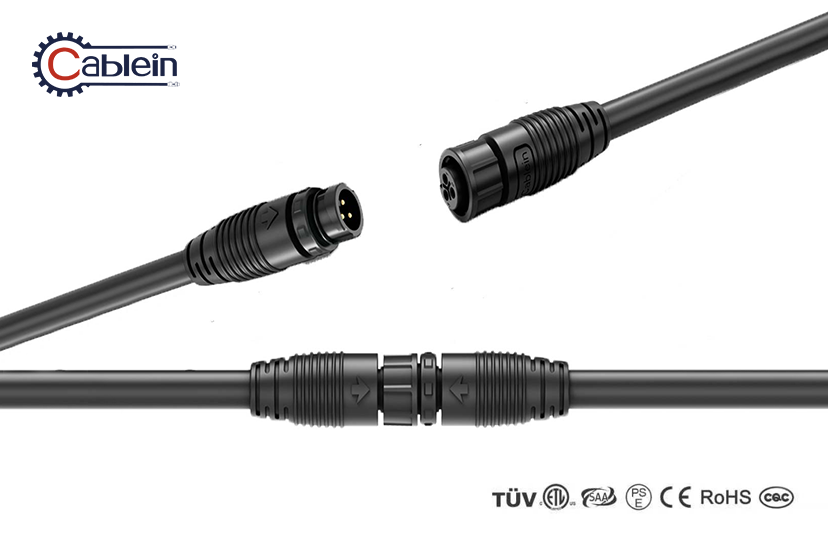
Straight IP68 M20 T shape waterproof connectors are compact along their axis, making them ideal for tight conduit runs or panel feedthroughs. T-shape connectors occupy a wider footprint due to the perpendicular branch port, but they replace what would otherwise require a separate IP-rated enclosure plus two additional straight connectors. In most branch wiring scenarios, the T-shape approach reduces total component count and installation labor.
Sealing Integrity at the Junction Point
The branch junction is where most waterproof connector failures originate. Cablein's M20 T-shape design integrates a silicone sealing gasket directly at the branch port, preventing moisture from tracking along the cable jacket into the main line. The snap-lock assembly applies consistent radial compression to the seal without requiring torque tools — a detail that matters when field electricians are working at height or in wet conditions.
Installation Speed and Maintenance Access
Tool-free termination is a measurable advantage. Independent testing on comparable snap-lock connectors shows installation time reductions of up to 60% compared to traditional screw-terminal junction boxes. Cablein's T-shape connector uses a snap-clip locking mechanism and accepts cable diameters of 5–9 mm and 9–12 mm across its dual-range ports, covering the most common LED fixture cable gauges without additional adapters.
How to Choose the Right Waterproof Connector for Your Application
As far as the wiring is concerned, what steps can you take to guarantee that everything is in its appropriate location? The manner in which you feel about this particular inquiry is one of the three real inquiries that will eventually decide who you select to go with. To what extent does the connection perform within the framework that it was supposed to serve? It is important to consider this. In order to accomplish the project that you are now working on, what specific kinds of licenses are necessary?
Assess Your Wiring Topology First
A straight M20 waterproof connector is the best and most cost-effective choice for a simple point-to-point run, with one power source and one device. With a T-shape connection, you don't have to buy an entire enclosure if your plan only needs one feed to power two fixtures or sensors at the same node. By drawing out your wire layout before choosing plugs, you can avoid over-engineering and spending money on things that aren't needed.
Match Environmental Ratings to the Actual Deployment Condition
Fixtures that are buried in the ground and marine parts that are submerged need IP68. Installations that are exposed but not submerged may work with IP67. The M20 T-shape connector from Cablein has both an IP67 and an IP68 grade. It has a UL94-V0 flame-resistant PA66 shell and can work in temperatures ranging from -40°C to +105°C. For areas near the coast or that get a lot of salt spray, make sure the supplier can show you proof of their salt spray test results. Cablein puts contacts through a 48–96 hour saline mist cycle.
Verify Certifications Against Project Specifications
Most European public infrastructure bids need CE and RoHS certifications. ISO 9001:2015 certification for production means quality control at the process level, not just checking at the product level. When you submit bids for projects like marine integration or city lights, having these papers on file from your connection provider speeds up the compliance review process by a lot.
Benefits and Challenges of T-Shape vs. Straight Waterproof Connectors
There are real pros and cons to both types of IP68 M20 T shape waterproof connectors. Understanding both helps you make the right choice.
Where T-Shape Connectors Excel
T-shape links are designed to handle branch distribution. Here are some of the best things about this design:
- One-input, two-output distribution at a single sealed junction point reduces enclosure count and lowers total installed cost in multi-fixture LED layouts.
- Perpendicular branch geometry keeps the main cable run straight and organized, which simplifies troubleshooting and reduces cable stress at the junction.
- Dual cable diameter compatibility (5–9 mm and 9–12 mm) means a single connector SKU covers both the main trunk cable and smaller branch cables without adapters.
- Tool-free snap installation compresses field assembly time and reduces the risk of under-torqued glands that compromise the seal.
These benefits directly address the types of failure that landscape and marine installation teams see most often: water getting into branch points, connectors coming loose from vibrations, and mistakes made while putting things together in the field under time constraints.
Where Straight Connectors Have the Advantage
Straight connections are easier to use, lighter, and usually cost less per unit. They work well for straight wire runs with no branches. Because it is simpler and costs less, a straight IP68 M20 connector is best for single-device sensor feeds, panel connections, or simple cable extensions. Putting a T-shape connector into a point-to-point application makes it bulkier and costs more than it needs to.
Procurement Insights: Sourcing IP68 M20 Waterproof Connectors
Choosing the suitable form and determining the connection that is relevant are both equally important in terms of the degree to which they are relevant. Both of these aspects are equally important. It is important for customers to take into consideration a wide variety of other factors in addition to the single assessment of the unit pricing when they are deciding which suppliers to work with.
Certification Documentation and Traceability
Your project is less likely to fail if your supplier can give you a CE declaration of conformity, RoHS compliance reports, and ISO 9001 audit certificates when you ask for them. Cablein keeps all the certification paperwork and lets OEM orders be tracked down to the batch level, which is necessary for marine electronics brands that use their parts in certified finished products.
OEM Customization and Minimum Order Flexibility
A lot of nautical and outdoor integration projects need pin configurations or branch wire lengths that aren't available in the catalog. Cablein can make unique pin setups and changes to branch lengths for OEM clients starting at 200 units, and it can handle project-scale orders from 300 to 3,000 units. More than 10,000 units of each SKU are in stock for standard configurations, and lead times are between 7 and 10 days.
Total Cost of Ownership vs. Unit Price
If a connector breaks in the second year of a five-year outdoor installation, the cost of repairs and work will be much higher than the difference in price between a cheap component and a certified one. If you look at IP68 M20 T-shape waterproof connector supplier trustworthiness, warranty terms, and written test procedures when choosing connectors, you will get better long-term results than if you only look at unit price.
Conclusion
The form of an IP68 M20 T shape waterproof connector is important for its function, not for its looks. Straight connectors work well for point-to-point, linear runs. The branch distribution problem can be solved by T-shape connectors at a single sealed node. This cuts down on the number of enclosures needed, the time it takes to install them, and the risk of long-term moisture entry. As far as technology goes, the M20 T-shape format with IP68 approval, PA66 housing, and tool-free snap termination is the best choice for outdoor LED landscape systems, marine electronics, and green energy branch wire. Make sure the connector design fits the way your wiring is set up, check that the certifications meet the needs of the project, and buy from suppliers who can show you how they handle quality.
FAQ
1. What is the difference between IP67 and IP68 for outdoor connectors?
IP67 certification means that the product is safe from water immersion for up to 30 minutes at a depth of 1 meter. IP68 certification enables continued submersion at the manufacturer-specified levels and for the lengths of time. IP68 is the right rating for landscape fixtures that are buried in the ground or marine uses that will be in water for a long time.
2. Can I use a T-shape connector if my cable diameters differ between the main and branch cables?
Yes, Cablein's M20 T-shape connection can handle cables with a diameter of 5 to 9 mm on one port range and 9 to 12 mm on another. This means that different cable gauges can be used on all three ports without the need for extra adapters or reducers.
3. Do I need professional installation for tool-free snap connectors?
The snap-lock design is made so that trained electricians can put it together in the field without special tools. For uses that need IP68 verification on a certified installation, like marine vessel integration, a qualified technician should make sure the glands are tight and the seals are in place before the installation is turned on.
4. How do I verify that a connector meets CE requirements for a public tender?
Ask your provider for the CE Declaration of Conformity and any EN standard test results that are needed. Cablein gives these papers to OEMs and people who place large project orders.
5. What is the typical service life of a PA66 waterproof connector in outdoor conditions?
With a UV-stabilized PA66 housing and silicone sealing, these connections should last 5–10 years when left outside in full sunlight, as long as they are installed correctly and the wire is properly supported.
Partner With Cablein for Your Next Branch Wiring Project
Certified IP68 M20 T shape waterproof connectors from Cablein Technology are used all over the world for landscape lighting, marine electronics, and renewable energy. We have been making products for 9 years, have more than 30 utility model patents, and keep our own CE/RoHS paperwork. We can handle large orders, make changes for OEMs, and send standard stock quickly (7–10 days). You can email our technical team at nick@cableinco.com to get product datasheets, samples, or a quote for a custom configuration.
References
1. International Electrotechnical Commission. IEC 60529: Degrees of Protection Provided by Enclosures (IP Code). IEC, 2013.
2. Underwriters Laboratories. UL 94: Tests for Flammability of Plastic Materials for Parts in Devices and Appliances. UL Standards, 2018.
3. European Committee for Electrotechnical Standardization. EN 61984: Connectors — Safety Requirements and Tests. CENELEC, 2009.
4. International Organization for Standardization. ISO 9001:2015 Quality Management Systems — Requirements. ISO, 2015.
5. ASTM International. ASTM B117: Standard Practice for Operating Salt Spray (Fog) Apparatus. ASTM, 2019.
6. Brydson, J. A. Plastics Materials, 7th ed. Butterworth-Heinemann, 1999.