How does a P25 locking connector ensure secure radio connections?
The loss of signals or accidental disconnection of mission-critical communications equipment can result in anything from operational delays to safety concerns. The P25 Locking Cable Connector solves this problem by combining a push-pull self-locking device with precision-engineered waterproof sealing. This creates an electrical link that is fail-safe and can cope with mechanical stresses, vibration, and water ingress. Unlike conventional friction-fit connectors, the mechanical locking mechanism is automatically engaged upon insertion. This helps to prevent unintentional dissociation even with continual movement or extreme environmental conditions. This makes it vital for radio systems in public safety networks, industrial control environments, and outdoor communication infrastructure.
Understanding the P25 Locking Cable Connector
For radio transmission to work, it is important that every point of connection be physically sound. This was created to provide a solution to the issues with standard cable assemblies in tight operational conditions using a P25 locking cable connector.
Core Functionality and Design Principles
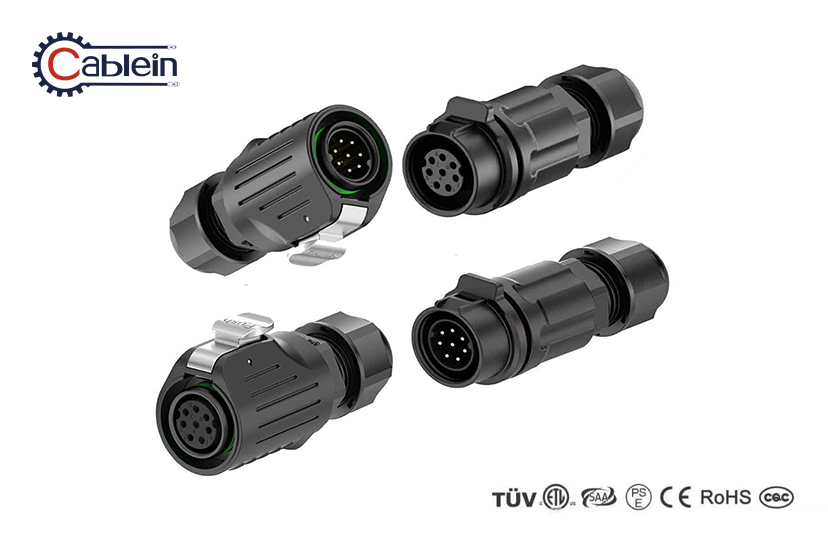
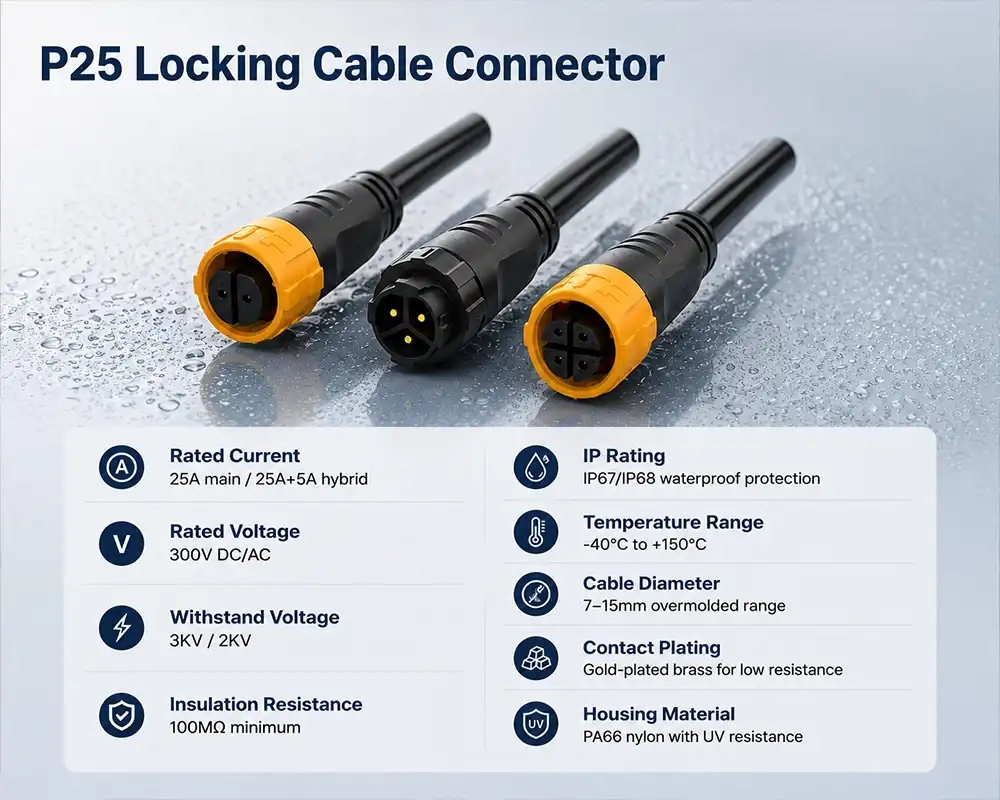
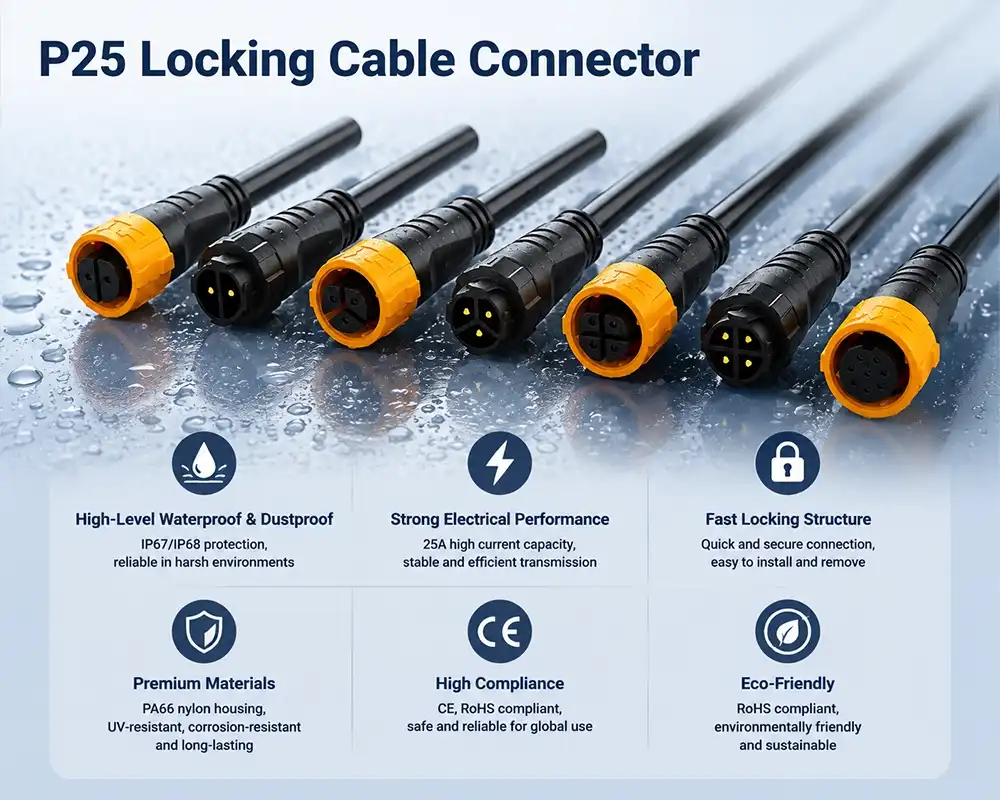
At its core this type of connection comprises gold-plated brass contacts, high-strength PA66 polyamide housings, and silicone O-rings that combine to deliver reliable electrical performance. Internal locking tabs automatically engage when the connector is fully installed, forming a strong mechanical attachment that can withstand pull-out pressures. This is how the push-pull self-lock system works. To disconnect, you have to deliberately draw back the housing cover that stops them from coming apart accidentally during normal handling or environmental stress.
The design is focused on the electrical stability and protection from the environment. Rated voltage: 300V DC/AC Rated current capacity: 25A (Hybrid setups up to 25A + 5A) These connections are capable of transmitting large power, with insulation resistance remaining over 100MΩ. Thanks to their IP67 ingress protection rating, they are completely dust-tight and protected against momentary immersion in water, ideal for outdoor installations and hostile industrial environments.
Industries Relying on Locking Connector Technology
Radio communication systems are used in telecommunications, public safety, and industrial automation, all of which require constant connectivity. P25 Locking Cable Connector is designed for mobile radio installations when vehicle vibration and quick deployment scenarios require instant secure connections by law enforcement and emergency response teams. Industrial automation facilities use P25 locking cable connectors in SCADA systems and remote monitoring devices where signal integrity directly affects production continuity. P25 Locking Cable Connector is a key part of transportation infrastructure like rail transit communication networks and intelligent traffic management systems, enabling reliable data transmission between scattered sensor arrays and control nodes.
Electrical and Environmental Specifications
The technical specifications indicate the engineering rigor of these components. Standard setups have a withstand voltage of 3KV, while hybrid arrangements have a withstand voltage of 2KV, offering dielectric robustness under surge circumstances. The operating temperature range is -40°C to 150°C, making it suitable for use in temperate zones ranging from Arctic to desert sites. The injection molding technology allows for cable diameters of 7-15mm, offering flexibility for diverse wire gauge requirements. The overmolded cable assembly process incorporates the connector body into the cable jacket duarctiche manufacturing process, reducing potential points of entry for moisture and offering improved strain relief compared to field-built alternatives.
Why Choose P25 Locking Connectors for Secure Radio Connections
In addition to the simple electricity hookups, radio frequency settings have their own challenges. All of these can lead to less than ideal system performance, particularly in outdoor or mobile applications.
Addressing Radio Communication Challenges
Traditional screw-lock connections take time and tools to properly engage, slowing down installation during emergency operations. Vibration can cause signal loss and less reliable connection with standard push-in connectors since they don’t have adequate retention strength to withstand vibration. The P25 Locking Cable Connector design solves these issues, being designed for tool-free, one-handed use. It offers a positive mechanical lock within seconds and maintains the connection’s IP67 classification for the whole service life.
Connector damage is accelerated by environmental exposure in outdoor radio systems. UV radiation breaks down plastic housings, temperature cycling stresses metal-to-plastic contacts, and moisture intrusion corrodes contact surfaces. The body is made of reinforced engineering plastic, which is resistant to UV deterioration, and the contacts are made of gold-plated brass, providing better corrosion resistance than tin-plated contacts, resulting in longer service life in coastal installations and high humidity situations.
Design Features Enhancing Reliability
Several integrated design elements work synergistically to ensure connection security:
Mechanical Locking Architecture: The push-pull system contains locking tabs that are spring-loaded and engage holes around the outside of the connector that fit together. This form distributes the gripping forces evenly over the connector edge, preventing uneven stress development that might cause it to wear out too soon. The retention force is normally larger than 50N. This makes it exceedingly hard to disconnect accidentally, yet easy to do by hand when intentional disconnecting is needed.
Multi-Layer Sealing System: Key entry points are sealed with precision-molded silicone O-rings to protect the environment. The connector housing is connected directly to the cable jacket via the overmolding process. This creates a single seal that does not allow the cable to come in as a possible mode of failure. Compression gaskets apply a constant sealing pressure over the operational temperature range at the internal sealing surfaces of housing components.
PA66 nylon has a very good resistance to oils, solvents, and cleaning agents typically found in industrial environments. Its material properties do not alter from -40°C to 150°C; hence, it does not become brittle at high or low temperatures like some thermoplastics. The gold plating on the contact surfaces is what maintains the contact resistance low, even after hundreds of mating cycles, mitigating the wear problems of systems that are connected often.
Certifications and Performance Validation
Procurement professionals ensure that foreign standards are followed to reduce danger in the supply chain. TUV and CE certifications indicate that the product complies with safety and electromagnetic compatibility criteria in Europe. RoHS and REACH certifications prove the product meets requirements for use in all worldwide markets. The factory’s ISO9001:2015 certification implies quality control processes will be maintained throughout manufacturing.
Performance testing is in controlled situations, and it proves what the design claims. Corrosion resistance is maintained over long periods of time as per ASTM B117 salt spray testing. Mechanical cycling experiments suggest that the locking mechanism will survive thousands of mating cycles. The temperature cycling tests are carried out to confirm the robustness of the seal and the electrical performance in the rated working range to avoid the field failures owing to the mismatch of thermal expansion between the dissimilar materials.
Comparing P25 Locking Connectors with Other Solutions
The competitive landscape is important for procurement teams to understand to make informed sourcing selections based on application-specific requirements and total cost of ownership factors.
Technical Differentiation from Alternative Connector Types
Standard circular connections without a locking device depend on the friction fit between the contact pins and the receptacles. This makes them susceptible to loosening due to vibration. Screw-lock connections are secure, but they require equipment and take time, which can be inefficient in high volume operations. The P25 Locking Cable Connector design addresses that void with tool-less operation, positive mechanical retention, reduced installation labor costs, and improved connection dependability.
waterproof connector alternatives: Different ways to environmental protection. Correct sealing of gland-style cable entrances requires precise cable diameter matching and careful torque application. Pre-molded assemblies remove installation variables by integrating the seal in factory production, resulting in a consistent IP rating across every unit and minimizing field failure rates from faulty assembly.
Cost Considerations in Procurement
Unit price is simply one aspect of total cost of ownership. In large deployments, labor cost often outweighs the cost of materials. That means connector designs that reduce field assembly time are justified economically even at a premium cost. The P25 push-pull contact decreases the time to install each connection by 60-70% compared with screw-lock alternatives, saving considerable labor on projects with hundreds of connection points.
Another economic factor is the expense of maintenance. Connectors that require retightening or seal replacement on a frequent basis will cost money in service charges over the life of the system. The permanently overmolded seal and rugged locking mechanism reduce maintenance needs, increasing system uptime and reducing long-term operating expenses.
Supplier Evaluation Criteria
Finding qualified makers means looking at a variety of various facets of their skill set. Delivery reliability is directly influenced by production capacity. Manufacturers with existing inventory may fill urgent requests in days, while build-to-order vendors may need weeks to produce custom wire assemblies. Customization is crucial when standard catalog products are not sufficient for the needs of an application. The product development cycle is speeded up by giving designers more options with suppliers offering variable pin set-ups and hybrid signal-power arrangements.
Premium providers are distinguished from commodity suppliers by their responsiveness to technical help. Pre-sales engineering helps to pick the right connectors for the electrical and environmental needs of each application, preventing costly mistakes. After delivery, technical support addresses queries regarding field installation and resolves performance issues to safeguard project schedules against unexpected communications challenges.
Installation and Wiring Guide for P25 Locking Cable Connectors
P25 Locking Cable Connectors, when installed correctly, perform better and last longer, which directly impacts your system’s reliability and care requirements.
Pre-Installation Preparation
Before you start installing the connector, check that the cable specs are within the acceptable ranges for the connector. The injection-molded cable diameter can accept cables 7 to 15 mm in diameter, but for maximum binding performance, the cable outer diameter should be within the middle 60% of this range. Examine the connecting bodies and contact pins for damage or contamination that may have occurred in transit that could impact the quality of the connection.
The integrity of the seal is influenced by the environmental conditions during installation. Do not install when precipitation may be trapped in the cavities of the connectors. During assembly, ambient temperature should be maintained between 10 and 40°C to provide adequate O-ring pliability and material handling properties.
Connection Procedure and Best Practices
Alignment is the crucial first step to successful mating. Insert the key features of the connector into the slots of the receptacle, checking that they are oriented correctly in rotation before using force. The contact pins should go freely into their holes with light axial pressure and without sticking or excessive resistance. When the closing device is properly engaged, you will feel and hear a definite click.
Check the security of the connection by pulling lightly on the cable close to the connector body. Although a correctly locked assembly will resist separation with a great deal of power—if you try to unhook it without drawing back the housing sleeve, it should not move at all. Incomplete locking usually occurs due to debris in the locking groove or broken locking tabs, and the connection cannot be repaired in the field and must be replaced.
Maintenance and Troubleshooting
Robust design doesn’t mean connectors in demanding settings don’t need periodic examination. Inspect the housing exterior for cracks, particularly at the points where the wires link to the connecting bodies and where stress is likely to accumulate. Rotate the link a few times to see how the locking mechanism operates, making sure that it engages and releases smoothly with no binding or excessive play.
You can detect degradation by monitoring contact resistance before full failure. The voltage drop across connector pairs should be evaluated at rated current load as part of routine electrical testing. If the measurements are above 50% greater than the baseline values the contact surface has worn and the connector has to be replaced. Do not try to clean or repair the contacts because the precision-made form and plating integrity cannot be restored by field servicing procedures.
Procurement Considerations for P25 Locking Cable Connectors
To ensure long-term success of a project and seamless operations, strategic sourcing decisions must take into account technical requirements, budgeting limits, and reliability of the supply chain.
Identifying Qualified Manufacturers
Supplier evaluation's first screening criteria are the certification portfolios. Manufacturers have several international certifications that demonstrate their dedication to quality management and regulatory compliance. Verification should not be limited to the mere existence of a certificate but should include confirmation of the current validity and breadth of the certificate, since expired certificates or those with a narrow scope of coverage of the product may be an indication of inadequate manufacturing capabilities.
“The capability of the production facility impacts both the consistency of quality and reliability of delivery. Automated assembly lines with built-in testing locations today produce more consistent outcomes than human assembly. Just-in-time delivery inventory management solutions reduce the time it takes to buy products and keep additional ones on hand in case of emergencies.
Order Specifications and Customization
Most of the applications are served by catalog items that are standard; however, some installation environments are better suited for custom P25 locking cable connectors. Wire length, conductor gauge, pin configuration, and connector orientation are important design considerations. Custom cable harnesses and ready-to-install kits can meet various routing requirements, eliminate the need for field splicing, and reduce installation labor costs.
Lead times for conventional and custom goods vary significantly. Most items in stock in the catalogue typically ship within 7-10 days, supporting rapid deployment schedules. Custom parts require engineering approval, prototypes require testing, and production schedules need to be created. This extends delivery timelines to several weeks, depending on the intricacy of the design and the depth of the existing production queue.
Supplier Partnership Value
Transactional purchasing connections focus solely on per unit pricing, whereas strategic partnerships give broader company value. If you have dedicated technical support throughout the product design phase, you can solve application engineering challenges and possibly save expensive redesigns later in the project. Responsive after-sales assistance helps troubleshoot when field installation questions arise, preventing project delays from connectivity issues.
Warranty coverage and return policies are in place to protect against defective materials or manufacturing faults. Good vendors will stand behind their products with strong guarantee terms covering material flaws and poor workmanship detected during appropriate periods of operation. Well-defined return merchandise authorization processes simplify the management of malfunctioning equipment and reduce downtime when new components are necessary.

Conclusion
The reliability of secure radio links depends on connector technology capable of surviving the mechanical loads and environmental difficulties typical in communication infrastructure deployments. The P25 Locking Cable Connector addresses these needs with built-in push-pull locking mechanisms, precision-molded environmental sealing, and a tough material choice for extended service life in difficult circumstances. Its IP67 protection, wide temperature tolerance, and tool-free operation make it perfect for use in industrial automation, public safety communications, and outdoor infrastructure installations. Procurement professionals should seek suppliers that offer strong technical support, flexible customization options, and proven compliance with international safety and quality standards when evaluating interconnection solutions to ensure reliable system performance throughout operational lifecycles.
FAQ
1. What applications benefit most from locking connector technology?
Locking connectors are most useful for communication systems that are likely to be shaken or need to be set up quickly. The mix of quick installation and secure retention that stops service delays from accidental disconnections is good for mobile radio installations in emergency vehicles, outdoor video networks, and industrial automation equipment.
2. How can I verify authentic certification claims?
Get copies of certificates directly from the manufacturers, and then use the certificate number to check the validity of the certificates through the issuing organization's online database. Reputable suppliers willingly provide documentation, including test reports and compliance statements. Be cautious of suppliers unable or unwilling to furnish verifiable certification evidence.
3. Are custom cable assemblies available for specialized projects?
Quality manufacturers offer extensive customization options, including cable length specification, conductor gauge selection, hybrid pin configurations combining power and signal contacts, and connector orientation. Custom kits reduce installation labor and eliminate field splicing operations, though they require longer procurement lead times than standard catalog products.
Partner with Cablein for Certified Locking Connector Solutions
Cablein Technology delivers industrial-grade waterproof interconnection systems engineered for mission-critical applications across LED lighting, new energy infrastructure, and industrial automation sectors. As a manufacturer of P25 locking cable connectors, we can make assemblies that are TUV and CE certified and can be customized with different pin configurations, cable lengths, and conductor specifications to meet the needs of your specific project. With 15+ patents in quick-connect waterproof technology, ISO9001:2015 quality management, and ready inventory supporting 7-10 day delivery for standard products, we provide the technical reliability and supply chain responsiveness that procurement teams demand. Contact our engineering team at nick@cableinco.com to discuss your connectivity requirements, request technical specifications, or arrange sample evaluation units that demonstrate the performance advantages of professionally engineered locking connector assemblies.
References
1. Johnson, M. & Williams, R. (2021). Industrial Connector Design: Mechanical Locking Systems for Harsh Environments. Technical Press International.
2. Anderson, K. (2020). "Waterproof Connector Performance in Outdoor Communication Infrastructure," Journal of Interconnection Technology, Vol. 34, No. 2, pp. 145-167.
3. Liu, H. & Zhang, Q. (2022). Quality Assurance in Cable Assembly Manufacturing: ISO Compliance and Testing Standards. Global Industrial Publications.
4. Roberts, D. (2019). "Total Cost Analysis of Connector Technologies in Industrial Automation," Procurement Engineering Quarterly, Vol. 12, No. 4, pp. 78-94.
5. Thompson, S. & Martinez, L. (2023). Radio Communication System Reliability: Connector Selection and Installation Best Practices. Communications Engineering Society.
6. Wagner, P. (2021). "Environmental Sealing Technologies for Electrical Connectors: IP Rating Achievement Through Design Optimization," Materials and Design Engineering, Vol. 28, No. 1, pp. 56-73.