How to Connect MC4 Connectors on Solar Panels: DIY Guide
Connecting an MC4 solar connector correctly is one of the most critical steps in building a reliable photovoltaic system. These standardized single-contact DC connectors—originally developed by Multi-Contact (now Stäubli)—secure the electrical pathways between panels, inverters, and battery storage units. A poorly crimped or mismatched connection can trigger arc faults, accelerate corrosion, and reduce system output by measurable percentages. This guide walks procurement engineers, installers, and OEM buyers through every stage of the process, from component selection to final waterproof verification, so every connection performs as intended over a 25-year service life.
Understanding MC4 Solar Connectors: Key Basics for Procurement and Installation
Before you use a crimping tool, you should know what makes a solar connection legal and one that isn't. This will help you avoid costly field failures.
What Makes an MC4 Connector a Technical Standard?
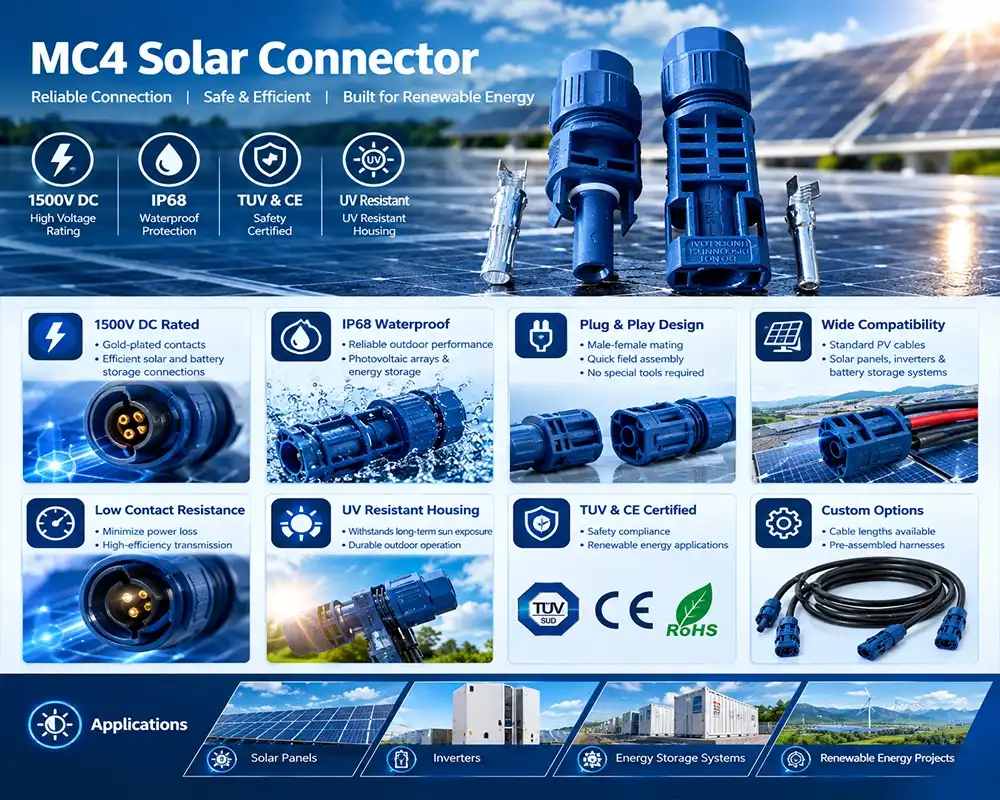
The "MC4" number refers to Multi-Contact's 4mm contact pin, which is now the standard shape in the business. Certified connectors need to meet the standards set by IEC 62852 and UL 6703. These standards cover things like dielectric strength, pull-out force, and contact resistance (≤0.25mΩ initial). Most housing is made of PPO or polycarbonate that has a fire safety rating of UL94 V-0. The operating temperature range is from -40°C to +85°C, and the IP67 or IP68 waterproof rating keeps dust out and water out for a long time, which is important for ground-mount and floating solar installations. This MC4 solar connector works with cables that are 2.5 mm² to 6.0 mm² (or 14 AWG to 10 AWG in US units).
Key Specifications That Procurement Teams Must Verify
Certification marks, voltage rating, and current capacity all have a direct effect on project approval and insurance compliance. Connectors that can handle 1500V DC are now the standard for current utility-scale arrays. When 1500V string designs use connectors that are only designed for 1000V DC, they break the code. The TUV and CE marks show that the product has been checked by a third party, and RoHS compliance meets the environmental needs of buyers who want to sell.
Step-by-Step Guide to Connecting MC4 Connectors on Solar Panels
The most common types of failure are cold crimps, partial contact, and seal damage. A methodical fitting process gets rid of all of them.
Tools and Materials Required
You will need a professional MC4 solar connector crimping tool (ratchet-type, calibrated to connector specifications), a wire stripper set for PV cable gauges, a digital multimeter, a continuity tester, and a genuine MC4 disconnect tool before you start. Don't use general crimpers instead; crimps that pass eye inspection but fail pull-out force tests at 80N will have the wrong die geometry.
Cable Preparation and Crimping
The end of the PV wire should have 5–7 mm of insulation taken off. No more, no less. Put the bare conductor all the way into the metal contact pin until it sits flat. Crimp using the die shape that was given. A good ratchet crimper won't let go until the right amount of compression force is applied. This keeps the clamp from under-crimping. Check the crimp visually to make sure there is no tearing in the strand, insulation stuck inside the barrel, or pin body deformation.
Housing Assembly and Locking Verification
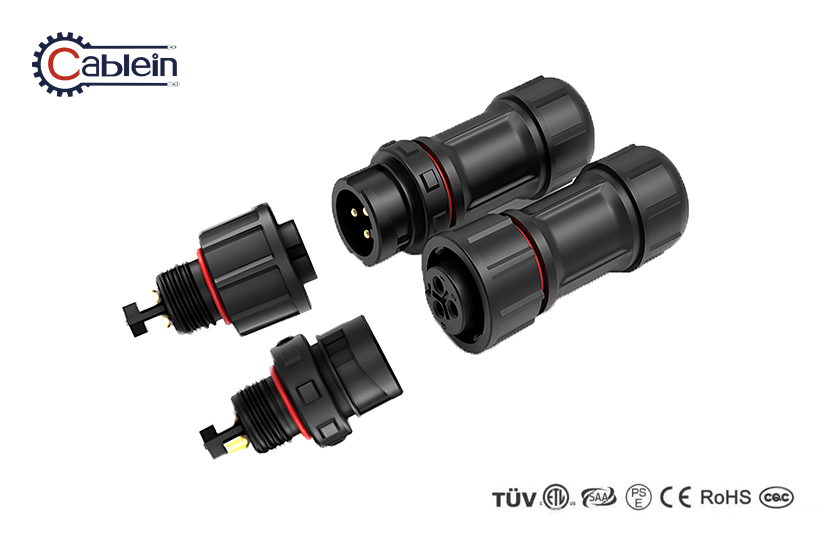
Before you put the crimped contact into the connector body, thread the cable gland nut onto the wire. From the back, slide the contact into the housing until you hear and feel a click. This means the retention clip is in place. To finish the IP68 seal, tighten the cable gland to the torque listed in the datasheet, which is usually between 2.5 and 3.0 N·m. Connect the male and female halves until you hear a second click, which means they are fully engaged. Without the disconnect tool, you can't pull them apart by hand if they are properly locked together. Before turning it on, do a continuity test and make sure the voltage output fits the figures for the expected string.
Here are some of the most common mistakes that should not be made during installation:
- Mixing connector brands — Cross-mating connectors from different makers, even if they both say they are MC4 compatible, creates tolerance gaps that raise contact resistance and increase the risk of heat failure under long-term load.
- Skipping the gland torque step — A cable gland that isn't tight enough lets water seep into the housing over time, going around the IP seal completely.
- Using a wrong crimp die — If you use the wrong die, it leaves tiny holes in the crimp barrel that get bigger when the temperature changes and raise the resistance of the contact over time.
Avoiding these three mistakes accounts for the majority of field-preventable MC4 failures identified in installation audits.
Comparing MC4 Connectors to Alternative Solar Connectors for B2B Procurement
Knowing the competition helps procurement managers explain to stakeholders and tech teams why they chose the specifications they did.
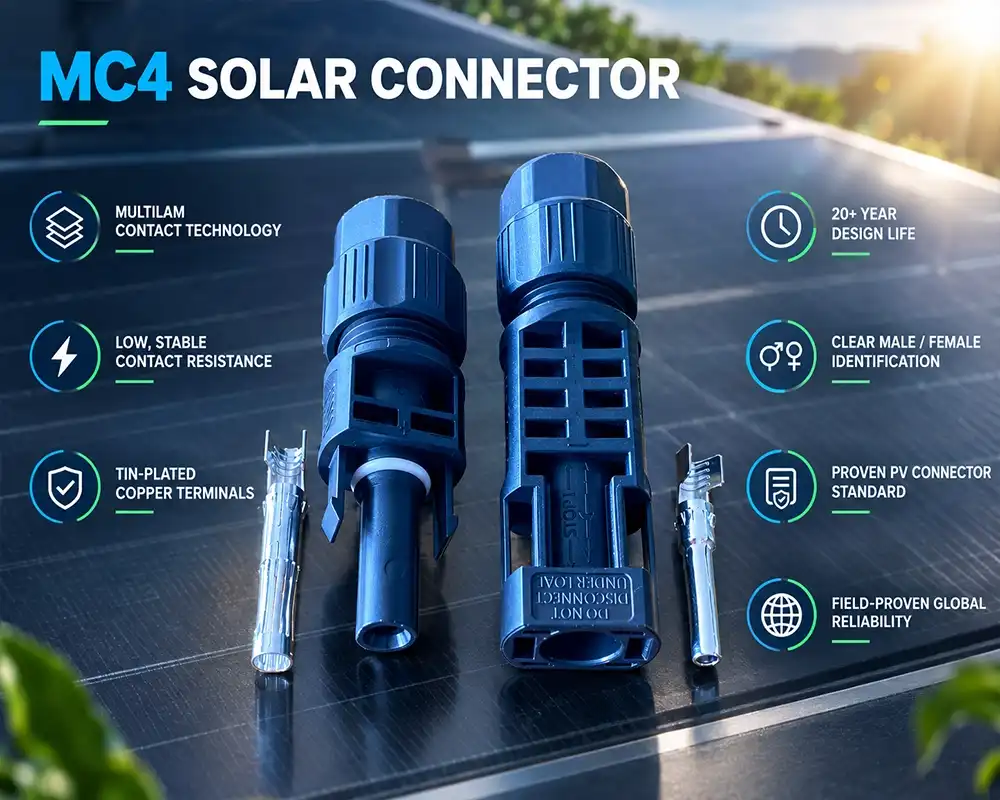
The original MC4 solar connector from Stäubli is the standard when it comes to contact shape, locking force, and long-term seal performance. Both Amphenol's Helios H4 series and TE Connectivity's Solarlok claim to be inter-compatible, but their disconnect tools are still unique. Anderson connectors work well for DC uses with lower voltages, but they don't have the IP67+ grade that outdoor strings need to be exposed to the weather. Listing connectors are required by the NEC 2020 code for business rooftop and utility-scale projects in the US. This means that UL 6703 approval is a must-have for purchasing.
The MC4 solar connector line from Cablein Technology is approved by TUV and CE, can handle 1500V DC, and has gold-plated contacts with contact resistance below 0.2mΩ, which is higher than the IEC 62852 level. The UV-resistant PPO housing stays mechanically sound from –40°C to +115°C, which includes the harshest climates in North America. Pre-assembled harness choices cut down on the time needed by field workers for big installations by a large amount.
Procurement Insights: How to Source Genuine MC4 Solar Connectors Online and Wholesale
It is known that fake PV connectors can cause fires. In 2019, TÜV Rheinland released results showing that connectors that were not certified often failed IP tests and had contact resistance values 10x higher than what was required. When buying in bulk, buyers should choose sellers who offer real certifications, not just logos on the packages that say they are certified.
To find the best wholesaler of MC4 solar connectors, make sure they have the following: original TUV or UL test results (not copies), ISO 9001:2015 quality management certification, published datasheets with contact resistance and pull-out force values, and enough in-stock items for emergency orders. Cablein keeps more than 10,000 units of each SKU in stock, and normal shipping is 7–10 days. OEM/ODM harness choices are available for custom wire lengths and pin configurations for each project.
Maintenance, Troubleshooting, and Safety Tips for MC4 Solar Connector Systems
Commercial systems must have their photovoltaic connectors inspected once a year; this is not a choice but a best practice supported by IEC 62446 licensing standards. Check for color changes that could mean heat damage, cracked housing that could mean UV damage, and signs of water getting in (white mineral deposits near the seal). Any contact that has visible corrosion needs to be replaced right away; corroded contacts in a string of high-current contacts create hotspots that can be seen with thermal imaging.
If there is a drop in voltage in a string that was working fine before, separate each pair of connectors and check the resistance across the point where they meet. Any number over 1mΩ should be replaced. Always turn off the power to the string and use the proper MC4 solar connector disconnect tool. Never use a screwdriver to pry mated connectors apart; this breaks the locking geometry and makes the waterproofing useless.
Conclusion
Three things make photovoltaic connections reliable: the quality of the parts, the right way to place them, and regular upkeep. Using a certified, properly crimped MC4 solar connector with a lock contact sound and a confirmed IP68 seal lowers the risk of an arc fault, lowers resistive power losses, and increases the system's useful life. Procurement teams can avoid project delays and compliance fails by giving priority to suppliers with clear certifications and confirmed stock depth. The connection line from Cablein Technology meets all the necessary standards and gives large-scale and OEM buyers the customization options they need.
FAQ
Can MC4 connectors from different brands be paired together?
Cross-mating is not recommended by the business. Different brands' manufacturing limits change the shape of the contact and the force of the seal. TÜV Rheinland makes it clear that putting together different brands of MC4 solar connectors can lead to high contact resistance and thermal failure. Use matched pairs that come from a single checked source.
What cable sizes work with standard MC4 connectors?
Most certified connectors can fit PV cables that are 2.5 mm to 6.0 mm wide, which is 14 AWG to 10 AWG. Always check the datasheet before crimping. Using a wire that is too big will deform the crimp barrel and weaken the pull-out force for the MC4 solar connector.
How do I confirm the connector is fully locked?
A genuine MC4 solar connector makes a click sound when it connects and needs a disconnect tool to break. You can tell that the locking retention clip is not working right if you can pull the mated pair apart by hand.
What causes an MC4 connector to overheat?
Most of the time, overheating is caused by a bad crimp that makes the contact resistance high. When there is a steady current, resistance converts electrical energy into heat. To avoid damage to the insulation and a fire risk, immediate inspection and replacement are necessary.
How long do MC4 connectors last outdoors?
Certified connectors that have been tested to IEC 62852 are guaranteed to work outside for 25 years if they are placed properly and have the right UV-resistant housing.
Source Cablein MC4 Connectors for Your Next Solar Project
Cablein Technology sells MC4 solar connectors that are TUV and CE certified and can work with 1500V DC systems. These connectors are waterproof (IP68), have gold-plated contacts, and are built to withstand harsh outdoor conditions with UV-resistant housing. Our team offers solid wholesale prices, stable stock, and full OEM/ODM support, whether you need a lot of connector pairs or custom setups that are already put together. To get a datasheet, trial order, or bulk price right away, email our engineering team at nick@cableinco.com or go to connectorswaterproof.com.
References
1. International Electrotechnical Commission. IEC 62852: Connectors for DC-application in photovoltaic systems. IEC, 2014.
2. Underwriters Laboratories. UL 6703: Connectors for Use in Photovoltaic Systems. UL Standards, 2021.
3. Stäubli Electrical Connectors. MC4 Connector Technical Documentation. Stäubli, 2022.
4. National Fire Protection Association. NFPA 70: National Electrical Code (NEC) 2020 Edition. NFPA, 2020.
5. TÜV Rheinland. Safety of PV Connectors: Test Results and Market Analysis. TÜV Rheinland Group, 2019.
6. International Electrotechnical Commission. IEC 62446-1: Photovoltaic (PV) Systems – Requirements for Testing, Documentation and Maintenance. IEC, 2016.