MC4 Connector: The Complete Guide to Solar PV Connections
When your solar installation demands reliability that lasts decades, choosing the right photovoltaic connector becomes critical. The MC4 solar connector has emerged as the industry-standard single-contact electrical connector used globally for connecting photovoltaic panels in strings. Originally developed by Multi-Contact (now Stäubli Electrical Connectors), this snap-in locking device solves critical challenges including DC arc-fault risks, thermal expansion failures, and environmental ingress. Our experience working with utility-scale projects and commercial rooftop installations has shown that proper connector selection directly impacts system efficiency, safety, and long-term operational costs.
Understanding MC4 Solar Connectors: Basics and Specifications
What Makes MC4 Connectors Essential for Solar Systems
"Multi-Contact" is what MC4 stands for, and the pins have a diameter of 4mm. Solar panels, inverters, and battery storage systems all join to these MC4 solar connectors in very important ways. Their snap-in locking system makes a strong link that you can hear and feel. That click you hear every time makes sure they're mated correctly. MC4 solar connectors allow plug-and-play field assembly without the need for special tools for initial connection, which is different from traditional wiring methods that take a lot of work and specific skills.
Technical Specifications That Matter for Your Projects
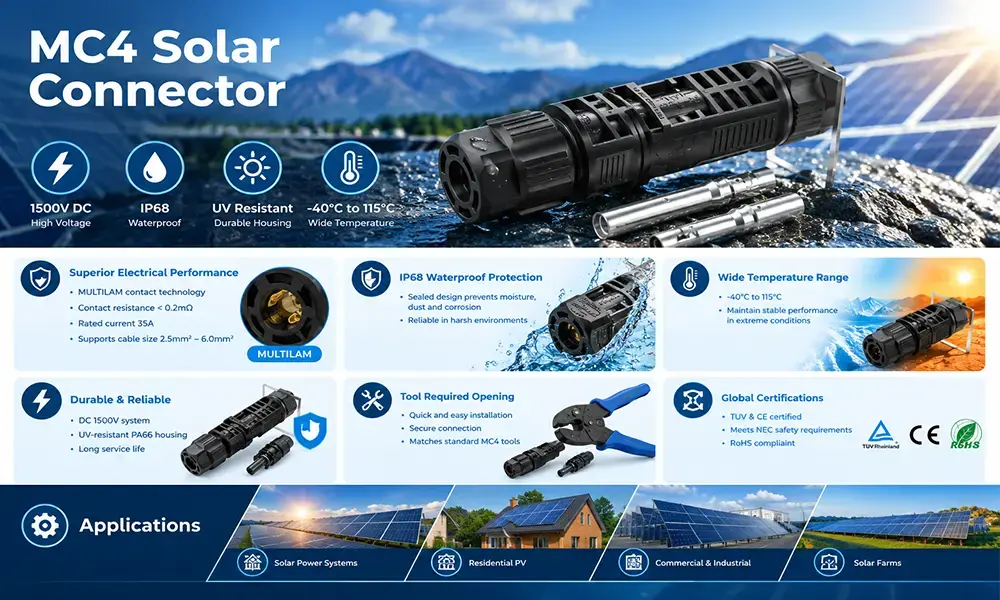
To be as efficient as possible, modern solar systems work at voltages that are rising all the time. Good MC4 solar connectors can handle 1500V DC systems, which helps with the move to large-scale setups. The gold-plated contacts make sure that power is transferred efficiently while keeping contact resistance below 0.2mΩ, which makes this product much better than generic alternatives. When joining many strings across big arrays, this low resistance is very important because higher resistance causes more heat to build up and more power to be lost at hundreds of connection points.
The way a material is made directly affects how long it lasts and how safe it is. Premium MC4 solar connectors have PPO (Polyphenylene Oxide) housings that have a flammability rating of UL94 V-0, which is the best fire safety level that can be used. Tin plating on the copper wires protects them from rusting over time. This is especially important in coastal areas with salt water or industrial areas with airborne pollutants.
Environmental Protection Standards You Can Trust
The IP68 rating for waterproofing means that it can be submerged in water, not just splashed. This difference is very important for ground-mounted installations in flood zones or floating solar farms where MC4 solar connectors may get wet for a short time. The UV-resistant housing keeps its mechanical strength even after years of being in the sun nonstop. It works reliably in temperatures ranging from -40°C to +115°C. This high temperature range covers a wide range of installation situations, from research stations in the Arctic to solar farms in the Middle East desert.
Comparing MC4 Connectors: Making Informed Decisions
Why MC4 Outperforms Alternative Connection Methods
When you use junction boxes and circuit blocks for traditional wiring, there are many places where something could go wrong. Each screw terminal, wire nut, or splice shows how the potential can become loose over time due to thermal cycling. Because they are made of a single piece and have a mechanical locking system, MC4 solar connectors don't have these weaknesses. Cross-connection errors between the inverter and PV string ports are avoided by the 45-degree curved mating face. This is a common installation mistake that leads to system breakdowns and safety risks.
If you compare MC4 solar connectors to their predecessors, MC3 connectors, they have better sealing technology and can handle more current (30A to 50A, depending on the cable cross-section). Anderson connectors are strong enough for mobile use, but they don't have the UV resistance or tool-required unlocking feature that keeps them from coming apart by mistake when they're loaded, which could cause dangerous arcing.
Evaluating Certification Standards and Quality Markers
When looking for connections for projects that need government permission, certifications are a must. TUV and CE certifications show that the product meets European safety standards, and ETL listing shows that the product meets North American electrical codes. products that meet the standards of IEC 62852 and UL 6703 promise efficiency for 25 years, which is the same length of time that most solar panel contracts cover.
Generic MC4 solar connectors that aren't approved pose big problems that go beyond just following the rules. We have records of failures in the field where poor materials broke down within 3–5 years, raising the contact resistance above the 5mΩ limit. This rise in resistance causes localized heating, which speeds up the breakdown of materials in a damaging loop. When you add up the savings from cheap connectors, replacement labor, system downtime, and possible fire damage, they quickly become nothing.
Installation and Troubleshooting of MC4 Connectors
Professional Installation Protocols That Prevent Failures
Preparing the cables is the first step in a proper installation. Take off the cable insulation until you reach the exact length that the manufacturer says you should, which is usually 6-7 mm of exposed conductor. Arc-flash risks happen when there is too much open wire, and they don't go away when there isn't enough. Professional MC4 solar connector crimping tools use measured pressure to make sure that the pull-out force is higher than 60N, which is the minimum requirement for mechanical dependability.
The order in which things are put together is important for waterproofing. Before you crimp the contact pin, slide the gland nut and seal ring onto the cable. Once the crimping is done, put the contact into the MC4 solar connector housing and press down until you hear a click. Tighten the gland nut by hand first, then use a measured wrench to add the final force. When you over-tighten, the seal can deform, and when you under-tighten, water can get in.
Diagnosing Common Connection Problems
If connecting points get too hot, it means there are problems with the contact resistance. Using thermal imaging during system setup helps find links that aren't working right before they break completely. Housing that is discolored or plastic that has melted are signs of severe overheating that needs to be fixed right away. If you try to use an MC4 solar connector that has been damaged by heat, the internal spring links will lose their tension forever.
Most waterproofing problems are caused by bad seal fitting or mechanical damage. If condensation forms inside the clear housing parts, make sure that the outer diameter of the cable matches the MC4 solar connector's specifications. Cables that are too big or too small can't keep the right seal tightness. The unlocking mechanism that needs a tool does two things: it keeps people from breaking safety rules while maintenance is being done, and it keeps connections safe during strong winds or earthquakes.
Procurement Guide: Sourcing and Buying MC4 Solar Connectors
Evaluating Suppliers for Long-Term Reliability
Comparing unit prices is only one part of strategic buying. Five important things help us decide which providers to work with: technical compliance, production capacity, quality consistency, shipping reliability, and engineering support. Suppliers who keep more than 10,000 units of each SKU in stock show that they want to keep projects on schedule. Standard release times of 7–10 days keep projects on track, and the ability to make changes quickly and easily meets specific needs.
Factory licenses show how advanced the production process is. Quality management systems are governed by ISO9001:2015 certification, but top manufacturers also use extra inspection protocols. Pull-out force testing checks the quality of the crimp, contact resistance testing finds differences in the way the product was made before it is shipped, and aging tests, which model 25 years of UV and thermal exposure, check the material's durability.
Understanding Total Cost of Ownership
The purchase price is only one part of the total costs over the life of the product. When compared to traditional wiring methods, quick-connect designs cut field installation time by 40–60%, which has a big effect on labor costs. When an MC4 solar connector fails, it costs more to maintain because it takes skilled workers and system shutdowns to fix the problem and replace the connector. Premium MC4 solar connectors with a 25-year service life remove the need for multiple repair rounds that are needed with cheaper options.
Customization options are more valuable than standard catalog items from a strategic point of view. Custom wire lengths get rid of the need for field splicing and the work costs that come with it. Pre-assembled harnesses come ready to be put on right away, which cuts down on the amount of work that needs to be done on-site in difficult places like water surfaces or roofs. OEM partnerships make it possible to make private molds for specific uses that need pin configurations or environmental requirements that aren't met by other molds.
Advantages and Future Trends of MC4 Solar Connectors
Proven Benefits Across Diverse Installation Types
Utility-scale ground-mount plants set up thousands of link points spread out over many acres. Each MC4 solar connector shows how much power could be lost if the contact resistance rises over time. The low-resistance design and gold-plated links keep the connection even after being outside for decades. Rapid thermal cycling happens on commercial rooftop sites because the sun quickly heats up panels in the morning and cools them down at night. This stretching and shrinking puts stress on weaker connectors, making tiny gaps that cause arcing, which is a major cause of solar fires on rooftops, according to reports from fire investigators.
Emerging Technologies and Market Evolution
The addition of battery energy storage has made the MC4 solar connector useful for more than just solar production. Panels, inverters, and storage units are now linked by these connectors in more complicated system designs. Their ability to work with both generation and storage applications makes system design easier and helps meet safety standards that are getting stricter.
As utility-scale projects try to be more efficient, the industry is moving toward systems with higher power. New MC4 solar connectors that work with 2000V DC systems are now being made. They have better insulation and longer creepage lengths to stop electricity from following the wires. The most advanced technology is smart connectors that can sense temperature and keep an eye on connections. This technology allows for planned repair and real-time system troubleshooting.
Progress in material science is expanding the temperature ranges that can be used and making things more resistant to UV light. Self-healing polymers are being studied to make connectors that can fix small physical problems on their own. As the first generation of solar systems ends its useful life, we think that the need to be environmentally friendly will push people to use reusable materials and design-for-disassembly principles.
Conclusion
Choosing the right photovoltaic connectors has a direct effect on the safety, economy, and longevity of your solar system. Millions of sites around the world, from roofs of homes to large solar farms for utilities, have shown that the MC4 solar connector standard works. When you know about technical specs like contact resistance, IP ratings, and certification standards, you can make smart buying decisions that balance the cost of the item at first with its dependability in the long run. Professional installation methods and correct troubleshooting steps stop the most common problems that slow down systems. As solar technology improves to include higher voltages and smart tracking features, MC4 solar connector technology keeps getting better to meet these new needs while keeping the plug-and-play ease of use that made MC4 the industry standard.
FAQ
1. Can I connect different brands of MC4-compatible connectors?
Many manufacturers say their products are compatible, but it's not a good idea to mix brands. Differences in manufacturing tolerances and the rate at which materials expand can make high-resistance links that are likely to fail at high temperatures. Cross-mating can also void most manufacturer warranties and may be against local electrical codes that say component systems must match.
2. What distinguishes 1000V from 1500V rated connectors?
For higher voltage rates, the creepage distance—the shortest path between wires across the insulator surface—needs to be longer. 1500V models have thicker insulation and wider spaces between them to stop electricity from tracking in high-voltage utility systems. Arc-flash and fire risks are very high when 1000V connectors are used in 1500V systems.
3. Why would an MC4 connector overheat during operation?
Overheating usually means that the crimp quality isn't good enough or that the contact resistance is too high. When crimping is done wrong, the mechanical and electrical stability needed for high-current transfer is not met. To keep MC4 solar connectors from breaking and creating fire risks, they need to be inspected and replaced right away.
4. Do I need specialized tools for MC4 installation?
For guarantee compliance and safety approval, you must use professional crimping tools made just for MC4 solar connector contacts. Standard crimpers can't put on the exact amount of pressure needed to properly compress the contact. In the same way, special unlocking tools are needed to disconnect. This keeps people from accidentally disconnecting and confirms that the MC4 solar connector is a real device.
Partner with Cablein for Reliable MC4 Solar Connector Solutions
Cablein Technology sells MC4 solar connectors that are made for businesses and come with full technical help and strict quality control. Our factory keeps more than 10,000 units of each SKU in stock, which lets us quickly start working on urgent projects and offers flexible customization options for unique needs. Before it is shipped, every MC4 solar connector is tested for 100% waterproofing and contact resistance. This makes sure that it meets the IP68 security and low-resistance requirements of your installation. As a manufacturer of MC4 solar connectors with TUV and CE certifications and a lot of experience, we offer OEM/ODM services that include custom cable lengths and pre-assembled harnesses that are made to fit the needs of your project. Email our engineering team at nick@cableinco.com to talk about your solar connectivity needs and get full technical specs for your future photovoltaic projects.
References
1. International Electrotechnical Commission. "IEC 62852: Connectors for DC-application in photovoltaic systems - Safety requirements and tests." Geneva: IEC Standards, 2020.
2. National Renewable Energy Laboratory. "Best Practices for Operation and Maintenance of Photovoltaic and Energy Storage Systems." Technical Report NREL/TP-7A40-73822, U.S. Department of Energy, 2019.
3. Underwriters Laboratories. "UL 6703: Standard for Safety for Connectors for Use in Photovoltaic Systems." Northbrook: UL Standards & Engagement, 2018.
4. German Solar Energy Society. "Planning and Installing Photovoltaic Systems: A Guide for Installers, Architects and Engineers." London: Earthscan Publications, 2021.
5. American Society for Testing and Materials. "ASTM E2848-11: Standard Test Method for Reporting Solar Radiation." West Conshohocken: ASTM International, 2020.
6. Solar Energy Industries Association. "U.S. Solar Market Insight Report: Analysis of Installation Trends and Component Reliability." Washington: SEIA Research Division, 2023.