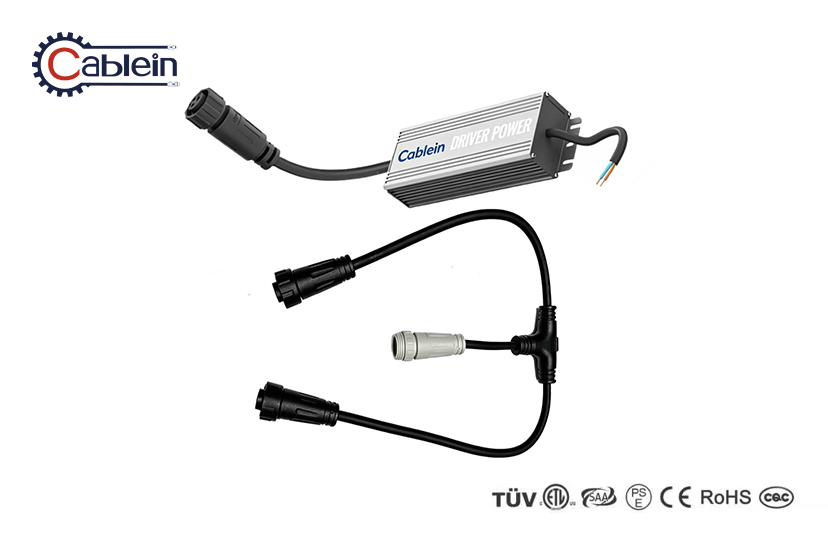
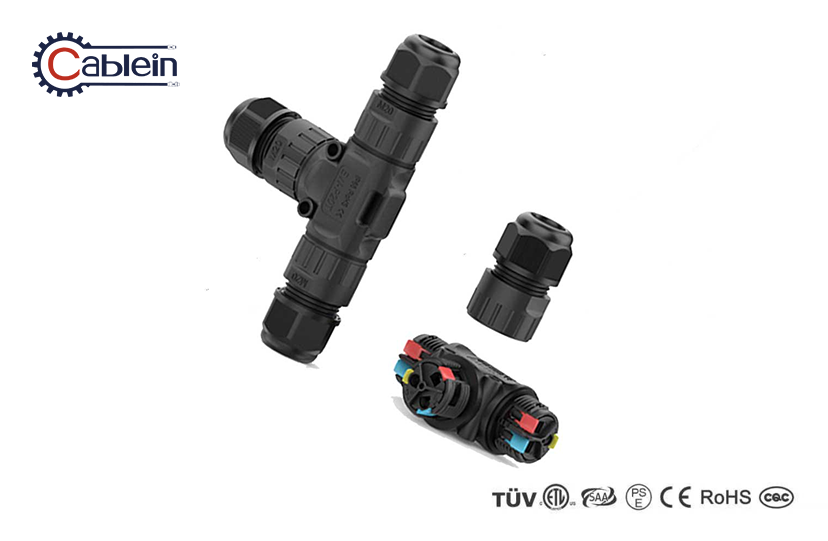
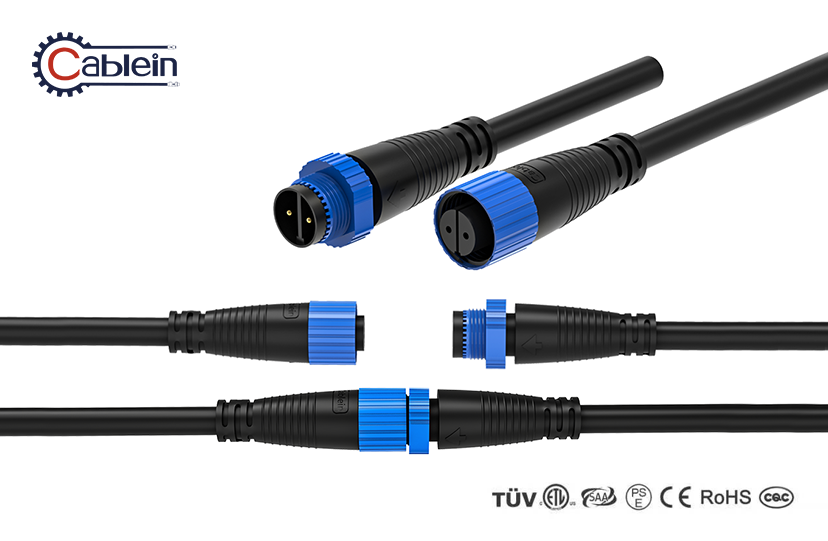
M20 Feed-Through Quick Clamp vs. Screw Terminal Waterproof Connector: Key Differences Explained
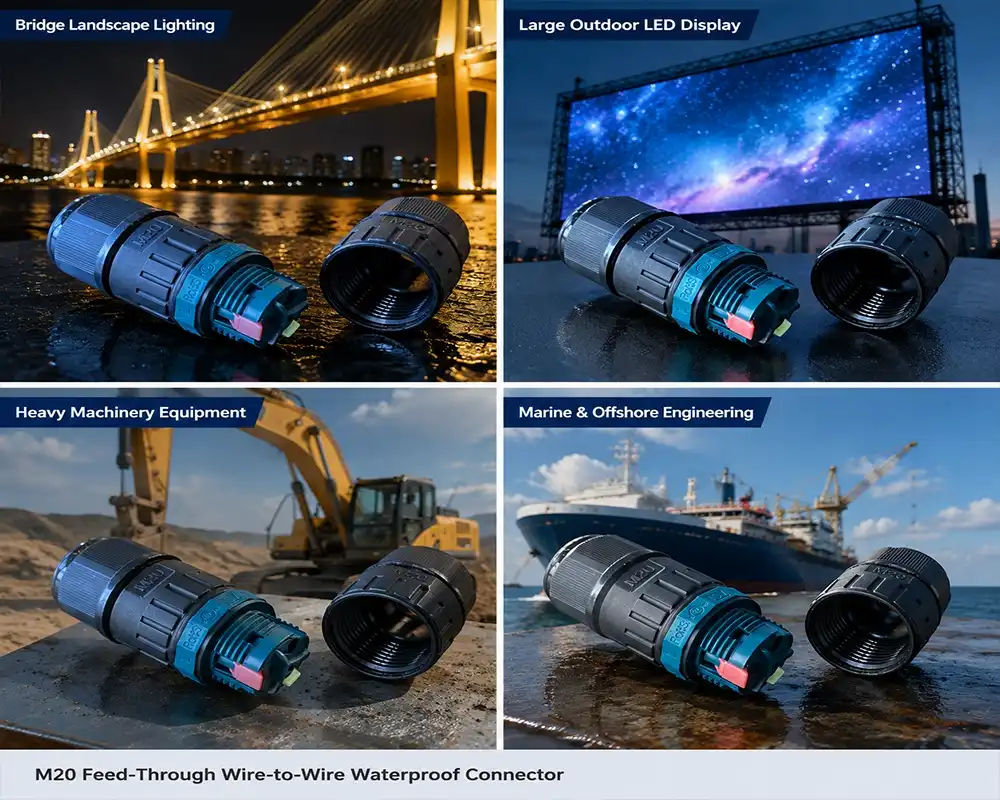
When selecting waterproof connectors for industrial power distribution, the choice between Quick Clamp and Screw Terminal designs fundamentally shapes installation speed, long-term reliability, and total cost of ownership. Both versions of the M20 Feed-Through Wire-to-Wire Waterproof Connector deliver IP67/IP68-rated environmental protection, yet their internal termination mechanisms cater to distinct operational priorities. Quick Clamp models offer tool-free, snap-in wire insertion that cuts field labor by up to 40%, while Screw Terminal variants provide vibration-resistant mechanical clamping favored in high-reliability settings like marine instrumentation and railway signaling. Understanding these differences helps procurement managers match connector architecture to project timelines, technician skill levels, and environmental stresses specific to outdoor lighting networks, smart city control cabinets, and renewable energy installations.
Understanding M20 Waterproof Connectors: Quick Clamp and Screw Terminal Types
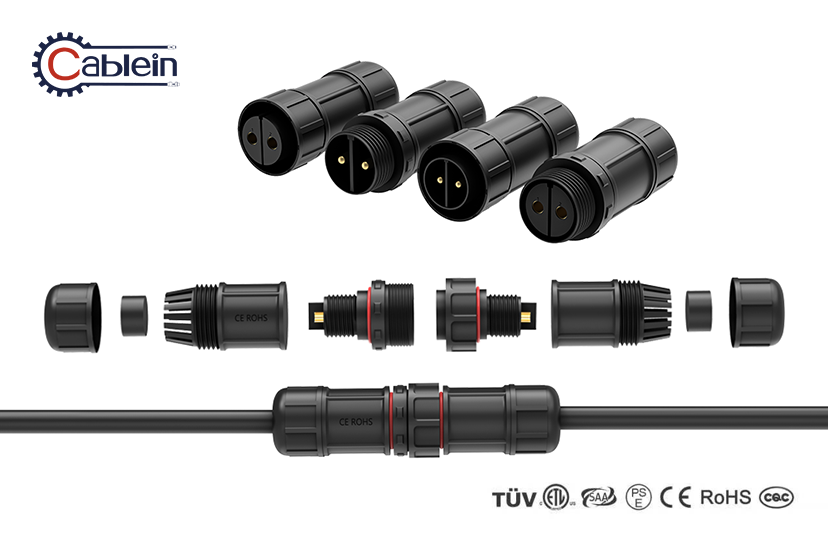
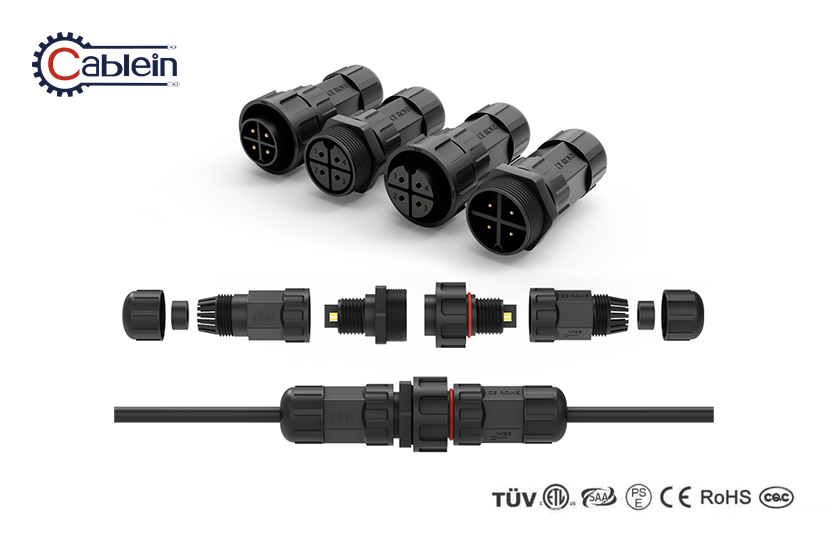
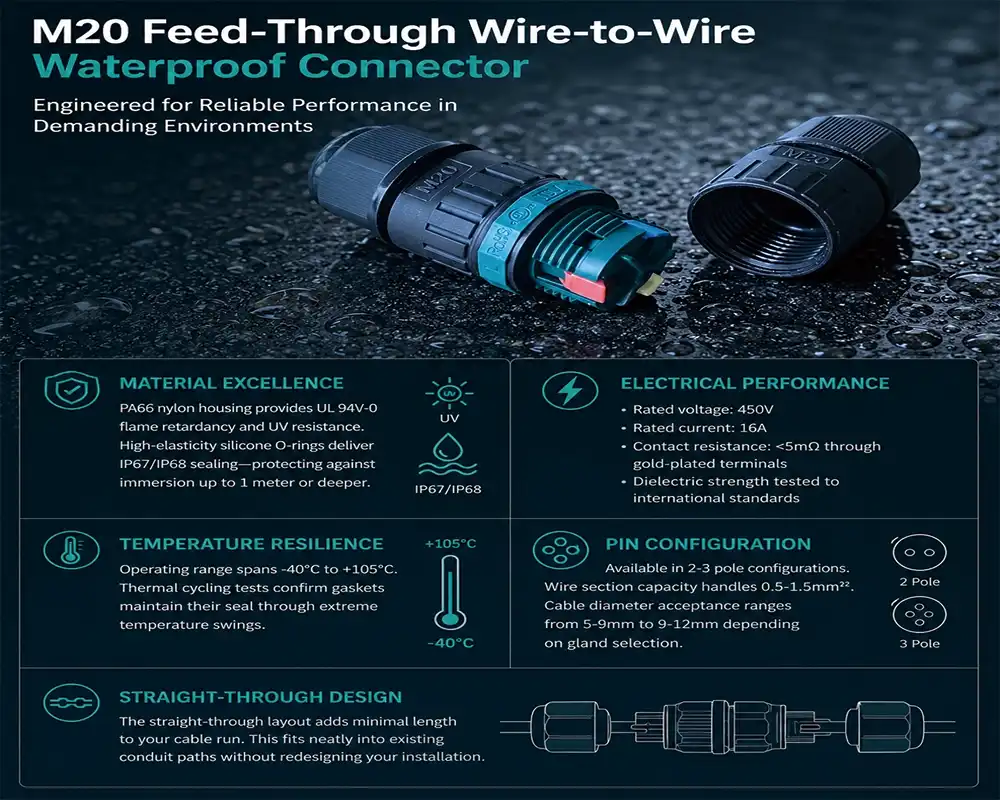
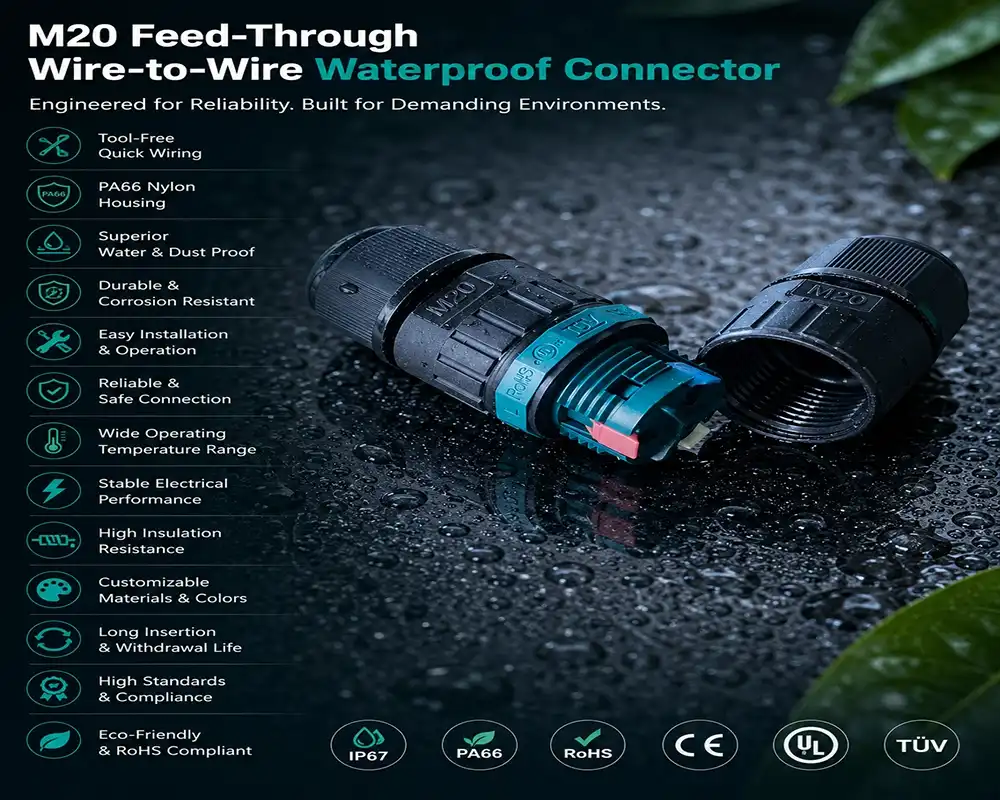
The M20 feed-through waterproof connection acts as a bridge between cable pieces that is completely sealed. This lets modular power distribution happen without having to permanently join the cables together. It can fit cable outer diameters ranging from 5mm to 12mm thanks to its 20mm metric thread diameter. This means it can be used for main supply lines carrying up to 16A at 450V. The straight-through design keeps wire runs short, which is very important when connecting floodlights in architectural lighting groups or retrofitting existing conduit systems.
IP numbers show how waterproof something is. IP67 connectors can be submerged up to 1 meter for 30 minutes, which is long enough to be exposed to heavy rain. IP68 versions can be submerged continuously at depths defined by the maker. This is necessary for underwater sensor networks or aquaculture oxygenation systems that are in touch with saltwater and hydrostatic pressure all year long.
Quick Clamp Termination Mechanism
The contact holes in Quick Clamp connections are loaded with springs. You take off the insulation on the wire and push it into the port until it clicks. The copper strands are held in place by an internal spring clamp. You don't need any screwdrivers or torque wrenches. This mechanism speeds up installation on scaffolding or in control panels that are too small to reach tools. The spring strain in the clamp keeps the contact pressure constant even if the wires move slightly. This lowers the chance that the connections will come loose over time.
Screw Terminal Construction
Screw Terminal connections have clamping plates made of metal that are moved by captive screws. To do this, you strip the wire, put it under the plate, and tighten the screw to the torque recommended by the manufacturer, which for M20 sizes is usually 0.5 to 0.6 Nm. The mechanical compression makes a gas-tight interface that stops vibration-induced loosening, which is a typical way for traffic light cabinets that are hit by big cars to break. The recessed terminal design keeps technicians from touching live conductors by accident while they are doing maintenance, which makes them safer.
Both designs have high-strength PA66 nylon housings that are UL94-V0 flame retardant and silicone O-rings that stay flexible from -40°C to +105°C. This keeps the seal strong through freeze-thaw cycles and desert heat.
Key Technical Differences Between Quick Clamp and Screw Terminal M20 Connectors
The two types have very different installation times. It takes about 15 seconds to make a Quick Clamp connection: remove 8 mm of insulation, enter the wire, and make sure you can hear the click. It takes 45 to 60 seconds per pole to install a screw terminal. You have to strip the wire, place it under the clamp plate, use a calibrated screwdriver to apply precise torque, and check visually that the threads are fully engaged. When electricians charge more than $50 an hour, Quick Clamp technology saves about 2.5 hours of work on a project that needs 200 connections. This means that the project costs less.
Material Composition and Sealing Technologies
Nickel-plated phosphor bronze springs that can be used 5,000 times are often used in Quick Clamp types. The spring's flexibility makes up for small differences in wire thickness in the 0.5–1.5mm² cross-section range. This means that one connector type can work with a range of cable gages. This adaptability makes keeping track of goods easier, but it causes small changes in contact resistance (usually 3 to 5 milliohms) as spring pressure spreads across strand surfaces.
Gold-plated brass contact plates are used in M20 Feed-Through Wire-to-Wire Waterproof Connector Screw Terminal designs. Gold treatment stops oxidation and keeps contact resistance below 2 milliohms for decades, even in salty coastal areas where ASTM B117 salt spray tests show 96 hours of resistance without obvious corrosion. The mechanical screw clamp creates pressure greater than 50 N/mm², which cold-welds the copper strands to the brass plate and makes a bond that can't be broken by pulling forces up to 80 Newtons.
The silicone O-ring sealing systems on both versions are the same. When the coupler nut is tightened, the O-ring is pushed 15 to 25 percent into a precisely machined groove. This makes a seal around the wire jacket that is good from all sides. This tension must fall within the 2.0-3.0 Nm torque window; if it's too loose, water could get in, and if it's too tight, the O-ring would bend and harden too soon.
Wire Compatibility and Electrical Performance
Quick Clamp connections can connect solid or stranded wires without ferrules, which makes setting up the field easier. But if the placement method is rushed, very fine strands (less than 0.2 mm in diameter) may get lost between the spring fingers. Screw Terminals can fit any strand arrangement, and the compressive force gathers fine strands into a stable bundle. This keeps the electrical contact stable even when the temperatures change, which happens when copper and brass expand and contract differently.
In low-frequency power applications, signal integrity stays the same. The inductance of Quick Clamp spring contacts is almost zero, while the capacitance of Screw Terminal flat plates is slightly lower. These differences don't matter at 50/60 Hz mains frequencies, but they could be important for data transfer above 10 kHz.
Procurement Considerations for B2B Clients: Choosing the Best M20 Connector Type
Project timelines have a big impact on the choice of connectors. Quick Clamp versions work great for quick deployments where installation teams have to make hundreds of connections every shift. When contractors used quick clamp connectors on a recent smart city streetlight retrofit that covered 1,200 poles, they finished four days earlier than planned, based on labor rates based on Screw Terminal. The design that doesn't require any tools also cuts down on the time and effort needed to calibrate them. Inspection teams only need to listen for a click instead of looking at torque wrench calibration documents.
Use-Case Scenarios
Heavy-duty tasks are usually done with screw terminal connectors. Passing trains constantly shake the lighting systems on railroad platforms. Over millions of shaking cycles, the mechanical screw lock stops the tiny movements that wear down spring contacts. In the same way, offshore wind turbine nacelle wiring needs Screw Terminals because Quick Clamp springs can relax over time, increasing contact resistance by 20–30% over five years. This is because Quick Clamp springs expand when exposed to heat in the sun and contract when cool at nite.
When it comes to retrofitting, Quick Clamp models work great. When electricians update the lights on the outside of old buildings, they often have to work from overhead lifts that don't have a lot of space for tools. Being able to make links with one hand while resting against the lift basket lowers the risk of falling and speeds up the project's finish.
Cost-Effectiveness Analysis
The initial unit price is 8–12% higher for M20 Feed-Through Wire-to-Wire Waterproof Connectors, which is because their internal mechanisms are simpler. In places with a lot of shaking or corrosion, the cost over time cancels out this benefit. A Screw Terminal connector put in a washdown zone of a chemical plant will usually keep its specification-grade contact resistance for 12 to 15 years. However, Quick Clamp springs may need to be replaced after seven years because being exposed to cleaning agents over and over again weakens the spring temper. It usually costs five times as much to replace work, which includes shutting down the system, disconnecting it, and checking it again after re-energizing it.
Tiered price is possible when you buy in bulk. Cablein Technology offers discounts for orders of 500, 1,000, or 5,000 pieces. At 1,000 units, the price of Quick Clamp connectors is the same as the price of Screw Terminals when the costs of the tools used for custom cable pre-assembly are taken into account. Pre-assembled wire harnesses get rid of the need for field termination work completely. Instead, quality control is done in the factory, where automatic pull-out force testing makes sure that every connection meets the 80 N minimum.
Comparative Analysis: M20 Feed-Through Waterproof Connector vs. Other Connector Types
M20 feed-through connectors are in the middle range of capacity. Smaller M16 versions can handle wires up to 9 mm in diameter and 10A current, making them good for branch circuits that power individual LED lights. The M20's 12mm cable capacity and 16A rating allow main distribution lines to supply multiple fixture strings. This cuts down on the number of home-run cables that need to be run from central junction boxes.
Panel-mount plugs are used in very different ways. M20 Feed-Through Wire-to-Wire Waterproof Connector designs join two cable ends together in the open or in junction boxes. Panel-mount designs, on the other hand, go through the walls of an enclosure to provide entry and exit points. Panel-mount connectors are used to connect cables to the NEMA-rated enclosure of a traffic signal controller cabinet. M20 feed-through connectors are used inside the cabinet to connect cables from terminal blocks to signal head outputs. This mixed method keeps the IP ratings of the enclosure while allowing modular wiring inside.
When used outside, links that aren't waterproof face huge risks. Electrochemical rust starts when moisture gets in, which raises contact resistance and creates resistive warmth. A study of outdoor lighting failures found that 63% of early lamp failures were caused by corroded connector contacts that happened when workers used cheaper indoor-rated terminal blocks instead of the original ones. Because of this, there was a voltage drop that LED drivers couldn't handle. This caused thermal shutdown cycles that damaged electronic parts and cut the life of the fixture by 40%.
Installation Best Practices and Troubleshooting Tips for M20 Connectors
Preparing the cables is the first step in a proper operation. Cut the insulation to the exact length shown on the body of the connection, which is usually 8 to 10 mm. Too much visible conductor increases the risk of short-circuiting, and not enough length stops the conductor from fully inserting into the contact chamber. To keep from nicking strands, which concentrates current and makes hot spots, use wire strippers that are calibrated to the cable gage.
Quick Clamp Installation Steps
Put the stripped wire into the M20 Feed-Through Wire-to-Wire Waterproof Connector connection body so that it is perpendicular to it. Press down steadily on the inside spring until it clicks. To do a pull test, grab the wire 50 mm behind the socket and tighten it up with 20 N of force, which is about the same amount of force needed to lift a 2-liter water bottle. The wire shouldn't move. If it slides, pieces of insulation may get into the spring. Take out the wire, check the chamber, and then put it back in.
Screw Terminal Installation Protocol
Place the wire under the clamping plate so that no extra strands stick out. Using a measured screwdriver, slowly apply torque: start with 0.3 Nm of snugness and work your way up to the end torque of 0.5 to 0.6 Nm. When the tension is raised above 0.8 Nm, the wire strands get crushed. This lowers the effective cross-sectional area and raises the resistance. When you under-tighten below 0.4 Nm, holes appear where rusting can happen more quickly. After tightening, pull on the wire with 50 N of force, which is the same as pulling a 5-liter paint can, to make sure it is still mechanically sound.
Put the coupling nut on the matching half and tighten it by hand until the O-ring touches the wire jacket. To compress the seal, use the last 2.0–3.0 Nm of torque. Visual confirmation: if the O-ring is there, it should slightly bulge in the observation window, which means it has been compressed by 20%. Write down torque values in maintenance logs so that you have a starting point for future inspections.
Common Pitfalls and Preventative Maintenance
Coupler nuts that aren't lined up right can cause cross-threading. Always turn threads by hand to start them, making sure they engage smoothly for the first three turns before using tools. If resistance shows up all of a sudden, turn the screw counterclockwise one full turn and re-align it instead of forcing the threads, which will score the PA66 material and make leak paths.
Salt spray areas need to be inspected every three months. To get rid of salt crystals, rinse the connections with clean water and then dry them with compressed air. Put a small layer of silicone grease on the outside threads (not petroleum-based lubricants, as they damage PA66) to get rid of wetness and stop galvanic corrosion between metals that are not the same.
Over years, UV light breaks down even stabilized PA66. Connectors that have surface chalking or a change in color from black to gray should be tested for dielectric strength. Put 1,000V AC between the contacts and the case for 60 seconds. If the leaking current is more than 1 mA, the insulation has broken down and needs to be replaced.
Conclusion
When choosing between Quick Clamp and Screw Terminal waterproof connectors, you need to think about how fast you want to install them and how stable they need to be in the long term. M20 Feed-Through Wire-to-Wire Waterproof Connector Quick Clamp technology cuts down on work that needs to be done in the field and works well for projects with short deadlines or limited access to tools. Screw Terminal designs, on the other hand, offer better resistance to vibration and consistent touch in tough industrial settings. When installed correctly, both architectures get IP68 waterproof ratings. However, the success depends on matching the termination method to the stresses of the application, such as thermal cycling, vibration amplitude, and maintenance intervals. To find the best connector approach for each stage of a project, procurement teams should look at the total lifetime costs instead of just unit prices. They should think about things like labor rates, expected service life, and what will happen if there is unplanned downtime.
FAQ
What is the maximum wire gauge supported by M20 connectors?
Most M20 feed-through connectors can handle wire cross-sections between 0.5mm² and 1.5mm², which is the same as AWG 20 to AWG 16 in American wire gage. The upper limits are set by the shape of the internal contact chamber. Going over 1.5 mm² stops Quick Clamp models from fully inserting, and in Screw Terminal models, it risks screw engagement that isn't complete. Always compare the connector datasheet to the wire specs to make sure they work together.
Can Quick Clamp connectors be reused after disconnection?
Quick Clamp designs can be reconnected 50 to 100 times before the grip force is lost due to spring fatigue. Each entry makes the spring metal a little harder, which lowers the stress over time. Screw Terminal connectors can be tightened and untightened more than 200 times because the mechanical clamp rebuilds full pressure each time. Screw Terminals should be used in critical applications that need to be maintained often to keep the efficiency high.
How do I verify waterproof seal integrity after installation?
Put the finished connection in water that has been mixed with a leak-finding dye. Then, for 5 minutes, apply 0.5 bar of air pressure to the inside of the cable. It's not supposed to bubble up. This field test mimics IP68 conditions and finds seal problems caused by loose coupling nuts or broken O-rings. These problems can be fixed right away, before the circuit is turned on.
Partner with Cablein for Reliable M20 Waterproof Connector Solutions
The M20 Feed-Through Wire-to-Wire Waterproof Connector from Cablein Technology comes in both Quick Clamp and Screw Terminal versions. It was designed to meet the specific needs of landscape lighting builders and industrial designers all over the world. Our high-strength PA66 housings can stand up to years of UV light, and the gold-plated brass contacts keep their sub-2-milliohm resistance even when they are exposed to saltwater and changes in temperature. With TUV and CE certifications and ISO9001:2015 quality systems, we keep more than 10,000 of each model in stock so that standard configurations can be delivered in 7 to 10 days. Custom choices include wire lengths that are already put together, which saves you time and money by eliminating the need for field ending work. Email our engineering team at nick@cableinco.com to get samples, technical datasheets, and volume pricing that fits the needs of your project. Visit connectorswaterproof.com to see our full range of IP68-rated interconnect options and see why procurement managers in over 100 countries choose Cablein as their waterproof connector provider.
References
1. International Electrotechnical Commission. "IEC 60529: Degrees of Protection Provided by Enclosures (IP Code)." Geneva: IEC, 2020.
2. ASTM International. "ASTM B117-19: Standard Practice for Operating Salt Spray (Fog) Apparatus." West Conshohocken: ASTM, 2019.
3. Underwriters Laboratories. "UL 94: Standard for Safety of Flammability of Plastic Materials for Parts in Devices and Appliances." Northbrook: UL, 2021.
4. Society of Automotive Engineers. "SAE J1673: High Voltage Primary Cable Assemblies." Warrendale: SAE International, 2018.
5. European Committee for Electrotechnical Standardization. "EN 61984: Connectors for Use in Photovoltaic Systems – Safety Requirements and Tests." Brussels: CENELEC, 2020.
6. National Electrical Manufacturers Association. "NEMA 250: Enclosures for Electrical Equipment (1000 Volts Maximum)." Rosslyn: NEMA, 2022.