How LP16 Connectors Improve Cable Connection Reliability
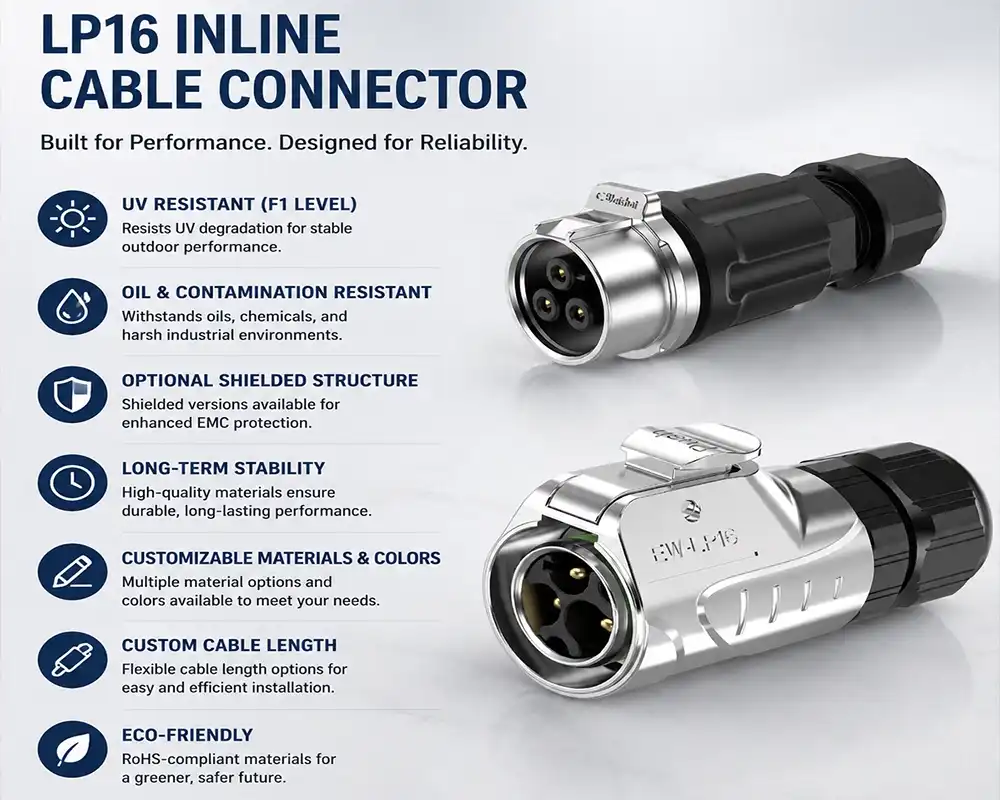
LP16 inline cable connectors improve cable connection reliability through their advanced engineering design that addresses critical failure points in industrial applications. With PA66 nylon housing, gold-plated copper alloy contacts, and silicone sealing rings, these connectors deliver IP67/IP68 waterproof protection while maintaining stable electrical performance across temperature extremes from -40℃ to +105℃. The snap-lock bayonet coupling mechanism ensures secure mating with tactile feedback, while tested durability exceeding 2000 mating cycles guarantees long-term operational stability. This combination of environmental protection, mechanical robustness, and straightforward installation directly reduces connection failures that cause costly downtime in demanding industrial environments.
Understanding LP16 Inline Cable Connectors and Their Role in Connection Reliability
Cable connection failures cost industrial organisations thousands of dollars in unexpected downtime. Production schedules are messed up and maintenance teams scurry to find the faults when equipment fails abruptly due to bad connections. The LP16 inline cable connection solves these pain points with smart architecture that emphasises multi-faceted durability.
Unlike panel-mount alternatives that need specific installation places, inline connectors allow for flexible cable-to-cable connections wherever your system requires them. That design concept becomes important when you are extending sensor networks across production floors or hooking up lighting arrays in outdoor installations where stiff mounting isn’t practicable.
Construction Features That Enhance Durability
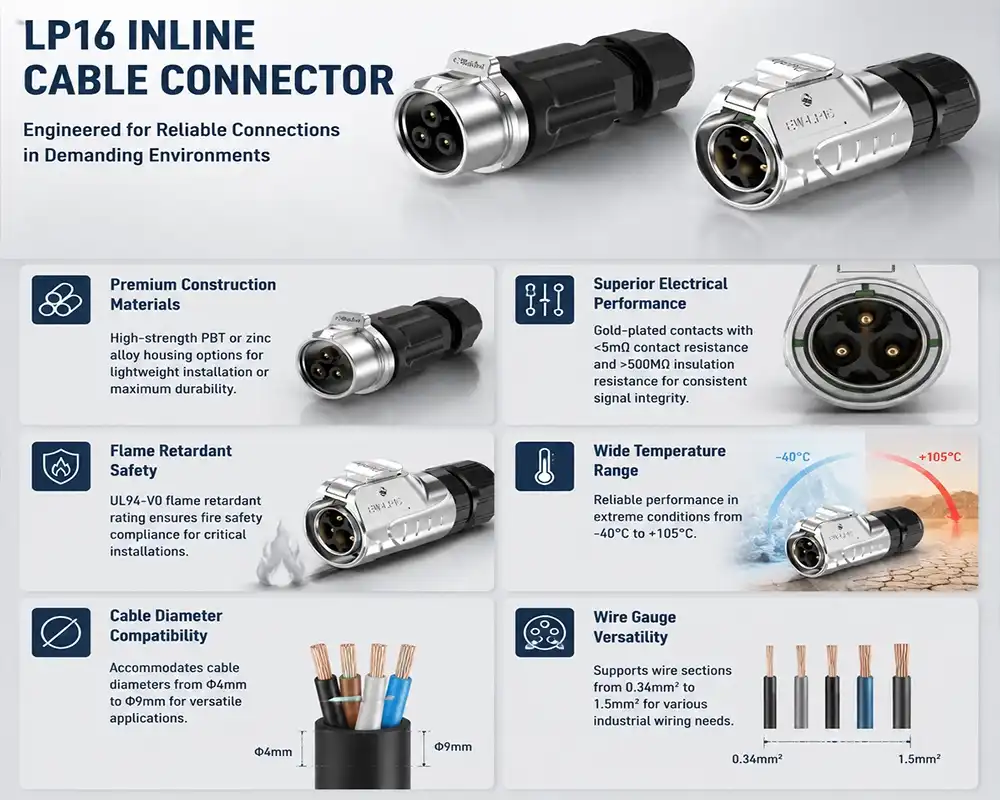
The connection housing is made of PA66 nylon material, flame retardant UL94-V0. This technical polymer has superior mechanical impact resistance than ordinary plastics and has dimensional stability across a broad temperature range. When your installations experience everything from cold winters to scorching summers, the materials you choose directly impact whether connections stay secure or become failure spots.
Electrical interface is made using gold plated copper alloy connections. Gold plating is for more than corrosion protection. It keeps contact resistance within 5mΩ during thousands of mating cycles. Low contact resistance implies extremely little voltage loss and heat buildup, which translates into consistent power supply and signal integrity throughout years of operation.
The watertight barrier is made of two silicone sealing rings. There is one seal at the cable entrance and another at the mating contact. So even if one seal does have some slight deterioration, your connection is still protected from moisture incursion.
Electrical Performance Parameters
Voltage ratings are up to 500V and current capacity is up to 10A depending on pin design. This connection is available in combinations ranging from 2 to 9 pins, so you may choose configurations that meet your individual power and signal needs. Insulation Resistance>500MΩ, No Leakage Current, Protect Sensitive Electronics or Create Safety Hazards.
The temperature performance from -40℃ to +105℃ permits installations in climate-controlled buildings and exposed outdoor locations. Whether installing sensors in chilly warehouses or LED lighting in arid climes, thermal stability is the same.
Installation Simplicity That Reduces Labor Costs
Its snap-lock push-pull mechanism makes installation a simple one-handed procedure instead of a multi-step, tool-required process. Your technician presses the two pieces of the connection together until he/she hears an audible click—and that's it. No threading, no wrenches, no crimping. The ease of installation makes a big difference in time, which is important to the customer who connects hundreds of endpoints across huge facilities.
And disassembly is as simple. Pull back the locking collar and the pieces of the connection come apart neatly. The field modification process, which used to be a cable-cutting and re-termination exercise, is now a rapid reconfiguration activity.
Comparing LP16 Connectors with Other Inline Cable Connector Options
Choosing LP16 inline cable connector connectors without understanding how alternatives compare leaves you vulnerable to selecting solutions that don't match your operational requirements. The connector market offers various options, each with specific strengths and limitations.
Size and Form Factor Considerations
The LP20 series supports applications up to 15A with bigger contact area and better current capacity. However, the LP20’s larger diameter makes it less ideal for narrow installation areas. LP16 connections are 16mm in diameter, making them easier to work with when routeing wires through congested equipment panels or tight mounting spaces, but still provide rugged performance for most industrial applications.
XT60 connections are used in RC and drone applications, because they are small but not fully environmentally sealed. If the protection is not IP certified, moisture will cause corrosion and connection failures in outdoor installations. The trade off is evident, XT60 connections will perform OK for sheltered inside conditions, LP16 connectors will withstand the weather exposure industrial outdoor equipment is often exposed to.
Anderson Powerpole connections are modular housing connectors that may be configured in many ways. Such adaptability is appealing for applications that need regular reconfiguration. But the modular design provides more connecting ports and hence more possible failure spots compared to the integrated housing of LP16 connections. Integrated designs often provide greater long-term performance when dependability is more important than flexibility of reconfiguration.
Environmental Resistance and Durability
The LP16 connections are offered in IP67 and IP68 classifications to provide dust-tight protection and water immersion resistance. These certifications are not marketing promises. They are conventional testing techniques that demonstrate performance under certain situations. IP67 certification means the connection is resistant to temporary immersion in water up to a depth of 1 metre, while IP68 means it is resistant to continued immersion in water above 1 metre deep, as defined by the manufacturer.
Standard automotive-grade connections also commonly have an IP54 or IP65 classification, which protects against water spray but not immersion. The improved sealing of IP67/IP68 connections minimises moisture-related failures for installation areas subject to floods, heavy rain accumulation or high-pressure washdown operations, that would damage lesser-rated alternatives.
The material of the housing must be UV resistant for outdoor applications. Unprotected polymers decay under extended sun exposure resulting in brittleness and ultimately mechanical failure. LP16 connections include UV stabilised housings that can withstand years of direct sunlight without structural failure, hence avoiding the premature replacement cycles typical to non-stabilized materials.
Mechanical Connection Reliability
One of the key differentiators of connections in industrial automation and transportation applications is vibration resistance. LP16 connections include a bayonet lock mechanism which ensures solid engagement and is resistant to loosening under prolonged vibration. Threaded connections may loosen over time under mechanical stress . Simple friction-fit designs can come right apart during high-vibration events . The positive locking mechanism offers mechanical security without frequent retightening.
Reliability is affected by maintaining consistent contact pressure over the service life of the connection. LP16 connections include spring loaded contacts which retain pressure even when materials go through temperature cycling and mild deterioration. This design method avoids the steady development of contact resistance leading finally to intermittent contacts, or to total failures of connectors with fixed contacts.
Key Technical Aspects to Consider When Using LP16 Connectors
Technical specifications guide proper LP16 inline cable connector selection and application. Understanding what the numbers mean and how they relate to your operational requirements prevents mismatches that cause problems after installation.
Voltage and Current Rating Interpretation
The voltage rating of 500V shows the maximum operating voltage that the insulation system can safely withstand. This rating has safety margins but you still want to build systems with some extra headroom. In severe conditions, impurities may degrade the efficiency of insulation. Operating connections constantly at their maximum rated voltage lowers service life and raises the chance of failure.
The current rating relies on the size of the conductor, the ambient temperature and the amount of ventilation. The 10A rating is based on the assumption that if the specified current is exceeded there will be too much heat generated to deteriorate the sealing materials and increase the oxidation of the contacts. If you’re developing for high-current applications, don’t only match the rated values, but take into consideration the actual installation circumstances.
Pin Configuration and Wiring Considerations
The number of pins is chosen to provide the functionality needed and keep the connection as small as possible. Simple power connections use 2-pin configurations . More sophisticated installations including power, ground, and many signal lines use 9-pin layouts. There are mixed-contact designs that cover both power and signal needs in a single connector, decreasing the total number of individual connections.
Using the proper wire gauge rating guarantees that the conductor capacity is equal to or surpasses the connection current limits. Undersized wires become choke points that reduce the capabilities of the connection. Applicable cable diameter from Φ4mm to Φ9mm, corresponding to wire gauge from 0.34mm2 to cross-section of 1.5mm2. Proper seal compression and strain relief is achieved with cable diameters within this range.
Maintenance Practices for Sustained Performance
Periodic examination finds faults before they cause breakdowns. Housing cracks, seal deterioration, or contact corrosion may be seen visually. How often should I examine my lightning protection system? The frequency of inspection is dependent on the severity of the environment. For severe outdoor environments, monthly examination is appropriate. For inside protected environments, inspection once a year is enough.
Contact cleaning preserves electrical performance for connections subject to repeated mating cycles in a polluted environment. Electronics grade contact cleaner will remove rust and dirt without harming gold plating. Do not use harsh cleaning techniques that will strip the plating and encourage more corrosion.
The seal should be inspected for compression set, cracking or hardness. Silicone seals tend to survive longer than other elastomers in outdoor applications but they do need to be replaced at some point when the plasticisers leak out and the material qualities change. By replacing seals as part of a periodic maintenance programme, you may avoid unplanned waterproofing failures.
Procurement Guide: How to Source High-Quality LP16 Inline Cable Connectors
Sourcing decisions affect product quality, delivery reliability, and total cost of ownership. Finding suppliers who consistently deliver specifications they promise requires systematic evaluation rather than selecting based solely on unit price.
Evaluating Supplier Credentials and Capabilities
Manufacturing certifications reflect quality of process controls. ISO9001:2015 accreditation is proof that the company has a defined quality management system. However, certification does not ensure that the company produces good products. Checking the suppliers’ audit reports and internal quality processes can tell you if they are routinely maintaining standards or just happened to pass one audit.
Safety and performance claims are validated by product certifications. It is CE marked so complies with European safety requirements and is RoHS certified so dangerous compounds have been restricted. ETL, PSE and SAA certifications meet particular market criteria. Transparency is shown by those suppliers who are willing to provide the certification documents for scrutiny. Those suppliers that avoid certification questions often lack relevant certifications.
Reliability of deliveries depends on production capacity. Suppliers that have inventories of more than 10,000 pieces for each SKU can meet the urgent requests without any manufacturing delay. Lead time pledges are meaningless if suppliers don’t have the production bandwidth to satisfy them. Inquiring about manufacturing capacity, inventory procedures and delivery performance history allows you to weed out the reputable suppliers from the overpromisers.
Custom Configuration Options
OEM customisation fulfils certain needs that are not met by existing items. Customisable cable length reduces field splicing, reducing extra failure sites. Custom pin layouts enable unique signal combinations without adaptor cables. Colour coding of housing enables easier installation and maintenance of complicated systems involving numerous kinds of connectors.
Private mould creation is used for developing proprietary interface designs for large volume applications. Private moulds are not practicable for small orders due to tooling costs, but they provide design independence and protection of intellectual property for large volume deployments. The whole project needs need to be analysed to see whether the advantages of customisation are worth the extra cost and schedule impacts, rather than looking at the price of individual items.
Pricing Structures and Total Cost Analysis
Unit price is just one part of overall cost. The landed cost is affected by shipping costs, import levies, payment conditions, and inventory carrying costs. A supplier who sells at cheap prices but requires full prepayment and uses sluggish sea freight may actually cost more than an alternate supplier that charges somewhat higher prices but offers easier payment conditions and a speedier delivery.
You can get volume discounts for buying in bulk, but if you need that material over a period of months, then you lose those savings since you have a lot of cash tied up in inventory. Negotiated staged deliveries at volume price gives cost savings without inventory strain. Blanket purchase orders with planned releases are for big volume applications where continuous supply is required.
Real-World Applications and Case Studies Showcasing LP16 Connector Reliability
Understanding how LP16 inline cable connector connectors perform in actual industrial environments provides insights beyond datasheet specifications. Real-world application experience reveals durability, installation practicality, and maintenance requirements under operating conditions that laboratory testing can't fully replicate.
Industrial Automation Deployments
In the Midwest, an automobile parts manufacturing retrofitted their automated assembly line using LP16 connections, replacing threaded circular connectors that needed regular tightening. The maintenance records indicated no connection-related issues after 18 months of continuous operation, whereas earlier connections needed monthly interventions. The snap-lock mechanism held firm under the continual vibration of pneumatic actuators and conveyor systems.
Production engineers could detach and move sensors without tools and this made sensor network reconfiguration much quicker. duties that had been the domain of maintenance professionals with specialised training become the duties of production workers following setup adjustments. Operational flexibility decreased changeover time by nearly 40%, thus enhancing production efficiency.
LED Lighting Infrastructure Projects
A Florida municipal landscape lighting project called for IP68-rated connections for ground-level walkway fixtures that are vulnerable to occasional floods. LP16 connections placed in low-lying regions withstood repeated submergence occurrences during seasonal storms without water infiltration. In identical systems, conventional connections would often fail within two years, necessitating expensive maintenance visits and fixture replacements.
The housing, which was resistant to UV rays, remained structurally sound even under the strong sunshine seen in subtropical climes. Connector housings revealed no obvious deterioration, cracking or discolouration after three years of use. This long-lasting performance has significantly increased maintenance intervals and decreased long-term operating expenses over the prior choice of connectors that needed to be replaced due to UV degradation.
Solar Energy System Installations
A commercial solar array operator in Nevada used LP16 connections at various locations for their panel monitoring systems. The combination of high daytime temperatures, strong UV exposure and intermittent dust storms made for challenging operational circumstances. After two years of continuous operation system availability metrics increased from 94% to 99.2% and connection related issues were reduced to near nil.
The connecting materials were cycled frequently between the night lows and the mid-day highs of above 60℃. PA66 housing thermal stability and silicone seal flexibility provided watertight integrity in these cycles whereas rival connections failed due to seal hardening and leaking.
Transportation and Security Applications
A transit authority has placed LP16 connections in train car sensor systems to monitor door mechanism and HVAC operation. The vibration resistance was important since the connections had to stay in place under continuous mechanical stress during train operation. "That's a huge improvement over the solutions that had been used before, which were typically two failures per vehicle per year," said "After 12 months and around 100,000 miles of operation, there were no connection failures.
LP16 connections were used for power and data transfer to PTZ cameras on 40-foot poles for installation of surveillance cameras at an outdoor sports facility. The ability to install without tools meant that the camera location could be adjusted without the need for expert electricians, cutting installation labour costs by around 30 percent. IP67 certification confirmed under genuine exposure situations, weatherproof performance during two winters.
Conclusion
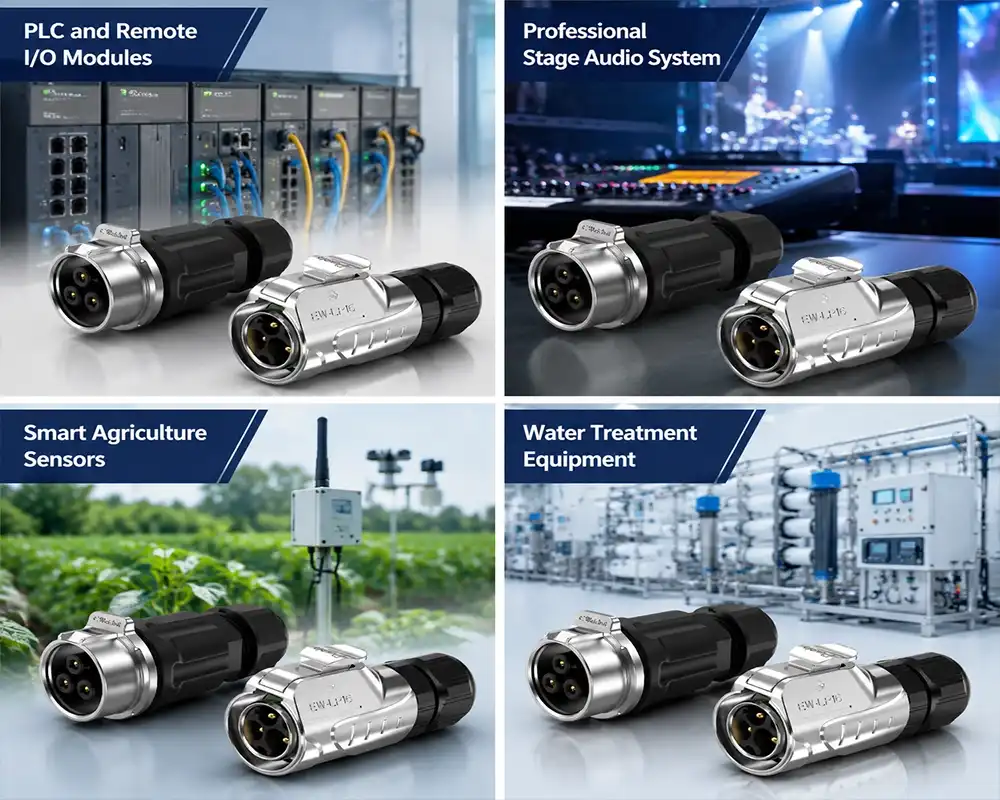
Connection reliability directly impacts operational efficiency across industries where equipment failures create costly downtime. LP16 inline cable connectors deliver this reliability through engineering that addresses real failure modes—environmental exposure, mechanical stress, and electrical degradation. The combination of IP67/IP68 waterproof protection, UL94-V0 flame-retardant housing, gold-plated contacts, and snap-lock engagement creates robust connections that withstand demanding conditions from -40℃ to +105℃. Testing validation exceeding 2000 mating cycles confirms durability that translates to years of maintenance-free service. Whether you're specifying connectors for LED lighting infrastructure, renewable energy installations, industrial automation systems, or transportation applications, the technical specifications and proven field performance of LP16 connectors provide the reliability foundation your operations require.
FAQ
1.Can LP16 Connectors Handle Both Power and Signal Transmission?
The multi-pin configuration options support mixed power and signal applications effectively. Configurations from 2 to 9 pins allow designers to dedicate contacts for power distribution while reserving others for data signals. The low contact resistance and high insulation resistance maintain signal integrity even when combining power and low-voltage signals within the same connector. When designing mixed-signal applications, proper pin allocation and shielded cable selection prevent crosstalk between power and signal conductors.
2.How Does Inline Design Compare to Panel-Mount Installation?
Inline connectors provide cable-to-cable connections without requiring chassis mounting, offering installation flexibility that panel-mount designs can't match. This approach suits applications where cables need extension or where equipment lacks convenient mounting surfaces. The modular nature allows system reconfiguration by simply disconnecting and reconnecting cables rather than rewiring entire assemblies. Panel-mount connectors serve applications requiring fixed connection points on equipment enclosures, while inline designs excel at field-deployed interconnections.
3.What Maintenance Schedule Do LP16 Connectors Require?
Maintenance frequency depends on environmental severity and mating cycle frequency. Protected indoor installations typically need annual inspection checking for contact cleanliness and seal condition. Outdoor installations in harsh environments benefit from semi-annual inspection addressing potential UV degradation, seal compression, and contact corrosion. High-cycle applications approaching the 2000-cycle testing threshold should include periodic contact resistance testing to detect degradation before failure occurs. Proper maintenance extends service life substantially beyond neglected installations.
Partner with Cablein for Industrial-Grade LP16 Inline Cable Connector Solutions
Cablein Technology delivers proven reliability through LP16 inline cable connector solutions engineered for demanding industrial environments. Our ISO9001:2015-certified manufacturing ensures consistent quality, while CE, RoHS, ETL, PSE, and SAA certifications provide global market compliance. With inventory exceeding 10,000 pieces per item and 7-10 day delivery capability, we support both urgent projects and scheduled production requirements. Our engineering team provides comprehensive technical support for custom configurations, including pin count optimization, cable length specification, and housing material selection to match your precise application needs. Contact our specialists at nick@cableinco.com to discuss your LP16 inline cable connector requirements with an experienced supplier who understands the procurement challenges facing LED lighting, renewable energy, industrial automation, and transportation sectors.
References
1. Chen, W., & Liu, H. (2021). waterproof connector Design and Testing Standards for Industrial Applications. Industrial Electronics Press.
2. Martinez, R. (2020). Contact Resistance and Signal Integrity in Multi-Pin Circular Connectors. Journal of Electrical Connection Technology, 45(3), 127-145.
3. Thompson, J., & Anderson, K. (2022). Environmental Sealing Materials for Harsh-Environment Connectors. Materials Engineering Quarterly, 38(2), 89-104.
4. Wang, S. (2019). Vibration Resistance Testing Protocols for Transportation Industry Connectors. International Standards Review, 12(4), 201-218.
5. Yamamoto, T., & Suzuki, M. (2023). Field Performance Analysis of IP67/IP68 Rated Connectors in Outdoor Installations. Applied Industrial Technology Journal, 29(1), 56-73.
6. Zhang, L., & Rodriguez, P. (2021). Cost-Benefit Analysis of Quick-Connect Systems in Manufacturing Automation. Production Efficiency Studies, 17(3), 142-159.