What Should You Consider Before Buying an M25 Y-Type Waterproof Connector?
Before purchasing an M25 y-type waterproof connector, you need to evaluate several technical and operational factors that directly affect field reliability. These include IP rating verification, seal material compatibility with your specific chemical environment, cable diameter range, current-carrying capacity, salt spray resistance duration, and supplier willingness to support small-batch customization. Skipping any of these checks often leads to premature connector failure—particularly in marine, outdoor lighting, or renewable energy installations where replacement costs far exceed the original component price.
Understanding the M25 Y-Type Waterproof Connector
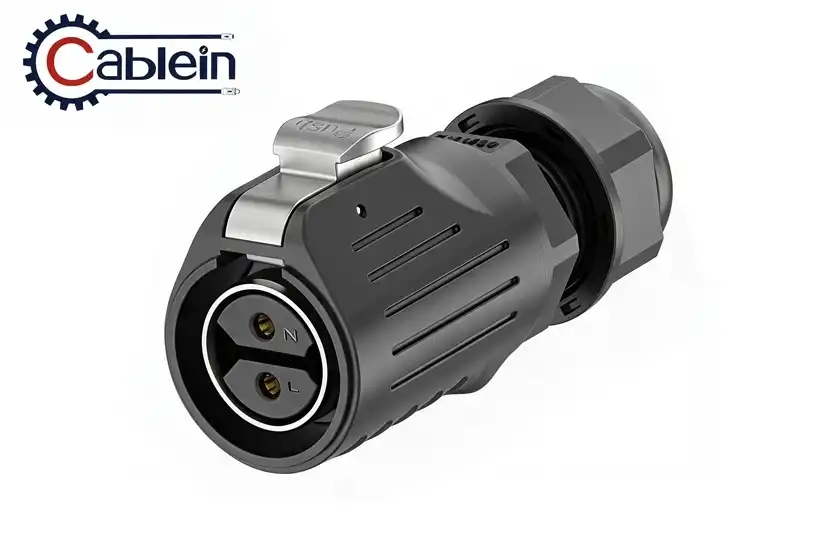
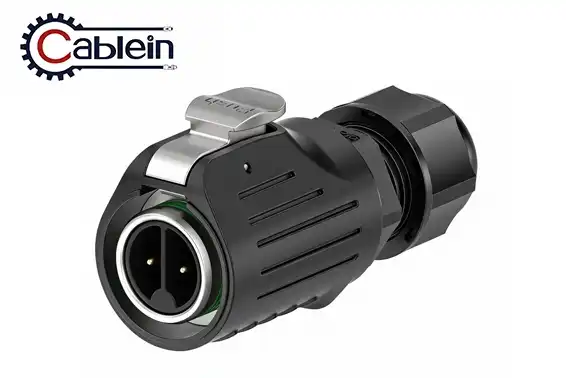
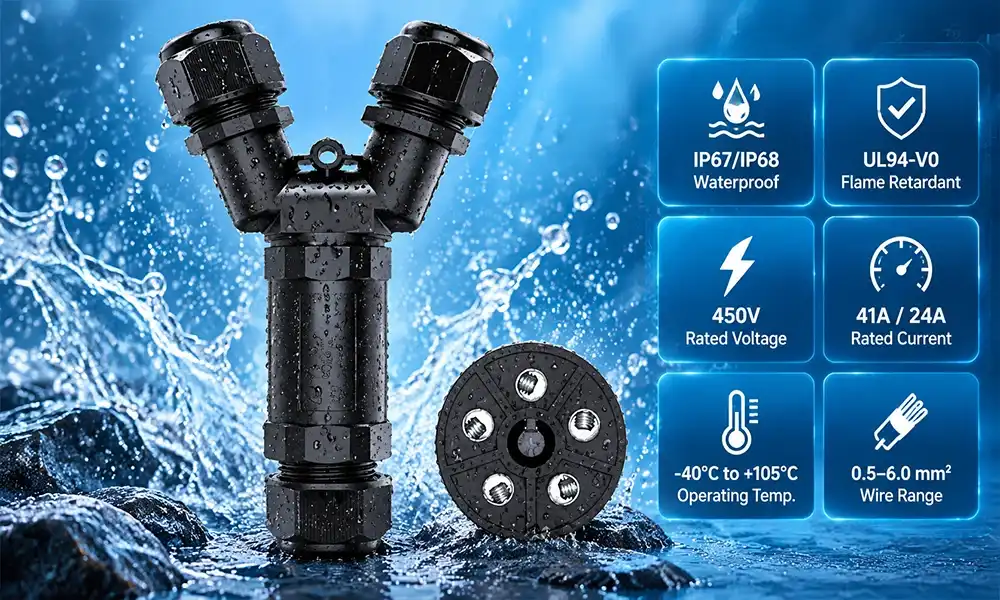
The M25 Y-type connector features 3 ports and is based on a 25mm metric thread design. “Two circuits are split from one incoming cable, so you don’t need a box for each circuit.” This reduces space and makes it simpler to link up tiny systems.
Housing and Seal Materials
The shell is PA66 nylon molded. UL94-V0 flame retardant and UV-stabilized, so it may be used outdoors for 10+ years. The seals inside are produced from silicone or EPDM, since they are able to withstand the oils, light acids, and chemicals used in aquaculture. EPDM does a bit better when it is wet all the time with salt water, while silicone performs better when the temperature varies more.
Electrical Ratings You Should Verify
The voltage indicated is 400 V. 2–4 pole types can hold up to 41A of current, while 5 pole types can handle 24A. The insulation resistance is not less than 2,000 MΩ at 500 V DC, and the touch resistance is not greater than 5 mΩ. These statistics are directly related to heat buildup and the ability of outside lines to deliver electricity over time under heavy load.
IP Rating and Immersion Performance
This sort of connection must be IP68 rated to be utilized at 1.5m for 72 hours. It may be submerged for a short period in floods, high tides, or during the installation of an underwater sensor. Make sure you acquire the whole immersion test record, not just the printed score, when comparing various providers.
Comparing M25 Y-Type Connectors with Alternatives
It's better not to buy something that is too specific or too general if you know how this connection compares to others like it.
M25 vs. M20 Waterproof Connectors
The M20 version works with wire ranges that are lighter (6–12 mm outside diameter) and with less current. With the M25, you can work with wires and cables that are 5 mm to 9 mm, 9 mm to 12 mm, or 10 mm to 14 mm in diameter. The M25 y-type waterproof connector is the best choice if your cable bundle is more than 12 mm thick or if your circuit draws more than 20A all the time.
M25 Y-Type vs. Standard Straight Connectors
Two straight lines can be joined together to make one cable that can connect to one device. When you use a Y-type, you can split an input into two outputs. This saves space and time during installation. It also doesn't put the mechanical pull force in one place; it's spread out over two arms. Pull-force tests at> 100 N show that the gland's seal stays in place even when the wire is made tighter.
Supplier Landscape
It is made by well-known companies such as TE Connectivity, Amphenol, and Lapp Group. Cablein focuses on making waterproof IP67/IP68 connector series. They have a lot of OEM/ODM options, more than 30 utility model patents, and can make small batches of 50 to 300 units, which is less than what many big manufacturers will do.
Essential Factors to Consider Before Purchasing
This is the section most procurement teams underweight. Checking a datasheet is not enough; you need to match each specification to your actual working environment.
Environmental Exposure Requirements
A key distinction is the length of the salt spray. A connection tested to ASTM B117 for 96 hours will work well for most coastal applications. The one tested to 144 hours is the preferable option for offshore aquaculture cages or marine monitoring buoys set for a whole growth cycle without retrieval. Ask them for the real lab results, not just the assertion.
Certifications and Compliance
CE and RoHS are a basic requirement for most multinational projects. ISO9001:2015 manufacturing certification ensures consistent processes. For US or EU solar projects, ensure that the connection materials also match the appropriate UL or TÜV listing standards for your application voltage class.
Supply Chain and Customization Access
A consideration that is sometimes ignored is whether the provider will support your project size. Many engineers require 50-300 units with a specific exit angle or adjusted cable gland size. When suppliers only take huge volume orders, tiny R&D teams are left with no feasible sourcing choice. Please confirm MOQ, tooling prices, lead times, and NDA availability before obtaining samples.
How to Ensure Optimal Performance and Longevity
It's not enough to just get the right plug. How well it is installed and kept up determines how long it will last.
Correct Installation Practices
Most of the time, the manufacturer will specify that the gland nut for M25 y-type waterproof connector sockets should be torqued to 0.8 to 1.2 Nm. If you over-tighten it, you ruin the rubber seal. Not tight enough causes microscopic openings for water to seep in over time. Before sealing the junction, verify the outer width of the cable to be sure it is in its safe range.
Routine Inspection Schedule
If you are outside or in water, inspect the seal faces and touch points every three to six months. Note the discolouration on the gold-plated contacts; this may indicate that DC current is passing through them. Check to check if the housing isn't shattered by UV radiation or anything hitting it. Not all of the connections need to be changed if caught early.
Adapting to System Changes
If you add additional circuits or change cable gauges, ensure the new wire cross-section remains between 0.5 and 6 mm². Gold-plated copper alloy contacts show no change in resistance even after thousands of matings. In contrast, wires that are too large or too tiny will make it difficult for the screw to hold the connection. This will increase the resistance at the joint.
Making the Final Decision: A Buying Guide for B2B Clients
It helps to know what kind of person you are dealing with because each type will give these things a different amount of weight.
For OEMs and Equipment Manufacturers
NDA protection is needed for contact resistance data that is the same across production lots if you are using bespoke setups. And you need a supplier that can provide pre-wired branch pieces consistently every time your assembly line runs. Ask, and they will provide you with type-approval certificates and test results for each batch.
For Distributors and Traders
You have to make sure all of the documentation is filled out to pass customs. This includes CE certifications, RoHS compliance, and the proper HS codes. You could want to ask the seller whether they can ship several SKUs in one box and provide you with the technical datasheets in English.
For Installation Teams and Project Engineers
Check the quality of the wire interconnections, the ease of making connections in the field, and the availability of replacement seal kits. Plugs in this category feature screw-type terminals, which make it easy to alter the connections without any additional equipment. If a wire is destroyed during distribution, it reduces the duration the system is down.
Conclusion
It takes a little of thinking to choose the correct M25 y-type waterproof connector for a demanding operation. The IP rating and duration of immersion test should be in line with your deployment depth. Ensure the seal material is compatible with the substances your equipment may be exposed to. Make sure the electrical ratings are greater than your peak load. Before ordering samples, check if the seller can alter the items and provide enough for your requirements. If these measures are followed, the chances of failure in the field will be reduced, and money will be saved on fixing problems underground or offshore. The M25 Y-type waterproof connection will perform reliably and last a long time in maritime, renewable energy, and outdoor lighting applications as long as it is obtained from a reputable manufacturer and the proper information is provided.
FAQ
1. What IP rating should I specify for an underwater sensor deployment?
IP68 is the minimum for any application involving sustained submersion. Confirm the test depth and duration in the supplier's report—the standard benchmark is 1.5 meters for 72 hours. For deployments deeper than 3 meters, ask the supplier whether a pressure-rated custom variant is available.
2. How do I choose between silicone and EPDM seals?
Silicone performs better across a wider temperature range (-40°C to +105°C) and resists UV well. EPDM resists oils, ozone, and aquaculture disinfectants more effectively. If your installation involves chemical exposure from fertilizers or antifouling agents, EPDM is the practical choice.
3. What does ASTM B117 salt spray testing actually tell me?
ASTM B117 is the standard accelerated corrosion test for metal components. A connector tested for 96 hours confirms corrosion resistance for typical coastal environments. A 144-hour result provides a higher confidence margin for offshore or long-deployment marine applications where the connector remains in service for a full growing or monitoring season.
4. Can I use this connector for both AC and DC circuits?
Yes. The 400V/41A rating covers most AC and DC distribution scenarios. Verify that your actual circuit voltage and current remain within the rated limits, and that the wire cross-section you terminate matches the 0.5–6 mm² screw-terminal specification.
5. What customization options are realistically available at small quantities?
Pin count (2–5 poles), housing color, cable gland diameter, exit angle, and pre-wired branch length are all feasible customizations at quantities starting from 50 units with the right manufacturer.
Request a Sample or Discuss Your Project With Cablein
Cablein has been making waterproof plugs with IP67 and IP68 grades since 2017. This line of work is backed by more than 30 patents and ISO9001:2015 approval. We can get you an M25 y-type waterproof connector in 24 hours, whether you need one that is in stock or one that was custom-made for a solar or marine job. To get a specification or talk about your needs for an M25 Y-type waterproof connector provider, you can email our engineering team at nick@cableinco.com.
References
1. IEC 60529 – Degrees of Protection Provided by Enclosures (IP Code), International Electrotechnical Commission, 2013.
2. ASTM B117 – Standard Practice for Operating Salt Spray (Fog) Apparatus, ASTM International, 2019.
3. UL 94 – Tests for Flammability of Plastic Materials for Parts in Devices and Appliances, Underwriters Laboratories, 2013.
4. ISO 9001:2015 – Quality Management Systems: Requirements, International Organization for Standardization, 2015.
5. Connector and Interconnect Technology Handbook, IPC, 2020.
6. Waterproof and Marine Electrical Connectors: Selection and Application Guide, Electrical Installation Journal, 2022.