Cat5e vs Cat6 RJ45 Ethernet Waterproof Connector: Which One to Choose?
When evaluating Cat5e versus Cat6 RJ45 ethernet waterproof connector options, your choice depends on bandwidth requirements, future scalability needs, and environmental conditions. Cat5e connectors handle speeds up to 1000 Mbps and suit most current outdoor surveillance and automation systems. Cat6 connectors deliver superior performance up to 10 Gbps over shorter distances, making them ideal for data-intensive applications like smart city infrastructure and high-resolution video transmission. Both options offer IP67/IP68 protection when properly manufactured, but Cat6's enhanced shielding and tighter twist specifications provide better immunity against electromagnetic interference in electrically noisy industrial environments.
Introduction
Your network hardware has to deal with problems that standard office tools never has to. Rain hits open junction boxes hard. On building sites, dust gets into shelters. Changes in temperature put stress on cable connections that are outside. In these situations, standard Ethernet connections break after a few weeks, which costs a lot in downtime and emergency service calls.
Ruggedized communication options that keep signals strong in wet, shaking, and temperature changes are needed for industrial and outdoor network deployments. Choosing between Cat5e and Cat6 waterproof versions has a direct effect on how reliable the system is, how easy it is to install, and how much it costs to run in the long run. When purchasing managers look at different connectivity options for LED lighting networks, surveillance systems, industrial automation, or renewable energy installations, they need clear information on technical specs, which solutions will work best for which applications, and the costs and benefits of each. This analysis gives you the information you need to choose connectors that meet your immediate budget needs while also meeting the needs for future-proofing and environmental resilience.
Understanding RJ45 Ethernet Waterproof Connectors
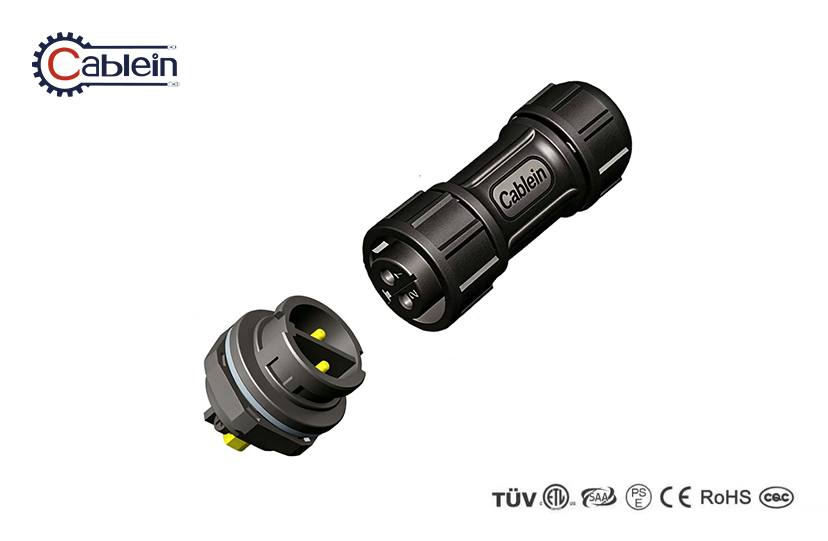
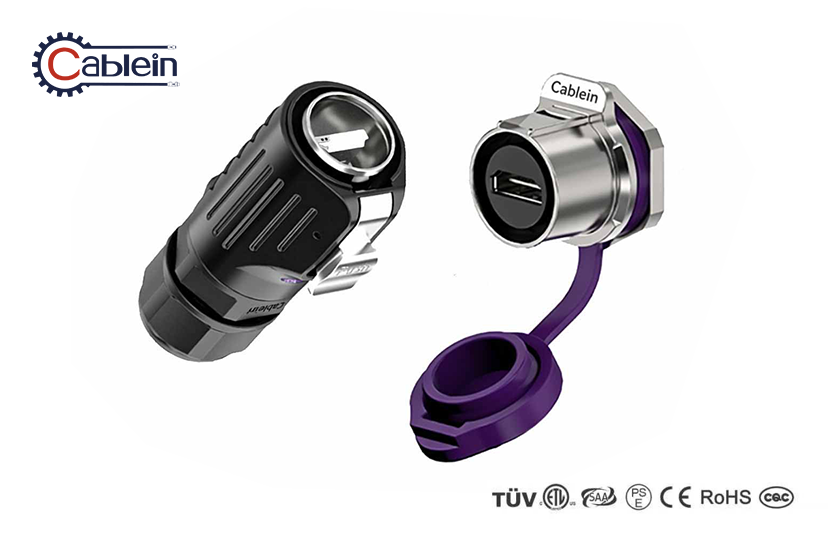
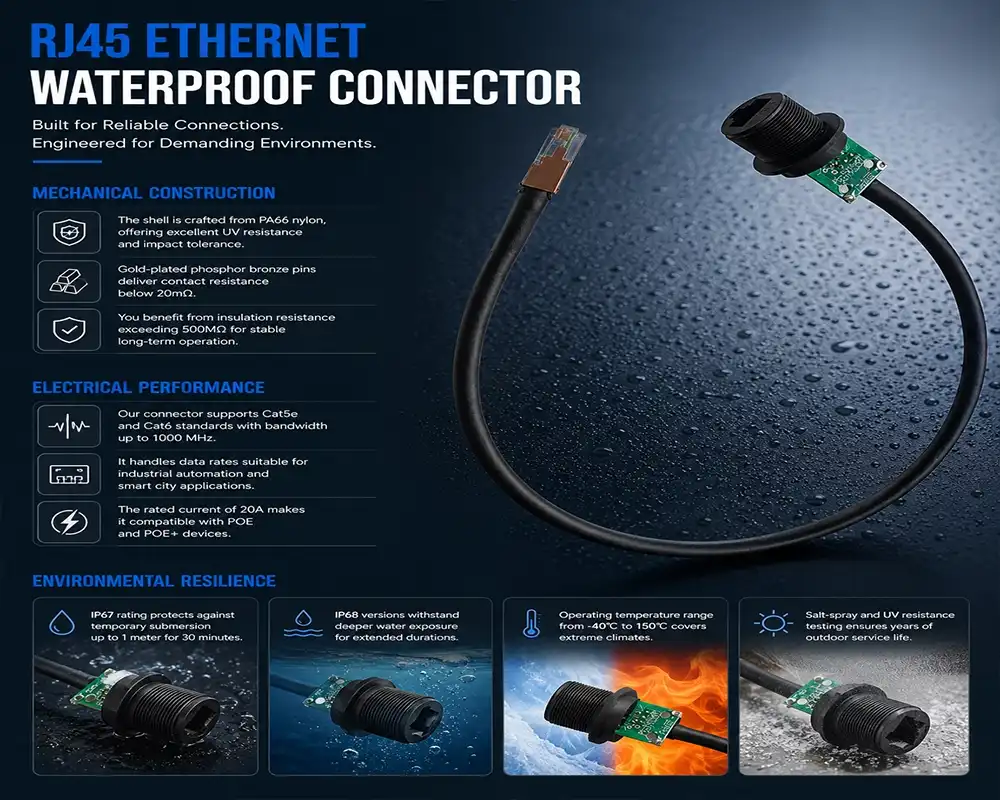
Standard networking protocols can be turned into industrial-grade connections with waterproof Ethernet connectors that can work in harsh environments where regular parts would break quickly. True waterproof connectors are protected by designed sealing systems that keep wetness and contaminants out, while basic weatherproof housings only protect against rain.
How IP Ratings Define Protection Levels?
The Ingress Protection rating system tells you how resistant a connector is to solids and liquids. IP67-rated connectors can be submerged temporarily up to one meter deep for thirty minutes. This means they can be used in places where it rains a lot, gets sprayed with water, or floods every once in a while. IP68 versions offer longer submersion protection—often rated for continuous operation at two meters or deeper—which is very important for marine applications, underground conduit systems, and installations in areas that are likely to flood.
Construction Materials That Ensure Durability
High-performance RJ45 ethernet waterproof connector housings are made of PA66 nylon that is engineered to be stable in UV light and resistant to impact. The structure of this material stays the same at temperatures ranging from -40°C to 150°C; it doesn't break or mold. There are gold-plated phosphor bronze contacts inside the parts that don't oxidize and keep their contact resistance below 20mΩ even after hundreds of mating cycles. Silicone O-rings are the main barrier against moisture; they press evenly against mating surfaces to block leak paths. Metal cable glands with threaded locking mechanisms keep cables safe while keeping environmental seals. Strain relief features keep solder joints safe from mechanical stress that could otherwise cause connections to fail or become intermittent.
This multi-layer safety method covers the whole range of failures, from catastrophic water entry that shorts out circuits right away to slow oxidation that lowers signal quality over months of use. When purchasing managers look at different sources, they should make sure that the companies do salt-spray tests that follow ASTM B117 guidelines and can show proof of waterproof performance through batch tests.
Comparing Cat5e and Cat6 RJ45 Ethernet Waterproof Connectors
The basic wire standard you choose affects both the system's current performance and its future growth. If you know about these differences, you won't buy too many connectors for simple uses or not enough for setups that will need more speed in the future.
Technical Specifications and Performance Metrics
Cat5e ports can handle up to 100 MHz of bandwidth and can reliably send data at 1000 Mbps (1 Gigabit Ethernet) over wire lengths of up to 100 meters. The wire is made up of four twisted pairs with a modest twist density. This gives it basic crosstalk protection that works for most modern networking needs. Cat6 connectors raise the bandwidth limit to 250 MHz, which lets 10 Gbps data be sent over shorter distances (usually 55 meters) while keeping 1 Gbps performance over the full 100-meter specification. Tighter twist requirements, better pair isolation, and often an internal spline separator that keeps the space between wire pairs constant all lead to better performance.
When these wire standards are built into waterproof connection housings, the differences in performance stand out more in places with a lot of electrical noise. Cat6 is better at blocking crosstalk, which helps keep signals strong near high-voltage power cables, motor controllers, and switching equipment that are common in industrial automation settings. When sites are outside, where lightning-caused spikes and radio frequency interference can mess up data transfer, the improved shielding is especially useful.
Cost Analysis and Long-Term Value
Cat5e waterproof connections usually cost 15–25% less than Cat6 units of the same type, which can help with the budgeting process for large-scale installs. The cost of installation labor stays the same because both types of connectors use similar termination methods. When you think about how long the system will last and how it might be upgraded, the business math changes. If you put in a surveillance system today with Cat5e infrastructure, you might have to completely redo the wiring in five years because camera resolutions will have gone up and video analytics will need more bandwidth. Cat6 infrastructure can handle these changes without having to be replaced, so the small starting cost is spread out over a longer service life.
Buyers who want to stick to a budget should look at the total cost of ownership instead of just the unit price. Cat6 connectors have better electromagnetic compatibility, which means they are cheaper to fix when problems happen in places with bad electricity. Because Cat6 has a higher performance margin, links that are close to their standard limits with Cat5e will have enough extra space for Cat6. This will cut down on the number of intermittent failures that require service calls and diagnostic costs.
Choosing the Right RJ45 Waterproof Connector for Your Application
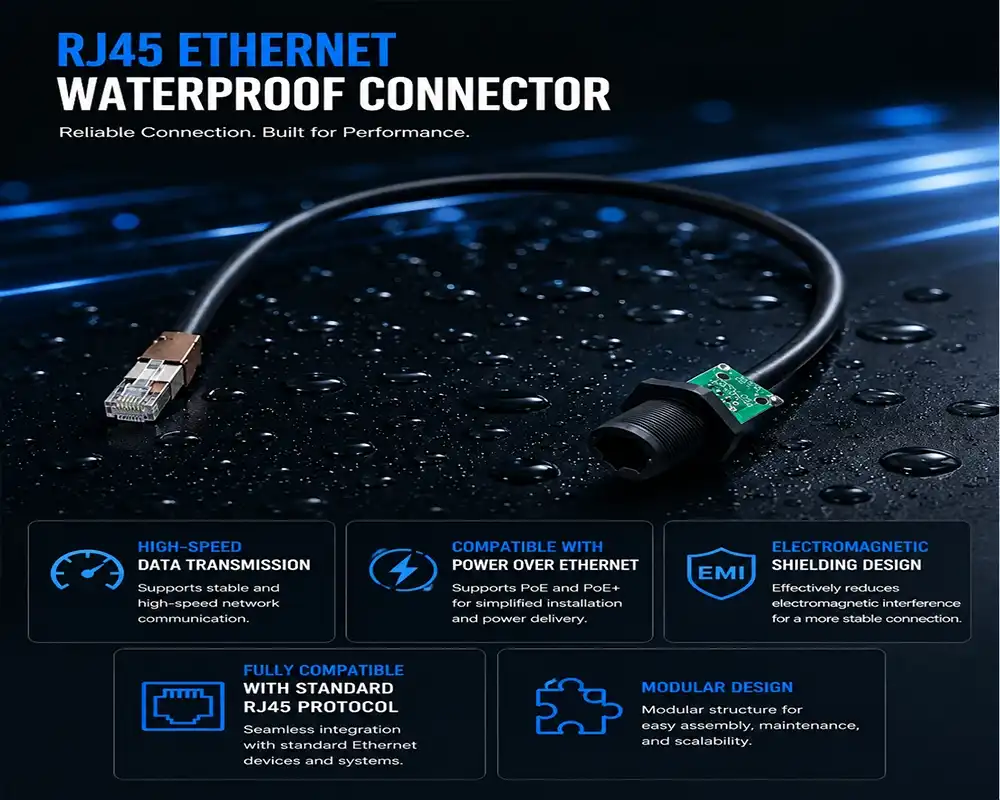
By matching RJ45 ethernet waterproof connector specs to real-world application conditions, both over-engineering and poor performance can be avoided. Your selection criteria should take into account both current needs and reasonable growth predictions as well as environmental stressors.
Application-Specific Selection Guidelines
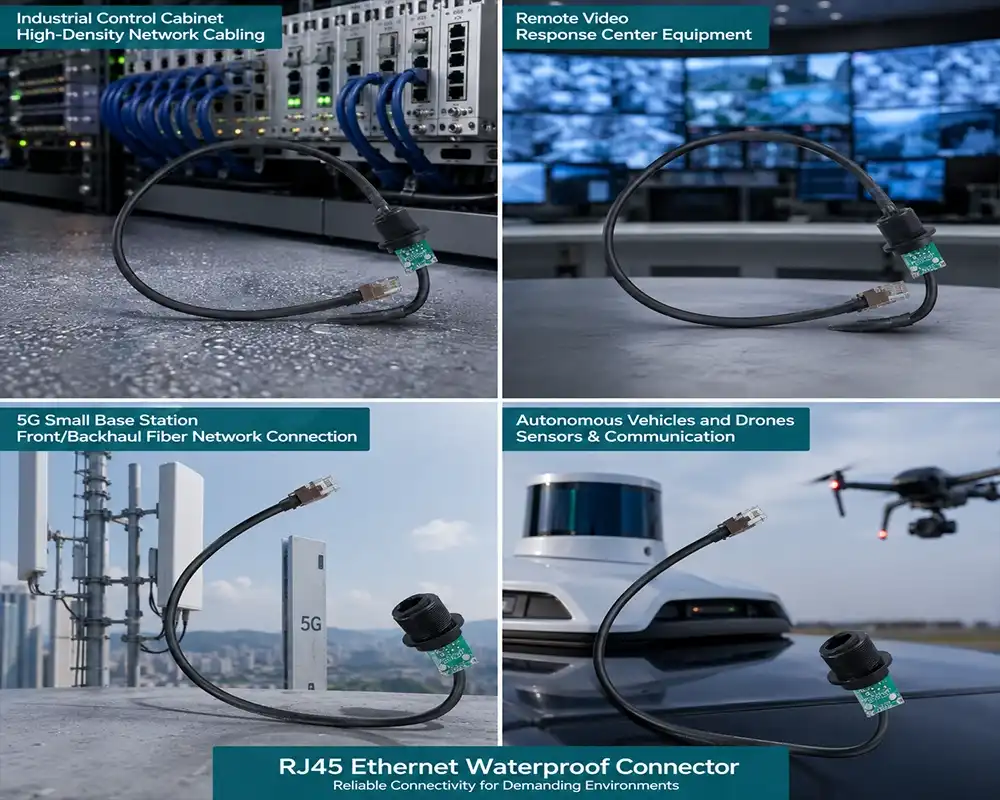
Standard IP cameras running at 5 to 8 Mbps per channel in outdoor surveillance systems work well within Cat5e limits. More than extra bandwidth capability, these systems gain from strong environmental protection and closure that can be installed in the field. On the other hand, infrastructure in smart cities that includes 4K cameras, environmental monitors, and wifi access points should use Cat6 connection to handle growing data needs without having to update infrastructure.
It's important to think about industrial automation networks in a special way. Programmable logic controls and spread I/O systems don't need a lot of bandwidth, but electrical noise from variable frequency drives and welding tools can damage signals. Cat6's better shielding makes signals more reliable in a way that can be measured. Marine and remote sites are subject to salt-spray corrosion, which speeds up the breakdown of contacts. Because of this, these harsh settings call for high-quality connectors with thicker plating and test results that show they can withstand rapid age.
Power over Ethernet protocols are being used more and more in LED lighting networks for arenas, landscape projects, and farming uses. These protocols send both data and electricity through the same cable system. In addition to data transmission requirements, these systems need connectors that can handle 20A of current. Cablein and other manufacturers make waterproof RJ45 systems that can handle POE and POE+ power loads without overheating. This means that they can work reliably in temperatures ranging from -40°F to 150°F, which is common for outdoor lighting setups.
Certification and Compliance Requirements
Product certifications have a direct effect on your ability to use your tools in controlled markets and get through project reviews. When something has a CE mark on it, it means that it meets European safety and electromagnetic compatibility standards. The ETL listing makes sure that safety standards are met by a third party, which is very important for installations in North America. Making sure that products follow RoHS rules about dangerous substances is necessary for sending equipment to European markets or putting it in government buildings with green buying rules.
Instead of relying only on design qualification, procurement managers should make sure that the companies that make connectors keep their ISO9001:2015 quality management certification and test each batch. Ask for test records that show that the IP grade is correct, that the contact resistance was measured, and that the insulation resistance was checked. Suppliers with a good reputation give marks of compliance that are unique to each production lot instead of general paperwork that might not show how well the product actually works.
Installation and Maintenance of RJ45 Ethernet Waterproof Connectors
The right way to place connectors determines whether they provide the environmental security they are supposed to or fail too soon, even if they were made well. When assembly steps damage the closing integrity, even high-quality parts don't work as well as they should.
Field Installation Best Practices
Field-installable connectors make inventory less complicated by letting workers cut cables to the exact amounts needed on-site. Carefully prepare the cable for the solder-type termination process by removing just the right amount of jacket to get to the conductors without leaving any extra bare wire that could cause a short circuit. Individual conductor insulation should only be stripped to the length that fits inside the contact barrel and no more. Too much stripped length can cause interference, and not enough length can make solder joints weak and prone to failure from shaking.
Before putting the seal together, clean all of its sides with isopropyl alcohol to get rid of oils and rust that stop it from compressing properly. Keep the minimum bend radius in mind when threading cable through the gland assembly so that you don't damage the insulation on the conductor or create stress concentration points. After connecting contacts together, look at each joint under a microscope to make sure it is fully wet and there are no cold solder joints, which have a dull, grainy look instead of a smooth, shiny finish.
Pay attention to where and how much you squeeze the O-rings when you put the seals together. Lightly grease silicone seals with a suitable grease to make them easier to install and stop them from rolling or pinching when they're mated. Tighten the threaded locking rings to the manufacturer's specifications using calibrated tools. Not enough torque lets water in, but too much torque can damage the housing threads or bend the sealing surfaces. Once the setup is complete, make sure the pins are mapped correctly by conducting continuity testing and insulation testing. This is done to make sure there are no shorts before the link is powered on.
Preventive Maintenance Strategies
Set up inspection schedules for RJ45 ethernet waterproof connector based on how dangerous the environment is. Visual checks should be done every three months to look for damage to the cable jacket, cracks in the connector housing, and locking rings that aren't tight enough, which means the seal is breaking down. As part of yearly detailed inspections, connectors are gently taken apart to check the condition of the internal seal, contact oxidation, and moisture contamination indicators. If you see compression set, surface cracks, or stiffening that makes the seal less effective, you should replace it.
When temperatures change a lot, thermal cycling speeds up the age process of seals. In desert or cold areas, outdoor connectors may need to have their seals replaced more often than indoor installations that don't need to be protected from temperature changes. Keep track of the results of inspections and maintenance tasks to set baselines for reliability that can be used to plan predictive maintenance and find trouble spots in installations that need design changes or new parts.
Market Trends and Future Outlook for Waterproof Ethernet Connectors
The market for workplace communication is still changing, with the goal of getting faster data rates, easier installation, and better environmental resistance. Knowing about these trends helps procurement managers choose solutions that will work for the whole planned lifecycle of a system.
Emerging Technologies and Standards
Push-lock and tool-free termination systems are becoming more popular in situations where field techs don't have the right crimping tools or have to work in small areas where traditional assembly is hard. When compared to solder-type termination, these quick-connect designs cut installation time by 40–60% while still providing IP67/IP68 protection. But procurement managers should think about whether the extra cost is worth it for their specific deployment cases by comparing the ease premium.
IEEE 802.3bt (POE++) delivers up to 90 watts per port to support power-hungry devices like PTZ cameras, LED lights, and wireless access points. Power over Ethernet standards are always getting better. Waterproof connectors need to change so they can handle more power without getting too hot and still keep the purity of the data stream. This leads to new materials with better heat dissipation designs and better contact plating to keep voltage drops to a minimum at higher current levels.
As the Internet of Things grows, there is a need for smaller, waterproof plugs that can fit sensor housings and edge computing devices that are getting smaller. To get around the lack of space in modern equipment, manufacturers are making reduced-profile designs that keep full IP68 protection in housings that are 30–40% smaller than traditional industrial connectors.
Sustainability and Environmental Considerations
Sustainability programs in businesses have a bigger impact on buying choices than just price and technical specs. As a response, connector makers are changing their designs to make their products easier to recycle. For example, they are using single-material housings instead of multi-material kits, which make it harder to separate used and unwanted parts. Some providers now have programs that will take back old connectors, recover valuable metals from contact plating, and turn recycled industrial plastics into new products.
Longer product lifespans are better for the environment because they mean less replacements. Connectors that are made to last 1,000 mating cycles or more and have seals that can be replaced leave less of an impact on the environment than disposable designs that need to be replaced completely when the seals wear out. Technical needs can be aligned with sustainability goals by procurement managers choosing providers who provide clear lifecycle assessment data and material composition paperwork and giving priority to designs that can be used.
Conclusion
When deciding between Cat5e and Cat6 RJ45 ethernet waterproof connector plugs, you have to weigh your immediate budget needs against your future internet needs and the need to protect the environment. Cat5e solutions offer cost-effective performance for current applications with moderate data needs. On the other hand, Cat6 variants offer more headroom and better electromagnetic immunity in tough electrical environments. For both choices to work reliably outside, they need to be made with good materials, the right closing design, and proof of testing. Your choice should be based on application-specific factors like data flow, exposure to electrical noise, temperature changes, and how long you expect the system to last. When you work with experienced providers who offer full technical support, the ability to customize products, and certified quality systems, you can be sure that the connectivity options you choose will keep your network reliable throughout the lifecycle of your project.
FAQ
Can standard RJ45 connectors be retrofitted for waterproof use?
Standard links don't have the closing design that is needed to keep things dry. Adding external boots or tape only provides a small amount of moisture resistance, making it unsuitable for use outside. Purpose-built waterproof connectors have O-ring seals, threaded wire glands, and external barriers that can't be added to standard parts and work well.
What practical differences exist between IP67 and IP68 ratings?
IP67 connectors can be submerged for a short time (usually up to one meter deep for thirty minutes), making them suitable for installations that get wet in heavy rain or floods every once in a while. IP68 models can survive ongoing submersion at greater depths defined by makers, usually two meters or more. This is needed for installations in underground vaults, marine settings, or places that are likely to flood for a long time.
When should I choose Cat6 over Cat5e for outdoor installations?
If you're putting in systems that need to send data at 10 Gbps, working near high-voltage equipment that causes electromagnetic interference, or looking for bandwidth growth in the next 5 to 10 years, Cat6 is the best choice. Cat5e is still a good value for apps that only need 1 Gbps and don't have to deal with a lot of electrical noise.
Partner with Cablein for Reliable Industrial Connectivity Solutions
Cablein makes waterproof connectors that have been tested in the field and are made to work in the harshest industrial and outdoor settings. Our PA66 nylon housings with gold-plated contacts and rubber seals are approved to be IP67/IP68 waterproof from -40°F to 150°F. We keep a ready inventory of more than 10,000 units for each product line as an experienced RJ45 ethernet waterproof connector maker with ISO9001:2015 certification and thorough testing methods for quick 7–10 day delivery. Our engineering team offers full customization, including choosing the type of wire, the length, and the orientation of the connectors. They are backed by CE, RoHS, ETL, and PSE standards. Our field-installable solder-type designs make inventory less complicated, and our 24-hour technical support makes sure deployment goes smoothly, whether you need Cat5e or Cat6 solutions. Get in touch with nick@cableinco.com right away to talk about your project needs and get detailed specifications that are made just for you.
References
1. Institute of Electrical and Electronics Engineers (IEEE), "IEEE Standard 802.3: Ethernet Physical Layer Specifications and Management Parameters for 10 Gb/s Operation," IEEE Standards Association, 2018.
2. International Electrotechnical Commission (IEC), "IEC 60529: Degrees of Protection Provided by Enclosures (IP Code)," Third Edition, 2013.
3. Telecommunications Industry Association, "TIA-568.2-D: Balanced Twisted-Pair Telecommunications Cabling and Components Standards," TIA Technical Committee TR-42, 2018.
4. American Society for Testing and Materials, "ASTM B117-19: Standard Practice for Operating Salt Spray (Fog) Apparatus," ASTM International Committee B08, 2019.
5. Bishop, R. H., "The Mechatronics Handbook: Industrial Networking and Control Systems," CRC Press, Second Edition, 2017, pp. 234-267.
6. Zhang, L., Chen, M., and Williams, T., "Environmental Stress Testing of Electronic Connectors for Outdoor Telecommunications Infrastructure," Journal of Electronic Materials, Vol. 48, No. 6, 2019, pp. 3421-3438.