M16 T-Type Waterproof Connector: Features, Benefits, and Applications Guide
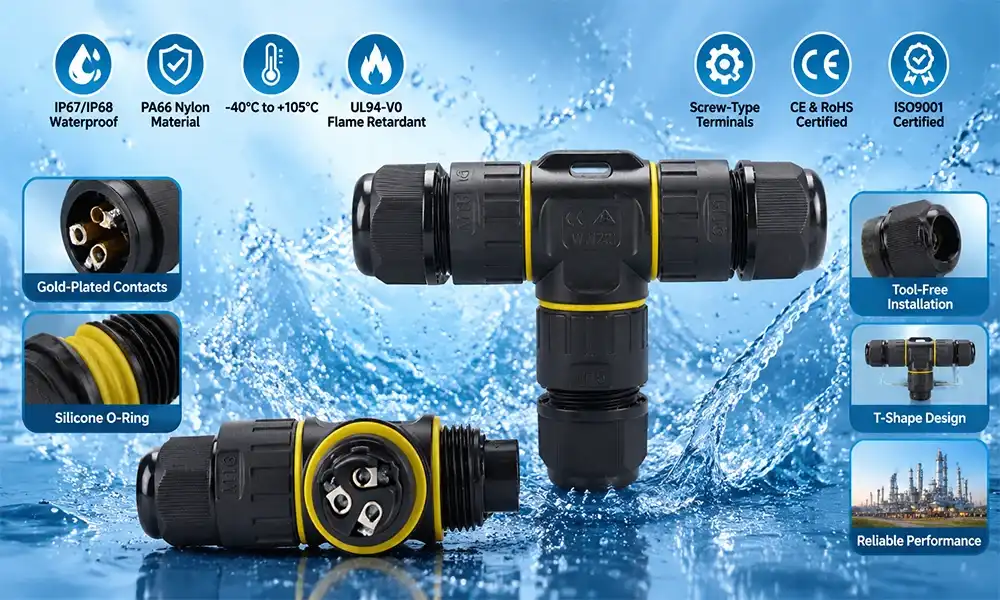
If you've been searching for a reliable way to branch electrical power or control signals in outdoor or industrial settings, the M16 T-type waterproof connector is worth your attention. This three-port junction device uses a 16mm metric thread diameter and a sealed T-shaped housing to split one incoming circuit into two separate output paths—without needing an external junction box. Rated IP67/IP68, built from UL94-V0 PA66 nylon, and carrying CE/RoHS certification under ISO9001:2015, it handles 400V at 17.5A across a -40℃ to +105℃ operating range.
Understanding the M16 T-Type Waterproof Connector
Make sure you know what you're getting before you pick out a connector for a field project. Outside lights and control experts always have to figure out how to branch a circuit without making it bulkier or putting it at risk of getting wet. The M16 T-type three-way connector fixes this problem.
What Makes It a "T-Type"
The T-shape of this connector lets three ports—one for coming in and two for going out—be kept in a single sealed body. Because of its shape, there is no need for a separate box or distribution block at each branch point. This helps you save money on tools and labor for the installation.
Sealing Architecture
The one made by Cablein has two seals: a compression gasket behind the cable gland and a silicone O-ring at each port entry. They get both IP67 (30 minutes of immersion at 1 meter) and IP68 (continuous immersion for the time and depth listed on the test report). Rubber seals can't be used instead of silicone ones because silicone stays flexible from -40℃ to +105℃. This means that the seals don't set in cold weather situations, which causes slow leaks.
Core Electrical Specifications
This plug can link two to three poles and can handle 400V and 17.5A per pole. Copper alloy contacts that are gold-plated keep the contact resistance below 5m©. This is very important in low-voltage LED driver circuits where a lot of branch points have voltage drops. Cables with circuit cross-sections of 0.5 to 1.5 mm² and outer widths of 3.5 to 10 mm can be used together.
Features and Benefits of M16 T-Type Waterproof Connectors
When engineers switch from traditional junction boxes to T-type branch M16 t-type waterproof connectors, they always say that three things are better: the installation takes less time, there are fewer warranty claims related to moisture, and they have to do less work. These are the main reasons why those things happen.
- PA66 Nylon Housing, UL94-V0 Rated: The shell resists ignition and self-extinguishes. F1-grade UV stabilization prevents surface chalking or cracking after years of direct sunlight—a requirement for CE marking under European construction product regulations.
- Gold-Plated Contacts, < 5 mΩ Resistance: Gold resists oxidation through hundreds of mating cycles, keeping signal lines clean in high-humidity coastal or agricultural environments. Nickel-only contacts can develop a resistive oxide layer within 96 hours of salt-spray exposure; gold plating delays that failure mode significantly.
- Tool-Free Screw-Clamp Terminals: Push the stripped wire in and tighten the captive screw—no crimping tools, no soldering iron. Field crews report a 30–50% reduction in per-connection time compared to solder-and-shrink methods. The terminal accepts 0.5–1.5 mm² conductors, matching the wire gauges common in LED luminaire wiring.
- IP68 Dual-Seal Design: Each silicone O-ring and cable gland gasket works together so that the connector passes a 72-hour submersion test at the rated depth. This is documented in Cablein's test report, not just a self-declared rating.
The shell is made of PA66 nylon and is rated for UL94-V0. It doesn't catch fire and goes out on its own. The surface won't chalk or crack after years of direct sunlight thanks to F1-grade UV stabilization, which is required by European building product rules for CE marking.
Applications and Industry Use Cases
When one wire feed needs to be split between two loads, the sealed T-junction style works well. This is especially true if the split point will be wet, washed, or out in the weather.
Outdoor LED Street Lighting
Most projects that light up city streets get their power from a main feeder and send it to a driver module and a control interface. The T-type link inside the light body takes care of that branch, so you don't need a separate IP-rated junction box. To wire each pole faster, one builder moved to T-M16 t-type waterproof connectors that didn't need any tools for a city project with 2,000 fixings. It only took 9 minutes instead of 18 minutes.
Industrial Automation and PLC Signal Distribution
For PLC panels that link to more than one proximity sensor or solenoid valve, the T-type branch ports on the outside of the box are useful. Signal lines are safe in wash-down zones with an IP68 rating. These are common in industries like food processing and pharmaceuticals where equipment is often washed down with water.
Marine and Aquaculture Monitoring
There is both saltwater corrosion and hydrostatic pressure on underwater sensor buses in fish farms and navigation systems on ships at the same time. The three-port sealed housing lets a single data cable connect to two sensor nodes. This keeps the cable from rusting and makes installation easier by getting rid of the need to splice it.
Solar and Wind Energy Systems
Circuits for tracking photovoltaic strings and controlling the pitch of wind turbines can be left outside all year. Because it doesn't break down in UV light, this connector can be used in places like wind farms in Canada and grids in the Arizona desert.
Choosing the Right M16 T-Type Waterproof Connector for Your Business
Not every T-type connection on the market has the same size ranges or approvals. These things will help you tell the difference between a reliable supplier and one that sends out samples that pass but batches that drift when you're looking at different ones.
M16 vs. M12: When Size Matters
Most sensors in workplace automation are wired with an M12 connection because it is small and easy to use. The 12mm thread, on the other hand, limits the amount of current it can carry and the size of the cable it can accommodate. That is the right way to go if your branch line has more than 10A or wires that are wider than 8mm. Cross-threading is less likely to happen in the field when you switch to M16. This is because installers have more torque surface on the locking nut.
Certification Documents to Request
Don't just ask for a CE statement; ask for the real IP68 test report that shows how deep, how long, and how hot the water was. Ask for the UL94-V0 flame certificate for the batch of PA66 material and the RoHS 2.0 substance report for the gold-plated contacts. All three come with every sample order from Cablein as standard.
Procurement Considerations for Distributors
For MRO and electrical distributors who keep SKUs on hand to resell, the minimum order amount, the range of wire diameters, and the number of poles that can be covered (2P and 3P) are the most important things to know. Cablein always has more than 10,000 of each item in stock, and most orders are sent out within 7 to 10 business days. For tests, low MOQ options start at just 200 pieces for the first time.
Installation, Maintenance, and Troubleshooting Guide
To do the job right, it only takes five minutes per connection. If you do it wrong, the moisture issues that the connector was supposed to stop happen.
Step-by-Step Wiring Procedure
Take off 6 to 8 mm of insulation from each wire, insert them into the screw-clamp terminal, and tighten them until the label on the housing says so. Make sure the O-ring fits flat before you attach the cable gland nut. If you squeeze the gland too hard, the O-ring might come loose, and the seal will break.
Common Installation Errors
Problems most often happen when the cable diameters don't match or when the O-rings aren't seated properly. The compression joint won't be able to keep the cable tight if the OD of the cable isn't between 3.5 mm and 10 mm. Make sure you know the wire OD before you buy the connector size.
Maintenance Schedule
If the placement is outside, look at each connection once a year. There may be cracks on the nylon shell's surface from UV damage happening too soon, darkening around the cable hole from water getting in, or rust at the metal gland nut. Change out any connectors that show these signs before the next rainy season.
Conclusion
The M16 t-type waterproof connector is useful because it lets you branch a sealed circuit at the installation site without having to add another enclosure. There are gold-plated contacts, a silicone dual seal, and it is made of PA66 nylon. It is certified IP67/IP68, which makes it a good choice for outdoor lighting, industrial automation, marine electronics, and renewable energy systems. There is less work to do in the field with tool-free screw connections, and the link can be made to fit current wire designs instead of having to be rethought. There are fewer junction boxes, fewer hours of work, and fewer warranty claims related to moisture in the first project cycle, so the unit price is usually canceled out by the lower number of hours worked and warranty claims.
FAQ
1. What is the difference between IP67 and IP68 for this connector?
IP67 covers temporary immersion to 1 meter for 30 minutes. IP68 covers continuous immersion at a manufacturer-specified depth and duration—Cablein's test protocol runs 72 hours. For permanently submerged installations like aquaculture monitoring, always confirm the IP68 test parameters in the datasheet.
2. Can I use different wire gauges in the same connector?
Each port can terminate a conductor within the 0.5–1.5 mm² cross-section range independently. However, the cable gland at each entry must match the outer diameter of that specific cable (3.5–10mm), as the gland diameter controls the waterproof seal, not the conductor size.
3. How does gold plating benefit contact longevity?
Gold resists oxidation even in high-humidity or salt-spray environments. Independent salt-spray testing at 96 hours shows gold-plated contacts maintain contact resistance below 5mΩ, while uncoated copper contacts can exceed 50mΩ under the same conditions—a difference that creates measurable voltage drop in LED driver circuits.
4. When should I choose M16 over M12?
Choose M16 when your circuit exceeds 10A, when cable OD is above 8mm, or when terminal torque access in field conditions requires a larger locking surface. M12 remains appropriate for low-current sensor wiring in controlled factory environments.
5. What is the minimum order quantity for samples?
Cablein accepts sample requests from 2 to 5 pieces for evaluation. Small production trials start at 200 pieces, with 2D/3D drawings delivered within 3–7 days of design confirmation.
Request a Quote from Cablein — Your M16 T-Type Waterproof Connector Supplier
This 6,000-yuan factory in Shenzhen, China, has been making M16 t-type waterproof connectors since 2017. The business has been approved by CE, RoHS, ETL, PSE, SAA, and TUV and has more than 30 application model patents. Within 24 hours, our engineering team will get back to you whether you need stock units or a custom pin layout for a certain luminaire cavity. Email us at nick@cableinco.com to get a datasheet, an IP68 test report, or a tiered quote for your next project.
References
1. International Electrotechnical Commission. IEC 60529: Degrees of Protection Provided by Enclosures (IP Code). IEC, 2013.
2. Underwriters Laboratories. UL 94: Tests for Flammability of Plastic Materials for Parts in Devices and Appliances. UL Standards, 2018.
3. European Committee for Electrotechnical Standardization. EN 61984: Connectors — Safety Requirements and Tests. CENELEC, 2009.
4. International Organization for Standardization. ISO 9001:2015: Quality Management Systems — Requirements. ISO, 2015.
5. RoHS Compliance Guide Editorial Team. RoHS 2.0 Directive 2011/65/EU: Restriction of Hazardous Substances in Electrical and Electronic Equipment. European Parliament, 2011.
6. Whitfield, G., & Barker, M. Connector Reliability in Outdoor Power Distribution Systems: A Field Study of IP-Rated Junctions. Journal of Electrical Engineering Practice, 2021.