How to Choose the Right LP16 USB Type-C Waterproof Connector for Industrial Applications?
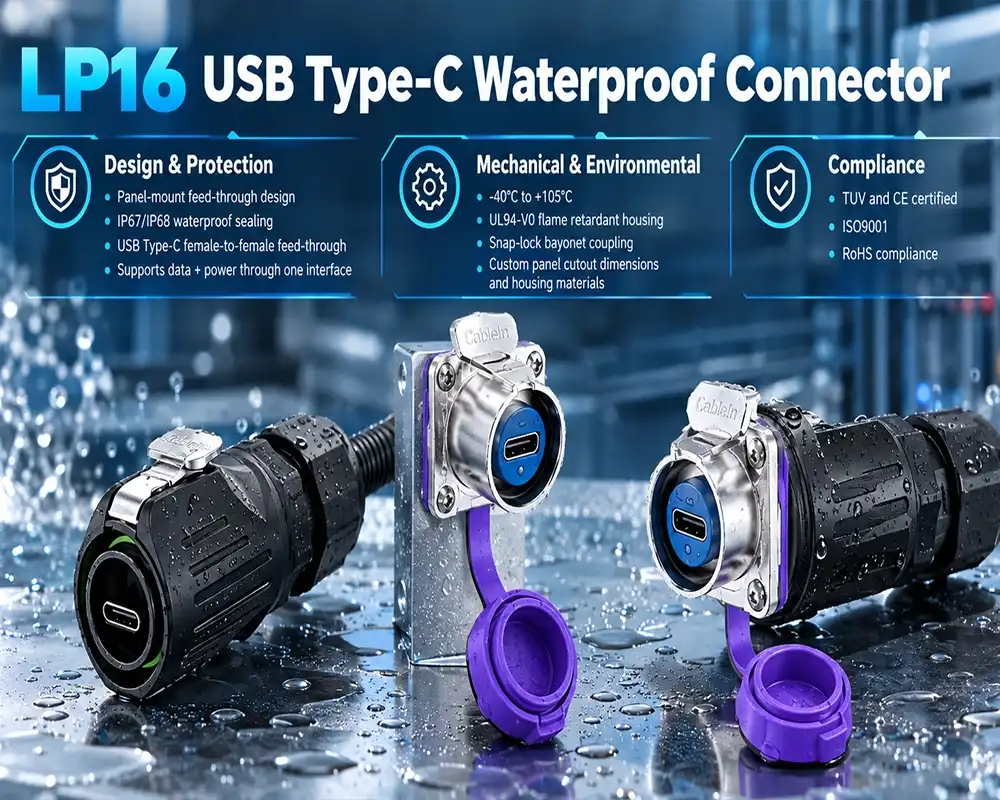
Choosing the right LP16 USB Type-C waterproof connector starts with understanding your environment. If your equipment operates outdoors, near water, in dusty facilities, or under constant vibration, a standard USB port will eventually fail you. The LP16 series from Cablein Technology addresses these exact vulnerabilities — delivering IP67/IP68 sealing, a snap-lock bayonet coupling, and a panel-mount feed-through design rated for -40℃ to +105℃. Whether you are sourcing for LED lighting systems, EV charging infrastructure, or industrial automation equipment, this guide helps you make a confident, informed decision.
Understanding the Core Specifications and Benefits of LP16 USB Type-C Waterproof Connectors
What the Technical Specs Actually Mean for Your Application
The LP16 USB Type-C waterproof connector is a panel-mount female-to-female feed-through type, which means it makes a sealed pass-through point in the case of your equipment. Both sides of the panel can still be reached, which makes managing cables a lot easier. It can deliver power at DC 20V/3A and transfer data at up to 10Gbps (USB 3.1 Gen 2). All of this can be done through a single standard USB-C port.
If a connection has an IP67 rating, it means it can handle being submerged in water up to 1 meter deep for 30 minutes. IP68 goes even further; it allows for continued running underwater at certain depths. This difference is important for outdoor uses like stadium LED displays, solar tracking stations, or coastal security systems.
Material Durability You Can Rely On
The housing has a zinc metal shell and a hard chrome finish, so it doesn't rust even in places where salt spray is present. The body is made of PBT plastic, which is UL94-V0 flame retardant and has good chemical and heat protection. Gold-plated copper alloy contacts keep the resistance of the contacts at or below 30mΩ. This keeps the signal and power flow stable for more than 1,700 union cycles.
UV stability in the housing stops aging and breaking down in the outdoors, which is a small detail that makes a big difference in placements on rooftops or in open fields. EMI/EMC shielding saves signals even more in places with a lot of electrical noise, like plant areas or rail transit enclosures.
These material and performance traits lower the number of repair tasks needed, lower the total cost of ownership, and keep your systems going through heavy duty cycles.
Comparing LP16 USB Type-C Waterproof Connectors with Other Market Options
LP16 vs. Standard USB-C Ports
A USB-C port made for consumers doesn't protect against outside intrusion. It turns into a liability in any place where there is moisture, dust, or mechanical stress. That weakness is fixed in the LP16 USB Type-C waterproof connector panel-mount solution, which has a verified IP67/IP68 seal and a locking mechanism that stops the connection from coming loose when the device shakes, which a friction-fit USB-C port can't do.
LP16 vs. M12 Industrial Connectors
M12 plugs are a well-known standard in the business world, but they were not made to carry USB protocol data directly. Adding USB-C capabilities to an M12 body usually needs adapters, which add more places where things can go wrong and signal loss. The LP16 connector keeps the full set of USB Type-C pins on the inside, so power and data flow without any conversion losses.
The LP16 option lowers the cost of ownership by avoiding the need to buy adapters, making wiring less complicated, and making panel cutouts easier. This is a clear benefit for buying teams that need to weigh up-front cost against long-term dependability. Cablein also lets you choose the size and material of the cutouts in the panel, which makes integration more flexible than with most off-the-shelf M12 choices.
How to Evaluate and Select the Right LP16 USB Type-C Connector for Your Needs?
Matching the Connector to Your Environment
Before choosing a waterproof circular connector, you should make a clear plan of how it will be used. Ask: What is the temperature range around you? Is there exposure to chemicals, UV light, or salt spray? Is there a lot of vibration or mechanical shock during the installation? The LP16 USB Type-C waterproof connector's temperature range of -40°C to +105°C and IP68 rating make it perfect for most outdoor and commercial uses.
Verifying Certifications and Supplier Credibility
For equipment to get into controlled markets, especially in North America and Europe, it has to have TUV and CE certifications under ISO9001 and RoHS compliance. These certificates show that the connection has been tested for safety and environmental impact by a third party.
When looking for a supplier of industrial waterproof USB connectors, these are the main things you should check:
- IP rating documentation: Ask for real test results instead of just claims on a paper. IP67 and IP68 are two different standards that have different requirements for immersion.
- Certification traceability: Make sure that the CE, TUV, RoHS, and ISO9001 certificates are up to date and came from a reputable organization.
- Customization capability: Check to see if the supplier can make custom cable lengths, pin configurations, or private molds for your specific enclosure.
- Delivery reliability: Check the supplier's lead times, stock levels, and ability to handle urgent orders without affecting your production schedule.
These factors together tell you if a supplier can keep up with your project after the sample stage. Your operations are at risk when you work with a seller who meets technical standards but can't deliver on time.
Installation Best Practices and Use Cases in Industrial Settings
Step-by-Step Installation Guidance
The LP16 USB Type-C waterproof connector is important because it is waterproof, and if it is installed correctly, it will stay waterproof. If you use too much force or the matching surfaces aren't lined up correctly, it can damage the seal and make it impossible to get certified.
- Prepare the panel cutout to the measurements given. Cablein allows you to make custom cutout sizes, so make sure that your measurements match up with the enclosure drawing before you start machining.
- Insert the connector body from the front of the panel and tighten the back locking nut. Do not tighten too much; follow the manufacturer's torque recommendations.
- Engage the bayonet coupling on the side with the external plug in place until you hear and feel a click. This makes sure the lock is in place. The snap-lock method lets you operate it with one hand, which cuts down on installation time in the field.
- Test seal integrity before the system is fully operational, especially for IP68-rated parts that will be submerged in water all the time.
Where This Connector Performs Best
There are many demanding industries that have shown the LP16 connector to be reliable. It is used as a safe programming and debugging port on CNC machines and robotic arms in industrial automation, where oil mist and shaking make it hard to use other connection points. In outdoor LED tracking systems, it keeps data lines open for smart city signs and stadium scoreboards even when it rains a lot and is exposed to UV light for a long time.
Marine research teams use it on underwater data loggers and sensors that measure the depth of the water. The salt spray resistance and watertight integrity keep the hardware from breaking during long deployments at sea. EV charging stations and solar monitoring systems can also use it to protect communication ports in places that are exposed to weather and temperature changes for long periods of time.
Conclusion
It's not just a technical matter to choose the right waterproof connector; it's also a matter of managing risk. Industrial systems often fail because of four main problems: water getting in, vibrations that cause connections to break, rust, and signal instability. The LP16 USB Type-C waterproof connector fixes these problems. It is reliable in LED lighting, new energy, automation, and transportation applications thanks to its verified IP67/IP68 ratings, TUV and CE certifications, strong bayonet locking mechanism, and wide operating temperature range (-40°C to +105°C). When you work with a certified manufacturer, you can be sure that you will get uniform quality, paperwork that can be tracked, and quick expert help throughout the lifecycle of your project.
FAQ
Does the LP16 support USB Power Delivery at higher wattages?
The plug can send up to 20V/5A of power, so it works with USB PD profiles that are used in industrial diagnostic tools and embedded computers. Before deploying, make sure that the current rating of your wire assembly meets the LP16 USB Type-C waterproof connector's requirements.
What is the practical difference between the IP67 and IP68 versions?
IP67 protects against short-term exposure for 30 minutes at a depth of 1 meter. IP68 means that it can be used continuously underwater up to a certain depth set by the maker. IP68 is the right choice for permanent outdoor enclosures that could be flooded or have standing water.
Can a standard USB-C cable be used with the LP16 socket?
The USB Type-C standard is used for the internal link. But to get the rated IP protection, you need the LP16 series plug that goes with it. It's not safe to use a cable that doesn't match because it breaks the sealing system and lets water in.
How does the bayonet lock perform under sustained vibration?
In contrast to friction-fit USB-C ports, which only rely on contact friction, the bayonet system physically locks the two halves together with a click that can be heard. This keeps them from disconnecting under the IEC 60068-2-6 vibration conditions that are typical in places like train travel and robotic manufacturing.
Are custom configurations available for specialized projects?
Yes. Cablein lets you choose the size of the panel cutout, the material of the case, and the OEM/ODM development for special needs.
Get a Quote from Cablein — Your Trusted LP16 USB Type-C Waterproof Connector Supplier
Customers in over 100 countries have been able to get certified waterproof connectivity solutions from Cablein Technology since 2017. Our LP16 USB Type-C waterproof connectors are certified by CE, TUV, RoHS, and ISO9001. We also offer OEM/ODM modification, fast samples, and stable bulk shipping. Get in touch with our engineering team right away for a personalized product advice or to ask about bulk prices. You can email us at nick@cableinco.com or go to connectorswaterproof.com to see our full line of products.
References
1. USB Implementers Forum. USB Type-C Specification Release 2.1. USB-IF, 2021.
2. IEC (International Electrotechnical Commission). IEC 60529: Degrees of Protection Provided by Enclosures (IP Code). IEC, 2013.
3. UL (Underwriters Laboratories). UL 94 Standard for Tests for Flammability of Plastic Materials. UL Standards, 2013.
4. Molex. Connector Selection Guide for Industrial Environments. Molex Technical Library, 2022.
5. TUV Rheinland. CE Marking and Industrial Safety Certification Guide. TUV Rheinland, 2023.
6. IEC (International Electrotechnical Commission). IEC 60068-2-6: Environmental Testing — Vibration (Sinusoidal). IEC, 2007.