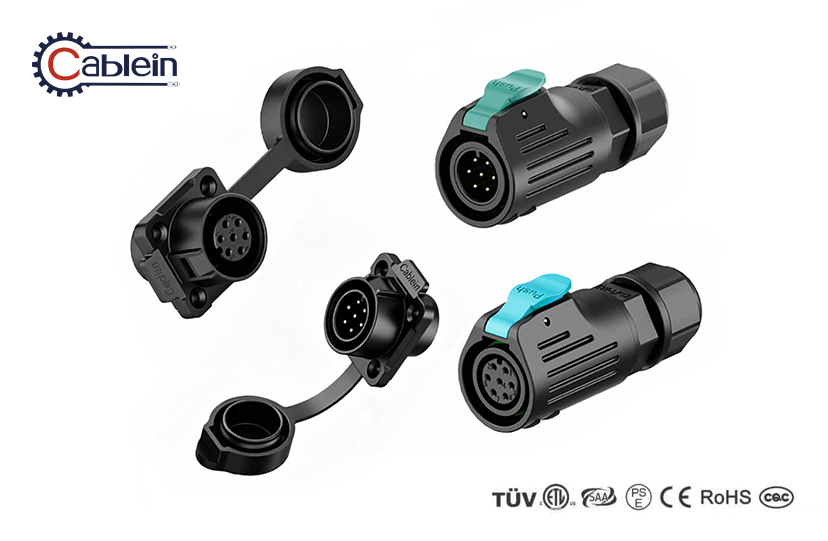
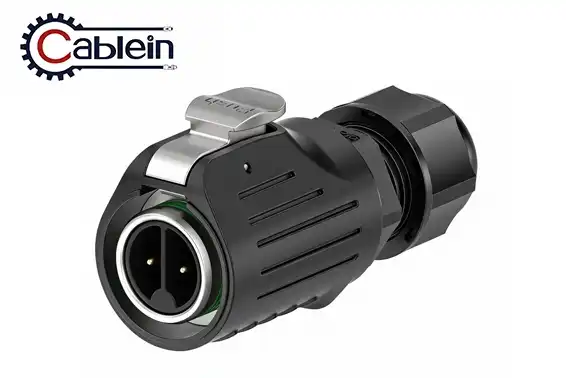
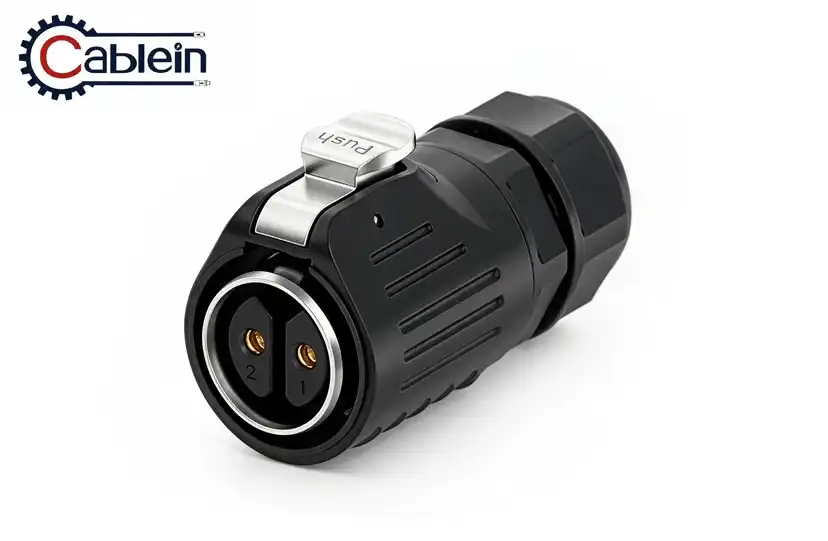
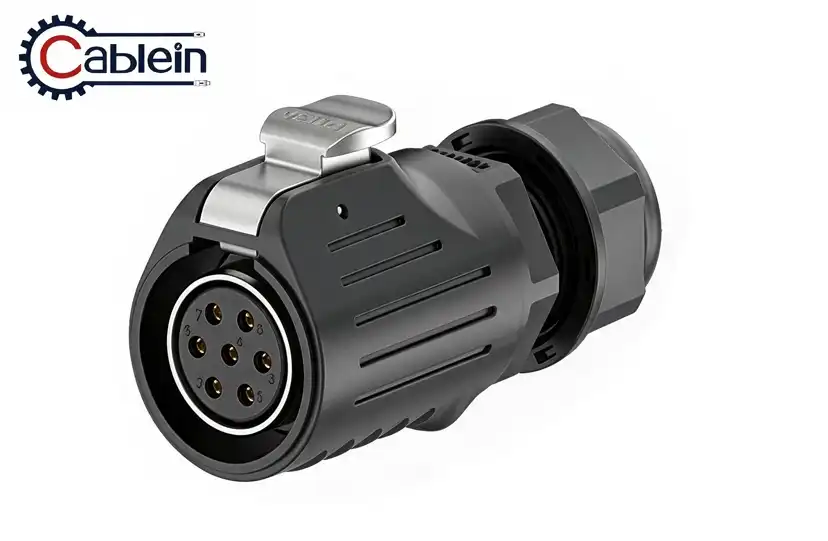
M25 4-Way Waterproof Connector Explained: When Do You Need a Multi-Port Design?
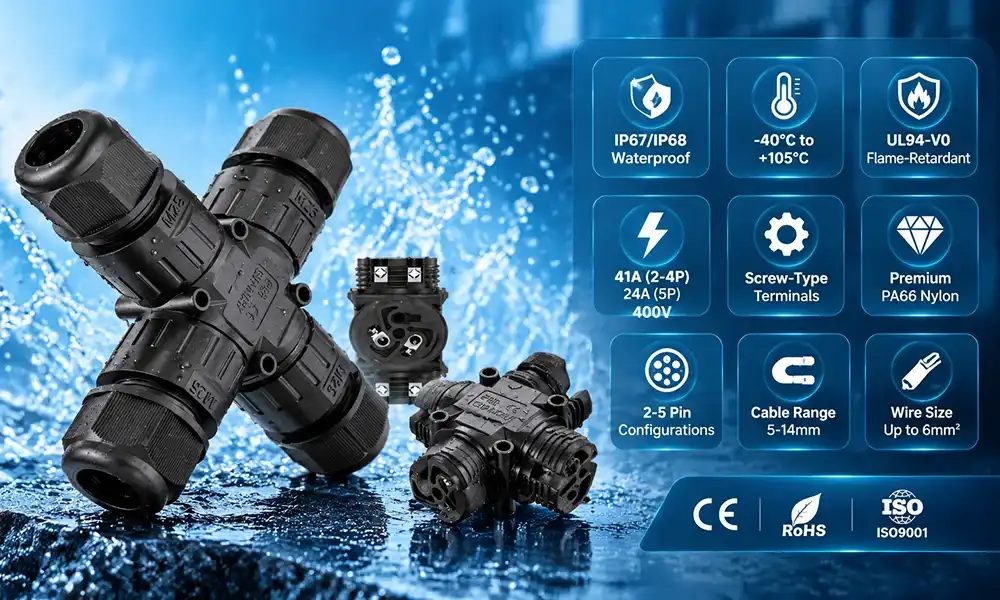
When working with wiring for outdoor lighting poles, solar arrays, or industrial control panels, you’ve probably fallen across the same problem: one power supply, several branch lines, and not enough room for separate junction boxes. The M25 4-way waterproof connector addresses this problem immediately. This consolidates four cable entries into one sealed housing, replacing three separate connections with one compact device that is certified for submersion to IP68, 450 V, and temperatures from -40℃ to +105℃. This article takes you through what this multi-port design is, when you truly need it, and how to find the correct one for your application.
Understanding the M25 4-Way Waterproof Connector
The M25 designation is for the metric thread size, which will accommodate cable outer diameters from 5mm to 14mm. The four-port cross body provides one input and three distinct output routes, all in a single sealed box. It is this shape that differentiates it from simpler T-splitters or regular M20 two-way devices.
How the Cross-Port Design Works
The interior arrangement has each port on its own axis, with distinct screw terminals for each branch. Power enters through port one and distributes to ports two, three, and four independently. A key benefit for maintenance is the ability to isolate or de-energize one output without disturbing the others.
IP Ratings and Sealing Mechanism
Each cable entrance and the interaction with the lid of the housing are fitted with O-rings made of silicone or EPDM. With this setup, it can get IP68 certification; therefore, the connection can resist permanent submersion at depths from 4m to 10m. The quarter-turn lid fastening allows the technician to open the housing for inspection or rewiring by hand, with no tools required.
Core Technical Specifications
The connector is made of UV-stabilized PA66 nylon, UL94-V0 flame retardant. It consists of 2- to 5-conductor topologies, voltage ratings of up to 450V, and current ratings of 16A to 41A depending on the terminal block design. Gold plating on contacts reduces contact resistance and protects against oxidation over the stated outdoor service life of the connection (10-15 years).
Benefits and Applications of Multi-Port Waterproof Connectors
Before picking a multi-port fitting, it is necessary to understand what practical problems a multi-port fitting solves, not simply a single-port solution. The simple logic is this: Less connection points, fewer causes of failure.
The major advantages of this distribution link in the field settings are:
- It saves space in tight spaces. Typically there is less than 100mm of lateral room within a smart pole. The space saving for extra modules such as sensors or 5G antennas may be quantified by replacing three M25 single connections with one four-way device.
- Autonomous branch housing control. Each port has its own screw termination for electrical separation between the lighting circuit, camera feed, and sensor line. Keeping one branch does not interfere with other branches.
- The same cable diameters are used in all branches. You may feed a variety of gauge wires through the same body; thus, there is no need to stock several gland sizes, so spare parts management is better. Acceptance range: 5- 14 mm.
- Proven environmental resilience. Testing relevant to coastal, marine and outdoor infrastructure projects include 72 – 96 hours ASTM B117 salt spray, 2500V AC dielectric strength and EN 61984 pull-out force compliance.
Smart City and Outdoor Lighting
Modular LED streetlight arrays commonly run one 3-phase feed to a pole, then branch to the luminaire, a CCTV camera, and an environmental sensor. A M25 4-way waterproof connector distribution hub handles this topology without secondary junction boxes.
Marine and Submersible Environments
Dockside shore power pedestals and pond filtration pump systems face constant humidity and periodic flooding. The IP68 rating with silicone O-rings maintains seal integrity even after years of intermittent submersion.
Solar and Renewable Energy
String inverter parallel connections require weatherproof distribution points that survive thermal cycling. The -40℃ to +105℃ operating range covers desert installation temperatures as well as cold-climate winter conditions.
Installing and Maintaining Your Four-Way Waterproof Junction Connector
But does the IP68 rating stand up in the field? It is contingent upon installation. No amount of lab rating on the connection will help if the O-ring is not properly placed or the gland nut is not properly torqued.
Pre-Installation Checklist
Strip the cable insulation to the appropriate length. Ensure the cable outer diameter is within the range of 5- 14 mm. Check all O-rings for cuts or distortion before installation. Do not use broken gaskets.
Wiring and Sealing Procedure
Insert the cable through the gland nut before terminating the conductor. Tighten each screw terminal to the recommended torque, then seat the lid and turn the quarter-turn fastener until it clicks. You will not get a good IP68 seal with just your hand. You will need a tool to tighten the gland nut.
Routine Inspection and Troubleshooting
Inspect O-ring condition every 12-18 months in extreme UV conditions. Intermittent continuity on a branch circuit. Open the cover and check terminal screw torque. Gold-plated connections are corrosion resistant, but salt deposits on terminal surfaces in coastal installations should be washed with isopropyl alcohol before reassembly.
Choosing the Right Multi-Port Waterproof Connector for Your Needs
The market consists of multi-port M25 4-way waterproof connectors from a host of prominent manufacturers like Amphenol, Weipu, and CNLINKO. Each brand is a little different in the priorities they address in terms of materials, pin alternatives, and certifications.
Evaluating Specifications Against Your Application
Check the voltage and current ratings to be sure you need that rating before you shop around for costs. The outward appearance does not guarantee interchangeability; a 250V connection will not directly replace a 450V connector. Check the precise IP rating test circumstances – some manufacturers rate to IP67 (temporary immersion to 1 meter) rather than IP68 (continuous depth beyond 1 meter).
Procurement Considerations for B2B Buyers
Standard configurations usually have a minimum order quantity of 100 pieces for off-the-shelf inventory. Typical custom port directions, private-label markings, or pre-terminated harness assemblies need 500 pieces or more. Normal lead time for stock is 7 to 10 days. Custom tooling or mold changes take longer to schedule. Cablein maintains a supply of more than 10,000 pieces for each common item, allowing for purchase on short notice for projects in progress.
When to Choose a 3-Way or 5-Way Alternative
If your pole or enclosure only requires splitting one input into two outputs, an M25 3-way T-splitter costs less and takes up less space. However, if you need five or more branches in your design, it could be advisable to have a specialized distribution box with separate glands, rather than stacking several multi-port connections for greater serviceability. The M25 4-way format is best suited for situations where there are precisely three output branches from a single input.
Conclusion
One challenge that often arises in the field is how to take one power or data input and link it to three distinct outlets in a limited outdoor location. The M25 4-way waterproof connector is a viable solution to this issue. Gold-plated contacts, silicone O-rings, and a UL94-V0 PA66 housing provide a cross-shaped body that performs well in green energy installations, smart city infrastructure, and maritime installations. The multi-port style is the optimum solution when separate branch control is required, quick tool-free access for maintenance is needed, and a sealed junction is required that remains IP68 compliant after ten years of outdoor operation. Before you choose a connector, ensure that the current rating, the number of ports and the range of wire sizes are correct for your requirements.
FAQ
1. What is the difference between IP67 and IP68 for a four-way waterproof connector?
IP67 says that it can be submerged up to one meter for up to thirty minutes. According to the company that made IP68, it can be submerged for long periods of time at greater depths, usually between 4 and 10 meters. It is recommended that systems be at least IP68 for long-term use outside or on the water.
2. Can I run cables of different diameters through the same connector body?
Yes. If you use the right O-ring or gland insert for each cable size, the 5–14mm cable acceptance range lets different-grade wires go through different ports in the same housing. This is as long as the seal is tight everywhere the cable goes in.
3. How do I know if a 4-way configuration is necessary rather than a simpler 3-way version?
The four-way design is best if your wiring layout needs one input and three separate output branches. If you only need two output branches, a T-splitter is a smaller and cheaper way to get what you need.
4. Are these connectors reusable after the lid is opened for servicing?
Yes, as long as there are no arcing marks on the screw terminals and no cuts or compression set on the silicone O-rings. See if the seals are still in good shape before putting everything back together.
5. What compliance documentation should I request before placing a bulk order?
You should ask for proof of the ASTM B117 salt spray test, the EN 61984 pull-out force test, the 2500V AC electrical strength test, and the IP68 immersion test. There should be CE and RoHS notes on all shipments going to the US or EU.
Request Samples or a Custom Quote from Cablein
A company called Cablein Technology has been making the M25 4-way waterproof connector for nine years. It has more than 15 patents and is approved by CE, RoHS, and ISO9001:2015. We can help you with your bill of materials (BOM) from the sample stage all the way through mass production, whether you need standard stock or a private-labeled, pre-wired M25 4-way waterproof connector supply setup. You can email us at nick@cableinco.com to get samples, drawings in 2D or 3D, or a quote that is made just for your project.
References
1. International Electrotechnical Commission. IEC 60529: Degrees of Protection Provided by Enclosures (IP Code). IEC, 2013.
2. American Society for Testing and Materials. ASTM B117: Standard Practice for Operating Salt Spray (Fog) Apparatus. ASTM International, 2019.
3. International Electrotechnical Commission. IEC 61984: Connectors — Safety Requirements and Tests. IEC, 2008.
4. Underwriters Laboratories. UL 94: Tests for Flammability of Plastic Materials for Parts in Devices and Appliances. UL Standards, 2018.
5. National Electrical Manufacturers Association. NEMA 250: Enclosures for Electrical Equipment (1000 Volts Maximum). NEMA, 2020.
6. International Organization for Standardization. ISO 9001:2015: Quality Management Systems — Requirements. ISO, 2015.