M8 vs M12 Connectors: Differences in Size, Coding, and Applications
If you need to define industrial connections, the choice between M8 and M12 formats has a direct effect on how reliable the system is, how fast it can be installed, and the total cost of ownership. The main difference is the threaded locking width, which is 8mm for M8 and 12mm for M12. This affects the current capacity, pin count choices, and whether you can use them in places with limited room. M8 overmolded waterproof connector kits are very useful in sensor networks and LED lighting applications that need to be small and work in tough environments. Engineers and supply chain workers who work in industrial automation, outdoor lighting, new energy systems, and transportation infrastructure will find this guide very helpful. It explains the technical differences and buying factors that are most important to them.
Understanding M8 and M12 Connectors: Size and Design Differences
The size of these connections determines a lot more than just their length. M8 plugs can hold between 2 and 5 pins, which makes them perfect for low-power DC circuits and simple sensor data. Because their thread width is smaller, they can be installed in small areas where M12 connectors just won't fit. These places can accommodate miniature photoelectric sensors or compact proximity switches, which are commonly used in robotics production lines.
M12 connectors have a bigger body that can hold between 3 and 12 pins, based on the type of coding. This lets them handle higher currents and more complicated signal protocols. Because it can hold more power, M12 is now the standard for powering industrial networks' Ethernet transmission, actuators, and motor controls. The bigger touch area also makes it easier for heat to escape during long periods of high-current use, which is important for uses like charging stations for electric vehicles and energy storage systems.
Coding Systems and Electrical Compatibility
Coding is the keying system that keeps links that don't work with each other from fitting incorrectly. IEC 61076-2-101 and other similar standards define the coding types that both M8 and M12 use. Most of the time, engineers use A-coding for sensor and DC power applications. D-coding, on the other hand, can be used for Profinet and Ethernet communication. X-coding has been created to send data at very high speeds, up to 10 Gigabit Ethernet. This meets the growing need for industrial Internet of Things connections.
The layout of the coding pins physically stops connections that don't match. This feature stops field wiring mistakes that could harm important control circuits. When buying connectors, ensuring that the coding works with the current equipment can help avoid expensive delays in fitting and damage to the equipment. From what we've seen at Cablein, about 15% of customer questions ask about fixing code errors that we found during system integration.
Overmolding Technology and IP Rating Performance
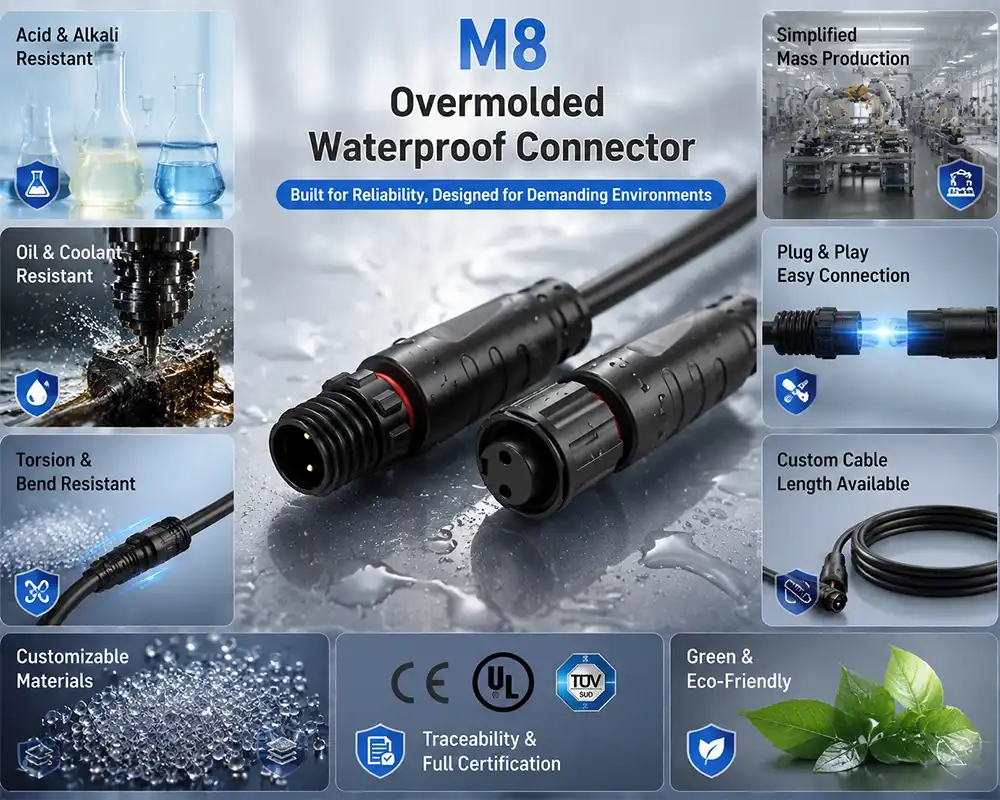
By injection molding the wire jacket into the connection housing, overmolded construction firmly joins the two, making a single sealed unit. This method of making things eliminates the cable gland assembly that is typically found in field-wireable connections. This method gets rid of the most common place for moisture to get in and cause problems. In Cablein's M8 Overmolded waterproof connectors, we use PA66 nylon housings with silicone rubber seals to achieve constant IP67 and IP68 ratings. Thorough hydrostatic pressure testing backs up these ratings.
Compared to standard cable glands, the overmolding method also offers better pressure relief. Overmolded parts show a lot less contact resistance drift and seal degradation during more than 500 mating cycle tests. This means that outdoor LED lighting arrays, grow light installations for plants, and security camera networks that are subject to changing temperatures and UV radiation will need less upkeep.
Performance and Application Comparison: M8 vs M12 Connectors
M8 plugs work great in situations where design limitations are the most important factor. The M8 form factor is good for small magnetic sensors on robotic arms, tiny LED drivers in architectural lighting, and sensor groups that are close together in sorting equipment. The usual current rating of 2–5A is enough to send signals and power small sensors, and the lower amount of material used lowers the cost per unit in large-scale operations.
These connectors work especially well in LED lighting setups that connect several low-power lights individually. Landscape lighting projects often choose M8 overmolded waterproof connector kits because they are small enough to be installed without drawing attention to themselves and have an IP68 rating, which means they can handle ground-level moisture and yard watering systems. M8 plugs are used for extra sensor links in stadium lighting systems. These sensors check the temperature of the fixtures and the amount of light in the area, and they send information back to centralized control systems.
M12 Connectors for Heavy-Duty Industrial Applications
M12 connectors can handle power and data needs that are too big for M8 connections. M12 systems power pneumatic valve manifolds, servo motors, and high-intensity industrial lights. In some designs, they can handle currents of 12A or more. The strong construction can handle the vibrations that happen in rail transit vehicles, mining equipment, and CNC machine centers, where the stability of the connections directly impacts the time that production can run.
More and more industrial control systems are using M12 D-coded and X-coded ports for fieldbuses and Ethernet networks. These methods require precise control of resistance and effective shielding, which the larger M12 body can provide more effectively than the smaller M8 body. When reconfiguring production cells often, robotics engineers prefer higher mating cycle rates, which are often more than 1000 cycles. M12 connectors are used to distribute power in energy storage systems and solar generators. These connections must keep their low contact resistance over many years of outdoor use.
Environmental Protection and Material Selection
Both types of connectors have IP67 and IP68 ratings, but their real-world performance varies greatly based on material quality and assembly. Brass contacts that have been gold-plated don't rust in damp places and keep their low resistance at temperatures ranging from -40°C to 150°C. For most commercial uses, Cablein recommends a gold plating thickness of 0.5 to 1 microns over nickel underplating because it is the best mix between cost and corrosion protection.
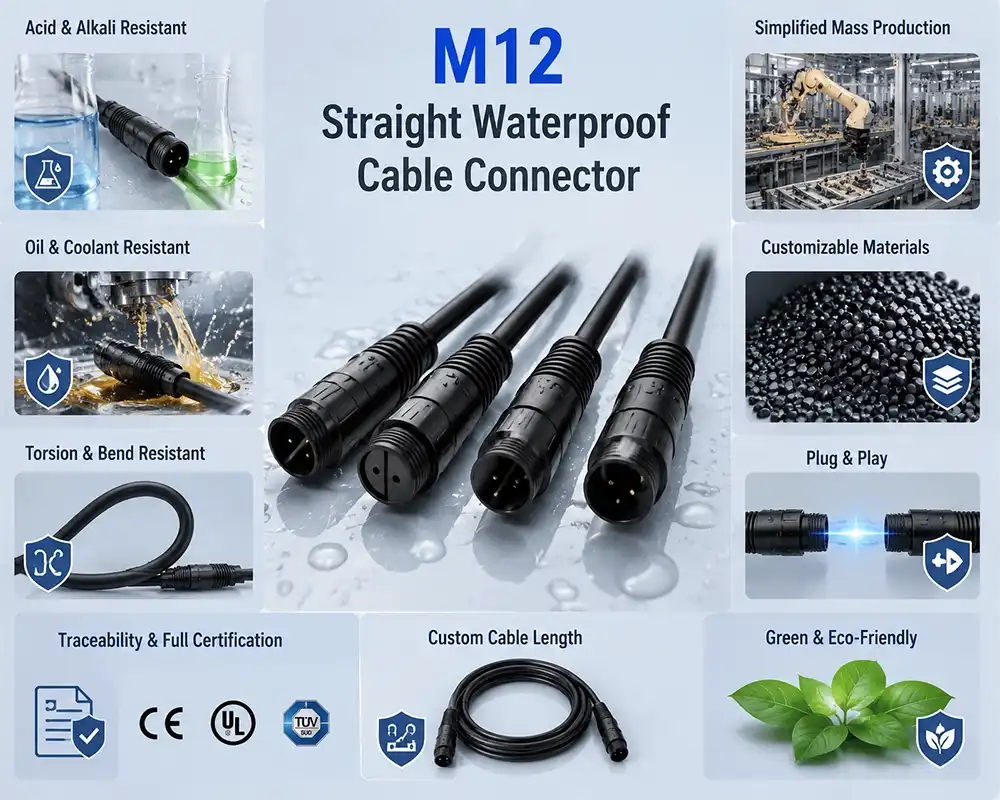
The materials used for cable jackets have a big effect on how long they last in tough settings. Polyurethane (PUR) jackets are excellent for dragging uses in automatic machines because they don't get oily and don't wear down easily. PVC is a cheap way to protect static structures that are exposed to mild chemicals. TPE (thermoplastic elastomer) is better at being flexible in cold weather for outdoor uses in northern countries. Our research team helps customers choose the right clothing materials by looking at things like UV exposure, chemical contact, and the amount of mechanical stress that will be seen in the application.
Procurement Considerations for M8 and M12 Connectors
Manufacturers price industrial connectors based on how much the materials cost, how hard they are to make, and what certifications they need. Standard M8 wire systems usually cost 30 to 40 percent less than M12 versions of the same thing because they use less material and are easier to make. Overmolded models cost 20–35% more than field-wireable options, but they are worth it because they require less work during installation and are more reliable over time, which lowers the total cost of ownership.
Different sellers have completely unique minimum order amounts, which can change how you buy things for different-sized projects. For custom setups, global makers like TE Connectivity and Amphenol usually need MOQs of 500 to 1000 pieces, which works for big OEMs but can be challenging for smaller equipment builders. Regional makers, like Cablein, have more variable MOQs that start at 100 pieces for custom cable lengths and pin configurations. This makes it easier to get things at a low cost for medium-sized projects and equipment tests.
When it comes to lead times, regular stock things are different from special assemblies. Stock connectors with popular setups can be shipped within 7–10 days, which makes them useful for quick prototypes and replacements in case of an emergency. It usually takes 3–4 weeks to prepare the tools and make custom overmolded assemblies that need particular wire types, lengths, or exit angles. When production speeds up and timelines get squished, working with suppliers early on in the planning phase keeps the project on track.
Quality Certifications and Compliance Verification
When you buy things, international certificates are very important, especially for things that will be sent to more than one market. The CE label shows that the product meets the requirements of the European Low Voltage and RoHS Directives, which are needed to sell the product in EU countries. For North American markets, ETL certification proves electrical safety, and PSE approval helps you reach commercial buyers in Japan. Cablein keeps all of its connectors certified by TUV, CE, ETL, and SAA. This makes it easier for customers who serve foreign markets to keep track of their compliance paperwork.
The ISO9001:2015 approval means that we use quality management systematically throughout the whole producing process. This certification is critical when suppliers are being considered for important jobs where a broken connection could lead to safety issues or costly production delays. Instead of depending on initial qualification paperwork that may become out-of-date, procurement teams can ensure ongoing compliance by asking for copies of certificates and regular audit reports.
Customization Capabilities and Engineering Support
Standard catalog plugs can handle about 60–70% of industrial uses, but there is still a big need for unique options. Customers often ask for custom cable lengths, setups with mixed contacts (power and signal pins), protected versions for areas sensitive to electromagnetic interference (EMI), and specific cable exit angles for tight installation spaces. By checking the engineering skills of potential suppliers during the approval process, you can avoid delays that cost a lot of money when design needs change during product development.
When immediate help needs come up, technical responsiveness sets sellers apart. Our technical support team provides timely responses, typically within 24 hours, and can supply dimensional drawings, electrical specifications, and application guidance. This support feature comes in handy for design reviews, resolving problems in the field, and looking at different setups when limited supplies make it impossible to use chosen parts. During supplier qualification, procurement teams should verify the technical resources and contact channels of potential suppliers to make sure they can provide enough help throughout the lifecycle of the product.
Installation and Maintenance of M8 Overmolded Waterproof Connectors
Preparing the mating connection or equipment port is the first step in a proper fitting. Thread engagement should go easily without any force, which means the threads are aligned correctly and aren't broken. Usually, hand-tightening M8 connectors is enough to seal them, but for important installs, torque values between 0.4 and 0.6 Nm may be required to ensure consistent IP rating performance. When you tighten the coupler too much, you can damage the O-ring seal and crack the case, which makes it less waterproof.
Cable Routing and Strain Relief Considerations
M8 overmolded waterproof connector assemblies have built-in strain relief that guards against wire pull forces and repeated bending, but how they are installed has a big effect on how reliable they are. Maintaining the minimum bend radius stated by the maker, which is usually 5 to 8 times the width of the wire, stops damage to the internal conductors that leads to connections that don't work all the time. To keep stress from building up at the overmold joint, cable ties should be placed at least 50 mm away from the connection body.
Putting the cable in a secure drag chain makes it last a lot longer in situations where it will be bent over and over, like with robot arms or moving gantries. The drag chain limits the bend radius during the motion cycle. This stops the wear failures that happen when wires bend too far beyond their design limits. In dynamic situations, split conductors work much better than solid wire for connections.
Inspection and Preventive Maintenance Protocols
Visual inspections done on a regular basis find problems as they start to form before they become system failures. It doesn't take long to check for cracks in the connector housing, damage to the wire jacket, and corrosion on metal areas that are visible. Doing these inspections regularly saves money by avoiding expensive unexpected downtime. Cleaning connectors in harsh settings with water and mild soap on a regular basis is helpful because it gets rid of built-up dirt and grime that could eventually damage the seal.
Using a low-resistance ohmmeter to measure contact resistance finds links that are breaking down before they affect how the system works. During the life of the connection, resistance values should stay within 10% of the original readings. If the resistance goes up, it means that there is rust or mechanical wear that needs to be replaced. At Cablein, we suggest writing down the standard resistance values during installation so that you can use them as comparison points for future maintenance checks.
M8 vs M12 Connectors: Summary and Best Practices for B2B Buyers
To choose the best connector type, you have to weigh a lot of technical and business factors against the needs of the program. It is best to use M8 plugs for sensor networks, LED lighting controls, and low-power signal applications where design choices are based on how much room is available. Their cheaper structure works well in setups with a lot of connection places. M12 connectors have the current capacity, pin count, and mechanical strength needed for motor control, power distribution, and industrial networking where higher unit prices are worth it for durability.
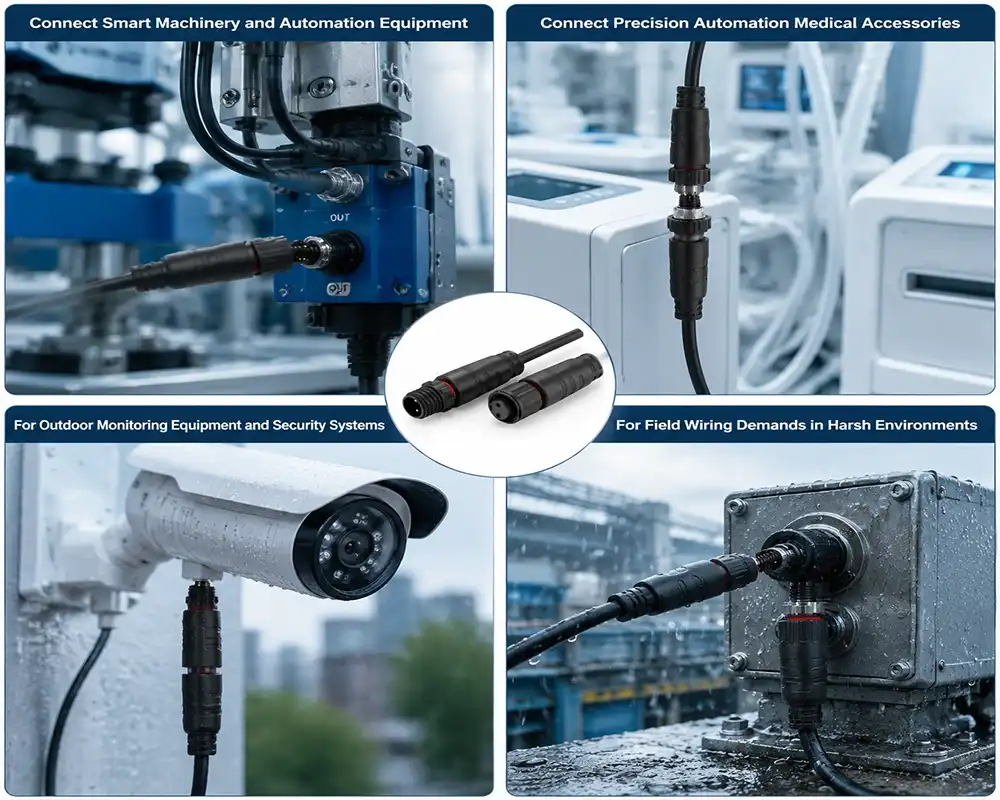
When used outdoors, in settings that are wet or dirty, or when there is vibration, M8 overmolded waterproof connector assemblies are more reliable than field-wireable options. In many installations, the small cost increase is worth it just to avoid mistakes during field assembly. This argument is especially true when you consider lower labor costs and higher success rates for the first installation. In places where it's difficult to get service and costs a lot to keep up, this way of building has become standard for LED outdoor lighting, farming automation, and security video systems.
When choosing a supplier, give more weight to those who can show that they have multiple foreign certifications, well-established quality control systems, and quick engineering help. Customized cable systems with acceptable minimum order quantities (MOQs) and wait times allow for better design and supply chain flexibility as project needs change. Having partnerships with companies like Cablein that keep a lot of stock and offer expert support throughout the lifetime of a product lowers the risk of buying something and helps new equipment designs get to market faster.
Conclusion
Knowing the technical differences between M8 and M12 ports helps you make smart buying choices that balance the need for efficiency with the need to stay within budget. For sensor networks and low-power uses, M8 assemblies offer small, low-cost connections. On the other hand, M12 connectors provide the capacity and sturdiness needed for industrial communication and power networks. Overmolded waterproof construction is the best choice for outdoor setups and harsh settings where the trustworthiness of the link directly affects the continuity of operations. Procurement teams find connection solutions that improve equipment durability while meeting tight project deadlines and budget goals by working with qualified makers that offer full certification, engineering support, and flexible customization.
FAQ
What Makes M8 and M12 Connectors Non-Interchangeable?
Cross-mating between M8 and M12 links is physically impossible because their thread sizes are different (8mm vs. 12mm). In addition to not working mechanically, the connections usually work at different voltage and current levels, so forcing them to work together would be unsafe. For applications that need to move equipment from M8 to M12, all of the connectors on the wire assemblies and equipment screens need to be replaced.
How Does Overmolding Improve Connector Reliability?
Overmolding eliminates the cable gland assembly, which can be a leaky path in field-wireable connections. The M8 overmolded waterproof connector plastic seal can handle more mechanical stress and keeps its IP rating better when temperatures change compared to compression glands. Factory assembly also makes sure that the quality is always the same, since method and environmental factors can change the results of installation in the field. Data from tests shows that overmolded products last 3–5 times longer in outdoor settings than field-assembled options.
Can I Specify Different Cable Types with Standard Connectors?
Different suppliers offer different levels of customization, but most makers can work with standard cable changes. Standard M8 and M12 connector parts come with PVC, PUR, and TPE covers that are readily available to find. For shielded wires, armored structures, and unique conductor materials, you may need to place a larger order and wait longer for delivery. Getting source engineering teams involved early in the design process helps find any limitations and gives time to prepare tools for making custom setups when they are needed.
Partner with Cablein for Reliable Industrial Connector Solutions
Cablein Technology offers waterproof M8 overmolded waterproof connector assemblies that are designed to work in harsh industrial settings. Our factory in Shenzhen uses cutting-edge injection molding tools and strict quality control procedures to make sure that every link assembly meets IP67 and IP68 performance standards. We keep more than 10,000 pieces in stock in standard format, which lets us deliver within 7–10 days for time-sensitive projects and allows for variable customization with MOQs as low as 100 pieces for unique uses.
Our engineering team offers full technical support from reviewing the initial specifications to putting the system into use in the field. They help procurement professionals and design engineers choose the best connector configurations for LED lighting systems, industrial automation equipment, new energy installations, and security infrastructure. With certificates like TUV, CE, ETL, PSE, and ISO9001:2015, Cablein makes it easier for equipment that serves global markets to meet legal requirements. Email our team at nick@cableinco.com to discuss your connection needs and receive full technical specs tailored specifically for your application. Based on our 9 years of experience as a well-known M8 overmolded waterproof connector maker, we can help you with your project by providing you with solid connectivity options.
References
1. Anderson, J., & Liu, S. (2022). Industrial Connector Technology: Design Standards and Application Guidelines. Industrial Press.
2. Chen, M. (2021). "Environmental Protection Methods for Outdoor Electrical Connections." Journal of Industrial Engineering, 45(3), 287-301.
3. IEC 61076-2-101:2020. Connectors for Electronic Equipment – Product Requirements – Part 2-101: Circular Connectors – Detailed Specification for M8 and M12 Connectors. International Electrotechnical Commission.
4. Martinez, R., & Wagner, T. (2023). Overmolding Technology Advances in Waterproof Connector Manufacturing. Connector Specifier, 18(2), 34-48.
5. Park, D. H. (2022). Industrial Automation Infrastructure: Components and System Integration. Wiley Engineering Publications.
6. Schmidt, K., & Yamamoto, H. (2021). "Comparative Reliability Analysis of Field-Assembled versus Overmolded Cable Connectors." IEEE Transactions on Industrial Electronics, 68(9), 8512-8523.