What is a 2-way inline waterproof junction box?
A square 2-way inline waterproof junction box is a sealed electrical container that connects two wires together in a straight-through form, while preventing water, dust, and pollutants from accessing the interior connections. Its square shape offers the installer more room inside than round options, allowing for neater cable management and simpler placement against flat surfaces. Rated IP67 or IP68, the enclosures safeguard conductors in outdoor lighting, irrigation systems, coastal surveillance, and highway sensor networks—wherever moisture and mechanical stress are a persistent issue.
Understanding 2-Way Inline Waterproof Junction Boxes
Before choosing an enclosure, it's helpful to know what makes an inline waterproof box different from a regular terminal box that sits in a dry panel room.
What Makes It "Inline"?
The inline configuration has the wire entries on various walls of the housing. So we have one wire coming in from the left, and it goes out from the right and joins at the internal terminal block. You won’t obtain these advantages with a side-entry or multi-port branch box. This straight-through approach reduces the conductor bend radius, reduces the mechanical stress on the insulation, and keeps conduit lines clean.
Square vs. Round Enclosures
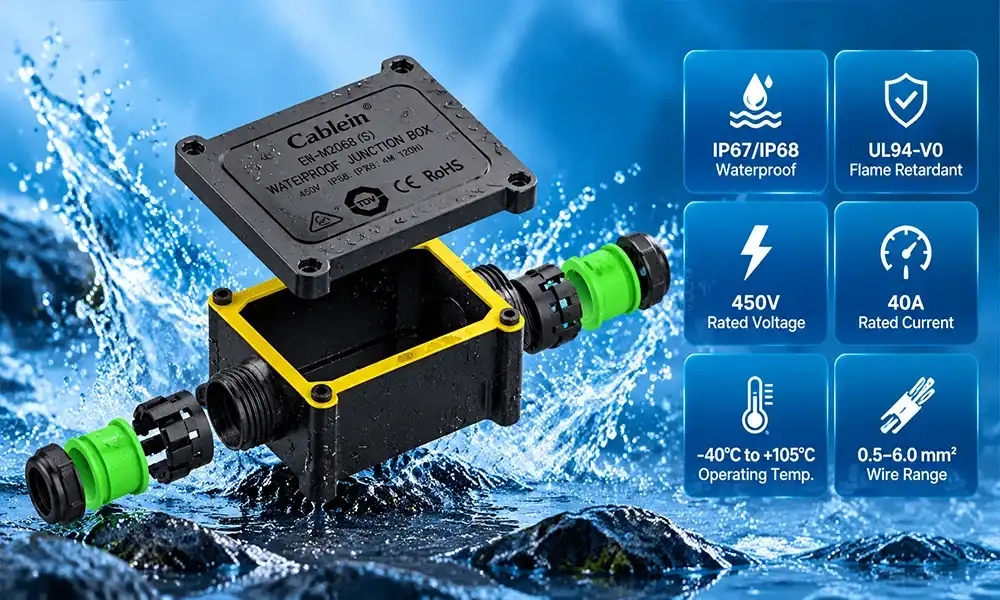
Inside, while dealing with conduit, circular junction boxes are most prevalent. But square geometry is more handy while you are working outdoors. The flat walls mean no gaps in installation, the four corner bosses provide you four distinct mounting options, and the bigger footprint means you may use wider terminal blocks that can accept conductors up to 6.0 mm2, a typical wire gauge range for landscape power distribution.
Key Material Choices
The body is constructed of PA66 nylon, a thermoplastic which is UL94-V0 certified for self-extinguishing behavior and is stable against UV damage. The silicone or TPE gasket between the lid and body compresses uniformly all the way around the edge. This maintains the seal even after hundreds of heat expansion cycles. These materials should persist for more than 10 years in direct sunlight in ISO 4892-2 tests that accelerate the aging process.
How Does a 2-Way Inline Waterproof Junction Box Work?
Understanding the sealing mechanism helps you verify that a product will perform—not just pass a spec sheet.
Gasket Compression and the IP Rating System
IEC 60529 defines the IP ratings. The first number (6) shows the level of complete dust exclusion, while the second number (7 or 8) denotes water resistance. IP67 is temporary immersion up to 1 meter for 30 minutes. IP68 offers protection against prolonged immersion under conditions specified by the manufacturer and the purchaser. When the captive screws are torqued, the PA66 lid compresses the silicone gasket evenly to establish a perimeter seal that prevents hydrostatic pressure in a 72-hour static water test.
Pre-Molded Knockouts and Cable Entry
Knockout screens are factory molded for 5 to 9 mm and 9 to 12 mm wire diameters. You just push out the membrane you need and screw a cable gland into the hole. This method leaves the unused knockouts as sealed surfaces — no drilling, no swarf within the square 2-way inline waterproof junction box, and no damage to the housing wall, which might enable intrusion later.
Installation Steps
On a work site, it takes less than 10 minutes to install this enclosure. 1. Remove the terminal block and pre-assemble conductors on the bench. Cut each conductor to the proper length, place it into the terminal block, and tighten the screws to the recommended torque. Put the block back into the housing. Knock out the needed knockouts, thread the cable glands, run the cables, and attach the box to the surface using M4 or M5 screws through the corner domes. Close the lid (captive screws prevent loss of hardware at height), and the connection is complete.
Benefits and Typical Applications of Square 2-Way Inline Waterproof Junction Boxes
The correct enclosure will reduce warranty callbacks, save time on the job during installation, and reduce the amount of work that is required to be repeated following inspection. Some of the finest aspects of this device:
- IP67/IP68 dual certification means the same box operates in both splash-prone above-grade fixtures and completely buried ground-light systems, eliminating the need to store two distinct SKUs.
- The housing is protected against accidental tool drops and vehicle proximity on construction sites by an IK08 impact resistance to a 5-joule impact (1.7 kg mass dropped from 300 mm).
- The removable terminal block permits bench pre-assembly, decreasing field wiring time and lowering the chance of crew errors in low-light or rainy settings.
- With captive lid screws, the most frequent hardware loss on site is prevented. This is especially important for facade work at height or above, where lost screws may create safety concerns and project delays.
Those advantages immediately address the difficulties contractors face during inspections: a factory-built, sealed cage will pass site audits more frequently than field-drilled choices.
In real life, it is utilized in architectural LED lighting circuits on business facades, harbor CCTV power distribution across steel piers, roadside traffic sensor loops that are impacted by road vibration, and wiring for drip irrigation solenoid valves in greenhouses to grow plants. The enclosure can withstand 40 A at 450 V from -40 °C to +105 °C without the seal failing, no matter what.
Comparing 2-Way Inline Waterproof Junction Boxes: Making the Right Choice
Not every outdoor enclosure offers the same level of safety. Making the wrong choice adds cost by requiring replacement before it's time.
IP65 vs. IP67 vs. IP68
IP65 may be sprayed with directional water jets but does not have resistance against water absorption. IP65 is sufficient for above-ground installations where there will be no flooding, and it is also cheaper. IP67 is adequate for most landscape lights since it is resistant to short-term submersion. For connections that will be buried or submerged for a long period, such as underwater pier fittings or LED systems that are concealed in the earth, IP68 is what is required. It is more expensive to specify IP68 when IP65 would suffice. And if you specify IP65 for an underground application, it will fail within one rainy season.
Square vs. Round: Structural Comparison
Single-center-screw mounts may spin round housings, while square housings mount flush and withstand torque from stiff wires better. The four-point attaching scheme of square 2-way inline waterproof junction boxes also distributes the vibration load more uniformly. This is helpful in highway installations where big vehicles pass just a few meters from the mounting surface.
Evaluating Supplier Reliability
The label on a product may not necessarily reveal the entire picture. A seller should maintain stock for rapid parts replacement, provide 72-hour hydrostatic test data, and have quality records traceable to ISO 9001:2015. Contractors require 50-100 units to accomplish one construction section. “If a supplier won’t ship small replenishment orders, it can throw a wrench in project schedules. CE and RoHS compliance paperwork should be accessible on request, not weeks after the purchase has been made.
Procurement and Buying Guide for 2-Way Inline Waterproof Junction Boxes
It takes more than comparing unit prices to buy the right thing at the right time.
Verify Certifications Before Ordering
Request a CE Declaration of Conformity, RoHS test results, and IP rating test certifications from a third-party facility certified by the government. Check whether UL or ETL listing is applicable to your application if the product is going to be marketed in the US. A delivery risk is a provider that cannot supply these papers in a timely manner for a typical quotation cycle.
Customization Options Worth Considering
Standard catalog items work for most applications; however, bespoke setups are really helpful when you have a particular need. Qualified manufacturers offer different terminal block configurations for different conductor counts, knockout diameters other than the standard 5–9 mm and 9–12 mm range, custom housing colors to maintain the OEM fixture assembly brand look, and laser-engraved identifiers for smart city deployments to keep track of assets. They have a non-disclosure agreement and a manufacturing priority promise that stops their goods from going to competitor OEM companies without consent.
Stock and Lead Times
Standard configurations should ship within 1-3 business days if they are in stock. Custom colors or knockout variants are often ready in 7–15 days. Ensure that your supplier can arrange delivery in phases that coincide with the milestones of each building section. If they can't, you may have to house one major cargo on site.
Conclusion
The square 2-way inline waterproof junction box helps protect and maintain two-cable connections operational in areas where there is a continual risk of moisture, UV radiation and physical damage. Its square design, dual IP67/IP68 certification, PA66 housing, and detachable terminal block make the device simple to install, pass site inspections, and maintain its seal for years of outdoor operation. Choose the IP rating that matches the depth of installation. Verify certificates before purchase. Ensure the supplier has sufficient stock and that your project budget and timeline are secure. If the box is critical (such as when the connection is underground, or above, or miles from the closest service car), make sure you confirm these specifics before the first order arrives.
FAQ
1. What is the difference between IP67 and IP68 for a junction box?
IP67 covers temporary submersion to 1 meter for up to 30 minutes. IP68 covers continuous submersion beyond 1 meter at a depth and duration agreed between manufacturer and end-user. For buried ground lighting or submerged marine fixtures, specify IP68. For surface-mounted outdoor fixtures exposed to rain and washdown, IP67 is generally sufficient.
2. Can I use a 2-way inline waterproof junction box for direct burial?
Yes, provided the product carries an IP68 rating verified by a 72-hour hydrostatic pressure test. Confirm that the cable glands and knockouts are also rated for the burial depth. Standard soil chemicals and fertilizer residue do not degrade PA66 nylon within normal service intervals.
3. What wire sizes fit inside the terminal block?
The terminal block in Cablein's square inline waterproof junction box accepts conductors from 0.5 mm² to 6.0 mm², covering most low-voltage landscape lighting, sensor, and CCTV power circuits. Confirm gauge compatibility before ordering for high-current applications above 25 A.
4. How do I confirm a supplier's IP rating is genuine?
Request the original third-party laboratory test report citing IEC 60529. The report should name the testing body, the specific product model, and the test date. Self-declared IP ratings without supporting documentation carry meaningful risk of non-compliance.
Get a Quote on Square 2-Way Inline Waterproof Junction Boxes from Cablein
Since 2017, Cablein has been making waterproof cases and plugs with an IP rating. All of our products have CE, RoHS, ETL, and ISO 9001:2015 certifications. Our square 2-way inline waterproof junction box provider catalog has standard stock that can be sent out in 1–3 days and custom designs that have lead times of 7–15 days. We answer all technical questions and price requests within one business day, whether you need 50 units for a single building project or 5,000 units for an OEM fixture program. To get a datasheet, dimensional drawing, or bulk quote right away, email us at nick@cableinco.com.
References
1. IEC 60529: Degrees of Protection Provided by Enclosures (IP Code). International Electrotechnical Commission, 2013.
2. UL 94: Tests for Flammability of Plastic Materials for Parts in Devices and Appliances. Underwriters Laboratories, 2013.
3. EN 62444: Cable Glands for Electrical Installations. European Committee for Electrotechnical Standardization, 2013.
4. ISO 4892-2: Plastics — Methods of Exposure to Laboratory Light Sources — Part 2: Xenon-Arc Lamps. International Organization for Standardization, 2013.
5. ISO 9001:2015: Quality Management Systems — Requirements. International Organization for Standardization, 2015.
6. Whitfield, R. Outdoor Electrical Enclosure Selection Guide for Industrial and Infrastructure Applications. Electrical Products & Solutions, 2021.