How to Select the Right Round 2-Way Through-Type Waterproof Junction Box for Harsh Environments?
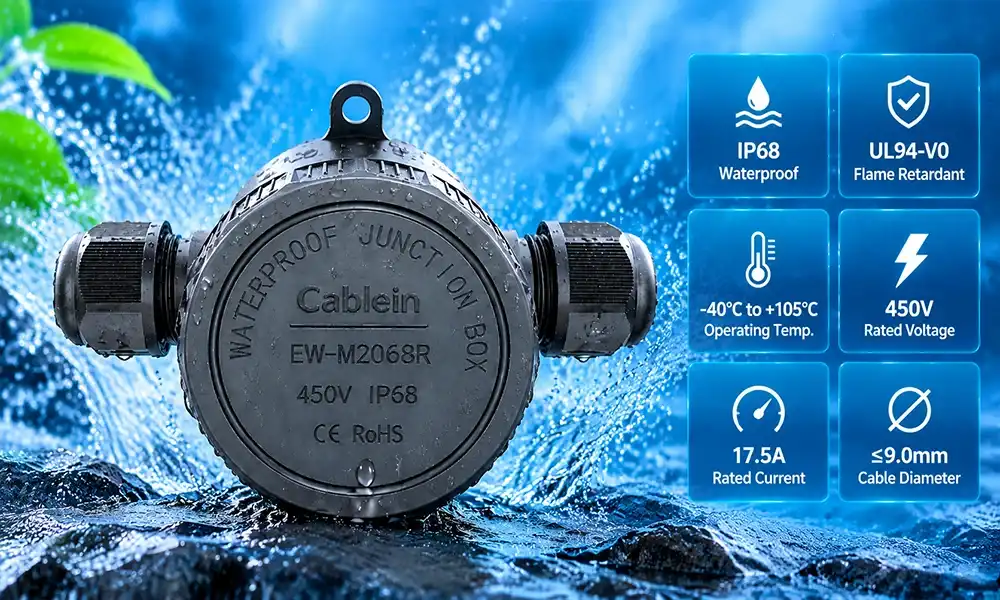
Selecting the right round 2-way through-type waterproof junction box starts with matching the enclosure's IP rating, material grade, and cable entry range to your actual site conditions. For outdoor splices exposed to submersion, UV, or chemical wash-down, you need at least IP68 certification, a UV-resistant PA66 housing, and a closed-cell silicone gasket that holds compression after repeated thermal cycles. Factor in cable diameter (φ5.0–φ9.0 mm), operating temperature range, and whether the terminal system requires tools—because on a real job site, most installers won't carry crimping equipment.
Understanding Round 2-Way Through-Type Waterproof Junction Boxes
Before comparing products, it helps to understand what separates a through-type enclosure from a standard terminal box.
What the Through-Type Design Actually Does
A round 2-way waterproof enclosure routes cable straight in through one port and out through the opposite port, keeping the wire run linear. This eliminates sharp bends at splice points, which reduces insulation fatigue over time. In tight conduit paths—under pool decking, along irrigation trenches, or inside landscape fixtures—that straight-through geometry saves real installation time and preserves long-term seal integrity at both cable entries.
Why Round Housing Outperforms Rectangular Alternatives
Circular geometry distributes mechanical load evenly across the entire wall, leaving no stress concentration at corners. The IK08 impact rating on a round enclosure is therefore more meaningful than the same rating on a rectangular box, because a round profile absorbs shock rather than focusing it. The smooth exterior also sheds dirt and standing water efficiently, which matters in muddy garden beds or pool surrounds where residue accelerates seal degradation.
Material and Seal Technology That Drives IP68 Performance
UV-stabilized PA66 nylon retains tensile strength and dimensional stability after years of direct sunlight—it does not become brittle or warp the way standard ABS can. Paired with a closed-cell silicone gasket, the seal resists compression set even after hundreds of open-close cycles, maintaining consistent waterproof integrity across a -40 °C to +85 °C ambient range. The UL94-V0 flame-retardant rating adds an additional safety margin in landscape and pool environments where arc faults are possible.
Essential Selection Criteria for Harsh Environments
A lot of the time, people choose the wrong box because they don't have enough information about one of three things: the IP rating, the connectivity, or the power output.
Match IP Rating to Real Submersion Depth
Some parts of pool lights and watering valves are always wet, so IP65 isn't enough to protect them from raindrops. What you should at least get for those uses is an IP68 rating of up to 2 m for 2 hours. If a round 2-way through-type waterproof junction box only has IP65 or IP67, it will pass dry tests but fail when groundwater rises or a valve chamber floods and the seasons change.
Verify Cable Entry Range and Interchangeability
Each kind of wire comes in a range of sizes. Low-voltage garden wire is about 5–6 mm wide, while pump feed lines are about 8–9 mm wide. With an adjustable rubber ring that fits φ5.0–φ9.0 mm, one SKU can do the job for all of them. Inventory is easier to keep track of now. Before you buy something, make sure that the seller has replacement rings available.
Check Electrical Ratings Against Your Load
There is a terminal block with a rating of 17.5 A and 450 V AC that can handle most 12 V–24 V low-voltage irrigation and landscape circuits, as well as all 120/240 V pool pump controls. No matter what the IP rating is, the one-minute 2500 V AC dielectric resistance test shows that the insulation is good.
Common Challenges and Troubleshooting Tips
Even well-designed enclosures can fail if the right steps aren't taken during installation or if the torque tips aren't followed.
Gland Torque Is the Single Most Common Failure Point
Leaky always means loose wire glands, never bad seals. The closing torque of 2.5 Nm will not harm the rubber ring when a conventional torque-limiting screwdriver is used. Over-tightening will cause the gasket to be permanently distorted and never completely recover until the following cycle. Marking the lid after it has been closed properly helps the site crews know that it was closed properly after inspections.
Seal Degradation in Chlorinated and Saline Water
In pools and around the seaside, chlorine and salt ions may accelerate the degradation of certain lower-grade elastomers. This degradation is less obvious on closed-cell silicone that is 40 to 60 Shore A hard than on open-cell foam plugs. But if the package reads “rubber sealed” but not “closed-cell silicone,” you should request a material data sheet before you purchase it.
Proactive Maintenance to Extend Service Life
Cable glands on submersible systems should be examined every year, and each time they are struck by anything mechanical. If you find cracks or thin patches on them, you should replace the seals. If a box can withstand more than 1,000 mechanical spins, you may work on it with frequent maintenance without fear of destroying the lid mechanism. This is useful for irrigation systems that need to have the controllers reset each season.
Comparison of Leading Product Options and Cablein's Position
The waterproof enclosure market spans a wide range of price and quality tiers. Understanding where products differ helps buyers avoid specification mismatches.
Where Budget Products Fall Short
Lower-cost enclosures generally employ unfilled nylon or recycled PA6, rather than UV-stabilized PA66, which becomes chalky and dimensionally unstable after 18–24 months of outside exposure. Open-cell foam gaskets lose their compression set resistance after a few temperature cycles, and what was IP68 on day one is IP54 by year two. Buyers who find this out via return data and poor evaluations sometimes switch providers after one selling season.
What Certified Products Deliver Differently
TUV, CE, RoHS, and REACH documentation products are third-party verified and not self-declared by the producer. 85 °C / 168-hour high-temperature aging test, salt spray testing under ASTM B117, and glow wire test at 850 °C per IEC 60695-2-11 are genuine stress conditions, not marketing promises. The tests forecast how a round 2-way through-type waterproof junction box would function after two or three outdoor seasons. That’s the difference between acceptable and troublesome return rates.
Cablein's Round 2-Way Through-Type Waterproof Junction Box
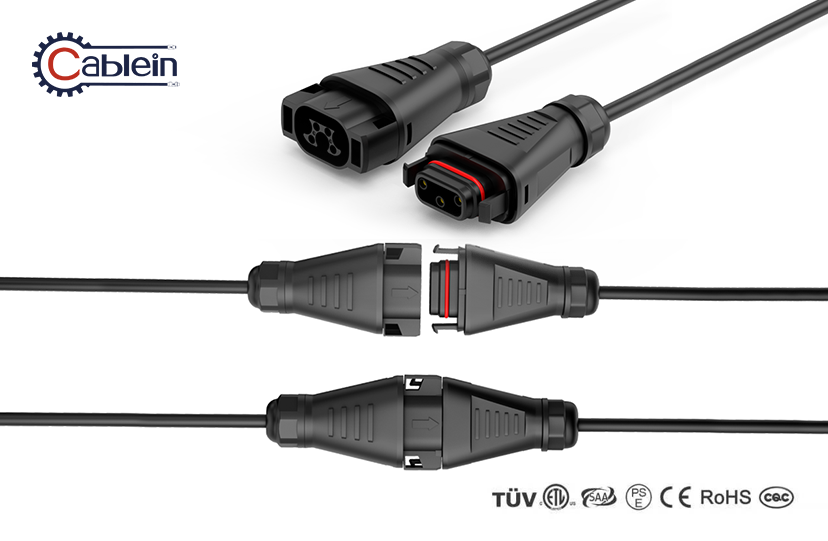
Cablein’s housing is constructed of UV-stabilized PA66 with a closed-cell silicone seal, IP68-rated at 2 m for 2 hours, and CE, TUV, RoHS, and REACH certified, supported by ISO 9001:2015 manufacturing standards. The tool-free AWG 1.5 terminal block, adjustable φ5.0–φ9.0 mm silicone rings, and IK08 impact casing cover the precise failure scenarios specified above. Custom options include pre-installed cable glands, adjusted entrance sizes, and OEM packaging – characteristics that are important to Amazon sellers who ship goods straight to FBA, and to contractors who require site-specific setups.
Purchase Guide and Procurement Recommendations
To make a good buying decision, you should weigh the technical needs against how reliable the supply is and the total landed cost.
Sampling Before Scaling
Put samples in water to examine how they operate before committing to manufacture anything. The most costly risk is a 3-8% return rate owing to units that leak. Soaking the unit overnight at a depth of 2 m costs nothing and eliminates this risk. If suppliers refuse to provide you with samples or are unable to provide you with third-party test findings, remove them from the list no matter the unit cost.
MOQ Flexibility and Reorder Speed
For maintaining the ad rank, the online business should have MOQ of minimum 200-500 pieces and the reorders should be fulfilled within 7-10 days. Organic ranking frequently needs to start from scratch if stock-outs are two weeks or more, which is costlier in recovery advertisements than the savings of a slower but cheaper supplier.
Certification Documentation for Market Access
CE and RoHS papers are, of course, needed for EU markets. EU platforms are examining more and more those restrictions, and REACH has limits on chemicals. In the US, the presence of TUV or ETL documentation improves the perception of a product's reliability, while it is not a requirement. More than a name on a spec sheet? Ask for actual cert files instead. Check the certificate numbers with the business that issued them.
Conclusion
It’s a technical decision that has clear cost consequences when you pick a round 2-way through-type waterproof junction box for hard conditions. If the correct enclosure is employed, the installation rate and return rate are safe. The housing should be of UV-resistant PA66 material and shall have a closed-cell silicone gasket. It should also have a validated depth rating of IP68, approved electrical ratings, and the capability of switching out cable entry. The Cablein circular two-way through-type waterproof junction box satisfies all these requirements. It is certified by a third party, and its manufacturing process is audited by ISO 9001:2015. Three handy tools may separate a long-lasting, dependable device from one that causes unnecessary warranty claims.
FAQ
1. What IP rating do I actually need for an outdoor buried splice?
For cable splices buried in soil or submerged in irrigation valve chambers, IP68 is the correct minimum. IP65 covers rain splash only. IP67 covers brief immersion up to 1 meter but may not hold during seasonal flooding. IP68 at 2 m for 2 hours covers the worst-case conditions in landscape and pool installations.
2. Can I use a standard junction box instead of a through-type design in a pool environment?
A standard box works for surface-mounted dry locations, but it creates unnecessary bend stress on cable jackets in wet or buried applications. The through-type configuration keeps cable runs straight, which reduces mechanical strain on both the cable and the gland seal—critical in chlorinated and saline water where any micro-gap becomes a corrosion path.
3. How do I confirm the closed-cell silicone gasket is genuine?
Request the gasket material data sheet and check Shore A hardness (typically 40–60 for closed-cell silicone). Closed-cell silicone does not absorb water when cut or compressed; open-cell foam does. You can verify this with a simple cut-and-squeeze test on the sample gasket.
4. What wire sizes does a tool-free terminal block actually accept?
Cablein's terminal block accepts AWG 1.5 conductors without a crimping tool. Strip the conductor, insert it into the terminal port, and the spring-clamp mechanism locks it in place. This design suits DIY end users who complete low-voltage landscape or irrigation wiring without specialized electrical tools.
5. How often should I inspect gland seals in a pool installation?
Annual inspection is the standard practice for submerged or poolside enclosures. After any physical impact or after chlorine shock treatments, check that glands compress evenly and the lid seats flush. Enclosures with a mechanical life of ≥1,000 cycles support this routine without seal wear concerns.
Partner with Cablein for Your Next Waterproof Enclosure Project
This round 2-way through-type waterproof junction box is made by Cablein Technology and is approved by CE, TUV, RoHS, and REACH. They also have quality controls based on ISO 9001:2015 and at least 10,000 of each item in stock. It can be sent to you in 7–10 days, whether you need 200 units for a test FBA shipment or a full OEM run with cable glands already installed. Email nick@cableinco.com with the details of your project and cable needs to get a sample or price right away.
References
1. International Electrotechnical Commission. IEC 60529: Degrees of Protection Provided by Enclosures (IP Code). IEC, 2013.
2. Underwriters Laboratories. UL 94: Standard for Tests for Flammability of Plastic Materials for Parts in Devices and Appliances. UL, 2013.
3. ASTM International. ASTM B117: Standard Practice for Operating Salt Spray (Fog) Apparatus. ASTM, 2019.
4. International Electrotechnical Commission. IEC 60695-2-11: Fire Hazard Testing – Glow-Wire Flammability Test Method for End-Products. IEC, 2014.
5. International Organization for Standardization. ISO 9001:2015: Quality Management Systems – Requirements. ISO, 2015.
6. European Chemicals Agency. REACH Regulation (EC) No 1907/2006: Registration, Evaluation, Authorisation and Restriction of Chemicals. ECHA, 2022.