How to choose the right M20 circular connector for industrial use?
To choose the right M20 circular connector for commercial use, you need to know what the climate, electricity needs, and long-term dependability requirements are. These threaded circle connectors, which get their name from the 20mm locking mechanism on them, provide strong waterproofing and mechanical stability in a range of demanding areas, such as robotics, LED lighting, new energy systems, and transportation infrastructure. When looking at different options, procurement teams should make sure that the IP rating works with the site conditions, that the current and voltage needs match the equipment specs, that the material choice balances cost and corrosion resistance, and that the supplier certifications make sure that the product meets international safety standards.
Understanding M20 Circular Connectors – Key Specifications and Features
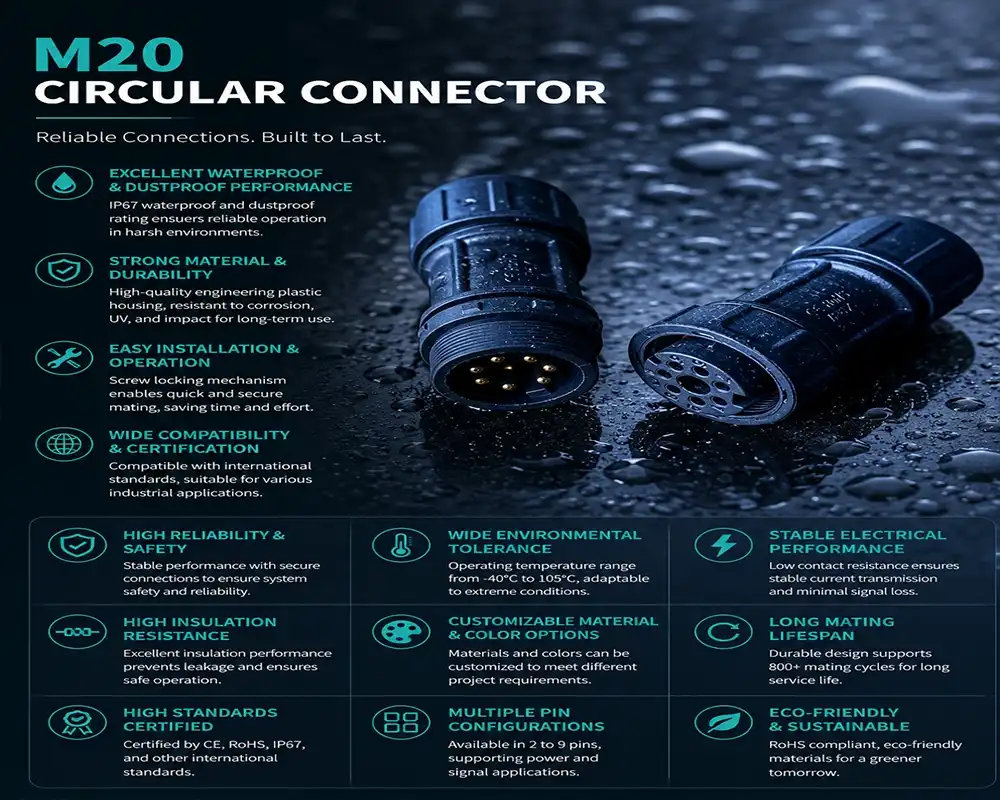
An M20 circular connector is a high-performance way to connect things that is made for harsh industrial environments where regular connectors don't work. The "M20" designation refers to the 20mm diameter of the threaded coupling that holds the male and female parts together. This type of coupling is better at resisting vibration than push-fit alternatives. These connectors have become very important in places like factory automation, outdoor lighting, and mobile equipment where mechanical stress and water damage are constant threats to the electrical integrity.
Core Technical Parameters That Matter
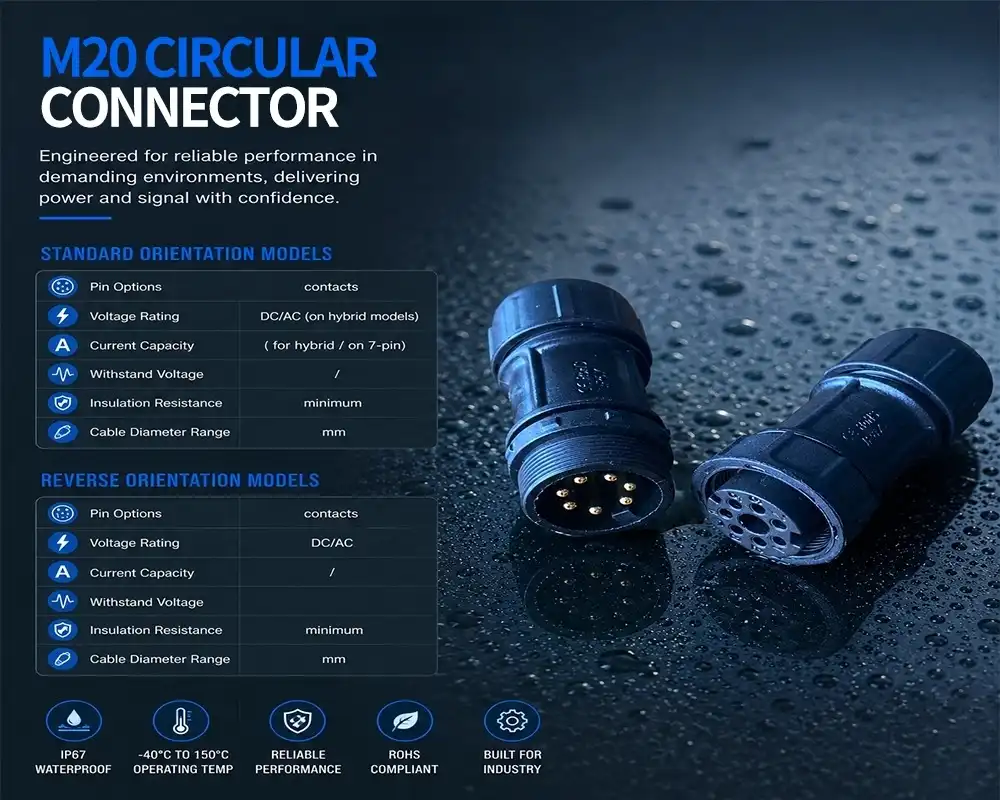
Industrial-grade M20 circular connectors usually have pin layouts that run from two to seven pins. Some models have hybrid layouts like 2+2 or 2+3 combinations that keep the power and signal wires separate. Depending on the form of the contact, the rated voltage can be up to 500V DC/AC for normal orientations and 300V for specialised setups. The rated current can be anywhere from 20A to 25A. The withstand voltage, which measures the strength of the insulation to breaking down, is usually between 2KV and 3KV. This gives safety gaps during voltage changes. Leakage currents that could damage sensitive control circuits or pose safety risks when it's wet can't happen when the insulation resistance is higher than 200MΩ.
Material Construction and Environmental Protection
Modern M20 circular connectors have housings made of PA66 nylon, which is very resistant to chemicals and keeps its shape even at high and low temperatures. This engineering thermoplastic doesn't break down when exposed to UV light for a long time, which makes it perfect for outdoor installations where sunlight breaks down less durable materials. Gold-plated brass contact pins make low-resistance paths that keep voltage drop and heat generation to a minimum while high-current is being sent. The gold treatment stops rust, which raises contact resistance over time. This way, the conductivity stays the same even after thousands of mating cycles. When threaded engagement presses down on silicone sealing gaskets, they achieve IP67 or IP68 ingress protection ratings, which mean they can block dust particles or withstand temporary submersion. These waterproof features are very important in places like food processing plants, car wash equipment, and marine settings where water is often present.
Temperature Range and Cable Compatibility
Extreme climates and processes that need to work at high temperatures can be accommodated by operating temperature ranges from -40°C to 150°C. This range of performance includes cold storage buildings, transportation systems for the Arctic, and production lines that work at high temperatures. The diameter range of the assembly cable is 6–13.5 mm, which means it can fit standard industrial wire gauges without having to be specially made. This makes it easier to buy things and keep track of supplies. Some models have longer thread lengths that make it possible to securely mount panels through thick enclosure walls. This is an important feature for adding connectors to equipment cabinets or junction boxes that are already there.
Comparing M20 Circular Connectors With Other Connector Types
Knowing how M20 circular connectors stack up against other sizes helps buying teams find the best mix between electrical power and physical footprint. The comparison has a direct effect on the prices of installation, the use of room, and the ability to grow in the future.
Size and Current Capacity Differences
M12 connectors have a smaller 12mm thread width that makes them good for connecting sensors and actuators in small places. However, because they have a smaller contact area, they can only handle 4–8A of current. M16 connectors fill in the gaps. They can handle modest currents of 10 to 16A and are used in lighting systems and motors with moderate power. Because M20 circular connectors can handle 20 to 25A, they can be used as the main power source for machines, EV charging stations, and big pump controls, where smaller connections would get too hot and break. M25 connectors can handle even more current (30–40A), but they take up a lot more space on the panel and need more thought about how to organise the cables. By matching the connector size to the actual load needs, both over-engineering costs and dangerous under-specification can be avoided.
Waterproof Rating Selection Strategy
Connectors with an IP67 rating can handle dust getting in and water immersion up to 1 metre deep for 30 minutes. This means they can be used on equipment that will be wet or exposed to rain or splashes. IP68-rated versions offer better protection against continuous submersion beyond 1 metre, which is important for underwater robots, pond aeration systems and equipment set up in flood-prone areas. It's a waste of money to pay more for IP68 protection when IP67 is enough, and selecting inadequate protection leads to early failure and unexpected downtime costs that are much higher than the initial savings.
Housing Material Trade-offs
Chemical weathering from oils, coolants, and cleaning agents that are common in factory settings won't hurt plastic PA66 nylon housings. Because they are lighter, they put less stress on cable assemblies and mounting hardware. But metal housings made of zinc alloy or brass plated with nickel offer better protection against electromagnetic interference. This is very important in places with a lot of electrical noise that have variable frequency drives, welding equipment, or radio frequency machinery. Metal housings are also better at protecting against hits from tools, trucks, and other material handling equipment. Instead of automatically choosing one type of material, choices about what to buy should take into account the unique threats that exist in each installation environment.
How to Select the Ideal M20 Circular Connector for Your Industrial Needs?
Systematically looking at the environment, electrical needs, and operational needs makes sure that the choice of connectors supports long-term equipment reliability instead of causing maintenance headaches.
Environmental Assessment Criteria
Switching between very hot and very cold temperatures puts stress on connecting seals and contact metal. Instead of standard-grade connections, operations that have daily temperature changes of more than 50℃ should use ones that are rated across the whole -40℃ to 150℃ range. Threaded coupling links are better than bayonet or push-pull designs that tend to come loose when there is a lot of vibration from machinery that moves back and forth, mobile equipment moving, or structure resonance. The needed IP grade is based on how often and for how long the device is exposed to moisture. The choice of housing material is based on chemical exposure from process fluids, cleaning routines, or air pollutants. The amount of UV radiation in outdoor installations affects the types of plastic compounds that can be used. UV-stabilized grades last longer than regular materials by several years.
Electrical Specification Matching
The voltage rating of M20 circular connector must be higher than the peak operating voltage by an amount big enough to account for short-lived voltage spikes that happen when the motor starts up or an inductive load switches. The current grade should be enough to handle the steady load, plus extra space for starting loads or future load growth. Specifications for contact resistance below 5mΩ keep voltage drop and heat production to a minimum when high current is used for a long time. Withstand voltage ratings between contacts and from contacts to ground make sure that there is safe isolation when there is a fault. The placement of the pins must allow for the necessary power lines as well as any signal, data, or ground wires. Noise-sensitive signals should be kept separate from the power lines using hybrid arrangements.
Installation and Maintenance Considerations
Field-assembled connectors with screw termination chambers get rid of the need for special crimping tools. This lets general maintenance staff quickly deploy and fix things in the field. Traditional wiring methods need more than one step to put together, but push-lock mechanisms and quick-connect systems cut down on installation time and labour costs. Cable diameter compatibility makes sure that links can use factory-supplied cable kits without the need for adapter hardware or special production. There are panel mounting choices with longer thread engagement that keep links in place through different wall thicknesses seen in different generations of equipment. Accessibility for maintenance workers to check and re-tighten connections on a regular basis keeps them from breaking without having to take the equipment apart.
Supplier Evaluation Factors
Certifications like ETL, TUV, CE, and RoHS compliance show that testing and quality control for making are in line with international norms. Customisation options for pin layouts, cable lengths, and contact arrangements let you make solutions that fit the needs of your equipment instead of having to make design compromises around standard products. Inventory availability and lead time dependability have a direct effect on project plans and production continuity. This is why seller stock depth and manufacturing capacity are so important when choosing a supplier. When technical help is quick to respond during design development and troubleshooting, engineering time is saved and problems are solved more quickly when they happen.
Top Brands and Trusted Suppliers of M20 Circular Connectors
Reliability, warranty support, and the efficiency of procurement are some of the ways that brand reputation and supplier capabilities have a big effect on the total cost of ownership.
Established Global Manufacturers
Amphenol has a large selection of circular connectors that have been used in a wide range of industries for decades and have a lot of field performance data. Their product lines come with a range of environmental grades and customisation choices, and they are shipped all over the world. TE Connectivity uses its experience in both the car and aircraft industries to make connectors that can withstand high temperatures and vibrations. Phoenix Contact focuses on integrating the robotics industry with connections that are made for quick setup and compatibility with diagnostic tools. These well-known companies put a lot of money into research, testing facilities, and quality control systems that make sure that production lots are always the same and that there is a lot of technical information available.
Emerging Specialized Suppliers
Cablein Technology has been a leader in waterproof industrial interconnection solutions since 2017. They focus on field-assembled connectors that make installation easier without lowering the security grades. Their engineering team has more than 15 patents for quick-connect and solder-free technologies that keep the IP67/IP68 sealing integrity while cutting down on labour costs. Shenzhen factories use high-tech production lines to make custom cable assemblies with pin configurations ranging from 2 to 7 contacts, voltage ratings up to 500V, and current capacities of up to 25A. International approvals like ETL, TUV, CE, and RoHS compliance make it possible to use in places around the world without worrying about following the rules. Stable inventory of more than 10,000 pieces per standard configuration allows for quick fulfilment, and flexible custom order scheduling can be adjusted to meet the needs of specific projects.
Procurement Channel Selection
When you work directly with a manufacturer of M20 circular connector, you can get engineering help when making specifications and help deciding what to do first when supplies are low. Distributors offer centralised buying across many types of parts and localised inventory, which lowers freight costs and shortens delivery times. Online industrial marketplaces let you compare prices and narrow down your choices based on specifications, but you have to be very careful to make sure that the seller is legitimate and that the products are real. Sample order policies let you try things out for yourself before committing to large amounts. This lowers the chance that design errors will be found during installation in the field.
Practical Applications and Case Studies of M20 Circular Connectors in Industry
Real-world deployment scenarios demonstrate how proper connector selection solves specific industrial challenges and delivers measurable operational benefits.
EV Charging Infrastructure
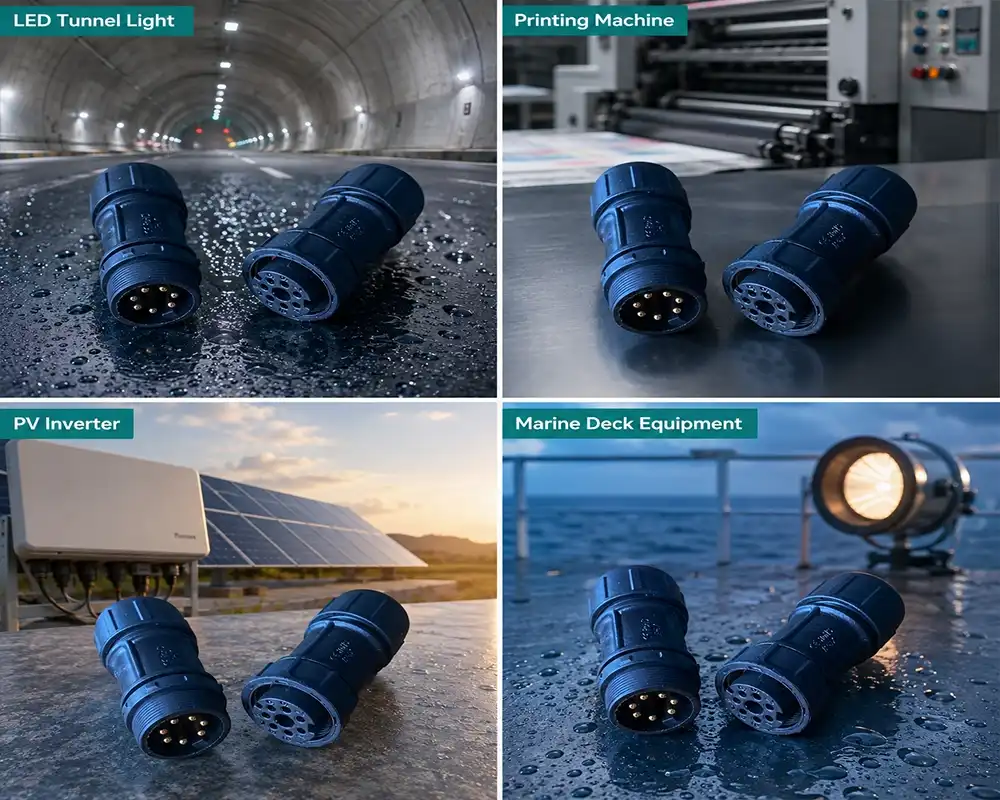
Charging stations for electric cars need connectors that can handle steady high current and work reliably even when they are outside in the rain. M20 circular connectors with IP68 protection and a rating of 25A constant current are used as the main power entry points to charging cabinets. This gets rid of the need for junction boxes, which add failure points and make installation more difficult. Large-gauge feeder cables can be connected directly to screw termination chambers, and threaded connection keeps the cables from coming loose from the daily vibrations of vehicles connecting and disconnecting. Temperature ratings from -40°C to 150°C allow installations to be used in places from the north to the desert without having to stop service during the winter or summer.
Industrial Pump Control Systems
Large irrigation pumps for farms and equipment in water treatment plants need reliable power distribution in damp places where broken connectors cause expensive downtime. The M20 circular connectors that are put together in the field have PA66 housings that protect them from fertiliser chemicals and wastewater. They also have IP67 sealing to protect them from pressure washing during maintenance. Being able to terminate cables on-site without having to send them back to the plant cuts down on the time it takes to set up when pump sites change with the seasons or when installation conditions make it impossible to use pre-assembled cables. Gold-plating on brass contacts stops corrosion, which raises resistance and makes heat that can melt weak connectors.
LED Stadium Lighting Networks
Professional sports arenas put in hundreds of high-power LED lights that need connections that can survive rain, humidity, and changes in temperature during the competition seasons. M20 circular connectors waterproof connectors connect power distribution lines to individual fixture assemblies. The threaded engagement keeps the connections from coming loose by mistake during maintenance or windy conditions. UV-stabilized building materials keep their mechanical properties even after years of being in the sun, and wide temperature grades mean that they can be used on hot summer days and cold winter nights without losing their performance. Custom cable assembly services from specialised suppliers provide ready-to-install solutions that cut down on labour costs and make sure that the quality of connections is the same across large installations.
Automation System Retrofits
Adding new sensors and controls to old industrial equipment often means adding links through enclosures that are already there. M20 circular connectors with longer thread lengths can be mounted firmly through thick panel walls without any changes. Screw terminations can handle different wire sizes from older and newer equipment. This adaptability speeds up modernisation projects by getting rid of the need to make custom adapters and reducing the need to redesign electrical panels. Anti-vibration threaded coupling keeps connections strong on machines that run at high speeds all the time, where other types of connectors gradually come loose.
Conclusion
When picking the right M20 circular connector, technical specs, environmental needs, and practical goals that are specific to each industrial application must all be taken into account. Successful procurement teams look at ingress protection ratings that match the amount of moisture that will actually be present, current capacity that matches the load requirements plus safety margins, and material choices that take chemical exposure and mechanical stress into account. Connector selection goes from being a purchase of a part to an investment in reliability that lowers the total cost of ownership through longer service life and less downtime when you work with suppliers that offer full certifications, customisation options, and quick technical support.
FAQ
What temperature range do M20 circular connectors typically support?
Industrial-grade M20 circular connectors can usually work in temperatures ranging from -40°C to 150°C, which makes them useful for very cold storage areas, outdoor installations in arctic climates, and high-temperature manufacturing processes close to heat sources. Most consumer-grade connectors can only work between 0°C and 80°C, so this range goes beyond that.
Can M20 connectors handle outdoor waterproof installations?
IP67-rated M20 circular connectors can handle short-term immersion in water, making them good for rainy and dirty places. IP68-rated models, on the other hand, can handle continuous soaking, making them better for underground equipment and places that are likely to flood. As long as the connector is installed correctly and the sealing gaskets are compressed by the threaded coupling, the protection ratings will stay the same.
How do I interpret M20 connector pinout configurations?
Following a keyed reference point, pin naming usually goes clockwise, with specs showing the total number of pins and any hybrid layouts, such as "2+2" for different power and signal groups. Manufacturer datasheets include measurements and pin locations to make sure that male and female connector halves can be mated properly.
Partner With Cablein for Reliable Industrial Waterproof Connectivity Solutions
Cablein offers M20 circular connector options that are specifically designed to meet your industry's needs by combining advanced technical knowledge with adaptable production methods. Our more than 200 skilled workers run a 6,000 ㎡ factory with high-tech production lines that can handle custom pin configurations, different cable lengths, and different types of materials. Our expert team is available to help you find the best specs for your working area, whether your project needs standard 25A power plugs or hybrid signal arrangements. We keep more than 10,000 pieces in stock in standard configuration, which means delivery in 7–10 days. For custom orders, we can schedule them in a way that fits your project's timeline. We are a well-known company that makes M20 circular connectors and have certificates from ETL, TUV, CE, and RoHS. We make sure that your purchase meets all foreign standards so you can sell it anywhere in the world. Email our team at nick@cableinco.com to talk about your unique connector needs and get full technical specifications that are tailored to your application.
References
1. Industrial Connector Standards Committee (2021). Circular Connector Design Guidelines for Harsh Environments. International Electrotechnical Commission Technical Report.
2. Peterson, R. & Zhang, L. (2020). Waterproof Connector Technology: Materials, Testing, and Applications. Journal of Industrial Electronics, Volume 47, Issue 3, pp. 234-251.
3. European Automation Manufacturers Association (2022). Best Practices for Electrical Connector Selection in Manufacturing Systems. Brussels: EAMA Publishing.
4. Thompson, M. (2019). Connector Failure Analysis in Outdoor Industrial Equipment. Reliability Engineering Quarterly, Volume 34, Issue 2, pp. 112-129.
5. National Electrical Manufacturers Association (2023). Ingress Protection Rating Standards and Verification Methods. NEMA Technical Standards Publication IEC 60529.
6. Chen, H., Rodriguez, J., & Williams, K. (2021). Comparative Performance of Threaded vs. Bayonet Circular Connectors Under Vibration. IEEE Transactions on Industrial Electronics, Volume 68, Issue 9, pp. 8567-8578.