M20 T Connector vs. Cable Splitter Connector: Which Should You Choose?
When you're wiring outdoor lighting, marine electronics, or industrial sensor networks, the connector you pick determines whether your system holds up for years or fails after the first rainstorm. Choosing between an M20 T-type connector and a cable splitter connector is not always obvious, especially when both products look similar on a spec sheet. The short answer: if your project runs in a wet, buried, or corrosive environment and demands branch wiring with minimal downtime, the IP68 M20 T shape waterproof connector is the stronger choice. It delivers dual IP67/IP68 protection, tool-free snap installation, and a one-in-two-out topology that maps directly to daisy-chain lighting layouts.
Understanding M20 T Shape and Cable Splitter Connectors
What Is an M20 T Shape Waterproof Connector?
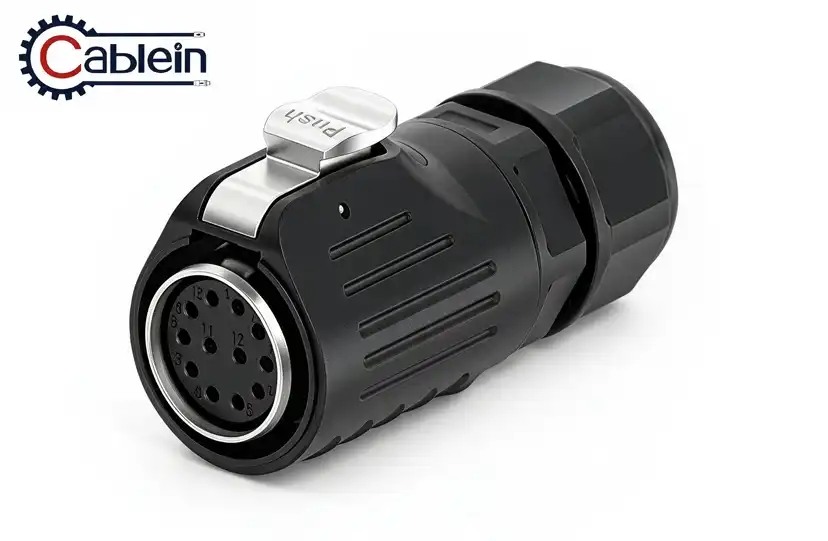
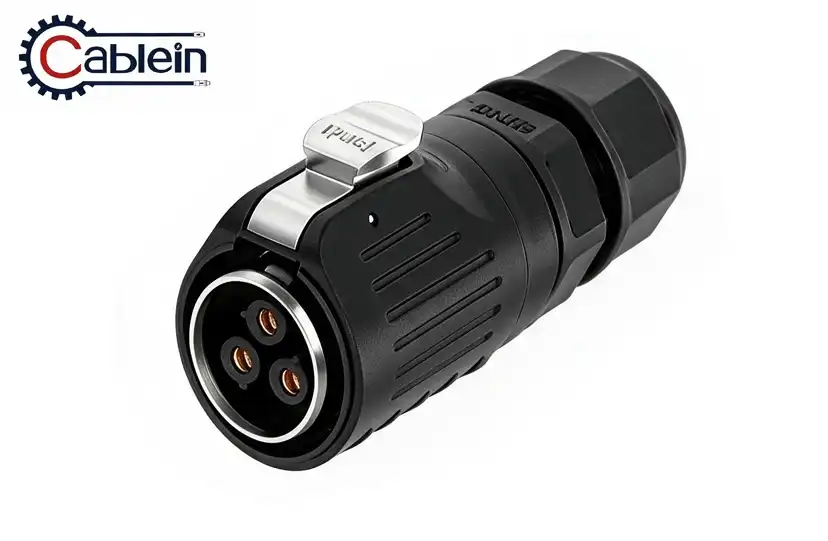
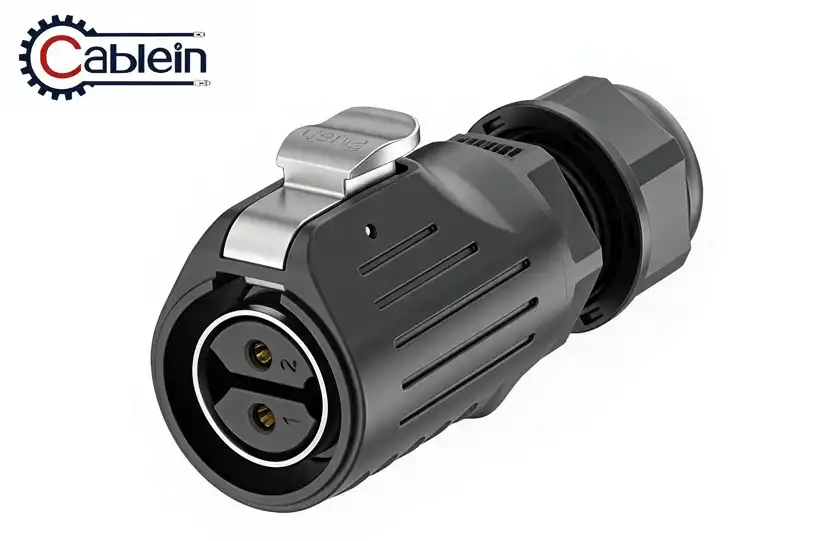
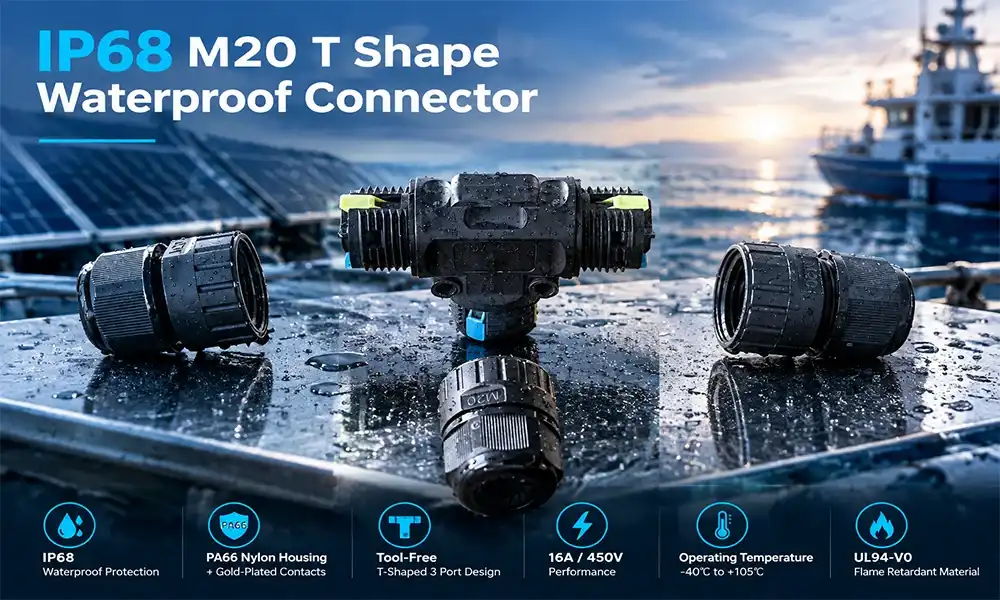
A 20 mm metric threaded wire opening is what "M20" stands for. The T-shaped body makes three ports: one input and two outputs, set up so that they are not touching each other. Cablein's version is made from PA66 nylon, which doesn't break down in UV light or when hit with force. Gold-plated brass contacts keep the resistance below 5 m©, and a high-elasticity rubber seal protects against water immersion all the time. The voltage range is from 250 V to 450 V at 16 A, which is enough for most landscape and naval branch circuits.
What Is a Cable Splitter Connector?
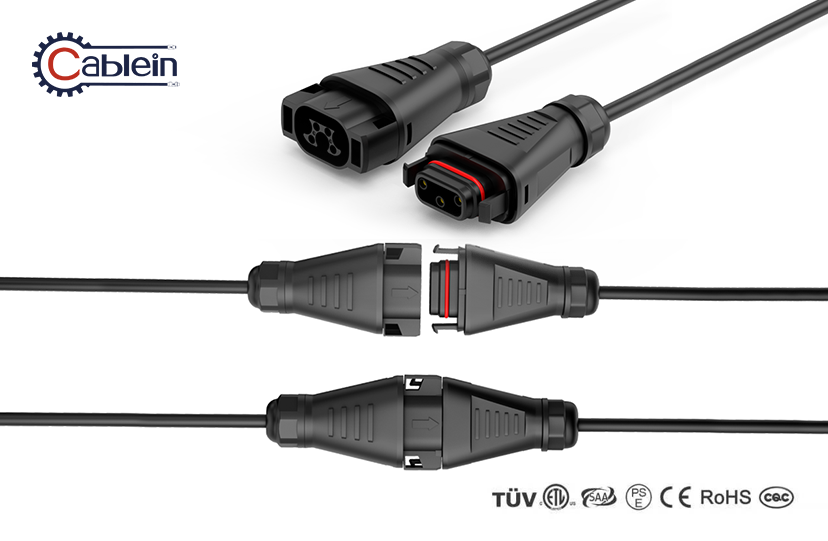
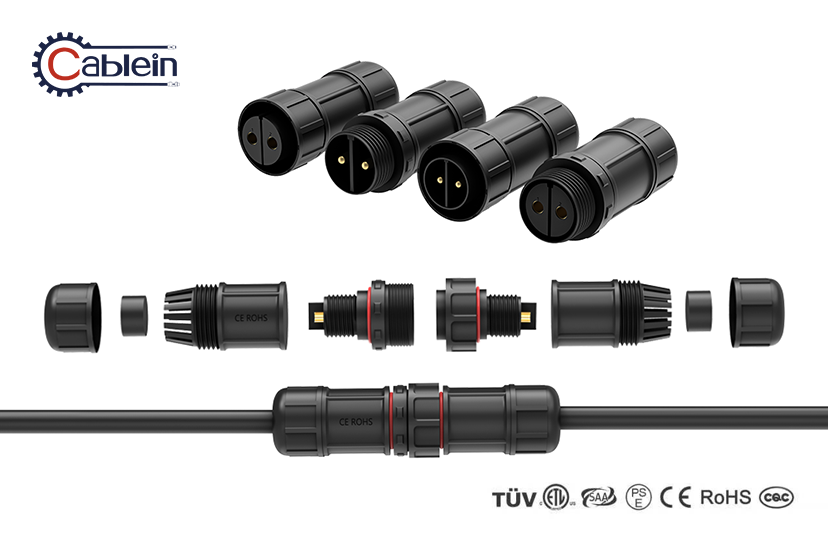
It usually has a Y-shaped or inline junction body that divides a single power or signal line into two or more branches. Most entry-level splitters have PVC housings with seals that press into place or are filled with gel. Sealing levels are very different, ranging from IP54 for basic outdoor types to IP67 for better-built ones. They are often used in low-voltage LED strip systems and outdoor lights where the ground is damp but not underwater.
Key Material and Sealing Differences
When it comes to tensile strength and heat resistance, PA66 nylon is better than regular PVC. At temperatures as low as -40 °C, a silicone O-ring stays flexible, but regular rubber seals can harden and crack when it freezes. The threaded M20 gland squeezes the seal with controlled pressure, making the seal consistent and reliable. Most cable splitters use friction-fit or sticky covering, which breaks down more quickly when temperatures change and when the device is moved around.
Comparing M20 T Shape Connectors and Cable Splitter Connectors
Sealing Performance and IP Rating
Both IP67 and IP68 certifications have been given to the M20 T connector. This was confirmed by testing it under hydrostatic pressure at 1.0 MPa and letting it age for 48 to 96 hours under salt spray. Most standard cable splitters are rated IP67, which means they can handle short-term submersion but not long-term submersion. For lamp strings that are buried in the ground or sensor branches that are underwater, that one rating step can mean the difference between a five-year service life and an inspection failure on the day of launching.
Mechanical Design and Installation Speed
Cablein's IP68 M20 T shape waterproof connector connection doesn't need crimping tools or heat guns because it has a snap-lock case. The wire is put in place, and the gland nut is tightened by hand. This completes the link in less than two minutes per node. When compared to traditional spliced joints, this method cuts the time needed to wire branches by about 60%. This is a big savings when hundreds of nodes need to be set up across a plaza or harbor. Cable splitters with screw connections are a little slower, and you need to know how to use a screwdriver and apply pressure correctly.
Functional Application Fit
The M20 T connector's one-in, two-out port shape is exactly the same as the branching topology of LED landscape strings, underground luminaire circuits, and distributed sensor networks. When it comes to surface-mounted, low-voltage consumer lighting that doesn't need to be serviced often, cable splitters work well. The M20 body with threads and a gasket seal is the right choice when the wire goes underground, behind building siding, or across the deck of a ship.
How to Decide Which Connector Fits Your Needs?
The best connection is chosen based on three factors: the need for ingress protection, the fitting situation, and the total cost of the project over its lifetime.
Before choosing between these two products, here are the main things you should think about:
- IP rating requirement: If your specification calls for IP68 or the installation point will sit below grade or waterline, the M20 T connector is the compliant option. Cable splitters rated only to IP67 will not satisfy inspection bodies that require continuous submersion protection.
- Cable diameter compatibility: Cablein's M20 T supports 5–9 mm and 9–12 mm cable ODs in a single product family, covering the majority of landscape and marine cable sheaths without custom adapters.
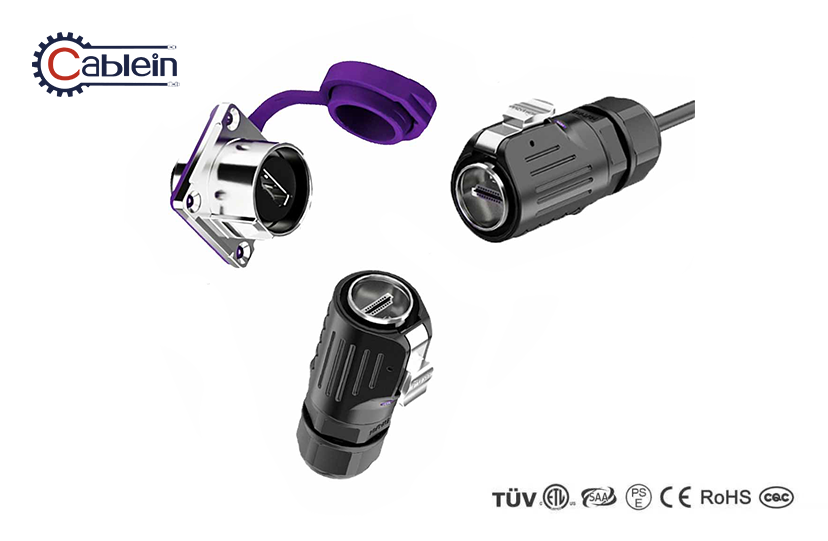
- Certification needs: CE and RoHS documentation ships with every Cablein unit, making it straightforward to attach compliance records to bid packages for public tenders in the EU or municipal contracts in the US.
- Batch size and lead time: Standard stock exceeds 10,000 pieces per item with 7–10 day dispatch. Custom pin configurations (2-pin or 3-pin) are available from 200 pieces, giving OEMs and project engineers flexibility without forcing large minimum orders.
These requirements directly target the points of failure that lead to extra work being done, which costs money. For example, a connector that only meets IP67 standards in a buried trench will corrode at the branch point within one yearly cycle, requiring costly excavation and rewiring. That chance is completely eliminated when the IP68 M20 T shape waterproof connector specs are matched to the real world during the design stage.
Installation and Maintenance Best Practices for M20 T Shape Connectors
Pre-Installation Checks
Before putting cables in, make sure that the OD of the cables fits within the rated range for the gland insert you chose, which is either 5–9 mm or 9–12 mm. Look for nicks or deformations in the silicone O-ring. Because it takes a lot of work to reopen a hidden junction, a broken seal should be changed before assembly, not after.
Assembly Sequence
By cutting the cable sheath by 20–25 mm, you can fit each conductor into its own contact cavity. Press down on the snap-lock housing until you hear a click that means it is fully engaged. Tighten the threaded gland nut by hand until you can see the O-ring getting squeezed against the wire jacket. You don't need a torque wrench because too much tightening can damage the seal more than too little tightness.
Routine Maintenance and Troubleshooting
Every year, check the surface of gland nuts in coastal or high-humidity areas for rust. Use a damp cloth to clean the outside; don't use petroleum solvents because they break down PA66 over time. When tested once a year, if a branch output has higher resistance, take off the port cap, clean the gold-plated contact, and put the conductor back in place. The clear cover choice lets you look at the part without taking it apart, which saves a lot of time during diagnosis.
Future Trends in Waterproof Branch Connectors
Higher Protection Grades and New Materials
More and more, businesses want products with IP69K ratings, which make them resistant to high-pressure, high-temperature water jets. This is important for places like offshore decks and industrial wash-down areas. Connector bodies made from glass-filled PA66 or PPS (polyphenylene sulfide) are now being mass-produced. These materials are more resistant to chemicals than standard grades.
Smart Monitoring Integration
The first smart connectors had a thermistor or humidity sensor built into the housing. These sensors sent information about the condition to a building management system. In this way, repair teams can see when a seal is wearing down before a problem happens. Although this is still a high-end product area, prices are going down as sensor downsizing progresses.
Procurement Strategy Implications
Procurement managers can avoid the risk of having to switch vendors by only choosing links that have been tested for things like hydrostatic pressure, salt spray, and thermal cycling. When suppliers keep their ISO 9001:2015 register up to date and share third-party test results, engineers have the proof they need to sign off on a project and make guarantee claims.
Conclusion
There is some difference in the level of risk that the IP68 M20 T shape waterproof connector and the cable splitter connector are designed to handle. Cable splitters work well in market settings where cost is the main factor. They can handle dry or slightly wet conditions. When the installation area is submerged, exposed to salt, or has high temperatures, the M20 T-shaped waterproof connector is the best choice. Cablein's PA66/silicone version is rated at IP67/IP68, -40 °C to +105 °C, and 16 A at 450 V. It can be terminated without tools, works with two different types of cables, and is CE/RoHS certified, which makes it a useful specification for monitoring renewable energy, marine electronics, and landscape lighting.
FAQ
1. What is the difference between IP67 and IP68 for branch connectors?
IP67 protects against short-term immersion up to 1 meter for 30 minutes. IP68 covers ongoing submersion at a depth and for a length of time decided upon by the buyer and the maker. Usually, this is 1.5 meters for 72 hours or more. For cable branches that are buried and marine connections that are underwater, IP68 is the right minimum standard.
2. Can the M20 T connector handle cables of different diameters in the same assembly?
Yes. With interchangeable silicone gland plugs, the dual-range design can fit cable outer sizes of 5–9 mm and 9–12 mm. This means that you can use both main-run and branch cable gauges in the same housing without needing extra adapters.
3. Is tool-free installation reliable enough for permanent outdoor installations?
Snap-lock housings on approved M20 T connectors pass the same tests for hydrostatic and pull-out force as models that are ended with a tool. You can put the snap contact through the whole IP68 cycle, not just a dry-bench test.
4. What lead time should I expect for custom pin configurations?
Cablein can make custom 2-pin and 3-pin layouts for orders of at least 200 pieces. A normal wait time is agreed upon for each project for custom sales. Normal stock items ship within 7–10 days.
5. Are CE and RoHS certificates available for tender submissions?
Yes. Each series of products made by Cablein under their ISO 9001:2015 quality system comes with CE and RoHS documentation, which can also be asked to be included in bid packages.
Request a Sample or Bulk Quote from Cablein
Since 2017, Cablein Technology has provided waterproof IP68 M20 T-shape connectors to lighting engineers, marine integrators, and OEM brands in more than 100 countries. Our in-house R&D team has more than 30 utility model patents, and before shipping, every unit goes through a 100% waterproof review. Our team responds within 24 hours, no matter how many pieces you need (50 for a test run or 3,000 for a project). You can email us at nick@cableinco.com to get a sample, download test results, or talk about setting up a custom IP68 M20 T shape waterproof connector provider account for your next project.
References
1. International Electrotechnical Commission. IEC 60529: Degrees of Protection Provided by Enclosures (IP Code). IEC, 2013.
2. Underwriters Laboratories. UL 94: Tests for Flammability of Plastic Materials for Parts in Devices and Appliances. UL Standards, 2018.
3. European Committee for Electrotechnical Standardization. EN 61984: Connectors — Safety Requirements and Tests. CENELEC, 2009.
4. Lighting Design and Application (LD+A). "Weatherproof Connectivity in Outdoor LED Systems." Illuminating Engineering Society, 2022.
5. IEEE Transactions on Industry Applications. "Thermal and Mechanical Reliability of Outdoor Electrical Connectors in Harsh Environments." IEEE, 2021.
6. Journal of Marine Engineering & Technology. "Corrosion Performance of Submersible Electrical Connectors in Saline Environments." Taylor & Francis, 2020.