Why Waterproof RJ45 and Type C Connectors Are Essential For Modern Networks
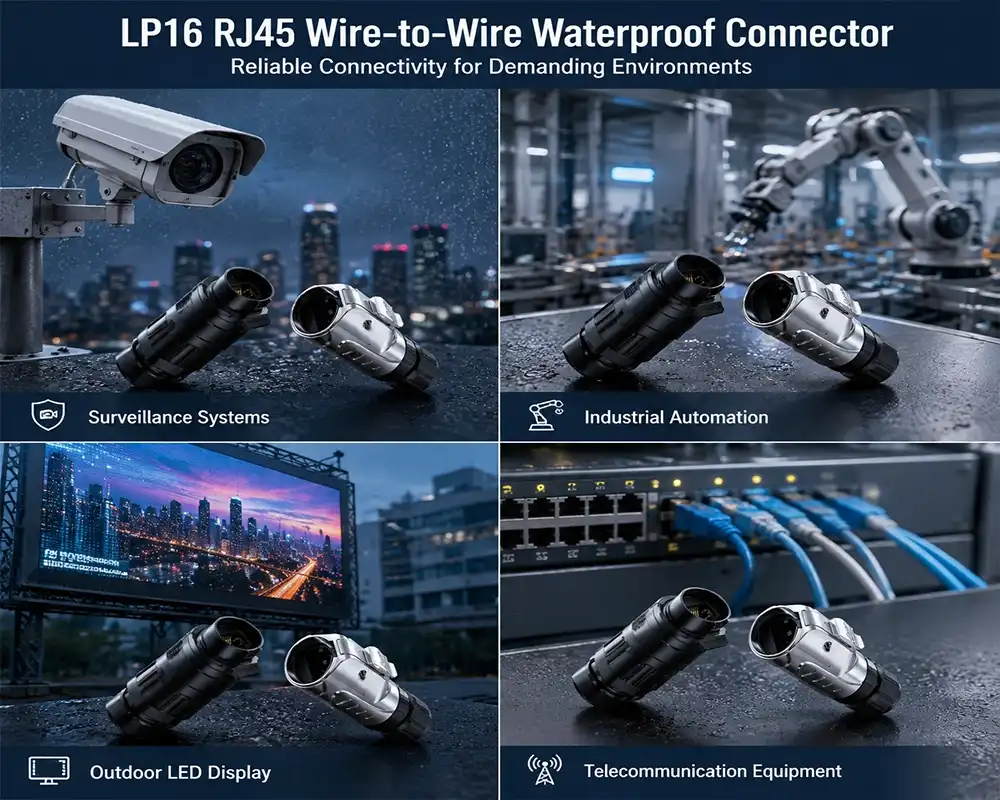
Modern network infrastructures face mounting challenges as connectivity extends beyond controlled indoor environments into harsh outdoor and industrial settings. Waterproof RJ45 and Type C connectors have become indispensable for ensuring uninterrupted data transmission where moisture, dust, vibration, and temperature extremes threaten conventional connections. The LP16 RJ45 wire-to-wire waterproof connector exemplifies this evolution, delivering IP67/IP68-rated protection while maintaining full compatibility with Cat5e and Cat6 Ethernet standards. This combination of environmental resilience and performance reliability addresses critical needs across LED lighting, industrial automation, renewable energy, and security surveillance applications.
Understanding Waterproof RJ45 and Type C Connectors in Modern Networks
Those days of limited network access to temperature-controlled server rooms are long gone. Today’s installations are on outdoor LED displays that are exposed to the rain, solar farms that are roasting in the bright sunshine, and manufacturing floors where coolant sprays and metallic particles fill the air. Standard Ethernet connections just weren't designed for these circumstances. Water infiltration corrodes contacts in a matter of weeks. Dust particles cause intermittent contact, and temperature cycling fractures in plastic housings. Such failures mean expensive downtime and emergency service visits.
The Core Technology Behind Environmental Protection
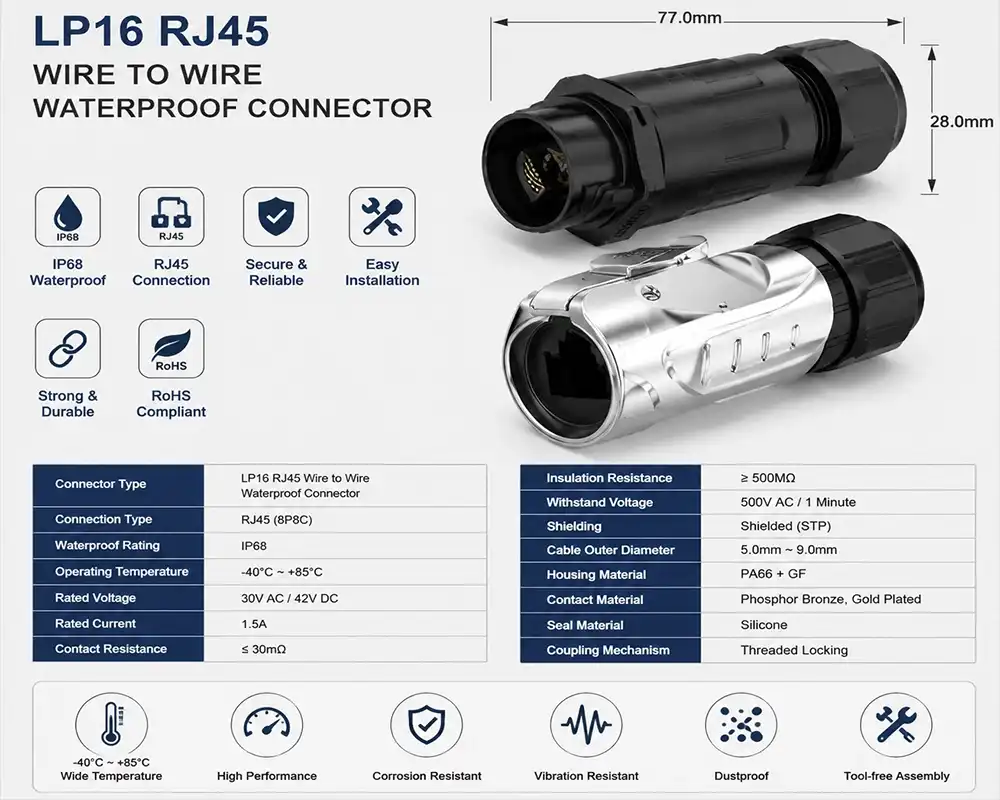
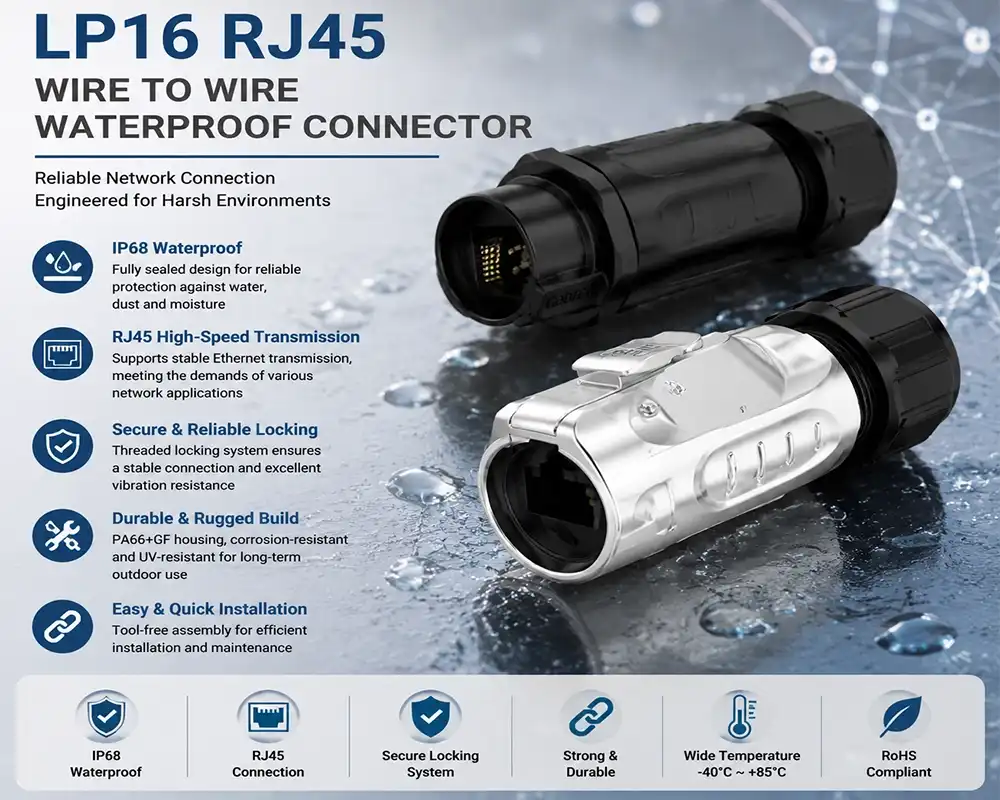
Waterproof Ethernet connections use numerous sealing methods to provide a barrier against the incursion of the environment. The housing is surrounded by precisely molded silicone gaskets that compress during mating to produce a continuous seal around the RJ45 interface. IP67 ratings provide submersion protection up to one meter for thirty minutes, while IP68 models can endure continuous immersion under certain circumstances. This is achieved using the LP16 RJ45 wire-to-wire waterproof connector's unique bayonet-type locking mechanism that maintains continuous compression on sealing rings even under vibration or thermal expansion. Gold-plated connectors as thick as 50μ prevent oxidation that would otherwise compromise signal quality in humid situations.
Another important criterion is temperature tolerance. Outdoor installations undergo temperature changes from frigid winters to sweltering summers. The LP16 connection is dependable across a temperature range of -40℃ to +105℃. The housing materials are UL94-V0 flame retardant and will not become brittle in the cold or soften in the heat, providing structural stability. The broad operational range enables constant performance of your network connections, whether put in an Arctic monitoring station or a solar project in the Middle East.
Wire-to-Wire Configuration Advantages
Its female-to-female feed-through architecture allows for cable expansion without signal loss. Wire-to-wire arrangements easily attach to an existing cable run. Panel mount connections need equipment to be modified. You retain flexibility in your network structure, placing the environmental protection precisely where you need it. This is especially beneficial for repairing outside LED installations or expanding security camera networks to exposed areas where replacing the wire would be prohibitively costly.
Comparative Analysis: LP16 RJ45 vs. Other Connector Types for Industrial Applications
To make procurement selections, one has to understand how various connection technologies meet certain operational needs. The standard RJ45 connections provide worldwide compatibility and minimal cost. However, the open design exposes contacts to contamination. Aviation-style circular connections are mechanically stronger and have better IP ratings, but their mass and expense make them unsuitable for network applications that need dense port arrangements.
Performance Differentiators in Real-World Conditions
Standard indoor RJ45 jacks quickly deteriorate if moisture spans exposed contacts, leading to corrosion, which raises resistance and ultimately causes open circuits. The LP16 connector’s sealed shell avoids such damage. Independent salt spray testing over 96-hour cycles demonstrates the connection is able to retain contact resistance below 30 mΩ, even after exposure equal to years of coastal operation. This resilience translates into lower maintenance costs and longer service times for outdoor installations.
Mechanical endurance is also needed for industrial applications. The continual vibration inherent in robotic work cells and automated manufacturing lines causes ordinary RJ45 locks to loosen over time. The LP16 uses a snap-lock coupling system that requires a conscious manual release, limiting inadvertent separation while yet allowing for tool-free joining. Testing confirms over 500 mating cycles without mechanical damage, providing enough for situations where reconfiguration is required periodically, or equipment is relocated seasonally.
Temperature resistance becomes a huge issue in renewable energy systems. The equipment warms up in the peak output phase and then cools down overnight, resulting in an extensive thermal cycle for solar inverters and battery management systems. Standard connections develop stress fractures that affect sealing integrity. The LP16’s choice of materials and thermal expansion coefficients excludes this failure mechanism and preserves IP67/IP68 protection for the life of the device.
Procurement Considerations for Volume Buyers
Bulk purchase tactics have a substantial influence on the final project cost. Lead times and inventory stability become just as essential as unit cost when procuring connectors for big-scale installations. Established manufacturers like Cablein store more than 10,000 pieces per item variation, which means that they can provide quick turnaround times and bulk reductions that stretch the project budget for urgent projects. Custom wire lengths and pre-assembled harnesses also help to cut installation labor costs, a key consideration when installing hundreds of connection points throughout sprawling buildings.
Certification compliance speeds up project approvals and deployments worldwide. The LP16 is TUV and CE certified to ISO9001 and is RoHS compliant, removing regulatory barriers for providing equipment to European markets. This comprehensive certification portfolio minimizes the due diligence load on your procurement team while offering quality assurance that protects your company’s brand.
How to Choose the Right Waterproof Connector for Your Network Needs
To choose suitable connection solutions, it is important to align the technical parameters with the environmental and operating circumstances. The decision procedure is initiated by the evaluation of the environmental protection level. For indoor use with periodic cleaning operations, splash protection to IP65 is necessary. Equipment used outside, exposed to rain, must be IP67. For submersible applications such as fountain lights or maritime sensors, IP68 certification with particular depth and duration requirements is needed.
Matching Electrical Performance to Application Requirements
The choice of connection type is determined by the needs for data transfer. Most surveillance and lighting control systems using regular Gigabit Ethernet work well with LP16 RJ45 wire-to-wire waterproof connector Cat5e ports. If you were running a 10-Gigabit network over a longer length of cable or needed to offer Power over Ethernet (PoE) and keep signal integrity along with the power, you'd need Cat6. The LP16 supports both protocols and is designed for PoE applications with a current rating of up to 1.5A, which is adequate for IEEE 802.3af/at powered devices without any overheating problems.
Connector design choices. 2. Physical installation restrictions. In tight areas, you may need low-profile housings or right-angle cable exits. The LP16 connector’s small dimensions are combined with a strong sealing performance thanks to its 16mm mounting aperture. The choice of cable entrance configurations must also be considered, as some applications prefer a straight-through layout, while others need strain relief boots to prevent cables from frequent bending at the connection interface.
Working with Authorized Manufacturers
Certified manufacturers provide consistent product and technical support throughout the project lifetime. There are counterfeit connections flooding the commodities markets that look like the real thing but are made of inferior materials and fail waterproof testing. Established vendors will have technical documentation, application engineering assistance, and quality traceability, which is crucial when trying to fix installation problems or plan system expansions.
It is the ability to customize that separates manufacturers that can handle complicated projects from those who are commodity providers. Custom cable lengths remove the need for field termination, adding possible failure spots. Pre-assembled harnesses with built-in strain relief and labeling eliminate installation mistakes and expedite deployment timelines. OEM product development services allow private mold designs for applications that need customized form factors or particular features not accessible in conventional product lines.
Installation, Maintenance, and Best Practices for Waterproof Connectors
Proper installation is the only way to ensure waterproof connectors work with the rated environmental protection over their service life. Even the best connections might be compromised by installation practices that break the seal. Before starting the installation, check for shipment damage to connection parts and check that sealing gaskets are fitted correctly in grooves. Any dirt on the sealing surfaces will produce leak routes that defy the waterproof design.
Step-by-Step Installation Guidelines
Reliability of the connection depends on cable preparation. Strip cable jackets to a suitable length. Too short, you won't be able to seat the connector properly. Too long, and you'll have stress concentrations. Make sure that all pairs of conductors are twisted all the way to the termination point since untwisting will decrease data transmission performance. The LP16’s tool-free design facilitates installation in the field, but you must be certain to properly engage the snap-lock connection and hear the click of the mechanical latching.
No premature failure resulted from routing concerns. Connectors should be positioned with cable entry pointing downward whenever feasible so that water does not collect at the mating contact. Proper strain relief should be used to avoid straining the connection with the weight of the cable or wind loads. If the environment is very vibratory, anchor the cable within 15 cm of the connection to isolate mechanical stress from the sealed junction.
Maintenance Protocols for Long-Term Reliability
Regular checkups detect problems in their infancy before they result in network outages. Locking mechanisms on the LP16 RJ45 wire-to-wire waterproof connector should be checked visually quarterly to ensure they are still engaged and there is no obvious damage to connection housings. Annual comprehensive inspections involve carefully un-mating connections to evaluate the quality of the sealing gaskets. Watch for compression set, cracking, or contamination that impairs the efficacy of sealing. Replace any degrading gasket even if the connection is presently working OK.
Environmental monitoring helps to forecast maintenance requirements. Unusual temperature fluctuations, chemical exposure, or mechanical abuse may need more frequent examination intervals. Record all inspection results to establish baseline performance and discover deterioration patterns that can suggest systemic problems needing design changes or component replacements.
Future Trends and Innovations in Waterproof Connector Technology
As Internet of Things installations grow and smart city projects develop, network infrastructure needs are continuing to evolve. Such improvements push waterproof connector innovations in many aspects. Improved IP ratings over IP68 are becoming available for particular applications such as offshore wind farms and deep submersion monitoring. They have to make specs for temperature tolerance and expand it to be able to place them in harsh regions. An Arctic research station and a desert solar farm both test the boundaries of present materials.
Advancing Data Transmission Capabilities
As 4K video surveillance and real-time machine vision systems become more common in industrial networks, bandwidth demands keep increasing. Future waterproof connection designs must satisfy Cat6a and Cat7 performance criteria and preserve environmental protection. This means higher production tolerances and sophisticated shielding procedures to prevent high-frequency transmissions from being degraded by electromagnetic interference. Data transmission enhancements are evolving with power delivery integration, with next-generation PoE standards up to 100 watts requiring connections that can handle larger currents without thermal concerns.
Innovations in material science allow connections to endure more severe chemical conditions. Conventional PBT plastics and zinc alloy housings are sufficient for normal industrial usage. Advanced polymer formulations and specialized coatings are required for specialized applications employing harsh solvents or corrosive atmospheres. These advances assist chemical processing companies, wastewater treatment plants, and agricultural activities where fertilizer exposure tests traditional connecting materials.
Industrial connections start to show smart connectivity traits. Sensors included in connector housings may monitor temperature, humidity, and vibration and report it over the same Ethernet connection they are protecting. This capacity to monitor condition allows for predictive maintenance techniques to minimize unexpected downtime and increase overall system dependability.
Conclusion
Waterproof RJ45 connectors have transitioned from specialized components to essential infrastructure elements as networks expand into challenging environments. The LP16 RJ45 wire-to-wire waterproof connector demonstrates how proper engineering delivers both environmental protection and electrical performance without compromise. Selecting appropriate connectors requires understanding application-specific requirements, evaluating supplier capabilities, and implementing proper installation practices. These investments in robust connectivity deliver measurable returns through reduced maintenance costs, extended equipment lifespans, and improved operational reliability.
FAQ
1. What IP rating do I need for outdoor Ethernet connections?
IP67 provides adequate protection for most outdoor installations exposed to rain and dust. This rating guarantees submersion protection up to one meter for thirty minutes—sufficient for temporary flooding conditions. IP68 becomes necessary for permanent submersion applications like underwater lighting or marine monitoring equipment where the connector remains continuously submerged.
2. Can waterproof RJ45 connectors support Power over Ethernet?
Quality waterproof connectors fully support PoE applications. The LP16 RJ45 wire-to-wire waterproof connector handles up to 1.5A current for IEEE 802.3af/at devices. Verify that your selected connector's current rating matches your PoE requirements, as higher-power PoE++ applications may require connectors with enhanced thermal management.
3. How do I verify waterproof connector quality before large purchases?
Request sample connectors and conduct your own testing. Perform submersion tests matching your application conditions, verify mechanical durability through repeated mating cycles, and validate electrical performance using network testing equipment. Reputable manufacturers provide certification documentation and test reports confirming compliance with published specifications.
Partner with Cablein for Your Industrial Ethernet Connectivity Needs
Your network infrastructure deserves connectivity solutions engineered for reliability in demanding environments. Cablein Technology specializes in manufacturing high-performance waterproof connectors, including the LP16 RJ45 wire-to-wire waterproof connector supplier solutions trusted by LED lighting manufacturers, renewable energy companies, and industrial automation integrators worldwide. Our ISO9001:2015 certified facility maintains substantial inventory, enabling rapid delivery for projects requiring immediate fulfillment, while our OEM/ODM capabilities support custom designs meeting unique application requirements. Contact our technical team at nick@cableinco.com to discuss your specific connectivity challenges and discover how our waterproof RJ45 solutions deliver lasting value through superior environmental protection and installation efficiency.
References
1. Institute of Electrical and Electronics Engineers. "IEEE Standard 802.3: Ethernet." IEEE Standards Association, 2018.
2. International Electrotechnical Commission. "IEC 60529: Degrees of Protection Provided by Enclosures (IP Code). Third Edition, 2013.
3. Telecommunications Industry Association. TIA-568: Commercial Building Telecommunications Cabling Standard. 2020 Revision.
4. Underwriters Laboratories. "UL 94: Standard for Safety of Flammability of Plastic Materials for Parts in Devices and Appliances. Current Edition.
5. Zhang, Michael, and Roberts, James. "Environmental Performance of Industrial Ethernet Connectors in Harsh Conditions." Journal of Industrial Communications Technology, Volume 45, 2022.
6. Anderson, Patricia. "Power over Ethernet Implementation Guide for Outdoor Networks." Network Infrastructure Quarterly, Spring 2023.