How is a Wafer Connector Different from a Circular Connector?
When specifying interconnect solutions for industrial equipment, the choice between wafer and circular connectors often determines long-term reliability and operational efficiency. Wafer connectors feature flat, low-profile designs ideal for PCB mounting and tight spaces, while circular connectors—such as the M20 circular connector—deliver robust cylindrical housings with threaded couplings for superior environmental sealing. The M20 designation refers to the metric 20mm thread diameter, providing secure locking mechanisms that withstand vibration, moisture ingress, and extreme temperatures across demanding applications.
Introduction
Connectors are the most important part of the infrastructure for outdoor lighting, green energy systems, and industrial automation. They link power sources, control systems, and field devices. More and more, procurement specialists and R&D experts are under pressure to choose interconnect options that are affordable, easy to install, and long-lasting. Knowing the main differences between circular and wafer connectors has a direct effect on how long projects take, how much money is spent on maintenance, and how much time the system is up. When room is limited, wafer connectors work best for electronics systems. On the other hand, circular connectors, especially the M20 circular connector standard, have become the standard for harsh environments that need IP67 or IP68 protection. This guide makes technical differences, application scenarios, and buying factors clearer so that B2B buyers can make decisions based on data that meet their operational needs and compliance requirements.
Overview of Wafer Connectors and Circular Connectors
Wafer connectors have thin, rectangular housings that are made for installing on a PCB through a hole or on a surface. These connectors usually have several rows of contacts set up in parallel, which lets a lot of pins fit into a small space. Board-to-board or board-to-wire interfaces are often needed for internal connections in control panels, consumer electronics, and telecommunications equipment. Their flat shapes make good use of vertical space, but they don't protect against the environment very well unless they are paired with other shelters.
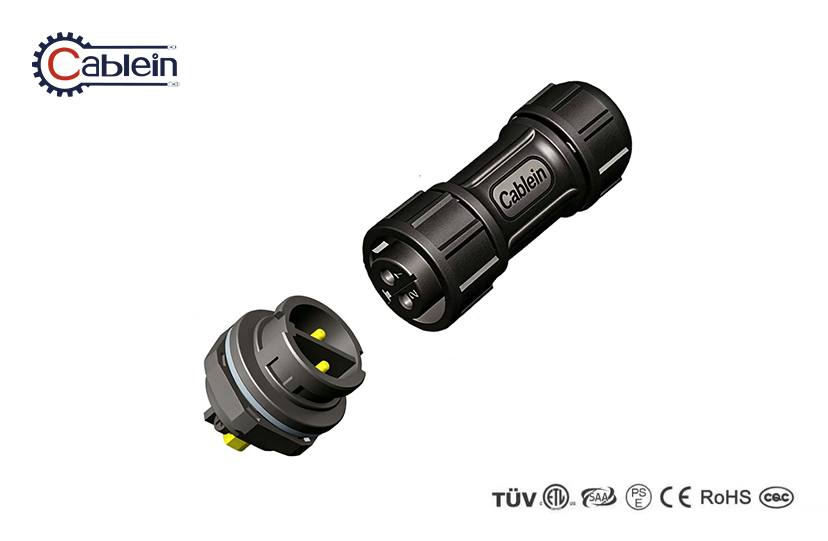
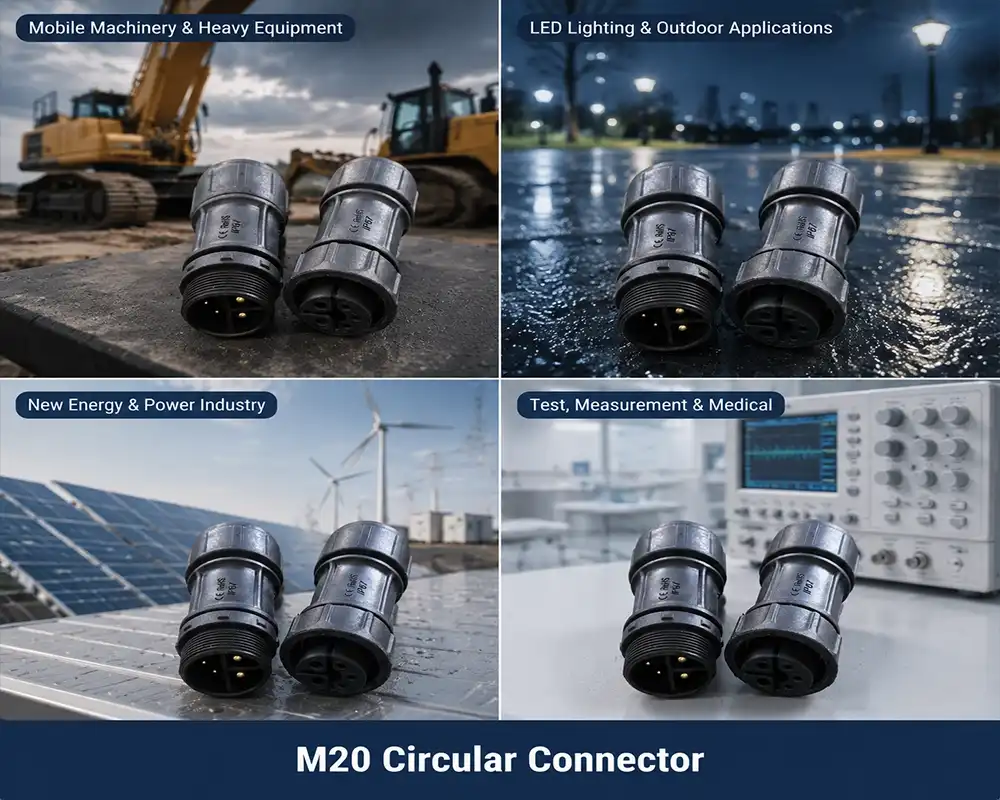
On the other hand, circular connectors have cylinder-shaped shells that join with bayonet or threaded mechanisms. For safe panel installation through thick enclosure walls, the M20 circular connector uses a 20mm metric hole. Environmental sealing is built right into these connectors. They have metal or PA66 nylon housings with silicone or rubber gaskets to get IP67 or IP68 ratings for entry protection. There are different kinds of pin configurations, from two-contact power connectors to multi-pin hybrid assemblies that can send both power and signals at the same time. Because circular shapes naturally spread mechanical stress around the edge of the coupling, they last longer when there is shaking and wire pull forces. Because of how they are built, they are essential for outdoor LED lights, EV charging stations, sun monitoring systems, and industrial robots that have to deal with dust, water, and extreme temperatures.
Structural and Material Differences
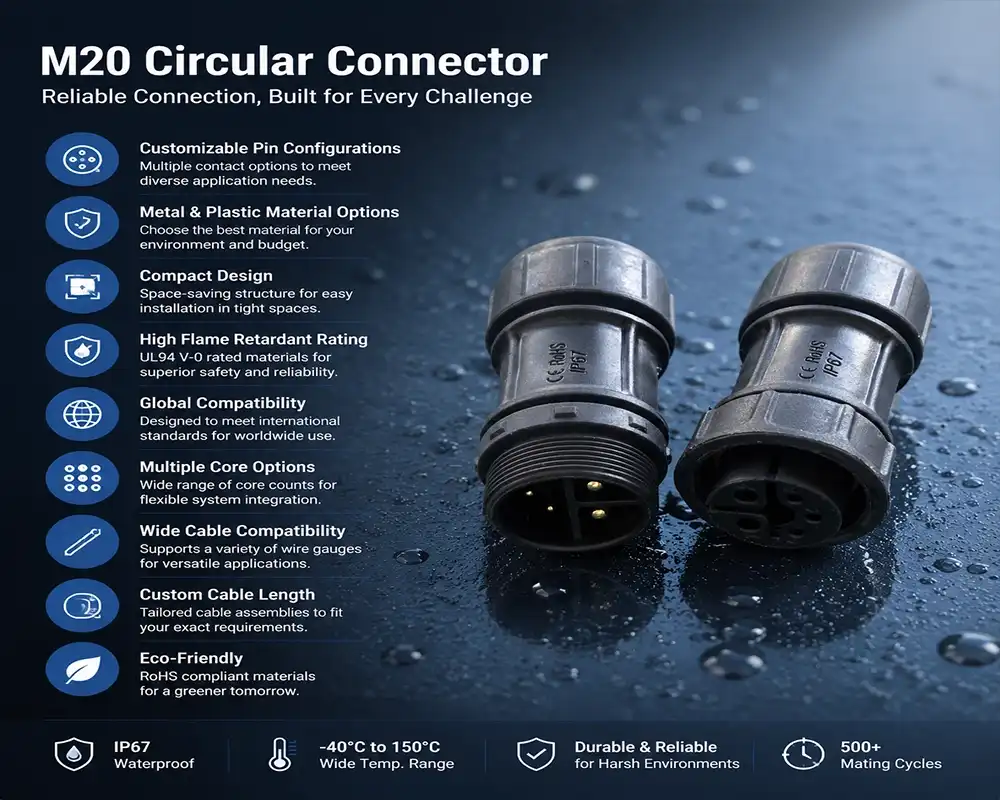
Plastic housings and light contact systems make wafer connectors ideal for low-cost production and layouts with a lot of components. Most circular connectors are made of reinforced nylon blends or zinc alloy shells that have been plated with nickel. These materials are better at resisting contact and blocking electromagnetic waves. The M20 circular connector has contacts made of gold-plated brass, which reduces contact resistance and rust and ensures stable electrical performance over more than 1,000 mating cycles. Threaded locking nuts offer mechanical security that snap-fit wafer designs can't match. They keep connections from coming loose by accident in places with a lot of vibration, like public transportation and farm equipment.
Detailed Comparison of M20 Circular Connectors vs Wafer Connectors
A thorough look at the differences between M20 circular connectors and wafer connectors:
Mechanical Robustness and Environmental Sealing
The threaded coupling on the M20 circular connector provides constant clamping force, so the seal stays intact even when the wires move laterally or expand due to heat. Wafer connectors don't have built-in environmental seals. Instead, they use conformal coats or external potting to keep moisture out. Most circular connectors pass IP68 submersion tests (30 minutes at 1 meter depth), but wafer solutions have a hard time getting even IP54 ratings without support from an enclosure. This difference is very important for marine applications, underwater robotics, and outdoor surveillance cameras because water entry breaks systems right away and costs a lot of money in downtime.
Electrical Performance and Current Handling
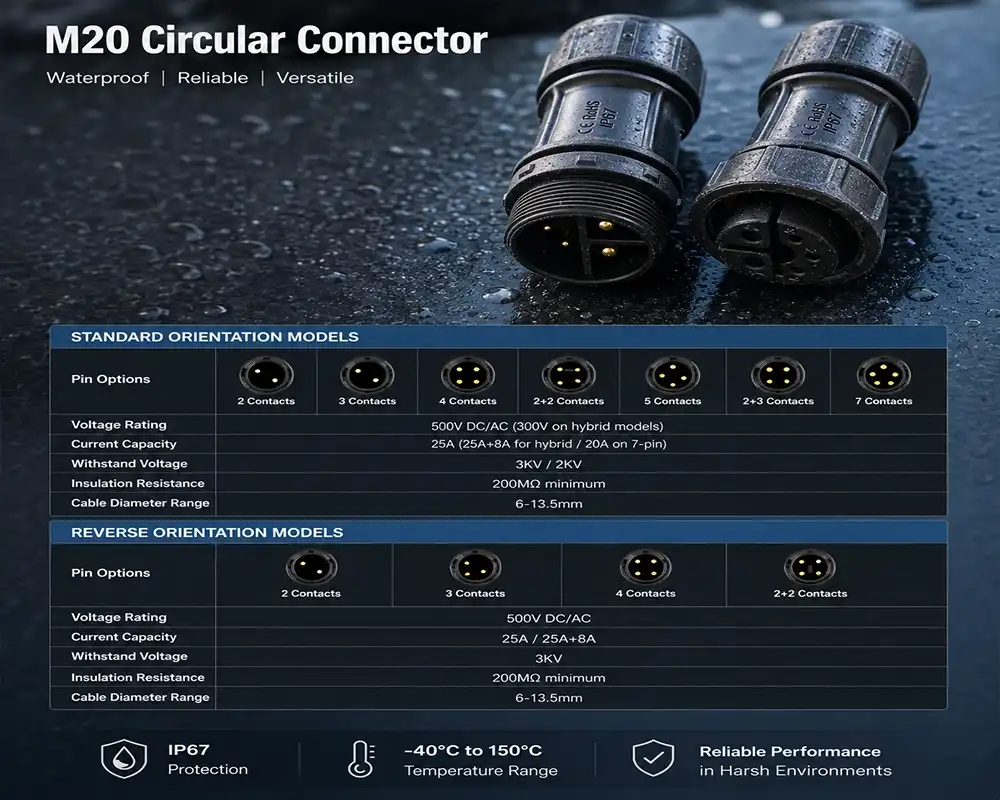
Wafer connectors put signal integrity first for sending low-voltage data, and each contact can usually only handle 3 to 5A of current. The M20 circular connector can handle higher power densities. Standard configurations can handle 25A, and hybrid models can handle 25A+8A combinations for power and control circuits running at the same time. It can handle up to 500V DC/AC and has a withstand voltage of 3kV and an insulation resistance of 200MΩ. Screw termination chambers inside circular designs can hold 14–18 AWG conductors, so there's no need for external junction boxes and the cost of installation labour is lower. Because of these features, circular connectors are necessary for EV charging equipment, big pump controllers, and main power entry points where managing voltage drop and heat is very important.
Temperature Range and Material Stability
The M20 circular connector works reliably from -40°C to 150°C, so it can be used in both cold storage facilities and industrial ovens that are heated to high temperatures. PA66 fabric housings don't break down when exposed to UV light, chemicals, or water, so they keep their structural stability for ten years. Wafer connectors usually have temperature ranges from -25°C to 85°C, which means they can't be used in places with harsh climates or high temperatures. This temperature stability has a direct effect on how often upkeep needs to be done and the total cost of ownership for solar array junction boxes that are exposed to desert heat cycles or outdoor LED displays that are installed in the cold.
Installation Complexity and Field Serviceability
Technicians can end wires on-site without using special crimping tools when they use circular connectors made for field assembly. The screw termination chambers of the M20 circular connector can hold stripped wire ends. These are held in place by tightening the terminal screws to the pressure values recommended by the maker. This method doesn't need solder, so installation is faster than with wafer connectors that need PCB soldering or IDC mass termination tools. M20 circular connector versions with longer thread lengths can fit panel walls that are up to 5 mm thick, which makes them easier to install in IP66-rated shelters. Modular insert designs let you quickly replace contacts without throwing away whole connector assemblies. This saves money on spare parts and keeps equipment running during maintenance.
Selecting Between Wafer and M20 Circular Connectors: A Buyer's Guide
Professionals in procurement have to look at different connector options based on more than just the unit price. When environmental exposure is managed and a lot of gadgets are being made, wafer connectors are a cheaper option. When failure costs are higher than component savings, circular connectors are the best investment. This is especially true for safety-critical infrastructure and outdoor installations that need little maintenance.
Evaluating Supplier Capabilities and Certifications
Manufacturers you can trust keep their ETL, PSE, SAA, CE, and TUV certifications, which show they follow international safety standards and RoHS/REACH environmental directives. Suppliers with ISO9001:2015 quality management systems can track batches and make sure that production quality is always the same, which is important for large-scale deployments. Technical datasheets with IP ratings, contact resistance, and mechanical life cycles make it possible for engineering teams to make sure the products are right before placing large orders. Well-known companies also offer OEM customisation for different pin arrangements, cable lengths, and colour-coding systems that make installation the same across multiple sites.
Lead Time and Inventory Management
Reliable sources keep more than 10,000 units in stock per standard configuration, which means that pressing project needs can be met in 7 to 10 days. Lead times for custom cable systems with M20 circular connectors range from 15 to 21 days, based on the complexity of the wire harness and the approval standards. For emergency sales, suppliers with their own factories are more flexible than wholesalers who depend on manufacturing chains in other countries. Blanket purchase agreements with scheduled deliveries that are in line with project goals are often the result of long-term relationships. These agreements cut down on the costs of procurement administration and storage.
Total Cost of Ownership Analysis
While wafer connectors are cheaper to buy at first, circular connectors save money over the course of their lifetime because they last longer and require less field labour. Because the M20 circular connector can be fixed in the field, whole cable assemblies don't have to be replaced when connectors break. This saves money on spare parts. Better sealing against the environment stops early failures that cost a lot in terms of equipment downtime, site visits, and warranty claims. When it comes to outdoor LED setups with hundreds of lights or solar farms with thousands of monitoring points, the dependability of the connectors has a direct effect on the return on investment (ROI) and the predictability of the upkeep budget.
Installation, Wiring, and Maintenance Guide for M20 Circular Connectors
When installed correctly, the M20 circular connector protects against environmental damage and lasts a long time mechanically. Before choosing a connector type, technicians should make sure that it works with cables of the right width (6–13.5 mm), this is to make sure that there is enough strain release and seal compression. Referencing manufacturer pinout diagrams stops wiring mistakes that hurt connected devices or make high-voltage applications less safe.
Step-by-Step Installation Process
The first step in getting a cable ready is to remove the top jackets so that the individual wires can be seen without damaging the insulation. The lengths of the strips should match the depths of the termination chambers listed in the installation guides. For screw terminals, this is usually 8 to 10 mm. Put the stripped wires into the terminals that are marked, making sure that no stray strands cross over to connect to other contacts. Use measured screwdrivers to tighten terminal screws to the suggested torque values. Be careful not to over-tighten, which can damage contact barrels. Slide cable glands over connectors that have already been put together and make sure that the O-rings fit properly in the gland holes before threading them onto the connection bodies. Cross-threading can be avoided by hand-tightening panel mounting nuts with thread-locking compound before using tools in places where shaking is likely to happen. The final check should prove that the seal has been compressed and that there are no exposed conductors.
Maintenance Best Practices
For outdoor installations, you should do visual checks every six months to look for cracks in the housings caused by UV light and corrosion on the contacts. Megohm meters should be used once a year to check the insulation resistance for moisture entry before problems happen. In places with a lot of humidity, closing gaskets should be replaced every three years, even if there is no damage that can be seen. This is because silicone elastomers lose their ability to compress over time. During routine maintenance, clean the contact surfaces with isopropyl alcohol to get rid of the oxidation that makes them less resistant to contact. Write down the results of the inspection and the serial numbers of the connectors to find patterns that show problems with the batch or environmental conditions that are too high for the design.
Future Trends and Innovations in Connector Technology
Connector makers are adding smart tracking features to round designs by putting sensors inside them that track temperature, humidity, and mating cycles. These IoT-enabled connectors send diagnostic data to cloud platforms. This lets maintenance plans swap parts before they break down and stop activities. For certain industrial processes, new polymer formulas are raising the temperature range to 200°C or higher. At the same time, hybrid fiber-optic-electrical connections are meeting the needs for high bandwidth in smart factory applications.
Customisation platforms now let engineers set up colour schemes, pin layouts, and keying orientations using web-based design tools. Within 24 hours, they get 3D models and quotes. This speeds up the development process and cuts down on the number of engineering revisions. Modular insert designs make it possible to switch between power, signal, and fiber-optic setups while using the same housings. This makes managing inventory easier across product lines. By investing in automated production lines, suppliers can keep their prices low while also lowering the minimum order quantities. This means that mid-level projects can now get custom solutions that were previously only available with standard catalogue items.
Conclusion
In electronics systems with limited room, wafer connectors are used for specific tasks. On the other hand, circular connectors, especially those that follow the M20 circular connector standard, are better for harsh industrial settings because they can seal against the environment, handle high currents, and be strong mechanically. The threaded coupling, IP68 grade, and field-serviceable form of the M20 circular connector make it a better choice for outdoor LED systems, green energy infrastructure, and automatic industrial equipment because it lowers the total cost of ownership. When procurement teams put supplier certifications, customisation options, and quick technical support at the top of their list of priorities, their companies are set up for long-term operational success. Strategic partnerships with manufacturers that offer rapid prototyping and full cable assembly services help to speed up project timelines while still maintaining quality standards.
FAQ
Which connector type suits high-voltage outdoor applications?
It is much better for circular connectors with IP67/IP68 ratings and reinforced insulation systems to be used outside and with voltages up to 500V than wafer designs. The M20 circular connector's threaded coupling and integrated sealing get rid of the moisture paths that cause tracking failures in high-voltage settings.
Can wafer connectors achieve equivalent environmental protection?
To get close to IP67 protection, wafer connectors need external casings and potting compounds, which makes the assembly more difficult and costs more. This method doesn't have the mechanical security and ease of serviceability that come with circle designs that use threaded closing mechanisms.
What factors influence lead times for custom connectors?
Orders for custom pin configurations from stock usually ship within 10 to 14 days. Lead times can go up to 4 to 6 weeks if the supplier can't make the parts quickly enough or meets the certification requirements. This is because of the special tools needed for non-standard housings or materials.
How do certifications impact global market access?
With ETL and TUV certifications, you can sell your products in North America and Europe. With PSE and SAA approvals, you can meet the rules in Japan and Australia. Multi-region certifications make it easier to manage the supply chain and lower the costs of compliance for multinational deployments.
Partner with a Trusted M20 Circular Connector Manufacturer
Since 2017, Cablein Technology has provided reliable, waterproof interconnect solutions for projects in more than 100 countries that use LED lights, green energy, and industrial automation. Our factory is ISO9001:2015 approved and makes M20 circular connectors with IP68 ratings, ETL/TUV certifications, and pin configurations that can be changed to fit your exact needs. We keep more than 10,000 units of each common item in stock, which means that pressing orders can be delivered in 7 to 10 days. Our engineering team is available 24 hours a day to help with technical issues. They can help you choose the right connectors, create cable assemblies, and install them in the field. Our OEM/ODM services can help you save money and meet strict quality standards, whether you need two-pin power connectors for outdoor lighting or hybrid assemblies for EV charging infrastructure. Get in touch with nick@cableinco.com right away to talk about your project needs and get samples within a week. Find out how our M20 circular connector source network and vertically integrated production can help you get what you need faster and more reliably in the harshest conditions.
References
1. Industrial Connector Standards and Application Guidelines, International Electrotechnical Commission Technical Report 60512-2019
2. waterproof connector Design Principles for Outdoor Electronics, Journal of Electronic Packaging and Manufacturing, Vol. 34, 2021
3. Comparative Analysis of Circular and Rectangular Connector Systems in Industrial Automation, IEEE Transactions on Industrial Electronics, 2020
4. Environmental Sealing Technologies for Harsh-Environment Connectors, Society of Automotive Engineers Standard J1772-2022
5. Lifecycle Cost Analysis of Industrial Interconnect Solutions, B2B Procurement Professional Magazine, March 2023
6. Advances in Connector Materials and Manufacturing Processes, International Journal of Advanced Manufacturing Technology, Vol. 118, 2022