M20 Cross Connector vs. Traditional Junction Box: Key Differences Explained
When you need to branch multiple cables at a monitoring pole or inside a control cabinet, your choice of connection method directly affects installation time, long-term maintenance cost, and system safety. The M20 cross connector 4 way cable extender and the traditional junction box both solve the same core problem—distributing power or signals across multiple lines—but they do it in fundamentally different ways. This article breaks down those differences so procurement engineers, project directors, and OEM buyers can make a well-grounded decision before placing an order.
Understanding M20 Cross Connectors and Traditional Junction Boxes
What Is an M20 Cross Connector?
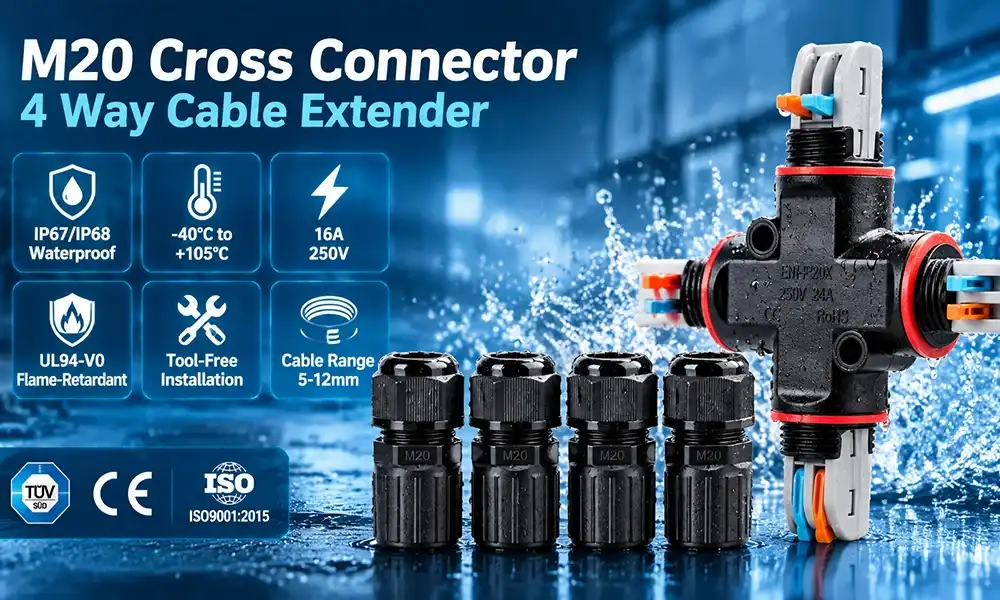
Based on the M20 screw standard, an M20 cross connector is a small black box with four ports used in industry. Its cross-shaped body can take in one cable and power or signal three branches that are going out at the same time. The Cablein one has a body made of PA66 nylon, contacts made of gold-plated copper alloy, and closing rings made of multiple layers of silicone. It has an IP67/IP68 rating and has been tested for 72 hours at a depth of 4 m. It works in temperatures between -40 °C and +105 °C and has a diameter of 5 mm to 12 mm. The UL94-V0 rating means it doesn't catch fire.
What Is a Traditional Junction Box?
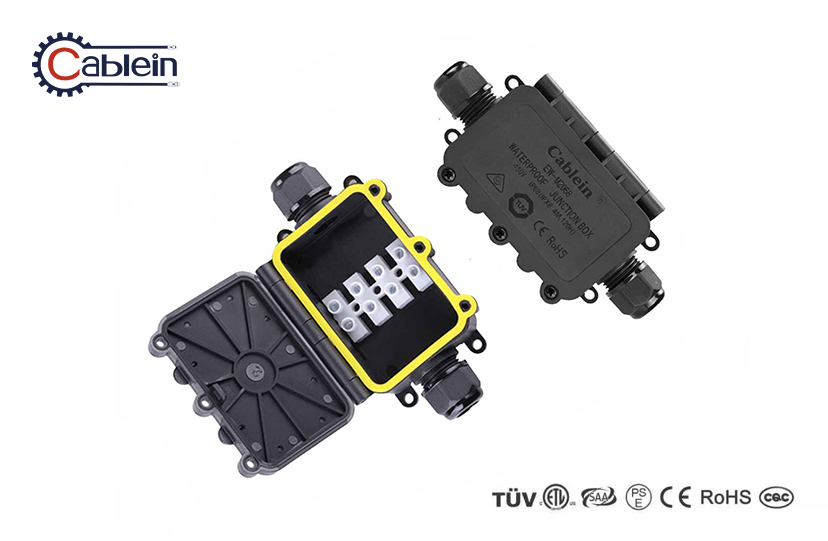
The lid of a normal junction box is made of metal or plastic, and it holds terminal strips, wire nuts, or connections that are made with resin. Installers take off the lid, plug in the wires, and then put the lid back on. They then mount the box on a surface. IP65 or IP66 is where most IP ratings end. To get to IP68, you need to do more steps with plastic that take longer and use materials that will last longer. Since they come in sizes between 80 × 80 mm and 200 × 200 mm or bigger, you can't use them in tight spaces like on traffic light poles.
Where Each Solution Fits
A smart traffic light, a solar panel string for tracking, or an I/O harness for an industrial robot are all outdoor multi-branch networks that work best with M20 cross connections. Still, traditional junction boxes are a good way to store big wire gauges, circuit breakers, or many rows of connections in one easy-to-reach place. One good example of this is main distribution boards that are kept inside waterproof boxes.
Key Differences Between M20 Cross Connectors and Traditional Junction Boxes
Design and Physical Footprint
It has four ports on its body, which act as a junction box, four cable glands, and internal terminal blocks. An IP68 junction box unit takes up about 60% more panel room than an M20 cross connector 4 way cable extender splitter, according to tests done in a different lab. This difference is very important for project engineers who have to work with small cabinet plans or pole cross-sections.
Waterproofing Approach
Most junction boxes have a seal around the outside that breaks down over time, especially when it's exposed to UV light or when the temperature changes a lot. On the M20 cross connection, each port has its own silicone ring that closes it and a locking nut that stops vibrations. Because each port that isn't being used seals itself, partial installs keep their full IP68 integrity without having to add extra plugs or plastic filling.
Installation and Maintenance
When you use regular boxes, you need to get tools, take out the wires, tighten the terminals, and put the lid back on. It could take twenty to forty minutes per junction to do this. You don't need any tools to terminate the M20 cross connection; just strip, place, and tighten. A study from highway surveillance projects in the Middle East and Southeast Asia found that installing modular cross connectors instead of resin-potted boxes cuts the time needed by more than 60% per connection point.
Practical Benefits of Using M20 Cross Connector 4 Way Cable Extenders in B2B Procurement
This gadget does more than just make things easier. These are the benefits that procurement teams in charge of large outdoor or industrial deployments care about the most.
- Labor cost reduction: Tool-free termination means a two-person crew can complete a monitoring pole junction in under ten minutes. On a 500-pole highway project, that efficiency difference translates directly into reduced labor hours and lower subcontractor invoicing.
- Total cost of ownership: Although the per-unit price of an M20 cross connector may be higher than a basic junction box, the combined cost of resin, labor, glands, and re-entry for maintenance makes the junction box the more expensive option over a five-year horizon.
- Certification-backed safety: TUV and CE certifications, manufactured under ISO9001:2015, provide documentation that procurement teams need for project verification and government tender submissions. Third-party test reports are available on request from Cablein.
- Vibration and UV resistance: The anti-vibration locking nut prevents contact loosening on poles subject to wind loading. The PA66 housing passes accelerated UV weathering tests (UL 746C), supporting long-term outdoor deployment without housing embrittlement.
Comparative Analysis: M20 Cross Connector vs. Alternative Solutions
vs. T-Connectors
A T-connector only has two output branches. The tracking pole can have a junction box added, or several T-connectors can be connected together. The junction box needs to have three outputs for a camera, radar, and extra lights. There is a chance of a leak with every new device. One body of the M20 cross connector 4 way cable extender has three outputs, which cuts down on the number of connections and the chance that one will fail.
vs. Standard Cable Joints
Wire joints that are heat-shrink or filled with resin last a long time. You have to cut and re-splice to change the circuit after it's been made. This takes time and costs money when done at a height. You can change the wiring in the whole system without touching the field cables because the M20 cross connector has screw-terminal design. Because of this, it is the best choice for systems that change over the course of a job.
Market Feedback
When there are multiple outdoor branches, procurement teams in the smart traffic and solar energy sectors constantly rate modular cross connections higher than both options. The main reasons for this are that they are easier to maintain and have IP ratings that can be checked.
Procurement Guide for M20 Cross Connector 4 Way Cable Extenders
How to Evaluate Suppliers
Before you buy a lot, get IP68 test reports from a third party instead of just printed ratings. For the line of goods you want, make sure the seller has both TUV and CE certifications. A general certificate for the company is not enough. Customers like Stefan's PLC and robotics integration teams can get batch-traceable quality paperwork and receiving inspection reports from Cablein that meet the needs of OEM change management.
Pricing and Order Structure
M20 four-way cable splitters have different prices per unit based on the number of poles, how the pins are laid out, and the size of the cable entry. It has more than 10,000 of each SKU in stock and can send most orders within 7–10 days. For project-specific drawings, you can get pin setups and branch lengths that are just right for you. Wait times are based on how many orders are coming in at once.
Sampling and Technical Support
If this is your first project, ask for a 50-unit sample batch before you send out the full purchase order. Cablein's engineering team can help you match drawings and get technical help within 24 hours. They can help you choose the right cable diameter, set up pins, and send in certification paperwork for a bid.
Conclusion
Standard junction boxes aren't as good as the M20 cross connector 4 way cable extender for outdoor and commercial use. It's bigger, waterproof, easier to install, and costs less to maintain over time. The modular cross connection is a better and more cost-effective way to connect multiple branches of cables in traffic poles, solar panels, or automation cabinets. Traditional junction boxes are still useful for large-format distribution jobs. It is very important for procurement teams that are in charge of project-scale volumes or OEM integration schedules to choose a supplier that is certified and can be tracked. If it's not done right, it could cost a lot of money to fix things in the field and make the commissioning go faster.
FAQ
1. What is the maximum cable diameter the M20 cross connector supports?
Most M20 models support 5–9 mm or 9–12 mm cables through interchangeable silicone seals. Cablein offers both size ranges, so you select the seal kit that matches your cable jacket diameter at the time of order.
2. Can this connector be buried underground?
Yes, provided you use the IP68-rated version with appropriately armored or direct-burial cables. For heavy-load soil areas, an additional protective conduit is recommended to prevent mechanical crushing.
3. Is the connector reusable after rewiring?
Yes. Unlike heat-shrink or resin-filled joints, the screw-terminal design allows full disconnection and rewiring. This is particularly valuable during system upgrades or fault diagnosis in the field.
4. How does the silicone seal handle thermal expansion?
The multi-layer silicone gaskets carry high elasticity, maintaining a consistent seal as cable jackets expand and contract across the -40 °C to +105 °C operating range.
5. Does it meet fire safety codes?
Yes. The PA66 housing carries a UL94-V0 flame retardant rating, meaning the material self-extinguishes within 10 seconds of ignition—meeting strict requirements for industrial and infrastructure applications.
Partner with Cablein for Your Next M20 Cross Connector Project
In 2017, Cablein sent waterproof plugs to over 100 different countries for use in construction projects. Our engineering team can find the right M20 cross connector 4 way cable extenders for your needs, whether you need 500 units for a highway deployment or custom-built kits for an OEM production line. They can also get you approved products on time. You can email us at nick@cableinco.com to get a sample, a bulk quote, or a technical datasheet.
References
1. International Electrotechnical Commission. IEC 60529: Degrees of Protection Provided by Enclosures (IP Code). IEC, 2013.
2. Underwriters Laboratories. UL 746C: Polymeric Materials—Use in Electrical Equipment Evaluations. UL Standards, 2020.
3. International Electrotechnical Commission. IEC 60998-2-1: Connecting Devices for Low-Voltage Circuits—Particular Requirements for Connecting Devices as Separate Entities with Screw-Type Clamping Units. IEC, 2004.
4. International Organization for Standardization. ISO 9227: Corrosion Tests in Artificial Atmospheres—Salt Spray Tests. ISO, 2022.
5. TÜV Rheinland Group. Certification Requirements for Industrial Connectors and Cable Management Components. TÜV Rheinland, 2021.
6. International Organization for Standardization. ISO 9001:2015—Quality Management Systems: Requirements. ISO, 2015.