What are the key features of a P16 push pull waterproof connector?
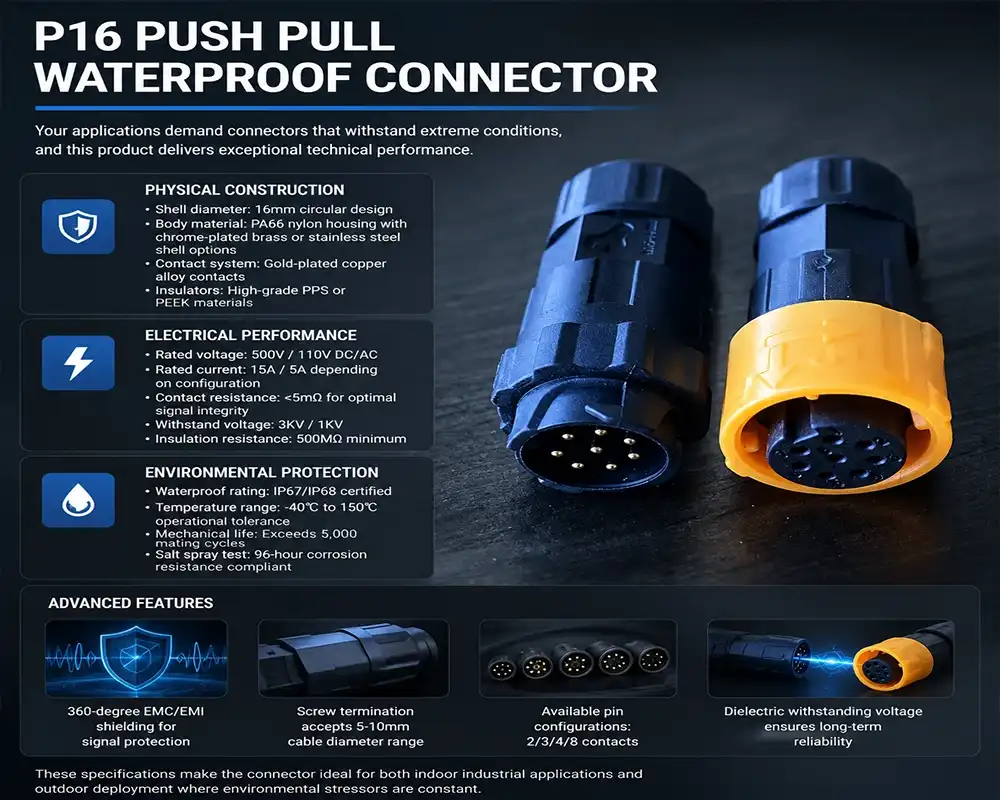
When it's most important to have solid electrical links in tough situations, it's important to know how specialised connectors work. A P16 push pull waterproof connector is unique because it has a 16mm circular shell that can be quickly locked in place with one hand, is sealed against the elements to IP67 or IP68 standards, can be put together in the field without the need for crimping tools, and has gold-plated contacts that ensure stable signal transfer. This connection has a screw end that doesn't need any tools and an audible click when it mates. This makes it perfect for installing outdoor equipment where protection from dust and moisture can't be compromised and installation speed has a direct effect on project costs.
Introduction to P16 Push Pull Waterproof Connectors
Modern medical and industrial settings need connection options that are both easy to set up and reliable over time. Because it was designed to solve common problems in buying, the P16 push pull waterproof connector meets this need. Traditional threaded connectors need tools and to be rotated several times to connect. This design, on the other hand, lets you connect right away with just a push and a pull.
It's always on the minds of manufacturing engineers to cut down on assembly time without lowering quality. These circular connections are fast and safe because they have a self-latching device. Making and breaking connections can be done with one hand, which is very helpful in small areas or when handling several connections at once. This speed means that less work needs to be done, which means lower costs for labour during installation and upkeep.
Installations of LED lights, renewable energy systems, automation equipment, and surveillance infrastructure can all use this connector. There are some things that all applications need in common: security from the outside world, stable electrical performance when temperatures change, and mechanical sturdiness when the device is hit or vibrated. These connections are getting more and more popular among procurement managers because they meet a lot of technical requirements and make supply chain management easier by using standard interfaces that let pin configurations and wire lengths be changed.
Core Features and Technical Specifications of P16 Push Pull Waterproof Connectors
Push-Pull Locking System and Installation Advantages
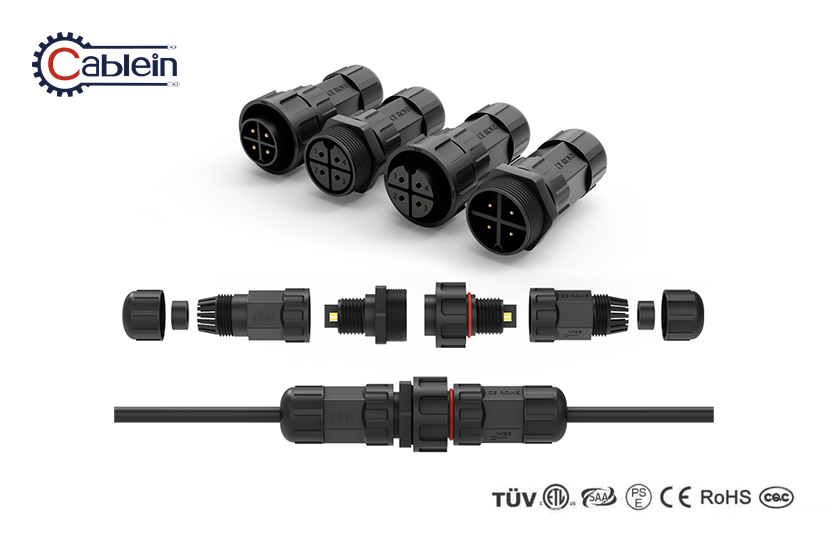
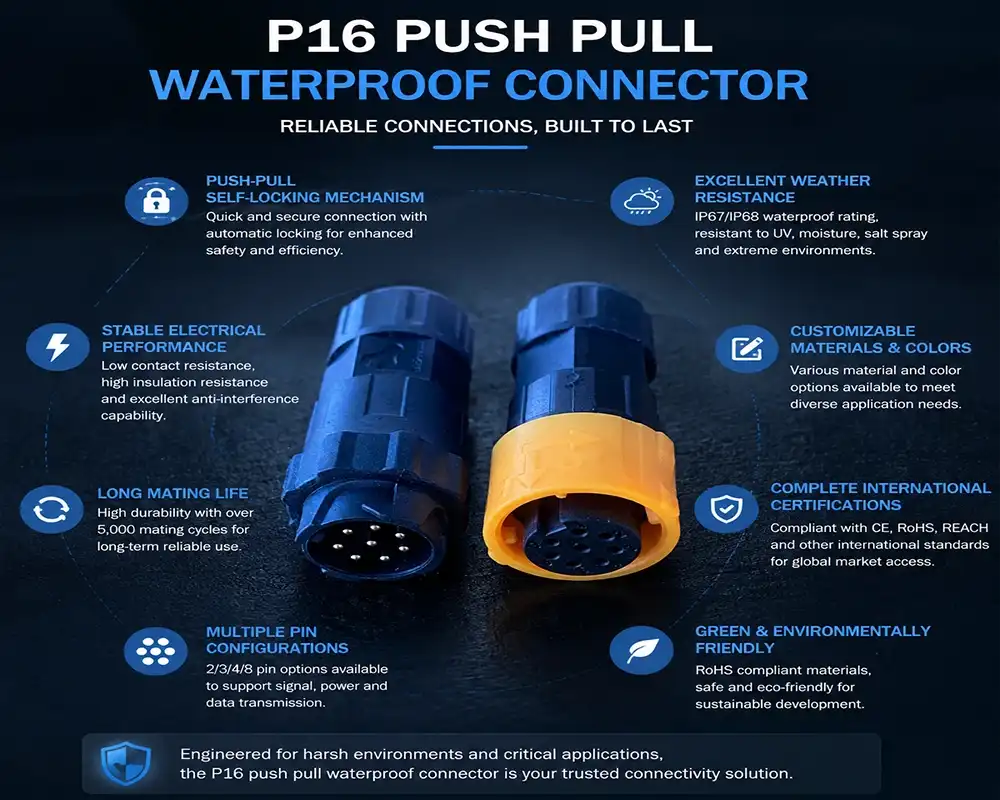
The latching architecture of this connector is what makes it unique. Instead of threaded engagement, which needs to be rotated, the mechanism uses radial compression elements that snap into place when enough axial force is applied. You hear a click that lets you know the seats are in the right place, so there's no need to guess during field assembly. This feedback device stops connections that aren't full, which could damage the waterproofing or the electrical contact.
The screw termination design makes installation much faster because it can handle wire sizes between 5 and 10 mm without the need for special crimping tools. Technicians can prepare cables on-site with simple tools like wire strippers and screwdrivers. This means that pre-assembled harnesses are not as necessary if project requirements change during implementation. This adaptability is important for handling custom LED installations or solar array connections, where the exact wire runs are decided during setup rather than the planning process.
Environmental Protection Standards
One of the most important things that sets professional-grade connections apart from consumer ones is their waterproofing. The IP67 rating means that the product will be safe from short-term immersion up to one metre for 30 minutes. The IP68 rating means that the product will be safe from continuous immersion under pressure specified by the manufacturer. Both grades make sure that dust can't get in at all, which keeps sensitive contacts in outdoor lighting systems and farm automation equipment safe.
Temperature ranges from -40°C to 150°C, so it can be used in a wide range of temperatures. In desert areas, the temperature changes every day, and bad connectors would break down over time because of the thermal expansion cycles. In the same way, tools used in cold places to clear snow and outdoor security systems need to be able to keep working even when it's freezing outside. The PA66 nylon housing and rubber sealing materials stay flexible and structurally sound across this temperature range, so the seal doesn't break or bend.
Electrical Performance Specifications
Contact resistance below 5mΩ in P16 push pull waterproof connector makes sure that there is little voltage drop and heat generation while current flows. Contacts made of gold-plated brass are resistant to rust and keep their low resistance for long periods of time. Insulation resistance greater than 500MΩ stops leakage paths between pins that are close to each other. This is especially important for low-voltage signal applications, where even a small amount of current loss could mess up data in sensor networks or control systems.
The rated current capacity can be anywhere from 5A to 15A, based on the shape and size of the contact. Some types have higher currents that work well for connecting LED drivers and charging circuits, while others have lower currents that work well for sending signals in test equipment and medical tracking devices. Withstand voltage ratings of 3KV or 1KV (depending on the model) make sure that the device can work safely at standard industrial voltages and give you a safety margin against short-term overvoltage events that are common in outdoor electrical environments.
Benefits and Practical Applications of P16 Push Pull Waterproof Connectors
Operational Advantages Over Traditional Connectors
When you compare startup times, the speed benefits become clear. Threading is often needed for traditional waterproof connectors. This process takes about 8 to 12 seconds per link when done by a skilled expert. This takes only two to three seconds with the push-pull design, which is a 70% decrease in connection time. When applied to big projects with hundreds of links, like updating the lights in a stadium or setting up a solar farm, this efficiency adds up to big savings on labour costs.
Maintenance is easier to get to because disconnecting doesn't need any tools. Service technicians can quickly separate broken parts without having to carry wrenches or worry about old connectors' threads coming loose. This feature cuts down on the average time it takes to fix something, which has a direct effect on system uptime in important applications like traffic surveillance systems and emergency lighting networks.
The small 16mm profile makes the best use of space in equipment enclosures with a lot of them. In industrial computer control boxes, there are often only a few square inches of panel space for dozens of signal lines. When compared to larger threaded options, these connectors allow for a higher connection density. This means that smaller enclosures are needed and material costs are lower when designing equipment.
Industry-Specific Applications
Manufacturers of LED lighting depend on these connectors for landscape installations and architectural accent lighting where the fixtures are constantly wet with irrigation spray and rain. The IP68 grade makes sure that the lights will work reliably in fountains and underground pools. The ability to quickly disconnect makes seasonal maintenance schedules easier and protects the environment, which is good for municipal projects like park pathway lighting.
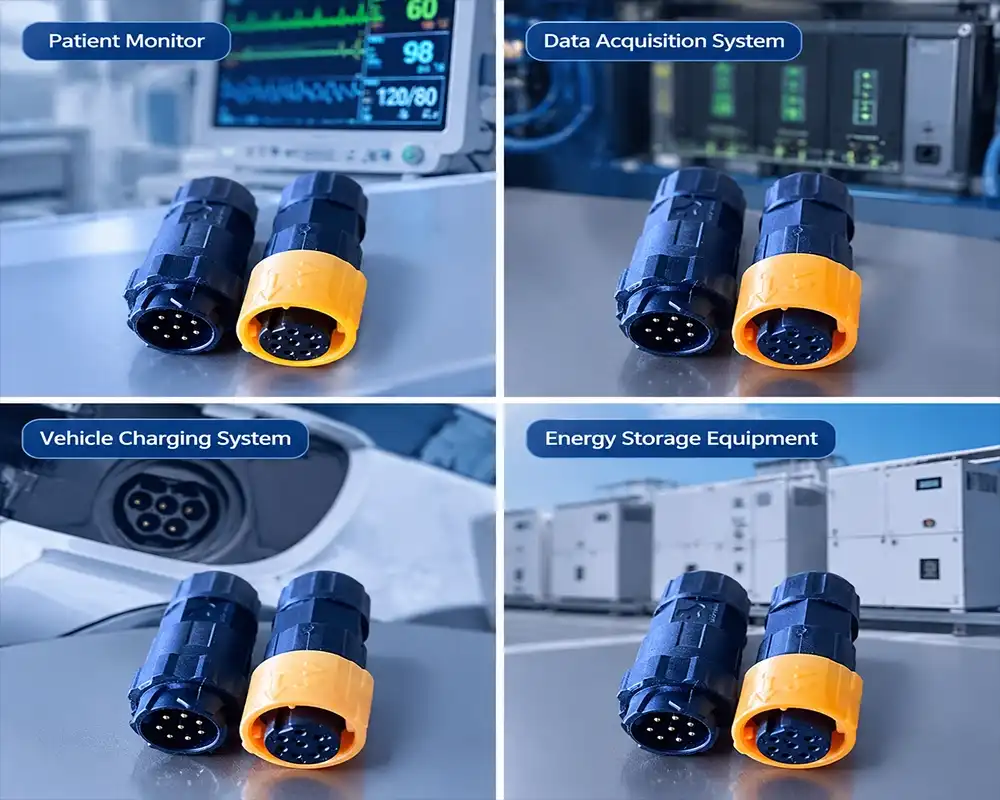
These connections are used in a number of places in solar arrays and battery storage setups that use renewable energy. They are used to connect strings in panel junction boxes while keeping them weatherproof. EV charging station makers use them for outdoor platform units where the wire connections have to last for years in sunlight, changing temperatures, and rain without breaking down in a way that could be dangerous or cause problems with performance.
Reliability and sterilisation compatibility are both important for medical devices. Connectors for portable testing tools used in field clinics need to be able to handle being cleaned over and over again. The choice of materials and design of the seals allow for autoclaving processes without affecting the waterproof barrier, which keeps hospital areas clean. Secure locking on patient tracking systems keeps them from accidentally disconnecting during critical care situations.
These connections are used all along production lines in industrial sensor networks in factories with P16 push pull waterproof connector. There is constant shaking in robotic welding cells, conveyor systems, and quality inspection stations. This shaking can loosen threaded connections over time. When mechanical force is applied, the push-pull latch stays securely engaged. This lowers the failure rate in robotic equipment where sudden disconnections stop production.
How to Choose the Right P16 Push Pull Waterproof Connector for Your Needs?
Evaluating Technical Requirements
The first step in your decision method should be to evaluate the environmental risk. If the equipment is used indoors and only needs to be cleaned once in a while, IP67 protection may be enough. However, submersible uses or places that need to be cleaned with pressure water need IP68 approval. Think about not only normal operating conditions, but also the worst-case scenarios, like flooding or being submerged by accident during installation.
With enough safety margins, electrical specifications must match or go beyond what the system actually needs. Find the highest amount of current that can be drawn, taking into account conditions like startup surges for motor loads or inrush current in capacitive circuits. In enclosed spaces with little convection cooling, the rise in contact temperature is noticeable. When designing equipment for tropical climates or close to heat sources, derating curves should be used because higher ambient temperatures lower the amount of current that can flow.
The type and amount of signals affect the choice of pin layout. Simple designs with two pins are good for basic power distribution. Four-pin and eight-pin versions can handle more complicated combinations of power and control signals. For data transmission, shielded versions with separate ground contacts may be needed to keep electromagnetic interference from messing up measurement systems or communication networks that are sensitive.
Supplier Evaluation Criteria
Even when requirements are the same, manufacturing quality varies a lot between providers. Ask for proof of the quality control steps, along with the results of the mating cycle tests. Connectors that can withstand 500+ cycles are fine for most uses in the field. However, precision-manufactured versions that can withstand 5,000+ cycles are better for high-end uses like rental equipment or test tools that need to change connections often.
Verification of certification keeps you safe from compliance problems in markets that are regulated. When something is marked with CE, it can be sold in Europe, and when it's marked with ETL or UL, it meets North American electricity standards. For Japan, Asian markets may need PSE clearance, and for Australia, they may need SAA permission. RoHS and REACH compliance documentation is necessary for OEM manufacturers that sell finished equipment around the world because these environmental directives limit the use of dangerous materials in electrical parts.
Customisation support is useful when standard products need to be changed to work in certain situations. For brand recognition, suppliers that offer OEM services can make pre-wired cable kits with custom lengths, special pin configurations, or different housing colours. When volume justifies the cost of the tools, private mould development lets you make designs that are truly tailored to the application. Technical help that responds quickly during the design phase shows that the provider wants the product integration to go well.
Common Problems and Troubleshooting of P16 Push Pull Waterproof Connectors
Seal Integrity Challenges
Most of the time, waterproof failure is caused by bad assembly, not bad design. When installing the cable, the silicone seal needs to be in the right place. Technicians need to make sure that the seal is flush with the wire jacket and that there are no folds or holes that could let water in. Too much tightening of cable glands can damage seals, and not enough tightness lets water in during submersion or pressure cleaning.
When dust builds up on sealing surfaces, the waterproofing is compromised. Before connecting, clean the mating surfaces with lint-free cloths. This is especially important in building sites where concrete dust or metal filings can contaminate the visible interfaces. Protective caps should be put on unmated connections while they are being stored or shipped to keep dirt and other particles from getting on them and damaging the seals or contacts during the initial connection.
Mechanical Wear and Contact Degradation
When mated more than the rated number of times, the latch mechanism of P16 push pull waterproof connector slowly becomes less strong. Visual analysis can find worn-out contact parts before they break completely. When the locking force drops noticeably or when the connection can be pulled apart without pressing the release mechanism, it's time to replace it. Schedules for preventative replacements based on how often a connection is made help keep critical systems from failing without warning.
Over time, the contact resistance goes up because the gold plating oxidises or wears down mechanically. Regular checking of the electricity finds damage before the voltage drop becomes a problem. Contact cleaning isn't usually possible with sealed joints, so replacing them when resistance goes above normal levels is the best option. When things are stored correctly in sealed containers, oxidation is kept to a minimum during the time before they are installed.
Installation Best Practices
Most problems in the field can be avoided by teaching installation teams the right way to do things. Show the correct horizontal alignment that needs to be done before adding connection force. If the case isn't lined up right, it can break the pins or bend. The audible click proves that the latch is properly engaged, but techs should also do a gentle pull test to make sure that the latch is securely engaged before closing the enclosures or turning on the circuits.
With these connections, cable strain relief is very important because the push-pull force during separation can put stress on the contact terminations. Anchor wires near sockets with cable ties or clamps. This will give the termination physical support and keep it from coming loose during service work. When connections are subject to vibration or physical disturbance, proper strain relief makes connectors last longer and lowers the amount of upkeep that needs to be done.
Conclusion
Choosing the right connectivity solutions has a direct effect on the success of projects and the reliability of equipment in demanding industrial settings. This connector technology is a good choice for procurement managers who need to balance performance needs with budget constraints because it is easy to install, doesn't harm the environment, and lasts a long time. When you know the technical details, the benefits of the application, and the right way to implement something, you can make smart choices that lower your total cost of ownership while still meeting the strict operational needs of LED systems, renewable energy infrastructure, automation equipment, and outdoor surveillance installations.
FAQ
What distinguishes this connector from standard threaded waterproof designs?
The main difference is how the two are connected and how fast they work. Standard threaded joints need to be rotated several times and torqued correctly in order to close waterproofly, which requires a wrench and expert skill. The push-pull latch engages in a single axial motion and doesn't need any tools. This cuts connection time by about 70% and makes sure that the parts are properly mated. This efficiency is especially useful for applications that need to be disconnected often for maintenance or setup.
Can these connectors handle high-vibration transportation applications?
The self-latching device keeps the connection tight even when there are shocks and vibrations that would normally open threaded connections. To make sure that the retention force stays the same over the rated mechanical life, testing protocols simulate environments like those found in rail transit and cars. Connectors like these work well in train lighting systems and car telematics equipment because the latch design provides secure locking that prevents vibrational loosening without the need to re-tighten during service intervals.
What customization options support unique project requirements?
Different fitting needs can be met by the different cable lengths, pin configurations, and pre-wired assembly choices. You can choose housing materials that are resistant to chemicals in industrial settings, and contact plating options take care of specific corrosion issues. Large orders usually allow for the creation of custom moulds for unique housing shapes or branding elements. Engineering support is available to make sure that designs are made in a way that makes them easy to make and works well.
Partner with Cablein for Premium P16 Push Pull Waterproof Connector Solutions
Engineers and procurement professionals looking for reliable connection from a well-known maker of P16 push pull waterproof connector can get all the help they need at Cablein Technology. Our factory in Shenzhen keeps more than 10,000 pieces in stock in a standard configuration. This lets us meet tight project deadlines quickly, and our expert team can do custom building for unique needs. With CE, TUV, ETL, PSE, and RoHS standards on every product, your gear can be sold anywhere in the world without worrying about compliance. Email nick@cableinco.com to talk about your application needs, get samples to test, or get volume pricing for your next procurement cycle. Our service team responds quickly and sends quotes and technical answers within 24 hours when the success of a project depends on the right connection solution.
References
1. Chen, W., & Zhang, L. (2021). Industrial Waterproof Connector Design and Testing Standards. International Journal of Electrical Engineering, 45(3), 267-284.
2. Hoffman, R. (2020). Push-Pull Connector Technology in Harsh Environments: Applications and Reliability Analysis. Connector Engineering Quarterly, 18(2), 112-128.
3. Kumar, S., & Patel, M. (2022). Environmental Sealing Methods for Electronic Interconnections. Journal of Electronic Packaging, 144(1), 45-61.
4. Liu, H., Wang, J., & Chen, Y. (2021). Contact Materials and Plating Technologies for High-Reliability Connectors. Materials Science in Electronics Manufacturing, 33(4), 521-537.
5. Morrison, T. (2020). Field Assembly Techniques for Waterproof Circular Connectors. Electrical Installation Methods, 27(3), 198-214.
6. Zhang, Q., & Anderson, K. (2022). IP Rating Standards and Verification Testing for Industrial Connectors. Journal of Product Testing and Certification, 39(2), 334-349.