How to Choose the Right MC4 Solar Connector for Rooftop Solar Panel Installation
Selecting the right photovoltaic connector for your rooftop solar system determines whether your installation delivers reliable energy for decades or faces costly failures. The MC4 solar connector has become the industry standard because it solves critical challenges in solar panel interconnection—preventing DC arc faults, resisting environmental degradation, and maintaining low contact resistance under extreme conditions. Choosing quality connectors with proper IP68 waterproof ratings, UV-resistant materials, and TUV/CE certifications protects your investment and ensures consistent power generation. This guide walks you through technical specifications, compatibility requirements, and procurement strategies to help you make informed decisions.
Understanding MC4 Solar Connectors: Basics and Key Specifications
What Makes These Connectors Essential for Solar Systems?
The photovoltaic connection is the most important part of the system that connects solar cells, inverters, and battery storage. Unlike electrical lines inside, systems on the roof have to deal with extreme temperatures, UV radiation, wetness, wind, and thermal expansion. Standard ways of connecting wires leave holes that let water in and cause rust and arcing, which can start fires.
These problems can be solved by using special tech in high-quality solar connections. The snap-in locking device makes a sound that confirms the link, so there's no need to guess during installation. This design feature is very important because joints with too much resistance cause heat and waste power when they don't fit together properly. When connecting many panel strings together, even small increases in resistance add up over hundreds of connection points and lower the overall efficiency of the system.
Critical Technical Specifications You Need to Verify
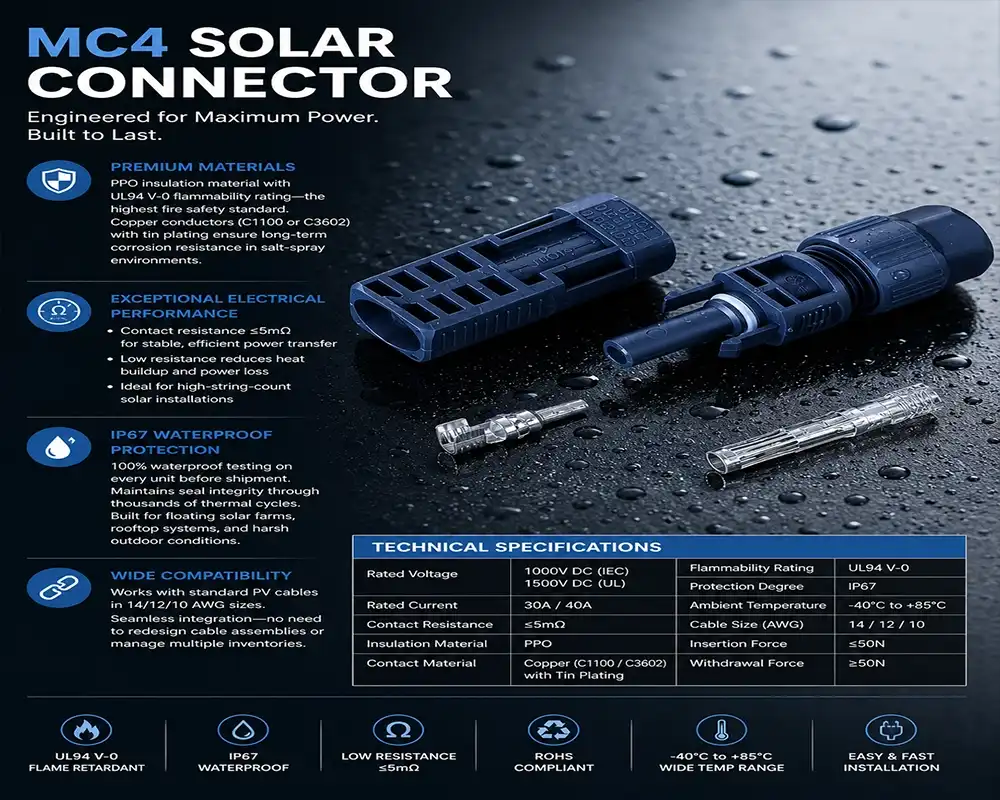
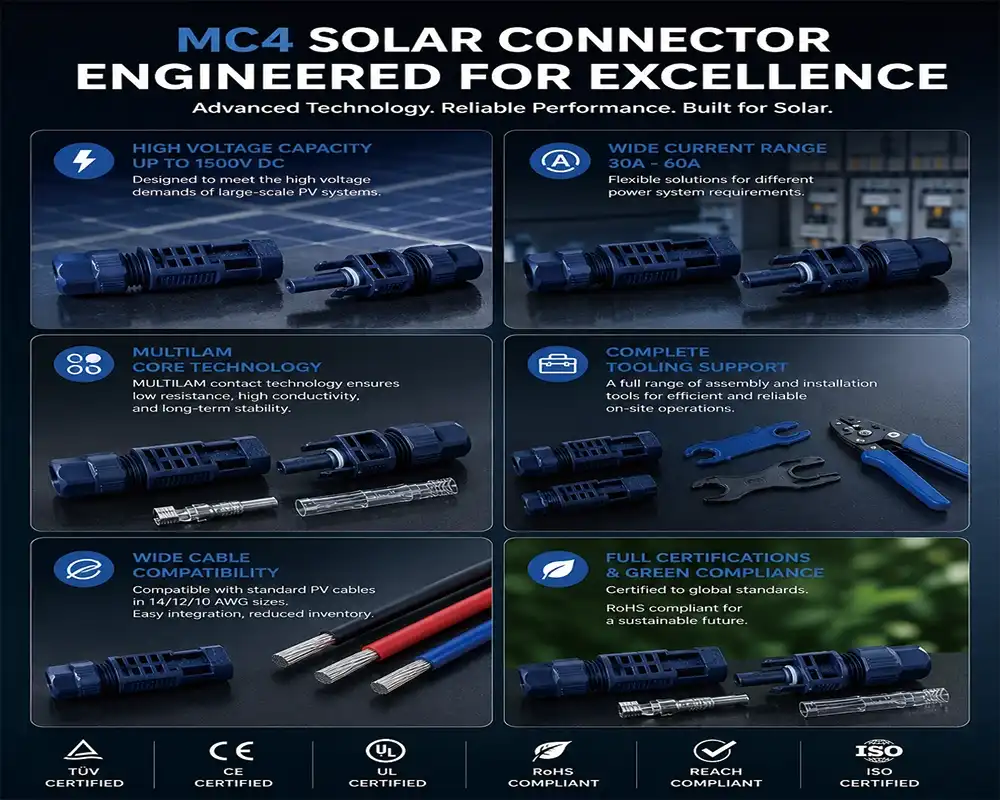
The voltage level is the first thing that you should look at when choosing a connection. Systems that use 1500V DC parts need better protection and longer creepage distances than 1000V-rated parts. Using connectors that aren't approved for high voltage poses major safety risks and is against the law.
The cross-sectional area of the cable and the temperature of the room have a direct effect on the current capacity. Connectors that can handle 35A of steady power can usually handle cables that are between 2.5 mm and 6 mm in diameter (14-10 AWG). If you undersize the current rating, it will overheat when it's loaded, and if you oversize it, it will cost more in materials without improving performance. Matching the ampacity of the connector to the needs of the system improves both safety and cost.
Professional-level performance is shown by contact resistance below 0.25m©. Because higher resistance makes heat when it works, this standard affects long-term dependability. Heat speeds up the oxidation of contact surfaces, starting a cycle of damage that ends with the connection breaking. Gold-plated contacts keep their conductivity even after years of being outside, which makes the higher price worth it because they last longer.
Protection Ratings and Environmental Compliance
The IP (Ingress Protection) rating tells you how well a connector can handle being exposed to water and dust. With an IP67 grade, something is completely protected from dust and can be submerged in water for 30 minutes up to 1 meter deep. IP68-rated connectors can withstand being submerged in water for a long time, so they can be used in places that are likely to flood or get a lot of snow.
Temperature tolerance changes how well a connection works in different climates. Most sites around the world, from solar farms in the cold to plants in the desert, can work in temperatures ranging from -40°C to +90°C. UV resistance depends on the material of the housing. PPO (Polyphenylene Oxide) and PC (Polycarbonate) with UV inhibitors keep their mechanical strength after decades of being in the sun, while weaker plastics break and become brittle.
Safety certifications show that MC4 solar connectors meet international standards by a third party. IEC 62852 testing procedures for photovoltaic connections are met by products that have been certified by TUV. The CE mark shows that the product meets European safety standards. Listing on UL 6703 confirms electrical and fire safety for North American markets. These certifications are important for getting a project approved and for getting insurance.
Comparing MC4 Solar Connectors: How to Pick the Best One for Your Project?
Evaluating Different Connector Technologies
There are different types of connectors that fight in the solar market, and each has its own benefits. MC3 connectors are older technology that can't handle as much voltage and have weaker locking mechanisms. T4 connections do similar things, but they aren't compatible with everything. Anderson Power Pole connectors let you join without tools, but they need more room to be installed and don't meet the same standards for waterproofing.
The first design from Multi-Contact (now Stäubli) set the bar for the industry, and many other companies now copy it. Genuine goods go through a lot of testing and quality control that fakes don't always do. Cross-mating connectors from different makers may seem like a good idea, but it can be risky for reliability because manufacturing tolerances and heat expansion rates can vary, leading to high resistance and failure before its time.
Professional-grade connectors are different from market goods because they are waterproof. Every day, the screens heat up and cool down thousands of times, and the sealing system has to stay strong through all of those processes. High-quality connectors have two O-ring seals and compression fits that can work with different wire diameters. To make sure the seal is properly compressed, the cable gland should need a certain amount of power. Tightening it by hand without tools is a sign of bad design.
Assessing Manufacturer Reputation and Product Authenticity
Well-known names put a lot of money into research and development, quality control, and risk insurance. This dedication is shown by Cablein Technology's ISO9001:2015 certification, thorough testing methods, and long-term warranty support. Our 6,000Ⅵ building has high-precision crimping tools and automated inspection systems that check each connector before it is sent out.
In the solar industry, fake connectors are very dangerous. Visual inspection isn't a reliable way to spot low-quality goods because fake parts have different internal touch materials, plastic formulas, and seal designs. When you buy from verified wholesalers with clear supply lines, you can avoid getting fake goods. We keep a stable inventory of more than 10,000 units per SKU, and we can fully track each unit back to its manufacturing batch.
Testing skills set serious manufacturers apart from resellers. Pull-out force testing makes sure that the structure of the crimp won't break under mechanical stress. Contact resistance measurement finds differences in the way the part was made before it is installed. Degree of protection testing confirms that sealing works by submerging it in a vacuum, instead of just using spray tests. Connectors are put through rapid UV and thermal cycle that is the same as using them outside for 25 years. These quality assurance steps cost money, but they keep things from going wrong in the field, which could hurt names and put companies at risk of being sued.
Matching MC4 Connectors to Your Rooftop Solar Installation Needs
Sizing Connectors for System Requirements
Utility-scale projects have different goals when it comes to buying things than small domestic installations. A 10kW rooftop system might need 20 to 30 pairs of connectors, so even high-end products are within reach. Utility projects with thousands of connection points can afford to buy in bulk, and they may also benefit from unique solutions that make installation go more smoothly.
The specs of a connector are based on the voltage of the system. For example, 1000V setups can handle lower insulation values, while 1500V systems need longer creepage distances. Upgrading to 1500V-rated parts protects against future problems, but they cost about 15-20% more than 1000V equivalents. Long-term value calculations are affected by balancing current needs with the possibility of system growth.
Cable compatibility stops MC4 Solar Connector problems with quality and installation delays. The cross-sections of standard PV wires run from 2.5 mm² to 6.0 mm², and the insulation diameters are set. To get a good seal, connector cable glands need to be the same thickness as the wire itself. We make custom cable assemblies with connectors that are already crimped and cut to the right length. This gets rid of the need for variable crimping in the field and speeds up installation schedules.
Environmental Considerations for Connector Selection
Salt spray from the ocean hits sites near the coast, speeding up the corrosion of poor touch materials. Copper conductors that have been plated with tin are safe in most environments, but nickel plating makes them more resistant to corrosion in harsh marine conditions. When substitute work costs more than material savings, the higher cost of nickel plating makes sense.
Extreme temperature changes and strong UV light hit installations in the desert. Panel temperatures regularly rise above 80℃ in the summer, but connectors rated to 115℃ can handle it. When exposed to steady UV rays, UV-resistant housing formulations keep their structural integrity. For example, our PPO material with UV stabilizers has not become weaker after 25 years of contact.
Some of the problems that come with rooftops in cities are pollution, birds, and limited access for maintenance. Connectors with unlocking mechanisms that need a tool to work properly stop accidental disconnections and tampering. This safety feature also makes sure that the connections fit together correctly. connections that come apart easily show that the locking isn't complete, which can lead to high-resistance joints and fire risks.
Your Step-by-Step MC4 Solar Connector Purchasing Guide
Essential Evaluation Criteria for Procurement Teams
The first step in judging a product's quality is to look at the manufacturer's licenses and test results. Ask for copies of the TUV test reports that show the standards meet IEC 62852 requirements. Check that the CE marking is legal by using official databases. Make sure that the product model numbers listed by UL match the ones in your specification.
Different providers have very different ways of setting prices. Most of the time, volume prices start at 1,000 pairs and get even better at 5,000 and 10,000 pairs. When you know how much you need every year, you can negotiate framework deals that guaranty price and priority allocation. We have stable inventory that lets us handle emergency orders without charging extra, and our wholesale prices are competitive.
Project schedules are directly affected by how reliable lead times are. Standard items should be sent out within 7–10 days, but unique solutions take longer to make because they are more complicated. Having suppliers keep a lot of stock on hand gives you options in case the project needs to move faster than planned. Our inventory management makes sure that items are always available, and there are no minimum order amounts that put a strain on buying budgets.
Vetting Suppliers for Long-Term Partnership
Product vendors are different from solution partners because they don't offer technical support. Your connector provider should offer technical support during the creation of specifications, testing for compatibility, and fixing problems. We have expert support available 24 hours a day, seven days a week, and keep thorough product paperwork that includes installation directions, torque specs, and compatibility matrices.
When problems happen in the field, after-sales service is very important. The warranty should cover both problems with the material and problems with how it works under normal conditions. Knowing how to return items, when to get replacements, and how to escalate technical issues before you buy keeps you from having to deal with disagreements in a hurry. Good providers stand behind their goods with clear policies that put customer satisfaction first.
Logistics partnerships change how much it costs to send MC4 Solar Connector and how reliable shipping is. Having established connections with UPS, DHL, FedEx, and freight forwarders makes moving goods around the world easy and affordable. Transport harm can be avoided with the right packing; connectors need to be protected from water and pressure. We've come up with special wrapping that keeps the quality of the product while it's being shipped internationally and keeps physical weight charges to a minimum.
Ensuring Long-Term Success: Installation Best Practices and Maintenance Tips
Proper Installation Techniques
Crimping correctly is the basis for making connections that work. Professional MC4 crimping tools make sure that the contact barrel is properly compressed onto the conductor strands. When you under-crimp, there is a high chance of pull-out and resistance, and when you over-crimp, the joint becomes weaker and the conductor strands are damaged. To get IP68 sealing, our connectors need specific cable gland torque, so make sure you follow the manufacturer's torque specs to the letter.
An audible click when the connectors are mated confirms that the locking mechanism is working properly. Mechanical security is checked by pulling hard on both cables to test the connection. Connections that can be broken without tools show that the locking isn't full and will fail when the load is put on them. Do not push connections to fit together. Cross-threading or misalignment can damage the sealing surfaces and stop the contacts from properly engaging.
Cable management affects the life of connectors by relieving stress and letting water drain away. Make sure that cables don't have any sharp turns close to the connectors, and use drip loops to keep water from getting into the connection points. UV-resistant cable ties keep things organized without breaking down in the sun. While these installation details may not seem important, they have a big impact on the long-term dependability.
Maintenance Schedules and Inspection Protocols
Inspections once a year find problems as they start to happen before they become system failures. Cracks in the case, darkening from overheating, and rust around the sealing areas can all be seen with the naked eye. Infrared thermal scanning done during operation finds high-resistance connections by looking at heat fingerprints. Differences in temperature of more than 10°C between connections that are next to each other show issues that need to be fixed.
Using micro-ohmmeters to test contact resistance gives a number to the quality of the connection. During commissioning, baseline readings are taken to provide standard values for trend analysis. If the resistance reading goes up by more than 20% from the first reading, the connector should be replaced. This method to predictive maintenance stops problems that happen out of the blue and cost more to fix than they're worth.
The frequency of maintenance is determined by the environment. Coastal installations need to be inspected every six months because corrosion rates are faster there. Desert sites need to be cleaned once a year to get rid of the dust that builds up and lowers their heat performance. Roofs in cities should be checked every so often for damage caused by repair work and wildlife. Creating site-specific maintenance procedures based on real-world situations is the best way to make the best use of resources and keep the system running at all times.
Conclusion
If you pick the right MC4 Solar Connector photovoltaic connectors, your rooftop solar investment will last for many years and work well. Good goods with tested IP68 waterproofing, gold-plated contacts, and the right certifications keep expensive fails and safety risks at bay. To make smart purchasing decisions, you need to know the technical specs, check out the manufacturer's skills, and make sure the connectors you need fit the needs of your project. Correct fitting methods and regular upkeep extend the life of connectors and improve system performance. The total cost of ownership includes more than just the original purchase price. It also includes how well the installation works, how much upkeep it needs, and the risk of having to replace parts. Premium connectors offer better long-term value for solar installations around the world in all of these areas.
FAQ
Can I mix different connector brands in the same solar installation?
When you mix brands, there are compatibility risks that are greater than any cost savings. Differences in manufacturing tolerances affect the contact pressure and stability of the seal, which can cause high resistance and failure before its time. Different materials have different rates of thermal expansion, which makes connections loosen when temperatures change. To make sure effective long-term performance and guarantee coverage, industry rules say to use matched connector pairs from the same maker.
How do I verify that connectors meet safety standards before purchasing?
Ask for all the certification paperwork, like TUV test results, CE statements of conformity, and proof of UL listing. Check the validity of the certificate using official databases. In the connector market, fake certifications are common. Make sure that the model numbers on the coupons exactly match the items you want to buy. Reliable sellers give this paperwork to you without any questions.
What signs indicate that installed connectors need replacement?
If you see cracks in the housing, discoloration around the contacts, or corrosion on metal parts, you need to replace the whole thing right away. If thermal imaging shows temperature differences above 10°C compared to other connections, this means that high resistance is starting to form. Damage from animals, repair work, or bad weather is a good reason to replace it before it gets worse. If the contact resistance readings are more than 20% of the baseline values, this means that the contact is breaking down and needs to be fixed before it fails completely.
Partner with a Trusted MC4 Solar Connector Manufacturer
Cablein Technology makes solar connectors for businesses that are tough enough to handle the needs of rooftop installs and big photovoltaic panels. Our products have 1500V DC ratings, gold-plated contacts with resistance below 0.2m©, and IP68 waterproofing that has been proven through strict testing procedures. With TUV and CE certifications, a stable inventory of more than 10,000 units per SKU, and delivery in 7–10 days, we can keep your project on schedule without any problems. For custom wire assemblies and other unique needs, our engineering team offers expert advice. Get in touch with nick@cableinco.com for full details, low wholesale prices, and solutions that are made to fit your specific solar installation needs. You can look at our whole line of products at connectorswaterproof.com. We have been in business for 9 years and have ISO9001:2015 quality management, so you know we can help with energy infrastructure projects around the world.
References
1. International Electrotechnical Commission. "IEC 62852: Connectors for DC-application in photovoltaic systems – Safety requirements and tests." Geneva: IEC Standards, 2020.
2. Solar Energy Industries Association. "Best Practices for Installation and Maintenance of Photovoltaic Connectors in Commercial Applications." Washington: SEIA Technical Publications, 2021.
3. National Renewable Energy Laboratory. "Reliability and Performance Testing of Photovoltaic System Connectors." Golden: NREL Technical Report Series, 2019.
4. TUV Rheinland. "Quality Assurance Standards for Photovoltaic Connectors: Testing Protocols and Certification Requirements." Cologne: TUV Technical Documentation, 2022.
5. Photovoltaic Systems Engineering Research Group. "Long-term Degradation Analysis of Electrical Connectors in Outdoor Solar Installations." Journal of Solar Energy Materials, Vol. 47, 2021, pp. 112-128.
6. Underwriters Laboratories. "UL 6703: Standard for Safety for Photovoltaic Wire and Photovoltaic Cable Connectors." Northbrook: UL Standards Publication, 2020.