How to Choose the Right Round 3-Way Straight Waterproof Junction Box for Your Installation
Choosing the right round 3-way straight waterproof junction box starts with matching the product's electrical ratings, sealing grade, and physical form to your specific site conditions. If you're splitting cable runs on a rooftop solar array, wiring LED signage inside a tight letter cavity, or powering dock navigation lights, each scenario demands a different combination of IP rating, housing material, cable entry diameter, and mounting style. Getting this decision wrong costs more than the box itself — it costs rework, warranty callbacks, and failed inspections.
Understanding Round 3-Way Straight Waterproof Junction Boxes
What the Design Actually Does
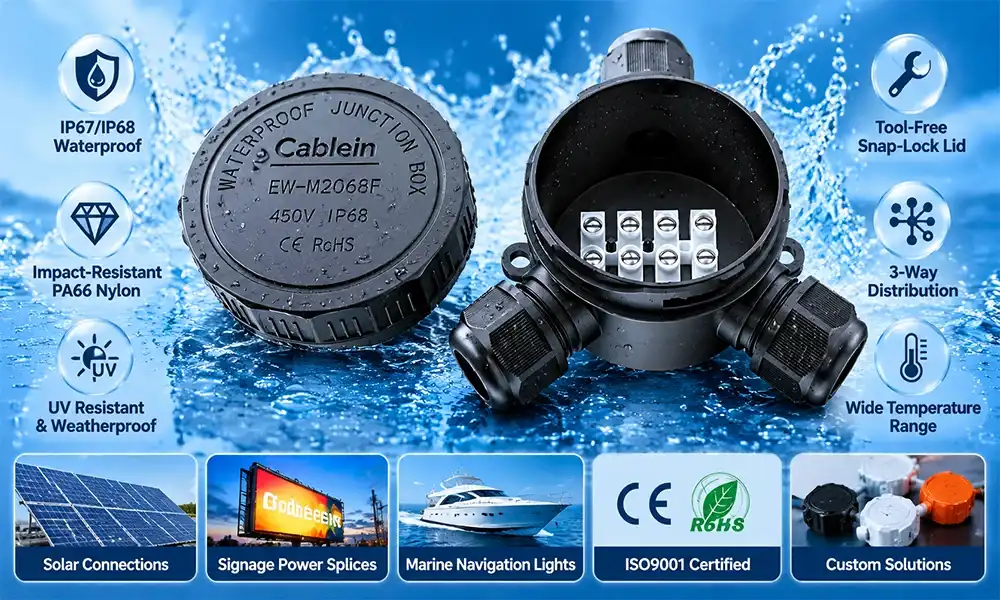
One cable coming in and power for two lines going out can both be handled by a waterproof enclosure with three ports. Because it is set up in a straight line, the wire path is short and neat. When mechanical stress is applied from the outside, the cylinder shape spreads it out more evenly than square enclosures. When the soil settles, or the wind blows, uneven pressure can happen in direct-burial and pole-mount projects.
IP Ratings Explained Simply
IP ratings are defined according to the IEC 60529 standard. There is no dust at all, as shown by the first number (6). The second number shows how resistant it is to water. IP65 works with water jets, IP67 with water up to 1 meter deep for 30 minutes, and IP68 with water at 2 meters for at least 2 hours. IP68 is a must-have feature for solar panels used outside, boats, and farms for irrigation. It is the very least that is needed.
Where These Boxes Are Used
These dividers are used in a lot of different areas. They are used to connect solar panels in parallel by people who put photovoltaic systems on roofs. The people who make signs hide them inside LED channel letters, which are very precise. They make dock lights that can withstand high tides, which is important to marina owners. Greenhouse managers make sure that high-pressure water doesn't damage the irrigation sensor lines. In each case, the box only does one thing: it keeps the live terminals dry and stable.
Key Criteria for Selecting the Right Waterproof Junction Enclosure
Evaluate the Installation Environment First
Before you compare things, put your site into groups. Is this inside or outside? Things like salt air from the coast, UV light on roofs, and buried conduit runs can all cause different kinds of failures. Going from -40°C to +85°C many times will cause a round 3-way straight waterproof junction box that is meant to be used inside and dry to crack. IEC 60068-2-11 says that housings must be tested for resistance to salt spray as well as resistance to water for installations near the coast.
Material and Sealing System Matter More Than Price
PA66 nylon that has been changed by impact stays in shape when it is put under mechanical stress, and years of direct sunlight don't break it down. ABS costs less, but it breaks down more quickly outside. Polycarbonate is clear, but it generally needs special protection against UV light. The O-ring substance determines how well the seal works. Regular EPDM gaskets can harden below -20°C, which means they don't meet the IP rating in the winter. Silicone rubber, on the other hand, stays flexible from -40°C to +200°C.
Here are the key things you should look at when making your choice, based on your project brief:
- Cable entry compatibility: Pre-formed silicone entry membranes that accept φ5.0–φ9.0mm cable diameters save field time and preserve the seal. If the cable outside diameter falls outside this range, installers must enlarge the opening, which voids the waterproof rating immediately.
- Electrical headroom: A 17.5A / 450V AC rating with a 2500V AC dielectric withstand provides adequate margin for residential and small commercial photovoltaic strings. Always verify your string current stays below 80% of the rated continuous current.
- Terminal accessibility: Make sure the terminal block supports your project's conductor kinds and cross-sections. Wiring and maintenance are easier with an accessible terminal arrangement, especially for rooftop installations where personnel wear gloves. Before specifying a tool-free terminal block, check its datasheet for conductor range and installation requirements.
- Mounting options: Pre-drilled base flanges let the box mount to DIN rail, conduit poles, or roof brackets without additional hardware.
Round vs. Square, 3-Way vs. 4-Way
Installation space and wiring arrangement should determine enclosure design and cable port count. A circular 3-way straight waterproof junction box can route linear cables with one incoming line and two outgoing lines. A 4-way junction box is better for three outgoing branches from one incoming feed, but a square enclosure is simpler to put in flat or limited locations. Before finalising your bill of materials, check cable entry, terminal capacity, mounting dimensions, and electrical ratings. Choosing the proper setup beforehand reduces installation modifications and component costs.
Installation and Maintenance Best Practices
Five-Step Installation Sequence
Making the waterproof three-port junction box so that it can be put together without tools cuts down on the time it takes to do it right. For each cable, open the snap-lock lid, put it through the entry membrane that has already been made, take off the insulation, and place the wire in the push-in terminal block. Plug the rubber O-ring all the way into the lid, then connect the base flange to the mounting surface. You don't need a torque wrench, cleaning, or welding tools.
Sealing Integrity Checks
Once the lid is shut, check to see that the O-ring is still in the right place and not turning or pinching. An O-ring that isn't lined up right is the main reason why IP68 setups fail in the field. If the round 3-way straight waterproof junction box is going to be buried or hidden behind a panel, do a simple continuity test on it before you do either of those things. Bugs in the wiring will be found this way before they become hard to fix.
Routine Maintenance to Extend Service Life
Each year, check the lid seal and the places where the cables come in. Look for the O-ring getting stiffer, surface discoloration caused by UV light, or tiny cracks in the case. Flame-resistant building materials that don't use halogens last longer than regular PVC-based ones, so they don't need to be changed as often. The snap-lock lid won't break even if you open and close it 1,000 times. This means that regular access for repairs won't hurt the cage.
Comparing Market Solutions and Supplier Insights
What to Compare When Evaluating Suppliers
Waterproof cases with three ports can be bought for a lot of different amounts of money. A lot of cheap items pass IP67 testing when they are first made, but they fail IP68 testing after 18 months because the material in the gaskets always shrinks. When you compare suppliers, don't just ask for a copy of the certificate; ask for test reports that are specific to the batch of goods. Some of the most important papers are the report on the IP68 hydrostatic pressure test, the spark wire test at 850°C, and the dielectric strength test at 2500V AC.
Certifications That Matter for US and Global Projects
Follow the CE and RoHS rules for projects going to the US market. This shows that the manufacturing process is being followed and also meets European export rules. If a plant has ISO 9001:2015 approval, you can be sure that they have a written quality control system that makes sure there aren't too many differences between batches. Some business building signs need to have proof that they are halogen-free flame retardant in order to pass a fire inspection.
OEM and Custom Sourcing Considerations
Managers who buy in bulk should check to see if the seller offers custom colors, laser-engraved logos, and circuits that are already wired inside. Being pre-wired cuts down on the steps that need to be taken to put something together on-site. The suppliers who own their own molds can change the holes in the housings or the sizes of the housings without having to buy extra tools. When a supplier has more than 10,000 units in stock and normal wait times of 7–10 days, the supply chain is less likely to break during busy installation times.
Decision-Making Guide: Matching Your Needs to the Right Product
By Industry Sector
PV workers should look for goods with an IP68 rating, controls that don't need gloves, and housings that won't break down in UV light. The people who make LED signs need signs that are round, small, don't use halogens, and come with different circuits already put in. When used on the water or at a dock, the housings need to be checked for salt spray and the rubber seals need to be rated below -20°C. For watered-down fertilizer solutions, greenhouses and farms need shelter from the weather up to IP68 level.
Customization as a Competitive Advantage
A plain part can be turned into a branded part for installation projects that carry your own brand by having custom-colored enclosures with laser-engraved logos added to them. This is important for OEM clients who put their own brand name on finished electrical systems they sell. Plug-and-play configurations that are already wired cut down on the time needed to train installers and the chance of wiring mistakes happening on the job site. This is a clear quality improvement for any company that does a lot of installations.
Conclusion
When picking the right round 3-way straight waterproof junction box, you should look at the IP rating, the material of the housing, the compatibility of the cable entry, the electrical ratings, and the mounting choices. Make sure they match what you will be using on the job site. A round shape with three ports works best and takes the least amount of time for branch wiring. products made from impact-modified PA66 and silicone O-rings that are rated IP68 and approved by ISO 9001, CE, and RoHS show that the products are in line with the rules. Installations that don't need tools and cable runs that are already cut out directly cut down on the time and money needed for big projects.
FAQ
1. What cable diameters does the pre-formed entry membrane accept?
Wires with a diameter of ±5.0mm to 9.0mm can be held in place by the silicone entry layer without any extra hardware. Most of the solar PV cables, LED power feeds, and security camera supply lines that people in the US buy can be bought at these prices.
2. Can this enclosure be used for permanent outdoor rooftop installation?
Yes. It is safe for the PA66 shell to be aged at 85°C for 168 hours. From -40°C to +85°C, the rubber O-ring doesn't change shape. For roofs that get warmer than 70°C in the summer, you need both of these traits.
3. Does IP68 certification cover pressurized spray from power washing?
IP68 protects against immersion under manufacturer-defined circumstances, not power washing high-pressure water jets. IP65 covers water jets under specific test circumstances, whereas IP69K covers high-pressure, high-temperature testing. Instead of using IP67/IP68, check the enclosure's jet-resistance rating and test documents if it will be power washed.
4. What is the mechanical service life of the snap-lock lid?
According to factory testing, the snap-lock lid can survive 1,000 opening and shutting cycles. Installation, environmental exposure, and maintenance affect service life. Check the lid and sealing pieces for wear, cracking and deformation and replace damaged parts. Four lid openings a year does not guarantee 250 years of service.
5. Is halogen-free documentation available for commercial building projects?
The item does have a halogen-free flame retardant certificate. If you want to get the business fire inspection signed off on, make sure that your provider gives you the test result.
Get the Right Waterproof Enclosure from Cablein — Request a Sample Today
Cablein's round 3-way straight waterproof junction boxes have been bought by more than 100 countries since 2017. The people who install solar panels, make LED signs, and make marine equipment have all used these. Our ISO 9001:2015 certification and more than 10,000 pieces of each item in stock mean that we can handle both small return orders and large OEM projects. We are a reputable company that produces round, three-way, straight, waterproof junction boxes. We can give you custom colors, circuits that are already wired, and laser branding. To get a sample, go to email our tech team at nick@cableinco.com.
References
1. International Electrotechnical Commission. IEC 60529: Degrees of Protection Provided by Enclosures (IP Code). IEC, 2013.
2. International Electrotechnical Commission. IEC 60068-2-11: Environmental Testing – Salt Mist. IEC, 2021.
3. Underwriters Laboratories. UL 508A: Standard for Industrial Control Panels. UL, 2018.
4. National Fire Protection Association. NFPA 70: National Electrical Code (NEC). NFPA, 2023.
5. International Organization for Standardization. ISO 9001:2015: Quality Management Systems – Requirements. ISO, 2015.
6. European Commission. RoHS Directive 2011/65/EU: Restriction of Hazardous Substances in Electrical and Electronic Equipment. Official Journal of the European Union, 2011.