How Does the Threaded Locking Mechanism Improve M16 Connector Reliability?
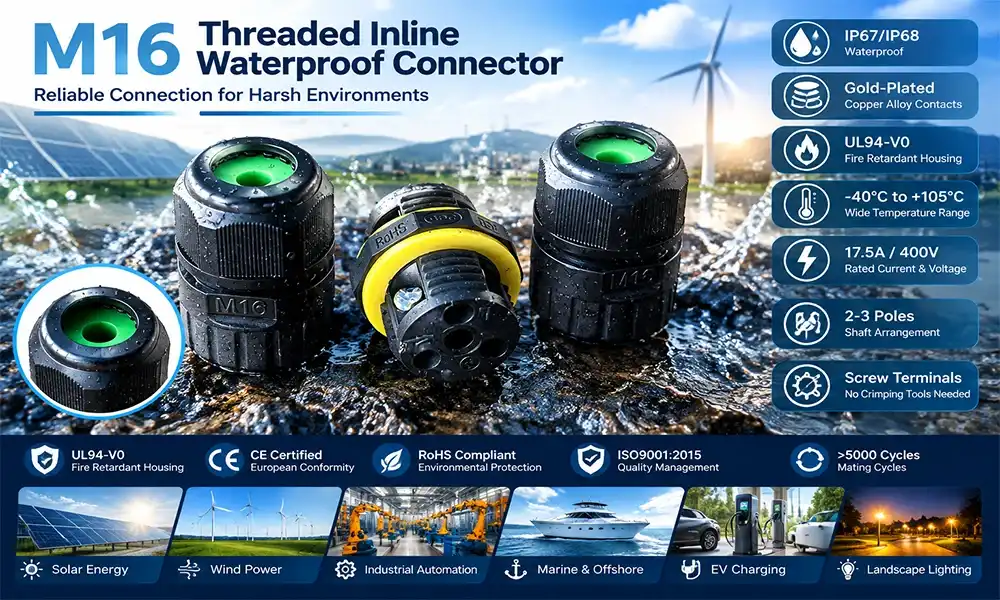
An M16 threaded inline waterproof connection employs a threaded locking mechanism which achieves a secure and progressive mechanical M16 threaded inline waterproof connector pieces. As the coupling nut turns onto the mating thread, it gradually compresses the interior silicone O-ring, creating a hermetic seal that prevents moisture, dust, and impurities. This regulated compression directly enables ratings of IP67 and IP68. Thread geometry turns the rotating force into an axial clamping stress; thus, vibration cannot back the joint loose, except for sealing. The result is a connection point that retains its electrical integrity and waterproof performance for thousands of mating cycles in industrial, outdoor, and transportation applications.
Understanding the Challenges in Connector Reliability
Inline waterproof connections are employed in some of the worst conditions in electrical engineering. Before you choose a closing style, it’s useful to understand what common activities on the work site do to break a secure connection.
Water Ingress and Seal Degradation
Moisture is usually the cause of early failures of the connection. If you don't seal it well enough, water will flow along wire jackets, seep in via open joints, and corrode contacts within weeks. If the connection is rated less than IP67, water or pressure washdowns may get in. This may lead to short circuits and signal mistakes in sensor loops.
Vibration-Induced Loosening
Machinery vibration poses a constant danger. Constant mechanical oscillation progressively loosens friction-fit or snap-fit connections in workplace robots and rail transit. A loose connection, even a small amount, can increase the contact resistance, decrease the quality of the signal, and increase the probability of an arcing incident.
Temperature-Driven Material Stress
Connection materials must stretch and compress numerous times to operate at temperatures from -40 °C to +105 °C. If the housing material cannot absorb these temperature variations without breaking or warping, the form of the seal changes and the waterproofing is lost. Inferior thermoplastics are brittle at low temperatures, while inferior O-ring materials lose their flexibility at high temperatures.
How the Threaded Locking Mechanism Works to Enhance M16 Connector Reliability
The 16 mm metric thread is not only a fastening convenience. It is a designed seal-activation mechanism. When the behavior at each step is known, it is obvious why it is superior to simpler locking schemes.
Thread Pitch and Torque Control
A set hand-tightened torque ensures a consistent clamping force, as the thread pitch of an M16 connection is precisely machined. That reproducibility implies that any technician on your team, regardless of skill level, will have the same O-ring compression and hence the same IP68 protection each and every time. Push-fit or bayonet designs depend on operator feel, which creates unpredictability.
O-Ring Compression Mechanics
As the coupling nut moves down the thread, it pushes the male body axially into the female housing. The silicone O-ring is placed in the groove and squeezed radially and axially to match both mating surfaces. Silicone retains its elastic recovery from –40 °C to +105 °C, so the seal won’t cold-set in a frigid warehouse or become soft in desert-temperature enclosures.
Vibration Resistance Through Thread Friction
Thread-on M16 threaded inline waterproof connector s provide an intrinsic resistance to reverse rotation. The friction angle of a typical M16 thread is over the self-loosening threshold according to the vibration testing DIN 65151. In practice, the connection remains engaged on conveyor frames, robot arms, and rail car body panels where continual mechanical movement would dislodge a push-lock alternative within days.
Comparison: M16 Threaded Inline Connectors vs Other Locking Types
Not every type of locking connection works the same way when put under heavy industry stress. This is how threaded coupling stacks up against the two most common options.
Threaded vs. Push-Fit Connectors
Push-fit connectors connect quickly, which makes them good for indoor uses where vibration is low. But in areas that are meant to be cleaned or outside, water pressure can push a push-fit joint out of place during cleaning rounds. The M16 threaded design physically stops this from happening because disengagement needs to be done on purpose by counter-rotating the threads. This makes unplanned removal technically impossible.
Threaded vs. Bayonet-Lock Connectors
A spring-loaded hinge in a bayonet connection keeps it from moving when it connects to another connector. When there is constant, high-amplitude shaking, they don't work well because the stop can wear out and the engagement depth isn't as deep as a full thread engagement. The M16 thread goes around the body several times, spreading the mechanical load over the whole length of the thread instead of just a few detent points.
Material Selection and Its Impact
The housing of Cablein's M16 inline connector is made of PA66 glass-filled nylon, which has a tensile strength of more than 180 MPa and can withstand UL94-V0 flame testing. After 500 mating cycles, gold-plated copper alloy contacts still have a contact resistance below 5 m©, while nickel-plated options have a hard time keeping this level of resistance even after being exposed to chemicals many times. The lower total cost of ownership over a multi-year operation is directly linked to these material decisions.
Practical Guide: Installing and Maintaining M16 Threaded Inline Waterproof Connectors
Correct installation takes less than five minutes, yet it determines whether the connector delivers its rated IP68 protection for years or fails within months.
Selecting Cable Diameter and Terminal Size
Match the cable outer diameter to the appropriate gland size—3.5–7 mm, 5–8 mm, or 7–10 mm. Cablein's screw-type terminals accept conductors from 0.5 mm² to 1.5 mm², covering most sensor and actuator wire gauges. Strip the conductor to 6–8 mm, insert it fully into the terminal, and tighten the screw to the specified torque. No crimping press is required, which reduces tooling costs on remote installations.
Thread Engagement and Torque
Align the M16 threaded inline waterproof connector bodies before engaging the coupling nut to avoid cross-threading. Hand-tighten until the nut seats firmly, then advance approximately one-quarter turn further with a spanner to achieve full O-ring compression. Do not overtighten—doing so distorts the silicone ring and can reduce its elastic recovery over time.
Routine Inspection and Maintenance
Inspect O-rings every 12 months in oil-mist or chemical environments, and every 24 months in clean outdoor settings. The field-serviceable design allows O-ring replacement without cutting cables or sourcing a new harness. This repairability is a measurable advantage over overmolded cable assemblies, where any seal failure requires complete harness replacement.
Procurement Considerations for Choosing the Right M16 Threaded Inline Waterproof Connector
Certifications and Compliance Documentation
Commercial-to-business buying teams and electrical design leaders are the subjects that are consistently accorded the highest potential for relevance in the context of this discussion. Specifically, this is due to the fact that they are the concerns that have the most potential for significance.
Total Cost of Ownership vs. Unit Price
It might be tempting to buy a connection with nickel-plated contacts and EPDM seals because it costs less per unit. In a high-humidity climate, however, the costs of upkeep and replacement usually add up to more than the initial savings after 5 years. Gold-plated contacts and rubber seals make the product last longer, which lowers the total cost.
Customization and Lead Time
Standard 2-pin and 3-pin versions are in stock and ready to ship. Through Cablein's OEM/ODM program, you can get custom pin arrangements, housing colors, or cable lengths that have already been put together. Standard orders are sent out within 7–10 days, and special builds are planned based on the number of orders and the difficulty of the specifications. This adaptability allows for both one-time builds for specific projects and ongoing monthly refill plans.
Conclusion
The M16 threaded inline waterproof connector threaded coupling mechanism is much more than simply a way to keep two ends of wire together. It also maintains the silicone seal and stops the connection point from being free from vibration. It also provides technicians with a connection point that can be repaired in the field and endure for years of industrial usage. The dual IP67/IP68 grade, gold-plated contacts, and PA66 nylon structure all contribute to protection against the three most prevalent causes of connection failure: water ingress, contact corrosion, and mechanical separation. Test data supports the notion that a threaded inline connection is preferable to a push-fit or bayonet alternative for buying teams and electrical engineers who require a dependable solution to extend cables in automation, outdoor electricity, or transportation applications.
FAQ
1. What IP rating does an M16 threaded inline connector achieve?
Properly installed, an M16 threaded inline waterproof connector achieves both IP67 and IP68 ratings. IP67 covers 30-minute immersion at 1 meter depth; IP68 extends protection to continuous submersion at greater depth per agreed conditions. The rating depends on full thread engagement and correct O-ring seating.
2. Can these connectors handle AC mains voltage?
Cablein's M16 inline connector is rated at 400 V and 17.5 A per contact. It suits 3-phase industrial control circuits and single-phase power feeds. Always verify local wiring regulations and confirm CE documentation before specifying for mains-connected equipment.
3. How do I replace a worn O-ring in the field?
Unthread the coupling nut, slide out the male body, and remove the silicone O-ring from its groove. Insert a replacement ring of the same cross-section diameter, reassemble, and retighten. The entire process takes under three minutes with no special tools.
4. What wire sizes are compatible with the screw terminals?
The screw terminals accept solid and stranded conductors from 0.5 mm² to 1.5 mm², which covers most industrial sensor, proximity switch, and small actuator wire gauges.
5. Is the housing resistant to industrial oils and cleaning chemicals?
The PA66 glass-filled nylon housing resists most aliphatic hydrocarbons, hydraulic oils, and mild alkaline cleaners. For applications involving concentrated acids or ketone-based solvents, contact Cablein's technical team for a compatibility assessment.
Get Reliable M16 Connector Solutions from Cablein—Request a Quote Today
Since 2017, Cablein Technology has sold M16 threaded inline waterproof connector s to customers in over 100 countries. These connectors are backed by ISO 9001:2015 certification and are tested in-house before they are sent out. Our team gets back to you within 24 hours, whether you need standard M16 threaded inline waterproof connector stock to be refilled every month or a custom pre-wired harness from a qualified M16 threaded inline waterproof connector manufacturer. You can email our technical sales team at nick@cableinco.com to get free datasheets, samples, or pricing for large orders.
References
1. International Electrotechnical Commission. IEC 60529: Degrees of Protection Provided by Enclosures (IP Code). IEC, 2013.
2. Deutsches Institut für Normung. DIN 65151: Dynamic Testing of the Locking Characteristics of Fasteners Under Transverse Loading Conditions (Junker Test). DIN, 2002.
3. Underwriters Laboratories. UL 94: Tests for Flammability of Plastic Materials for Parts in Devices and Appliances. UL, 2013.
4. International Organization for Standardization. ISO 9001:2015: Quality Management Systems — Requirements. ISO, 2015.
5. Braunovic, M., Konchits, V. V., & Myshkin, N. K. Electrical Contacts: Fundamentals, Applications and Technology. CRC Press, 2006.
6. Mroczkowski, R. S. Electronic Connector Handbook: Technology and Applications. McGraw-Hill, 1998.