How to Identify Which Branch Failed on an IP68 M20 T 3-Way Connector
When one branch of your outdoor lighting circuit goes dark, the clock starts ticking. Identifying the failed branch on an IP68 M20 T shape waterproof connector requires a systematic three-step approach: visual inspection of each port's seal and housing, continuity testing with a multimeter across each branch individually, and insulation resistance measurement at 500V DC. Because the M20 T connector routes one input to two outputs through a PA66 nylon body sealed with silicone gaskets, a fault in either output branch produces distinctly different voltage readings, making branch-level isolation straightforward when you follow a disciplined sequence.
Understanding the IP68 M20 T 3-Way Connector and Its Branches
Before you try to figure out what's wrong, it helps to know what this connection is all about.
What the T Configuration Means Electrically
A port that faces away from the main cable sends power or a signal to a second device. The T layout keeps the main feed cable running straight through. They both come from the same input port, but the current flows through them in different ways. So, just because Branch A is broken doesn't always mean that Branch B is broken too. Because of this, branch-level separation is possible and important.
Materials and Sealing Architecture
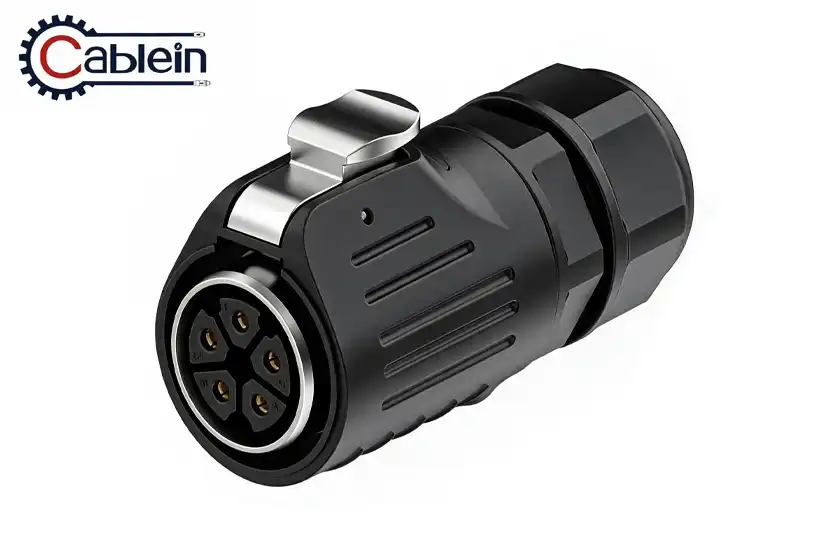
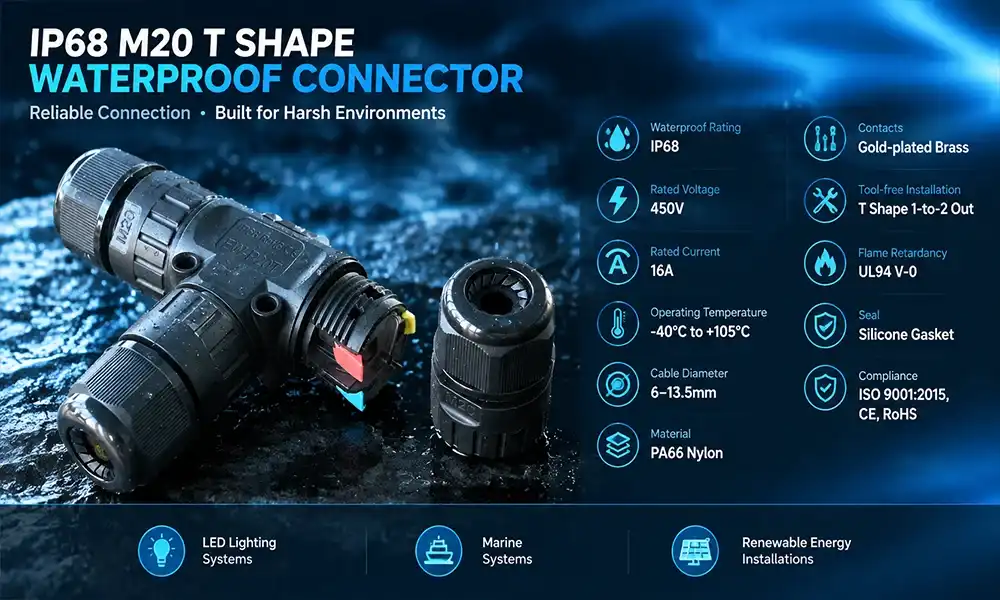
The waterproof IP68 M20 T-shaped waterproof connector from Cablein is made of UL94-V0-rated PA66 nylon that can't catch fire. Every place a wire goes in, it has a high-elasticity silicone O-ring and contacts made of gold-plated brass. An IP68 waterproof barrier is created when the silicone seal is pressed against cables with sizes of 5 mm to 9 mm or 9 mm to 12 mm. Because the contact resistance stays below 5 mΩ, there isn't much voltage drop across the junction.
Ratings That Matter for Diagnostics
The link works from -40°C to +105°C and up to 450V/16A. You can use these limits to help you figure out what's wrong when you check the branch voltages. If the number is outside the acceptable range, it means that there is either too much electricity or a breakdown in the insulation, not a mechanical seal failure. This helps you tell the difference between problems with the electricity and air coming in from outside.
Common Causes of Branch Failures in IP68 M20 T 3-Way Connectors
If you know why branches fail, you'll know where to start looking and what tools to bring.
Environmental Degradation
If the rubber seals crack over time, from UV cycling, or if they are put on incorrectly, water can get in through even parts with an IP68 rating. IP68 M20 T shape waterproof connectors that are buried in the ground are exposed to acids in the soil and changes in size when wet and dry. A seal that has flattened out over time lets water move along the wire jacket and into the contact hole. This leads to faults that happen from time to time and are famously hard to repeat on a bench.
Mechanical Stress at Branch Junctions
The snap-latch that locks each port cap wears out when a pump station or transportation fixture shakes. Moving the wire side to side over and over again puts stress on the gland entry. This makes the PA66 shell crack near the thread root. The main reason gland seals become distorted in outdoor light wire studies is that the cable pulls aren't lined up right when they are installed.
Electrical Overload and Wiring Faults
The gold-plated contact surface can turn black because of voltage spikes caused by inductive switching, wires with too small of a cross-section, or polarity being switched around. The contact resistance goes up, the branch gets hot, and the insulation breaks down faster when the plating burns through to the brass substrate. When there is more than one branch in an LED array, Branch B that is overloaded can hide Branch A that is open until both fail at the same time.
Step-by-Step Guide to Identify Which Branch Failed
Do these steps in the right order. With test equipment, it is not worth the time to skip visual checks.
Step 1 — Visual Inspection of Each Port
Turn off the power first. Take out each port's gland nut by hand. The IP68 M20 T-shaped waterproof connector from Cablein has a snap design that doesn't need any tools to open the ports. When you shine a work light on the seal face, look for spots, swells, or white mineral deposits. With a 10x loupe, look for pits or dull spots on the contact pins. Mark any ports that look like they might be broken before starting the electrical test.
Step 2 — Multimeter Continuity and Voltage Testing
Set your multimeter to continuity mode. Connect the probe pin-to-pin across Branch A and leave Branch B as is. Turn off the power and make sure the plug is open. If the circuit is broken, there is an open fault on that branch. Do it once more for Branch B. Make sure the power is back on and check the DC or AC voltage at each output port one at a time if both branches show continuity. The voltage drop on one branch is more than 5%, but the voltage reading on the other branch is fine. This might be because of a joint with a high resistance or a contact on the low-reading branch that has dried out.
Step 3 — Insulation Resistance and Thermal Imaging
Do a 500V DC insulation resistance test between each conductor and the connector shell for systems that will be buried or submerged in water. That branch has water in it if the number is less than 100 MΩ. You can see resistive heating from a broken contact if you have a thermal camera handy during live operation and the heat level rises above the ambient level at one port. Before it is taken apart, this is a clear sign that the branch has broken.
Troubleshooting and Fixing Branch Failures Effectively
The analysis will tell you how to fix the branch once you know which one is broken.
Safe Disassembly Without Compromising IP Rating
Be sure there is no electricity before you open the connection. Check the silicone O-ring to see if it has been squished or torn by taking it off. It doesn't matter how hard you twist the gland; a seal that has already taken a fixed flat set won't always seal again. When you need to replace O-rings, you should always use a set that fits together instead of just any rings. This is because the gland's shape needs to match the disc's height and width.
Deciding Between Repair and Full Replacement
This is a good way for field workers to decide what to do:
- Repair the wiring when the housing doesn't have any cracks and the rubber seal is still in place; the wire needs to be fixed. The contact surface should have light oxidation but no pitting. Clean the contacts with isopropyl alcohol, re-terminate, and test the insulation resistance again before you bury the cable.
- Replace the connector if the contact surfaces are carbonized, the PA66 case has cracks that can be seen near any port, or the insulation resistance stays below 100 MΩ after it has dried. When you use an authorized replacement, you keep the CE and RoHS compliance that is needed for project handover papers.
- Inspect the entire branch run if thermal imaging shows heat in more than one place. Most of the time, a broken connection means that there is a problem with all of the wires in the system, not just one part.
These rules give field teams the confidence to make decisions on the spot. This means that full-circuit fixes aren't needed and the system will be reliable for a long time.
Preventative Measures to Reduce Recurrence
A lot of builders don't know how important it is to let the stress out. Inside 150 mm of each port opening, use a tie-wrap anchor or conduit saddle to hold the wire in place. Before putting the seals together, put a small amount of silicone grease on each O-ring. This will keep them from drying out and breaking too soon. Make sure the IP68 M20 T shape waterproof connector you pick has a 48-hour salt spray test certificate if you plan to use it in the water or near the coast. Cablein's M20 T connectors, for instance, can handle 96 hours of saline mist tests, which means they can be used for sensor apps in ports and at sea.
Comparison and Benefits of IP68 M20 T-Shape Connectors in Harsh Environments
IP68 vs. IP67: What the Extra Digit Buys You
It is waterproof up to 1 meter for 30 minutes, which is what IP67 means. IP68 increases safety up to the depths that the maker says are safe for continued diving, which are generally between 1.5 and 10 meters. IP67 is not enough for lighting port docks or daisy chains of underground lights because it does not test against the long-term hydrostatic pressure that happens when the water table rises over the course of the year. Both IP67 and IP68 standards have been met by the Cablein IP68 M20 T-shape waterproof connector, so project engineers can use a single stock item that meets both standards for waterproofing.
T Configuration vs. Junction Box Wiring
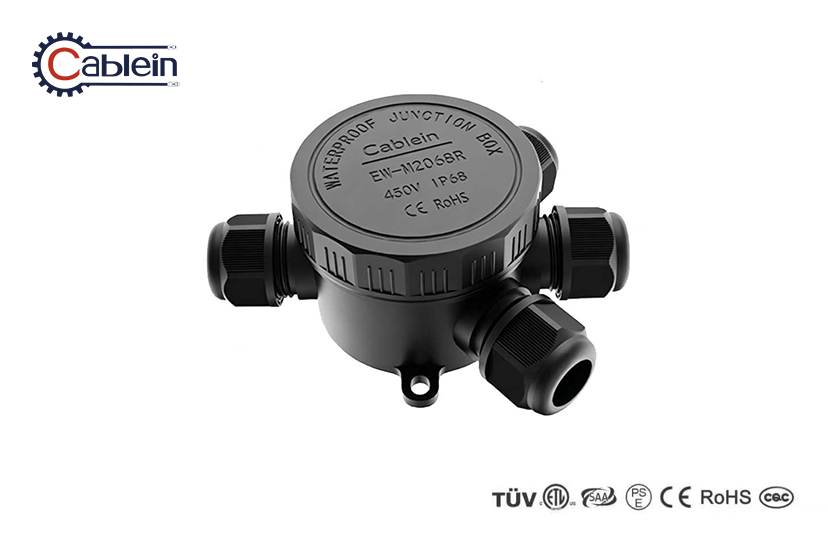
A three-way branch needs a standard IP-rated junction box. This takes an extra 45 to 90 minutes per node because the pipe entry needs to be sealed, the terminal blocks need to be wired, and the lid needs to be gasketed again. The tool-free snap termination on an IP68 M20 T-shape waterproof connector cuts that time down to less than 10 minutes. Why is a connection box cheaper per unit than a junction box? The time saved setting up 200 nodes in a landscape more than makes up for the price difference.
Long-Term Cost Considerations for Procurement Teams
IP68 M20 T-shape waterproof connectors that are compliant with CE, RoHS, and ISO9001:2015 standards have test records that can be found. In the US, EU, and GCC markets, this meets the requirements for municipal bids. Choose an approved M20 T waterproof branch connection during the design phase. This way, you won't have to spend a lot of money fixing problems in the field if an inspection authority questions a part's compliance after the project is finished.
Conclusion
To find a broken branch on an IP68 M20 T shape waterproof connector, you must first look at it visually, then use a voltmeter to check for continuity, and finally measure the insulation resistance. Most issues are caused by a seal that is worn out, too much mechanical stress at the opening of the gland, or carbonization from too much use. A properly specified connection with a dual IP67/IP68 grade, a PA66 housing, and a silicone seal build is a good place for field teams to start. Getting CE-certified parts when you need to repair something will protect the project's structure and make it less likely that problems will happen again during the installation's lifetime.
FAQ
1. How long does an IP68 M20 T connector last in continuous submersion?
In normal conditions, an IP68 M20 T-shaped waterproof connector with a UV-stabilized PA66 shell and silicone seals can be submerged in water for 5 to 10 years. This is as long as the cable strain relief stays in place and the O-rings are not dry-fitted during assembly.
2. Can I repair just one branch without replacing the entire connector?
Since the housing doesn't have any cracks and the silicone seal stays the same size, you can re-terminate the broken branch, replace only the O-ring on that port, and test the insulation resistance again before putting the circuit back into service.
3. What diagnostic tools do I need on-site?
A digital multimeter, a 500V DC insulation resistance tester, a 10× loupe, and, for live circuits, a thermal imaging camera are all used to do the full diagnostic process. All four of these tools can fit in any field kit.
4. Does the tool-free design hold up in high-vibration environments?
Pull-out forces are used to test the snap-latch on Cablein's IP68 M20 T-shaped waterproof connector. If the installation will be shaking a lot for a long time, like a pump station, add a cable saddle anchor within 150 mm of the port opening along with the snap latch.
5. Where can I verify CE and RoHS certificates before a project tender?
You can get test results and compliance statements from Cablein at connectorswaterproof.com. For packages for submitting bids, ask the technical team for batch-specific information.
Source Your IP68 M20 T Shape Waterproof Connector Through Cablein
We have IP68 M20 T-shape waterproof connectors that are made to CE, RoHS, and ISO9001:2015 standards and have been tested for 96 hours with salt spray. Need an IP68 M20 T shape waterproof connector sample run or a bulk order of 1,000 or more pieces? Our team will get back to you in as little as 24 hours. You can choose from two cable diameter ranges (5–9 mm and 9–12 mm) and make your own pin layouts. Send an email to nick@cableinco.com to get a paper or an example.
References
1. International Electrotechnical Commission. IEC 60529: Degrees of Protection Provided by Enclosures (IP Code). IEC, 2013.
2. Underwriters Laboratories. UL 94: Standard for Tests for Flammability of Plastic Materials for Parts in Devices and Appliances. UL, 2018.
3. National Electrical Manufacturers Association. NEMA 250: Enclosures for Electrical Equipment. NEMA, 2020.
4. Society of Automotive Engineers. SAE J1171: External Ignition Protection of Marine Electrical Devices. SAE International, 2021.
5. Institution of Engineering and Technology. IET Wiring Regulations, 18th Edition (BS 7671). IET Publishing, 2022.
6. American Society for Testing and Materials. ASTM B117: Standard Practice for Operating Salt Spray (Fog) Apparatus. ASTM International, 2019.