M20 T-Type Waterproof Connector: Features, Benefits, and Applications Guide
The M20 t-type waterproof connector is a three-port branching electrical connector built for outdoor power distribution in demanding conditions. Designed with a T-shaped body, it splits one incoming cable into two outgoing lines—without a junction box. Cablein's version uses PA66 nylon housing rated UL94-V0, gold-plated solid brass contacts, and a silicone sealing gasket. It carries ratings of 400V and 24A (2–4P) or 17.5A (5–6P), with IP68 protection verified at 10 meters for 72 hours. This guide covers its construction, performance data, real applications, and how to source it with confidence.
Understanding M20 T-Type Waterproof Connectors
What It Is and How It Works
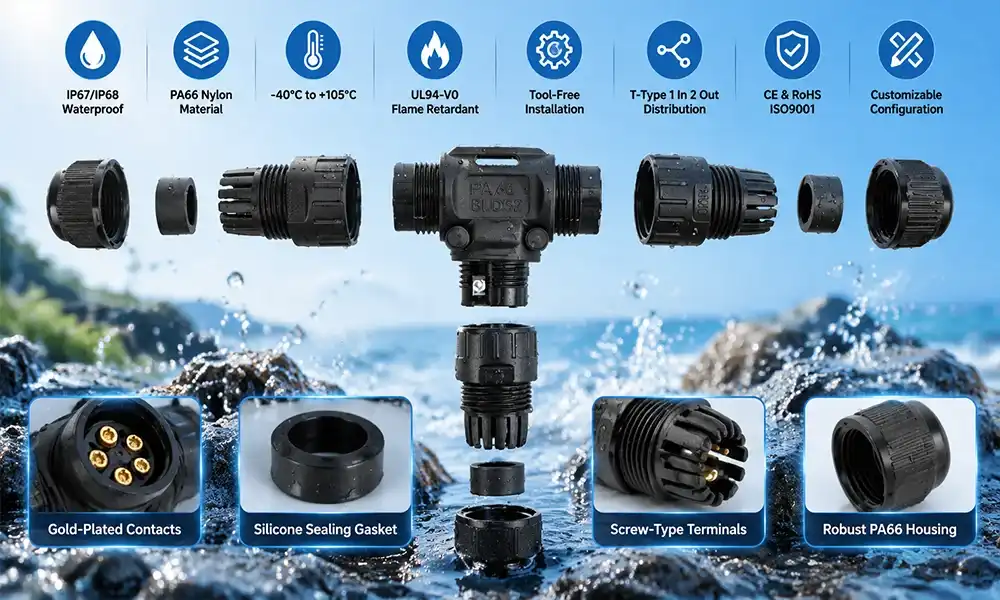
All three ports on a waterproof three-way branch connection have M20 threads. The T-shaped body sets up a 1-in-2-out topology, which means that one cable comes in and two cables go out, both carrying the same circuit at the same time. As you tighten the locking nut, the silicone closing rings inside press against the wire jacket, creating a moisture barrier based on pressure. This device is very different from a normal connection, which only uses a plastic housing contact and doesn't have a specific shape for sealing.
Key Electrical Parameters at a Glance
The M20 T-type branch connector from Cablein can handle 400V and 2–6 pole configurations. The 2–4P variants can handle up to 24A of current, while the 5–6P variants can handle up to 17.5A. At 500V DC, the contact resistance is < 5 mΩ and the insulation resistance is more than 2,000MΩ. The connector works with cables with outside diameters between 5 and 9 mm and 9 to 12 mm, and wire cross-sections between 0.5 mm³ and 2.5 mm³. In a temperature range from -40°C to +105°C, these numbers stay the same.
How It Differs from Standard Connectors
Standard connectors that aren't sealed rely on friction between the housing and the plug or simple rubber plugs to keep moisture out. The M20 T-connector has a UV-stabilized PA66 shell, a silicone gasket, a threaded locking collar, and gold-plated contacts that don't oxidize. This pair has a confirmed IP68 rating, which means it can be submerged in water for 72 hours at 10 meters. Standard plugs, on the other hand, don't usually have any rated ingress protection at all. For branch wiring outside, that lack of protection means higher costs for repairs and a higher chance of failure in the field.
Features and Benefits of M20 T-Type Waterproof Connectors
Material and Sealing Construction
The shell made of PA66 nylon is both UL94-V0 flame retardant and F1-grade UV resistant. In other words, the shell won't soften near heat sources and won't break after years of being in the sun. Gold-plated solid brass pins keep their low contact resistance for more than 1,000 mating cycles. The silicone gasket stays flexible from -40°C to +105°C, which keeps the seal from breaking down when the temperature changes.
Installation Speed and Field Practicality
Unsoldered or crimped wire ends can be used with screw-type terminals inside each port. A field technician takes the wire off, puts it in, and screws the terminal screw down tight. A normal screwdriver or a basic torque driver can be used to apply the recommended holding torque of 1.5 to 2.0 Nm. When you need to set up hundreds of street lighting branch points before the deadline, this design saves a lot of time compared to traditional junction box wiring when installing a single node.
Here are the main performance benefits that make this M20 t-type waterproof connector better than others on the market:
- IP68-rated submersion protection: Tested at 10 meters for 72 continuous hours, the connector maintains full seal integrity even in flooded conduit trenches or underwater aquaculture installations.
- 2000V AC dielectric withstand voltage: Verified through bench testing, this rating confirms the connector won't flash over during voltage transients or insulation spot-checks on municipal lighting grids.
- Salt spray resistance of 48–96 hours: Metal contact surfaces withstand corrosive marine atmospheres, making the connector suitable for coastal infrastructure and aquaculture pump circuits.
- 1,000+ rated mating cycles: Structural integrity holds through repeated field connections and disconnections without measurable degradation in contact resistance.
Comparing M20 T-Type Waterproof Connectors with Alternatives
M20 T-Type vs. Y-Type Branch Connectors
A Y-type connector turns one input into two outputs at an angle, while a T-type connection does the same thing but at a right angle. The T-shape works better with straight pipe runs and lighting setups that use daisy chains. It is better for Y-types to be used in fan-out topologies, where branches go off in different directions from a central point. The T-shape makes routing easier and reduces the stress on the cable bend radius for linear street lighting or tunnel installations.
M20 T-Type vs. M16 Waterproof Connectors
M16 connectors have a smaller thread diameter and can only handle 10–16A of current, but this can change depending on how the contacts are set up. The M20 thread can handle higher current loads (24A at 2–4P) and bigger wire outer diameters (up to 12mm). The M16 format might not be able to handle the load if your line has a lot of amperage or uses heavier-gauge wires. For 400V power distribution outside, the M20 format is the better choice.
Choosing the Right Connector for Your Application
Three things determine the best choice: the current rating, the cable diameter, and the branch geometry. The M20 T-connector meets all three requirements for straight-run smart lighting grids that need to carry 24A at 400V and cables with an outside diameter of 9–12mm. An M16 might be enough for sensor branches with less power. Before approving any connector for sealed outdoor use, procurement teams should get type-test reports from a third party that confirm the IP68 test method and depth.
Practical Guide: Installation and Application
Step-by-Step Installation
First, make sure that the outer width of the wire fits the size of the sealing grommet you chose (5–9mm or 9–12mm). Take off 8 to 10 mm of insulation from each wire. Before you put the wire into the connection port, thread the locking nut and grommet onto it. Connect the wires to the screw terminals and make sure each screw is tight. First, thread the locking nut by hand. Then, use 1.5–2.0 Nm of torque to push the grommet against the cable jacket. If you tighten it more than 2.0 Nm, the grommet might bend.
Where This Connector Performs Best
This three-way branch connector is used by smart city lighting grids to connect streetlight poles in a chain without having to open weatherproof boxes at each node. Tunnel lighting systems use continuous circuits with branch taps that connect to each bulb driver. In aquaculture facilities, the M20 t-type waterproof connector connects oxygenation pumps and automated feeder motors along cable runs along the water, which are always exposed to water. It's used by solar PV monitoring networks to connect sensor signal cables from monitoring units at the string level to data loggers in the central office.
Maintenance and Long-Term Reliability
Check the strength of the locking nuts during the first maintenance checkup every year. If the PA66 shell has any discoloration, it could mean that the UV protection has been broken beyond the F1 rating. If a connection fails a water ingress test during a regular check, only the silicone grommet needs to be replaced. The connector body itself should not be replaced first. Cablein gives installation instructions in the form of documentation and offers technical support to field teams through nick@cableinco.com.
Procurement Guide for B2B Clients
What to Verify Before Placing a Bulk Order
You should ask that the third-party IP68 type-test report be very clear about the test depth (10m), duration (72 hours), and testing standard (IEC 60529). Ask for the salt spray test certificate and the 2000V AC dielectric test record as well. In the purchase agreement, you should talk about batch-to-batch color consistency. For example, you could list the PA66 shell color code and ask for a pre-shipment color match inspection if the owner's engineer has strict requirements for visual uniformity.
Lead Time and Inventory Planning
Cablein keeps more than 10,000 units of each SKU in stock and ships most orders within 7 to 10 business days. For civil construction projects with tight schedules, this stocking level lets you place extra orders before the installation phases. Custom configurations, like branch cable lengths that aren't standard or pole counts that aren't standard, need a separate conversation about lead time. For air freight, UPS, DHL, and FedEx are some of our shipping partners. For bigger, more combined orders, sea freight is also an option.
OEM and Custom Configuration Options
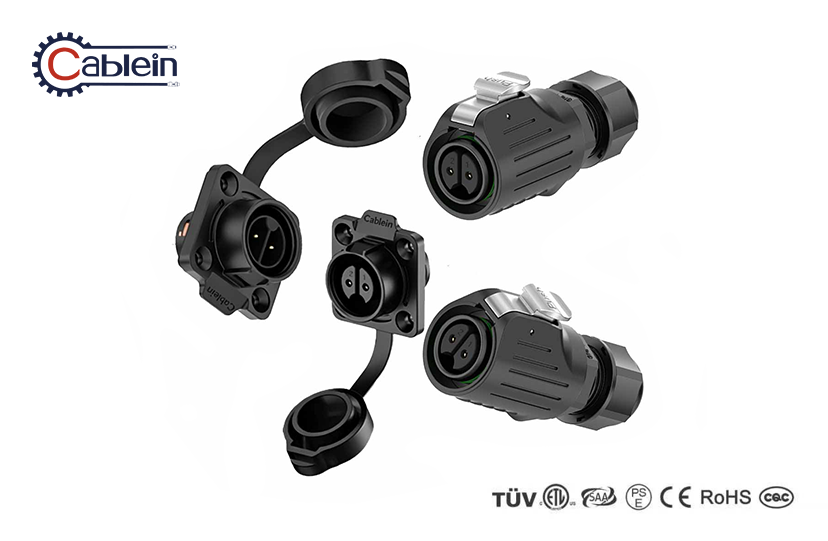
For integrators making smart pole systems or industrial IoT hubs, Cablein lets them create their own molds, choose their own colors, put their brand, and keep track of each batch. Documentation for CE and RoHS is included as standard. Other certifications, such as ETL, PSE, and TUV, are available for some product lines. You can find the full catalog of products and specification sheets at connectorswaterproof.com.
Conclusion
The Cablein M20 t-type waterproof connector solves a special field problem: getting power or data to branch circuits outside, where corrosion, moisture, and temperature changes are constants. A connection with a PA66 shell, gold-plated contacts, silicone sealing, and confirmed IP68 protection can pass inspection, be installed quickly, and stay sealed for years of use. This type of connector meets the electrical and environmental needs without the need for special installation skills. It can be used for industrial IoT networks, aquaculture infrastructure, or buying streetlights.
FAQ
1. What is the difference between IP67 and IP68 on this connector?
IP67 lets you submerge something for 30 minutes at a depth of 1 meter. IP68 is tested at greater depths and for longer periods of time. For example, Cablein's M20 T-type connector is tested at 10 meters for 72 hours straight. This difference is important for installing plugs in conduit holes that are flooded or in places that are always wet.
2. Can I use different cable diameters on each port of the T-connector?
Yes. There is a separate sealing grommet for each port. You can match the grommet size to the outside width of each cable (5–9mm or 9–12mm) separately for each of the three ports, as long as each cable is within the recommended wire cross-section range.
3. Does this connector work for RS485 data signals?
Yes, the connector can handle both 400V power circuits and low-voltage data signals, as RS485 is used in smart lighting control networks because the contacts are gold-plated, which keeps the resistance low and the impedance stable.
4. How do I confirm a supplier's IP68 claim is genuine?
As for the third-party type-test certificate, it should list the testing lab, the standard (IEC 60529), and the length and depth of the test. If a supplier can't show this document, they can't check the rating.
5. What happens if installation torque exceeds 2.0 Nm?
If you tighten it too much, more than 2.0 Nm, the silicone grommet can be compressed unevenly, which can leave gaps in the cable seal. Use a torque driver that has been calibrated at all times and stay within the 1.5–2.0 Nm range for proper IP68 performance.
Partner with Cablein for Your Next Project
From 2017 to now, Cablein Technology has provided industrial waterproof connectors for projects in over 100 countries. As a manufacturer of M20 t-type waterproof connectors, we can stock standard items, make custom designs for OEMs, and provide full certification documentation. Email our team at nick@cableinco.com to get a quote for your project or to ask for samples.
References
1. International Electrotechnical Commission. IEC 60529: Degrees of Protection Provided by Enclosures (IP Code). IEC, 2013.
2. Underwriters Laboratories. UL 94: Standard for Tests for Flammability of Plastic Materials for Parts in Devices and Appliances. UL, 2018.
3. International Organization for Standardization. ISO 9001:2015 Quality Management Systems — Requirements. ISO, 2015.
4. ASTM International. ASTM B117: Standard Practice for Operating Salt Spray (Fog) Apparatus. ASTM, 2019.
5. European Committee for Electrotechnical Standardization. EN 61984: Connectors — Safety Requirements and Tests. CENELEC, 2009.
6. National Electrical Manufacturers Association. NEMA 250: Enclosures for Electrical Equipment. NEMA, 2020.