Why Does an M20 Waterproof Connector Overheat? Common Causes and Solutions
An M20 waterproof connector overheats primarily due to electrical overload, loose terminal connections, poor ambient heat dissipation, or substandard materials. In multi-branch distribution setups—where an M20 cross connector 4 way cable extender routes power across three outputs simultaneously—any one of these factors can trigger dangerous temperature spikes. Left unchecked, overheating degrades insulation, weakens seals, and eventually causes system failure. Understanding what drives excessive heat is the first step toward preventing it, especially in outdoor infrastructure, smart traffic poles, and industrial automation panels where connector failure means costly downtime.
Understanding the M20 Waterproof Connector and Its Applications
What the M20 Standard Actually Means
The "M20" number refers to the connection body's metric thread size, which is 20 mm in diameter. This threading makes a tight seal around the jacket of the wire that keeps dust and moisture out. Because the standard works with cables with widths from 5mm to 12mm, it can be used for both signal-grade and power-grade wiring in the same product family.
Key Technical Features Worth Knowing
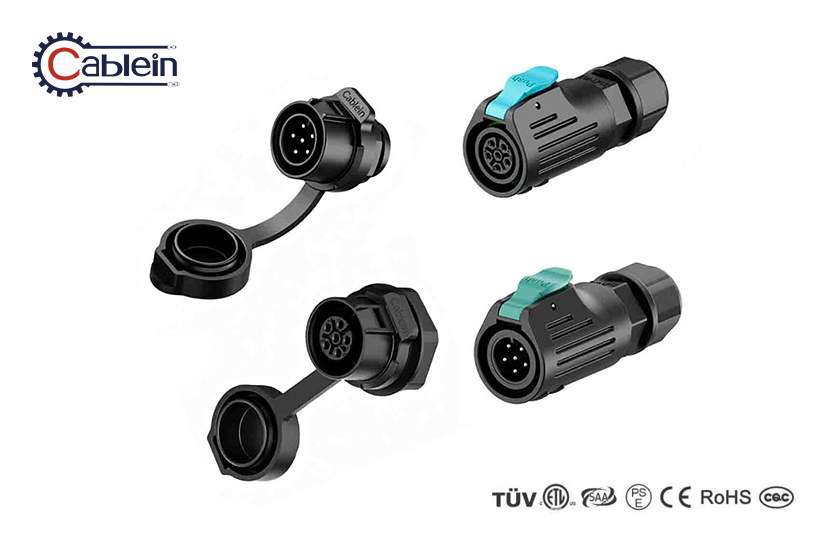
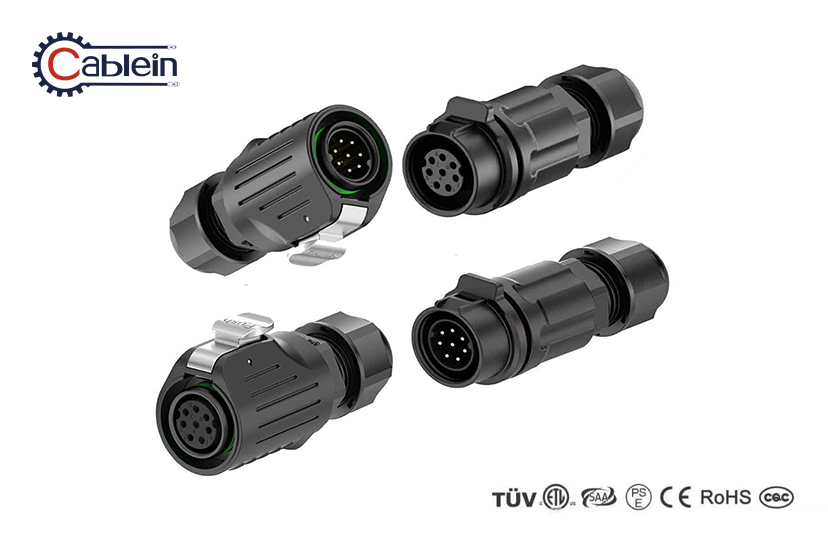
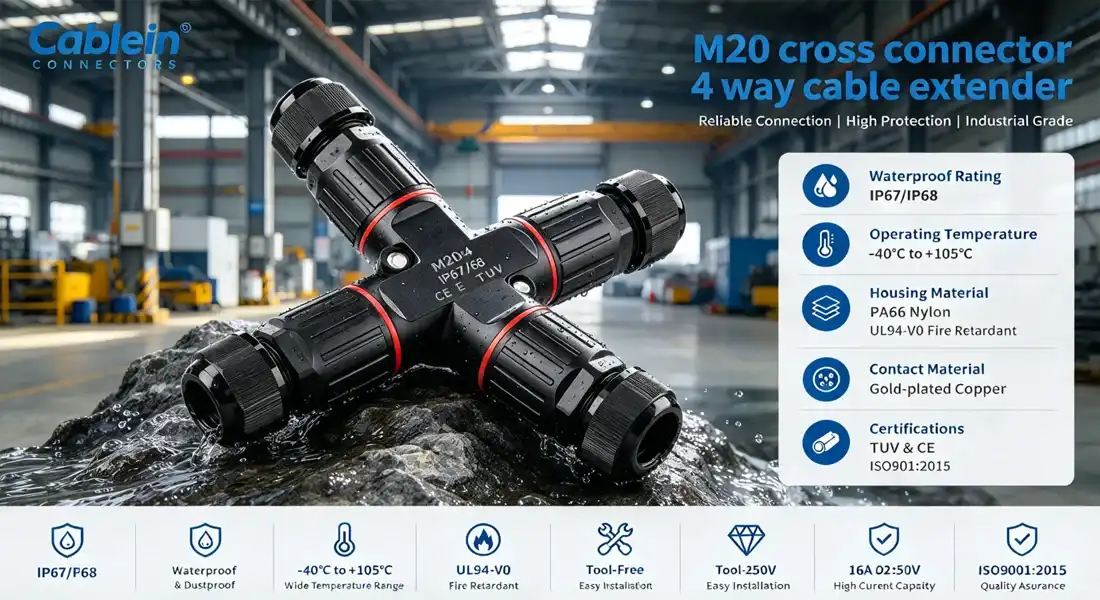
A well-made industrial M20 waterproof connection has a number of signs that it works well. For example, Cablein's cross-type version can handle 250–450V and 16–24A. It has been tested and proven to be waterproof up to 4 meters deep for 72 hours straight. The UL94-V0 grade means that the PA66 nylon shell is flame-resistant, and the gold-plated copper contacts keep the contact resistance in the low milliohm range. This keeps heat from building up at the terminal points. The TUV and CE certifications under ISO9001:2015 add proof from a third party to these claims.
Where These Connectors Get Deployed
The cross-shaped four-port layout—one input and three outputs—is common in solar PV junction arrays, tunnel LED lighting, wind turbine sensor belts, and networks of outdoor security cameras. In all of these situations, the connector has to be able to handle a steady flow of current, mechanical shaking, UV light, and big changes in temperature without breaking.
Why Does an M20 Waterproof Connector Overheat? – Root Cause Analysis
Electrical Overload Beyond Rated Capacity
Each connector can handle a certain amount of constant power. If the actual draw goes over this number, even for a short time, the resistance at the contacts turns the extra energy into heat. A connection that can handle 16A and 22A will get hot very quickly. When there is a four-way distribution, the three downstream branches can pull more current than the inlet branch was designed to supply. This can cause a hidden overload condition at the central junction.
Loose or Improperly Torqued Terminals
When a terminal is loose, it causes micro-arcing, which is tiny electrical bursts that raise the temperature in a certain area well above the atmospheric level. Field data from industrial repair teams constantly shows that M20 cross connector 4 way cable extender overheating is most often caused by loose connections. A common cause is screw connections that were tightened by hand instead of with a torque tool that has been calibrated. It only takes a small gap at the contact interface to raise resistance enough to make the temperature rise when the circuit is loaded.
Harsh Environment Stacking Against Heat Dissipation
Outdoor fittings in desert areas or sealed pipe runs can be exposed to temperatures above 50°C even when no electrical load is present. When airflow inside a traffic pole housing is blocked by direct sunlight and salt-fog corrosion attacks the terminal surfaces, the connector's thermal margin shrinks very quickly. The IP68 sealing is great for keeping out moisture, but it also limits convective cooling. This means that the materials inside the connector must be rated for the whole temperature range that is expected.
Counterfeit and Substandard Materials
There are M20 connectors on the market that are made from recycled nylon or copper alloys that have not been graded. These materials are less stable at high temperatures and have higher bulk resistance than gold-plated copper or approved PA66. Under the same load, a connection that looks the same on the outside but has worse contacts can get 20–30°C hotter. When buying things, the only reliable way to weed out these items is to use third-party test reports and batch traceability documentation.
Solutions to Prevent and Resolve Overheating in M20 Connectors
Install Correctly From the Start
If you run something correctly, the most common way it fails is stopped before it even starts. Tighten the terminal screws to the number recommended by the maker. For M20-class terminals, this is usually between 0.4 and 0.8 N·m. Use a calibrated torque screwdriver to do this. Cut the wire insulation to the right length so that the copper strand doesn't stick out past the end clamp. Before you thread the locking nut on, make sure that the silicone sealing gaskets sit flush.
Here are the main things you can do to keep installations from getting too hot:
- Match wire cross-section to current load. For a 16A circuit, use a minimum 1.5mm² conductor; for 24A, use 2.5mm². Undersized wire raises resistance throughout the loop, not just at the connector.
- Torque all locking nuts with anti-vibration intent. Cablein's anti-vibration locking nut design mechanically resists loosening from road traffic vibration or wind-induced pole sway—but only if it is fully seated at installation.
- Seal unused ports immediately. An open port admits humidity that condenses on contacts, raising resistance over time.
— Match the cross-section of the wire to the load. Use at least 1.5mm² of wire for a 16A circuit and at least 2.5mm² for a 24A circuit. Resistance goes up all the way through the loop when the wire is too small.
Schedule Routine Thermal Inspections
After installation, regular checks catch problems as they start to happen early. Thermal imaging cameras can find hot spots at junctions without having to cut the power to the area. For traffic infrastructure, every six months is a good time to check it, but every three months is better for continuous industrial processes. If the surface temperature of a connection is higher than 85°C when it is under regular load, it needs to be looked into right away.
Choose Components With Verified Thermal Ratings
Margin erosion can be avoided by choosing a four-way distribution connection that is rated for both the atmospheric temperature and the load temperature, not just a nominal value. Cablein's M20 cross connector has a verified operating range of -40°C to +105°C. This means that the housing and seals stay strong at temperatures where lower-quality nylon would melt or crack. Engineers can make the connector fit the needs of the circuit perfectly by choosing from different branch lengths and pin configurations. This takes the guessing out of the thermal budget.
Comparing M20 Connectors With Other Cable Connectors for Overheating Prevention
M20 vs. M25: Current Capacity and Thermal Headroom
The M25 connector body has more cross-sectional area for contacts and wire entry, which lets it handle higher currents—up to 32A in industrial-grade models is common. Stepping up to M25 lowers heat stress for uses that need more than 24A. The M20 cross connector 4 way cable extender, on the other hand, has enough thermal buffer for the 16–24A range that is common in smart traffic and tracking systems without being too big.
Cross Connector vs. T-Splitter: Heat Distribution Differences
Through a single line, a T-splitter splits an input into two outputs. A cross connector evenly spreads the load across three outputs. This makes the current flow more evenly across the junction housing. At the same total load, this geometry lowers the number of hot spots compared to a T-type. The downside is a little more complicated routing, but the cross-shaped port layout makes it easier for runs with more than one cable conduit.
Price vs. Certification: Where the Risk Really Lives
A lot of cheap plugs don't have TÜV or CE approval, and when they don't have third-party testing, they have a higher failure rate in the field. A connector that saves $0.50 per unit can cost thousands of dollars in labor just for one high-access maintenance call. Even if the unit price is higher, the total cost of ownership is lower for certified products that can be tracked from batch to batch, like those made under ISO9001:2015.
Procurement Insights and Choosing Trusted M20 Waterproof Connector Suppliers
Verify Certification Documents Before Ordering
Not just certificate numbers, but real TÜV or CE test results should be asked for. Reports that are true say exactly what type of product was tested, when it was tested, where it was tested, and what version was tested. Check the number on the certificate against the online record of the organization that issued it. This one step gets rid of a lot of the items on the industrial connector market that aren't what they seem to be.
Evaluate OEM vs. Generic Supply Chains
In contrast to generic distributors, OEM-grade suppliers keep NDAs, quality records at the batch level, and incoming inspection reports. When purchasing managers put connectors into certified equipment like PLC cabinets, traffic management systems, and energy storage units, OEM documentation is often what decides if the finished product passes its own certification audit.
Assess Lead Time and Project Supply Capacity
Infrastructure projects with standard lead times of 7 to 10 days and a supplier that can ship 500 to 2,000 units per project cycle lower the risk of running behind schedule. Cablein keeps more than 10,000 of each item in stock and sends them all over the world through UPS, DHL, and FedEx. This makes it easy for system designers working in different time zones to supply large projects.
Conclusion
Overheating inM20 cross connector 4 way cable extenders can be stopped by avoiding a few things: too much power, loose connections, thermal ratings that are too low for the environment, and using low-quality materials. Multi-branch distribution systems keep going without stopping by choosing the right parts, installing them with the right amount of power, and doing regular thermal checks. The thermal risk goes down a lot when a connector has third-party certification, verified material specifications, and batch documentation that can be tracked. It is always cheaper to invest in quality at the component level than to deal with mistakes in the field.
FAQ
1. Can overheating damage the cables connected to an M20 waterproof connector?
Yes. Overheating for a long time makes wire insulation softer and speeds up the oxidation process on copper lines. This can melt or crack the insulation. Even in an IP68 connection, moisture can get in, and there is a much higher chance of a short circuit once the protection is broken.
2. How often should I inspect M20 connectors in outdoor installations?
Outside infrastructure like traffic poles and solar panels usually needs to be serviced every 6 to 12 months. If you have sites in high-vibration areas or in harsh conditions like the desert or near the coast, you should use thermal imaging to check them every three months to find hot spots before they get worse.
3. Do all M20 connectors support four-way cable extension?
No, the M20 number only tells you the size of the thread. A standard M20 cable gland has only one port for entry. For four-way distribution, you need a cross-type junction connector that is specially made for your needs and has internal terminal blocks that are rated for the amount of current and voltage you need.
4. What wire cross-section should I use with a 16A M20 cross connector?
A wire with a cross-section of at least 1.5 mm² is needed for a 16A constant load. Use 2.5 mm² wire for circuits that are getting close to 24A. Using conductors that are too small raises the circuit resistance, which makes the connector and the cable run hotter.
5. How do I confirm an M20 connector's IP68 rating is genuine?
Ask for the original test record that lists the depth and length of the plunge. IEC 60529 says that Cablein's IP68 grade is checked at 4 meters for 72 hours. Check the name of the testing lab against databases of approved labs to make sure the report is real.
Get a Certified M20 Cross Connector 4 Way Cable Extender From Cablein
From 2017 to now, Cablein Technology has provided industrial waterproof connections for projects in over 100 countries. Our catalog of M20 cross connector 4 way cable extenders from a source includes TUV/CE-certified units that can be tracked by batch, have custom pin setups, and have stable project-quantity stock. Our team can handle both small orders (50 samples for a test installation) and large orders (2,000 units for a project). To get pricing and specifications, you can email our engineering team at nick@cableinco.com.
References
1. International Electrotechnical Commission. IEC 60529: Degrees of Protection Provided by Enclosures (IP Code). IEC, 2013.
2. International Electrotechnical Commission. IEC 60998-2-1: Connecting Devices for Low-Voltage Circuits – Particular Requirements for Connecting Devices as Separate Entities with Screw-Type Clamping Units. IEC, 2004.
3. Underwriters Laboratories. UL 746C: Polymeric Materials – Use in Electrical Equipment Evaluations. UL Standards, 2010.
4. International Organization for Standardization. ISO 9227: Corrosion Tests in Artificial Atmospheres – Salt Spray Tests. ISO, 2022.
5. National Fire Protection Association. NFPA 70: National Electrical Code (NEC), Article 110 – Requirements for Electrical Installations. NFPA, 2023.
6. Whitehead, M. & Thornton, R. "Thermal Failure Analysis of Industrial Electrical Connectors in Outdoor Infrastructure." IEEE Transactions on Components, Packaging and Manufacturing Technology, Vol. 12, No. 4, 2022.