M25 Y-Type Waterproof Connector vs T-Type Connector: Which Branch Connector Is Better?
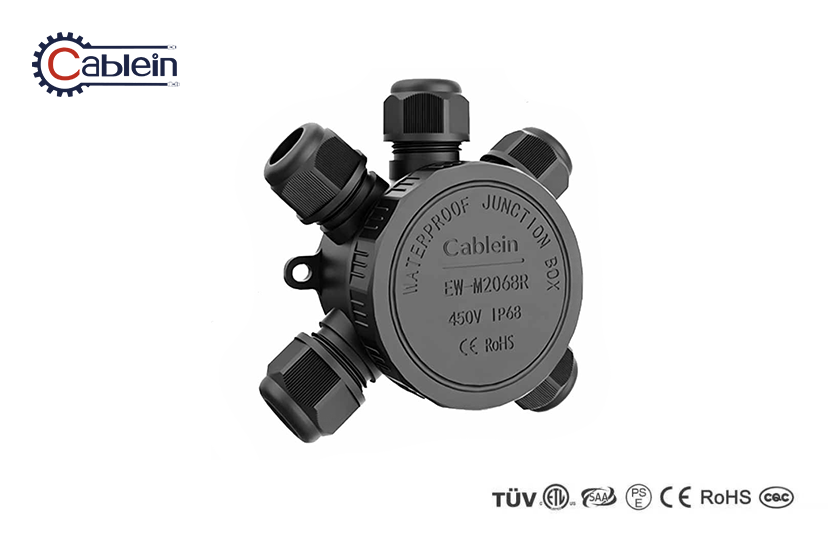
When choosing between the branching connection alternatives, engineers and procurement managers are always asking themselves whether to go with an M25 y-type waterproof connector or a T-type waterproof connector. The quick answer is that the M25 Y-type waterproof connection is the leader in most outdoor, marine, and industrial branching applications. Its tilted dual-arm shape balances cable pull pressures, minimizes seal stress, and tucks neatly into confined equipment spaces. The T-type shape positions all three ports at 90-degree angles, which causes mechanical strain spots in circumstances where there is cable movement or vibration. Being clear on why this matters can help you make a confident purchase choice.
Understanding M25 Y-Type and T-Type Waterproof Connectors
Both kinds of connectors are used to separate a single wire feed into two branch circuits without opening a junction box. But in the real world, they do quite different things because of the way they are constructed.
What Is an M25 Y-Type Waterproof Connector?
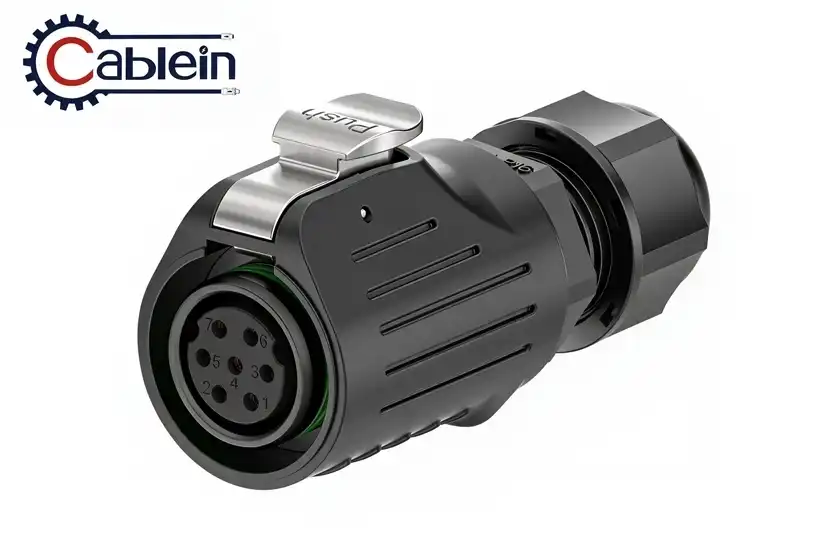
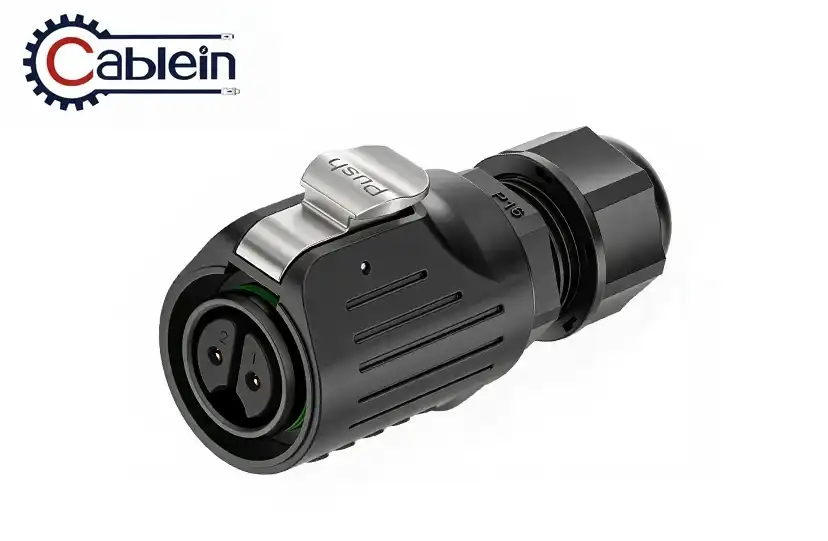
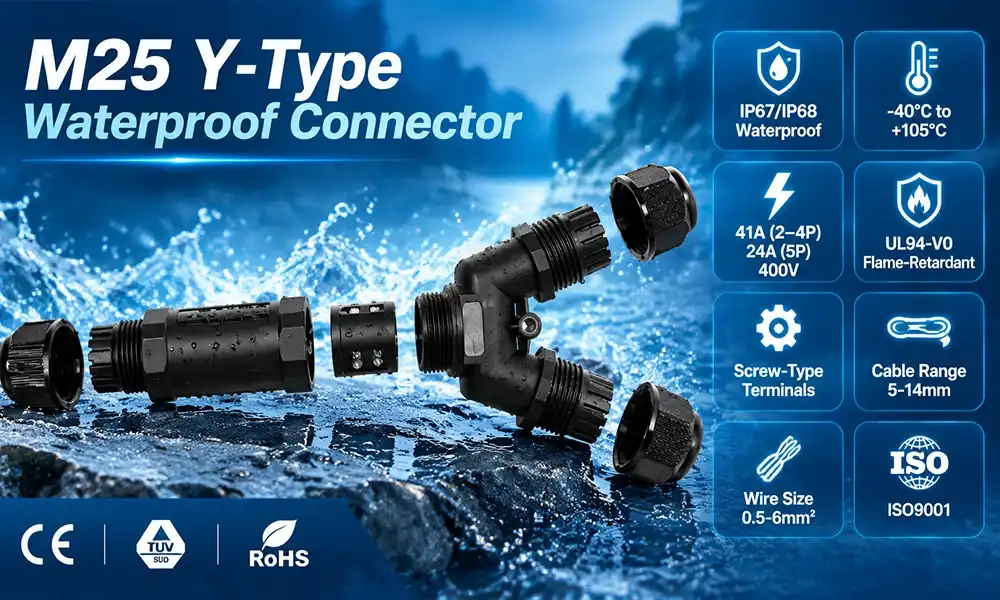
When you see the number M25, it signifies the opening thread of the wire is 25mm wide. The "Y" form causes the two output arms to protrude significantly from the main body of the wire. In this configuration, the pull forces of each arm branch are in opposite directions to each other. So there is no high-stress level seal site. Cablein’s M25 Y-type waterproof connection is produced from PA66 nylon, which is non-flammable according to UL94-V0 requirements. The contacts are constructed of copper metal, gold-plated, with a contact resistance value of less than 5m³. All three entrance sites are sealed with silicone or EPDM. It is rated for 24A of current in 5-pole setups and 41A in 2-4 pole combinations. Rated voltage: 400 V.
What Is a T-Type Waterproof Connector?
This gives it the appearance of a "T" as the two branch outputs of a T-type connection are 90 degrees from the primary input. This approach works well for installing flat panels or lengthy sections of conduit with wires coming out at an angle to a surface. That said, with a straight departure, the 90-degree shoulder receives most of the mechanical load. This form causes the seal at the branch joint to wear down quicker over time when it's moist or shakes a lot.
Key Structural Differences at a Glance
Y-type with angled arms for cables from 5 mm to 14 mm diameter and from 0.5 mm2 to 6 mm2 cross-section. Select from three sizes. The T-type has a narrower range of wire sizes it is compatible with, and it functions best when the cords are in place after the installation. You can quantify the geometric advantage of the Y-type; don't just think about it when wires move, heat expands, or water contacts the cable.
Performance and Durability Comparison: M25 Y-Type vs T-Type Connectors
Picking between the two is not about what’s on a spec sheet; it’s about real-world performance over years of operation in moisture, corrosion, electrical load, and mechanical stress.
Waterproofing and Immersion Performance
Cablein’s M25 Y-type connection is IP68 certified and tested for 72 hours in 1.5 meters of water depth without moisture penetration. The triple point silicone gasket system seals all three cable entrances separately. Most suppliers’ standard T-type connections are IP67, which is 1 meter for 30 minutes – good for splash protection, but not for submerged sensor arrays or maritime deployments. For underwater robots or aquaculture monitoring systems, that rating gap is the difference between a reliable deployment and an early failure.
Corrosion Resistance and Material Quality
For maritime and offshore applications, salt spray resistance is a must. Cablein’s Y-type connection passes ASTM B117 salt spray testing at 96 to 144 hours and has gold-plated copper alloy contacts for long-term corrosion protection. Insulation resistance is more than 2000MΩ at 500V DC after long salt exposure. Many T-type connections employ conventional tin-plated contacts that exhibit detectable corrosion deterioration after just 48 hours of exposure to salt spray, well short of a single aquaculture production cycle.
Temperature Range and Electrical Load Capacity
UL94-V0 rated PA66 housing preserves structural integrity from -40°C to +105°C. This may vary from frigid offshore installations to high-temperature solar farm enclosures. The Y-type can withstand up to 400V and 41A power loads. This is higher than the usual T-type connections that are rated at 300V and 16A. This electrical headroom is functionally relevant for wind turbine actuator branches or solar PV tracking systems.
Application Scenarios: Which Connector Fits Your Project Needs?
What kind of connection you use will depend on where it is and how it works. Here is a description that you can use that is based on real deployment settings.
Marine, Aquaculture, and Underwater Sensor Systems
Underwater ROV tether branches, offshore tracking systems, and aquaculture sensor arrays are all constantly being hit by salt, changes in pressure, and biological fouling. This is where the M25 Y-type connection comes in handy; it can handle salt spray for 144 hours and has an IP68 grade for immersion. It is harder to move wires inside submersible housings because they don't have much room and have strict bend radius rules. This is because the exit shape of a T-type link is 90 degrees.
Solar PV, Wind Turbines, and Outdoor Power Distribution
For solar tracking systems and wind turbine control cabinets, the M25 y-type waterproof connectors need to be able to handle UV light, changing temperatures, and the tension of the cables caused by the wind. The UV-stabilized PA66 housing takes care of this right away, and it can last for more than 10 years of use outside. As per the ASTM B117 standard, the Y-type's pull force distribution across angled arms is tested to a minimum of 100N. This stops seal pullout when the cable is moving for a long time, which is a typical way for T-type connectors on turbine actuator branches to fail.
Smart City LED and Telecommunications Infrastructure
The screw-type terminal blocks on the Y-type let you make changes to the field without having to separate the whole branch. This can be used for installations of LED lights in buildings, street lighting chains, and telecom distribution points. T-type joints usually have to be taken apart in order to get to the end. This makes the fix take longer and makes it more likely that mistakes will happen when sealing again. Because maintenance workers have to check on hundreds of nodes during each round of work on large-scale LED infrastructure, the cost of labor is directly affected by how quickly the work is done.
How to Choose Between M25 Y-Type and T-Type Waterproof Connectors: A Procurement Guide
Procurement decisions for industrial connectors involve more than selecting the lowest unit price. Long-term field reliability, supplier capability, and certification documentation all affect total cost of ownership.
Evaluate Your Environment First
Before comparing product specs, map your deployment conditions: expected immersion depth, salt exposure duration, operating temperature range, and cable movement frequency. Applications involving any combination of submersion, salt, UV, and vibration should default to the Y-type. Static indoor or controlled-environment installations where cables never move after commissioning may be adequately served by a T-type at lower unit cost.
Check Certification Documentation, Not Just Claims
CE, RoHS, IP67/IP68, and ISO9001:2015 certifications should be verifiable through actual test reports, not marketing copy. Cablein provides full ASTM B117 salt spray reports, IP68 immersion test records, and pull-force test data on request. When comparing suppliers, ask specifically for the salt spray test duration and the test standard referenced. A connector claiming "IP68" without supporting immersion duration data is not equivalent to one tested at 1.5 meters for 72 hours.
Consider Customization Needs and Minimum Order Quantities
Many engineers working on ROV systems, marine monitoring instruments, or offshore wind equipment need custom cable exit angles, specific housing colors, or non-standard pin configurations. Cablein accepts small batch custom orders from 50 to 300 units without requiring expensive dedicated tooling fees. M25 y-type waterproof connectors are generally only available in standard configurations from most suppliers, limiting flexibility for specialized applications.
Installation and Maintenance Best Practices for M25 Y-Type Connectors
A Y-type connector that was put in the right way will last a lot longer than one that was put in quickly and incorrectly. These steps are not just what the product manual says to do; they are based on real-life experience.
Correct Cable Preparation and Gland Torque
The wire wrapping must be stripped to the precise depth of the terminal block. This, for the most part, implies leaving 6 to 8 mm of line exposed. Ensure all the wires are in place before putting the required force (0.8 Nm to 1.2 Nm) on the screw connections. Resistance increases might occur for no apparent cause if the connections are not tightened correctly and are hard to troubleshoot while the equipment is out in the field. Over-torquing the terminals damages the effective cross section and the conductor strands. This causes the resistance to increase stepwise.
Seal Inspection During Installation
Before closing the case, be sure that each silicone or EPDM seal lies flush in its groove without folding or shifting. If one of the wire entrance gaskets is out of true, you might lose your IP68 certification. Once you have everything assembled, pull each wire fast to ensure the gland nut is seated all the way. For marine deployments, an early proof is a 30-min test in fresh water on a bench before putting the system in the field.
Scheduled Maintenance and Replacement Intervals
Inspect the exterior housing surfaces of connection points always exposed to salt and wire jackets for deterioration every six months. The housing color must not be changed, and the surface shall not be cracked. The cable jacket should also not get stiffer at the gland insertion. These are all symptoms of damage from UV rays or from chemicals. Call resistance should be less than 5mΩ during usage. The touch area is oxidizing and has to be replaced, as it is going above 10m©. In the maritime environment, issues that occur while the equipment is in operation are far more costly to rectify. Instead, plan on changing the connections when the equipment is serviced.
Conclusion
In most demanding industrial applications, notably marine, offshore, solar and outdoor LED applications, the M25 Y-type waterproof connection surpasses M25 y-type waterproof connectors. The PA66 housing, gold-plated contacts, triple-point IP68 sealing and angled arm geometry combine to give measurable extended service life in corrosive and mechanically demanding environments. T-type connections are still a good choice for static, indoor, or limited exposure applications when their basic shape is appropriate to the purpose. Y-type’s proven performance offers the dependability margin that field engineers need for any project where significant maintenance costs are associated with failure – submerged sensors, offshore monitoring, or outdoor infrastructure.
FAQ
1. What is the difference between IP67 and IP68 ratings for waterproof connectors?
IP67 certifies protection against immersion at 1 meter for 30 minutes. IP68 certifies protection at a manufacturer-specified depth and duration, commonly 1.5 meters for 72 hours for industrial connectors. For permanently submerged applications, IP68 is the minimum acceptable standard.
2. Can the M25 Y-type connector handle both AC and DC circuits?
Yes. The connector is rated for 400V and handles both AC and DC loads within that voltage ceiling. Current capacity reaches 41A on 2–4 pole configurations and 24A on 5-pole versions. Always verify that the specific circuit load stays within these parameters.
3. How does the Y-type geometry reduce cable seal failure compared to a T-type?
The Y-type's angled arms distribute cable pull forces across two diverging directions, reducing the peak force on each individual seal. The T-type's 90-degree exits concentrate bending stress at a single shoulder point, accelerating seal fatigue under cable vibration or thermal expansion.
4. What seal material should I choose — silicone or EPDM?
Silicone seals perform well across the full -40°C to +105°C temperature range and resist UV aging. EPDM seals offer better resistance to oils, mild acids, and agricultural chemicals. For aquaculture applications where fertilizer or disinfectant exposure is likely, EPDM is the recommended choice.
5. Does Cablein accept small batch custom orders?
Yes. Cablein accepts custom orders from 50 to 300 units, covering custom pin configurations, housing colors, exit angles, and pre-wired branch assemblies. NDA agreements are available for OEM and ODM projects.
Request a Sample or Custom Quote from Cablein
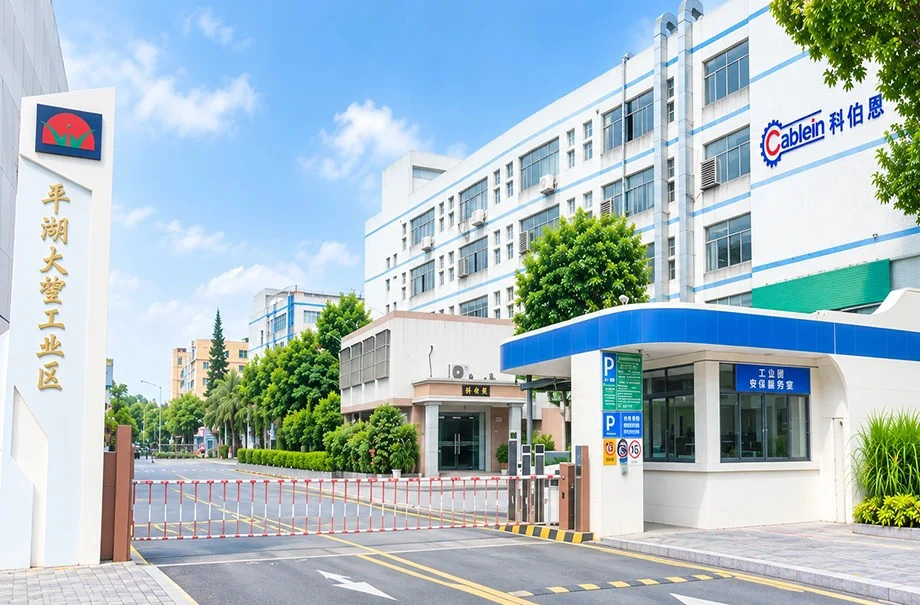
Cablein has supplied IP68-rated M25 Y-type waterproof connectors to marine equipment manufacturers, solar integrators, and infrastructure contractors across more than 100 countries since 2017. Our 6,000㎡ Shenzhen facility runs 100% inspection on every unit, and our engineering team supports custom configurations from initial specification through production validation. contact us directly to discuss your application, request test reports, or place a sample order.
Website: connectorswaterproof.com
Email: nick@cableinco.com
Whether you need a standard M25 Y-type waterproof connector supplier for a recurring project or a fully customized branching solution for a specialized marine deployment, our team responds within one business day.
References
1. International Electrotechnical Commission. IEC 60529: Degrees of Protection Provided by Enclosures (IP Code). IEC, 2013.
2. ASTM International. ASTM B117: Standard Practice for Operating Salt Spray (Fog) Apparatus. ASTM International, 2019.
3. Underwriters Laboratories. UL 94: Tests for Flammability of Plastic Materials for Parts in Devices and Appliances. UL Standards, 2013.
4. International Organization for Standardization. ISO 9001:2015: Quality Management Systems — Requirements. ISO, 2015.
5. Brydson, J.A. Plastics Materials, 7th ed. Butterworth-Heinemann, 1999.
6. Harper, Charles A. Electronic Packaging and Interconnection Handbook, 4th ed. McGraw-Hill, 2004.