Solar AC Connector vs DC Connector: Key Differences You Should Know
When selecting components for a photovoltaic system, understanding the distinction between a solar AC connector and a DC connector is not optional — it directly affects safety, compliance, and long-term system performance. A solar AC connector sits on the output side of an inverter, handling alternating current at rated voltages of 250V (TUV) or 350V (CSA). A DC connector, such as the MC4 type, operates on the panel side, managing direct current at much higher voltage levels. Choosing the wrong type can cause arc faults, failed inspections, or voided certifications.
Understanding Solar AC Connectors and DC Connectors
What Does a Solar AC Connector Do?
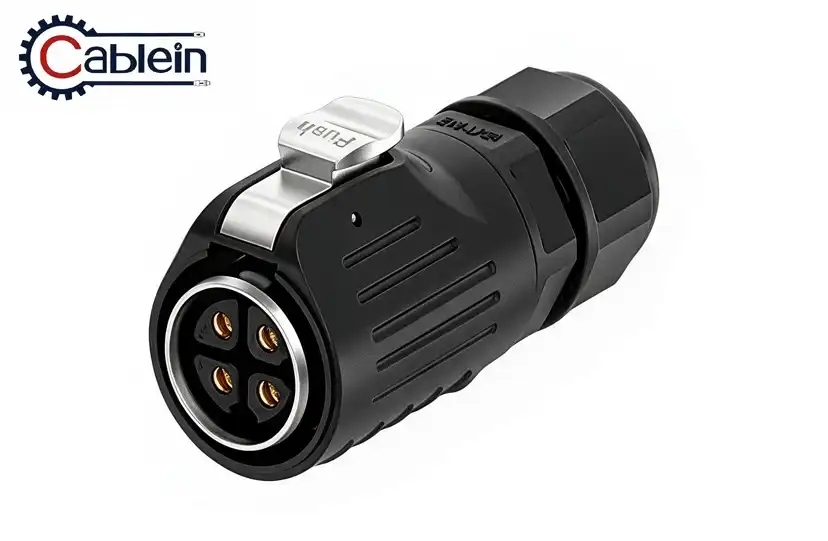
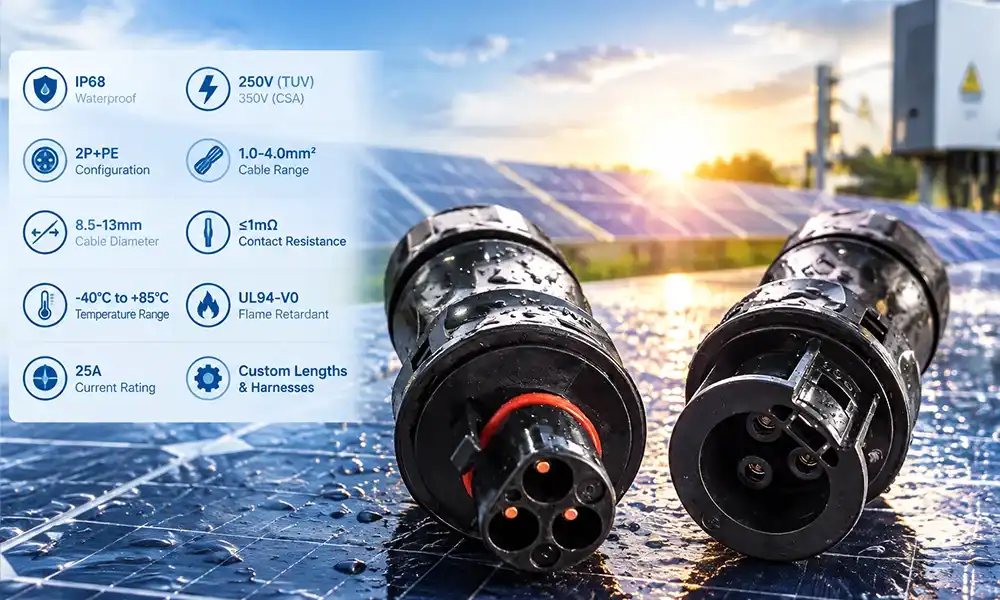
A solar AC adapter is an electrical link between a micro-inverter or string inverter and the AC grid that can be used in any weather. It moves alternating current at normal levels for a single phase. For instance, Cablein's 2P+PE configuration can send 25A of clean single-phase AC current through 4 mm² conductors. Unlike hardwired junction boxes, this type of connector can be easily assembled in the field without any tools. This cuts down on the time needed for installation and the number of mistakes that can happen during wiring.
What Does a DC Connector Do?
A DC connector, usually in the MC4 style, works on the high-voltage direct current side of a PV array to connect solar panels to combiner boxes or the DC inputs of an inverter. When used in industrial string setups, DC connectors can handle voltages of up to 1500V, which is higher than the normal 600V. DC arcs don't go out on their own as AC arcs do, so DC connectors have stricter arc-fault rules and must meet IEC 62852 or UL 6703 standards.
Where Each Connector Fits in the System
The DC plug goes between the junction box for the solar panels and the input of the generator. The solar AC connector goes from the inverter's AC output to the wires on the grid, the load center, or the AC trunk line. Because the electrical conditions in these two places are so different, they need different designs, approvals, and installation methods.
Key Differences Between Solar AC Connectors and DC Connectors
Voltage, Current, and Polarity
DC plugs are made to handle high-voltage, one-way current, usually between 600V and 1500V DC, and they are sensitive to polarity by design. Switching the polarity can hurt the inverter input stages right away. AC connections work with lower voltages (250V–350V in home and light business settings) and carry alternating current. This removes the risk of polarity but requires that the neutral and ground be separate. This is fixed by Cablein's 2P+PE design, which has separate wires for phase, neutral, and protective earth in a single waterproof body.
Certification and Safety Standards
DC connectors usually need to be certified by IEC 62852, UL 6703, or TUV 2 PfG 1169. Solar AC connectors fall under various compliance tracks, such as TUV and CSA listings for grid interconnection in North America. Cablein's solar AC connector has ratings from both TUV (250V) and CSA (350V), so it meets the inspection requirements for both European and North American grids. When a dealer serves more than one market, dual-certified goods make managing their catalogs easier and cut down on the number of SKUs they have to keep track of.
Environmental Protection and Durability
Both types of connectors have to be able to withstand being outside, but they do so in different ways. O-ring compression sealing is used in MC4-style DC plugs. Cablein's solar AC connector has an IP68 rating, which means it can withstand being submerged in water up to 1.5 meters for 24 hours. It does this with a molded cable entry system that works with cables that are 8.5 to 13 mm in diameter. The UL94-V0 flame-retardant housing works in temperatures ranging from -40°C to +85°C, so it can be used on hot roofs and in the winter in northern Europe.
Procurement Considerations for Solar AC and DC Connectors
To find the right connection type, you must first check where it fits electrically in the system and then make sure that the certifications are right for the market you want to sell to. Before placing a bulk order, here are the main things you should look at when buying something:
- Certification alignment: TUV and CSA documentation must be product-specific, not factory-level. Verify that the listing number on the certificate matches the exact part number you are ordering.
- Contact resistance specification: Silver-plated copper alloy contacts with contact resistance < 1 mΩ minimize resistive losses over a 25-year service life. Higher contact resistance generates heat and accelerates insulation degradation.
- Wire range compatibility: Screw-type termination accepting 1.0–4.0mm² conductors gives installers flexibility across cable gauges without stocking multiple connector variants.
- Stock availability and lead time: For distributors running 1,000–3,000 pieces per monthly replenishment cycle, confirmed in-stock quantities and 7–10 day delivery windows prevent project delays.
When selling to North American installers like Mike, these things become very important because they need CSA-listed plugs that are allowed for grid-tied connections, and sometimes they need pre-assembled AC harnesses with custom wire lengths like 3ft, 6ft, or 10ft.
Cablein keeps a steady stock of more than 10,000 pieces of each SKU and ships using long-term freight partnerships with DHL, UPS, and FedEx. This means that both bulk distributors and project-based buyers can count on solid delivery dates.
Installation and Safety Best Practices for Solar AC vs DC Connectors
Tooling and Termination
For field wiring, solar AC connectors with screw-type termination only need a standard flathead or Phillips screwdriver; no crimping tool is required. To get the right contact retention force for DC MC4 connectors, on the other hand, you need a calibrated crimping tool. When you mix tool types from different connector brands, you run the risk of getting the crimp shape wrong, which makes the contact more resistant and causes thermal failure points.
Pre-Installation Checks
Before turning on either type of connection, use a 500V or 1000V megohmmeter to check the insulation resistance. Before turning on the inverter, make sure that the phase and neutral conductors are correctly assigned on AC connectors. Before plugging a DC connector into an inverter, use a clamp meter to make sure the panel string is polarized correctly. These checks can be done in less than five minutes and stop most field problems before they happen.
Ongoing Maintenance
The usual way to check both AC and DC connections in industrial arrays is with infrared thermography. If a connection is more than 10°C above room temperature when it's under full load, it means the contact resistance is high and needs to be replaced right away. With a low contact resistance value of < 1 mΩ and silver-plated contacts, Cablein's products are made to stay within safe operating temperatures for 25 years in normal outdoor circumstances.
Choosing Between Solar AC and DC Connectors: Decision-Making Framework
It's not up to the person making the choice; it's based on how the system is built. You need a verified DC connector if the link is between the solar panels and the input of the generator. If the solar AC adapter is going to be used between the inverter's AC output and the grid or a load, it needs to be certified for the voltage and grid in your market.
For projects in North America, CSA listing is a must for connecting to the utility grid. For distribution in Europe or two markets at once, TUV certification meets most of the requirements set by the grid authority. With Cablein's dual-certified product (250V TUV / 350V CSA), you don't have to keep track of separate SKUs for each regional market. This saves money on storage costs and makes it easier to document products for online sales.
The size of the project also affects which connectors to use. Small micro-inverter systems for homes work better with AC harness kits that come already put together and have set wire lengths. Large industrial string-inverter roofs prefer modular links that can work with a wide range of wire gauges so that they can be quickly put together in the field across multiple inverter strings.
Conclusion
In any photovoltaic project, choosing the right type of connector—solar AC connector or DC—is a simple but important choice. DC connections handle high-voltage current on the panel side and need to be designed with polarity and arc-fault values in mind.
FAQ
1. What certifications should a solar AC connector carry for the US market?
For installations that are connected to the power grid in North America, CSA certification is the main requirement. The CSA rating of Cablein's connector is 350V, which meets most utility interconnection standards in the US and Canada.
2. What is the expected service life of a quality solar AC connector?
A connector made with UL94-V0 housing material, silver-plated contacts, and IP68 sealing is made to last for 25 years, which is the same amount of time that residential and business PV systems are supposed to work.
3. How do I verify connector quality before a bulk order?
Ask for a sample and test it for contact resistance, IP68 immersion, and temperature cycles between -40°C and +85°C. Please ask for the TUV or CSA certificate entry number and check it against the official database of the manufacturer's certifications.
4. Does Cablein accept small-batch orders for project-based buyers?
Yes. Cablein takes orders for as few as 100 pieces from project-based and installation contractor clients, and they offer pre-assembled AC circuits with custom wire lengths.
Get a Quote From Cablein — Solar AC Connector Supplier With Dual TUV/CSA Certification
Distributors, installation companies, and OEM brands in the US and around the world can get certified solar AC connector options from Cablein Technology. We make sourcing easy at every step by keeping a steady supply on hand, delivering within 7–10 days, being certified by both TUV and CSA, and giving you full technical documentation ready to list your products. You can email our team at nick@cableinco.comto get samples, prices, or a quote for a custom harness.
References
1. International Electrotechnical Commission. IEC 62852: Connectors for DC Application in Photovoltaic Systems. IEC, 2014.
2. Underwriters Laboratories. UL 6703: Connectors for Use in Photovoltaic Systems. UL Standards, 2013.
3. Canadian Standards Association. CSA C22.2 No. 182.3: Special Use Attachment Plugs, Receptacles and Connectors. CSA Group, 2015.
4. TÜV Rheinland. 2 PfG 1169: Requirements for Connectors for Photovoltaic Systems. TÜV Rheinland, 2007.
5. National Renewable Energy Laboratory. Photovoltaic System Reliability and Best Practices for Field Wiring. NREL Technical Report, 2020.
6. Solar Energy Industries Association. Solar Industry Research Data: U.S. Solar Market Insight Report. SEIA, 2023.